Map of England showing where the Risdon arms are recorded
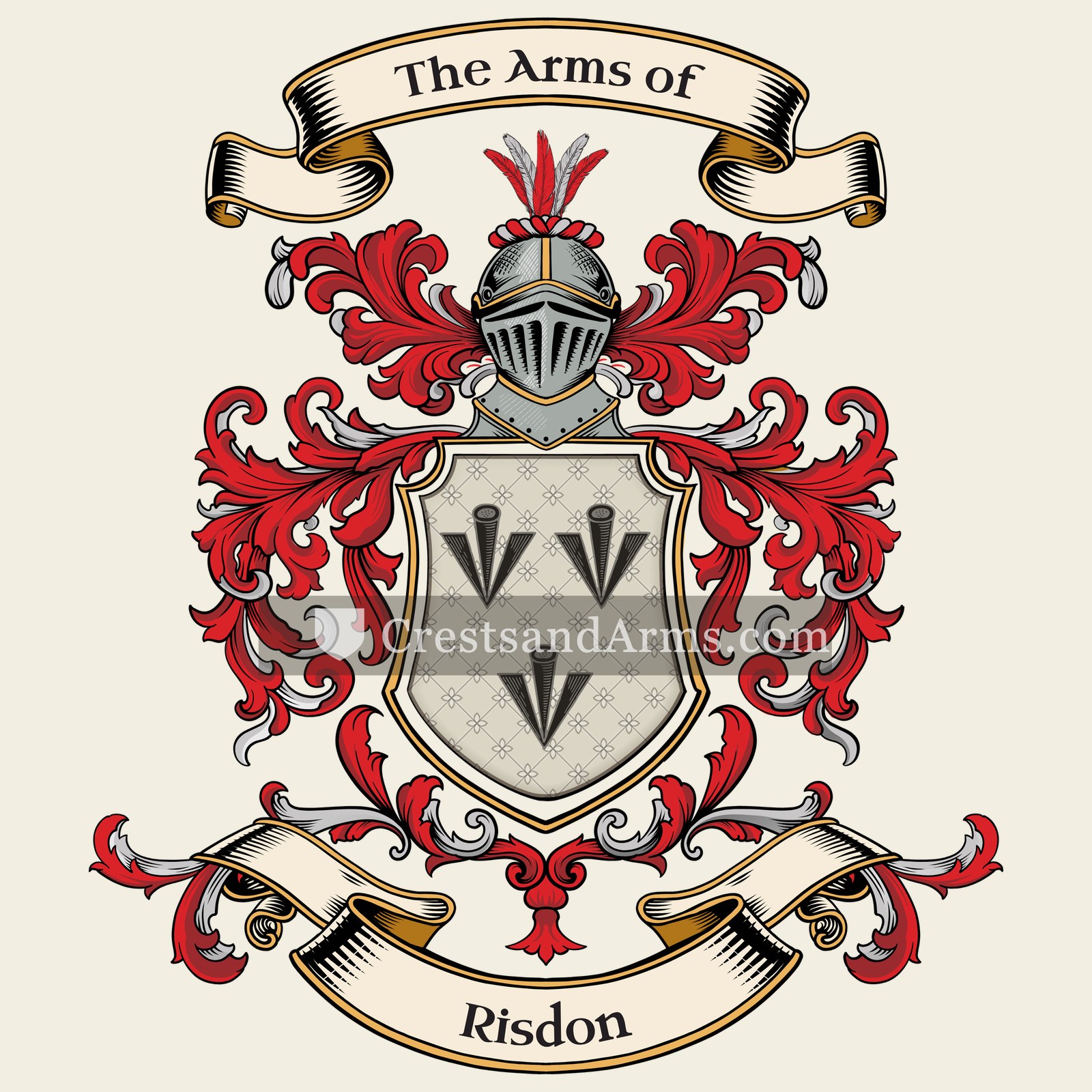
The Risdon arms were recorded in Devon, c. 1620.
Devon was a county of small manors and seafaring families. Its gentry were spread thickly across the countryside, and money made at sea often bought an estate, which in turn brought a coat of arms.
This is where the arms were entered in the register. Families often moved to other parts of the country, so the same name can turn up in more than one region.
The body that granted and recorded arms in England in this period.
James VI and I
Sovereign of the period
James VI and I
1603–1625
Reigning in England when the Risdon arms are first recorded.
How Arms Worked in England
English heraldry allowed arms to be shared by all legitimate descendants of the original owner. These symbols were treated as personal property that moved through the generations to all children. While the eldest son kept the original design, other family members could use the same shield without needing to change it or register their own unique versions.
Granting authority
The College of Arms in London has regulated the use of coats of arms throughout England and Wales since 1484.
How they got arms
Families typically obtained their coats of arms through a formal grant from the Crown or by proving their ancient right to them.
Where arms were recorded
All official coats of arms are recorded in the registers kept at the College of Arms, which date back to the fifteenth century.
The family's standing
Recorded among the armigerous families of Devon.
Origin & History of the Risdon Family in England
The surname Risdon is a locative name, meaning it originated from a specific place rather than an occupation or a personal trait. It is derived from the manor of Risdon located in the parish of Jacobstowe in Devon, England. The name itself combines the Old English words for brushwood and a hill or valley, suggesting that the first people to use the name lived near a wooded slope. By the early 17th century, the family had firmly established itself within the social and professional landscape of Devon. Records from 1620 confirm their presence in the region, where they were often involved in local land management and legal affairs. Over time, the family name became synonymous with the history of the county, as members of the Risdon line documented the local traditions and genealogies of their neighbors.
Related Branches & Arms
Root word
Hrysel-dun
Old English for brushwood or gravelly hill.
This name
RisdonDerived from a topographic location referring to a hill covered in brushwood or gravel.
also spelled
Rysdon
Risden
Documented Sources
Sir Bernard Burke, The General Armory of England, Scotland, Ireland and Wales, London: Harrison & Sons, 1884
Gover, J.E.B., Mawer, A., and Stenton, F.M., The Place-Names of Devon, 1931
Risdon, Tristram, The Chorographical Description or Survey of the County of Devon, 1811
The National Archives, Prerogative Court of Canterbury and related Probate Jurisdictions: Will Registers, PROB 11
Digital archive packCoat of arms PNG, gold border print PDF, vector SVG and the certificate of authenticity. Sent to your email in minutes.


 arrowReadiness for battle, and affliction endured
 arrowReadiness for battle, and affliction endured