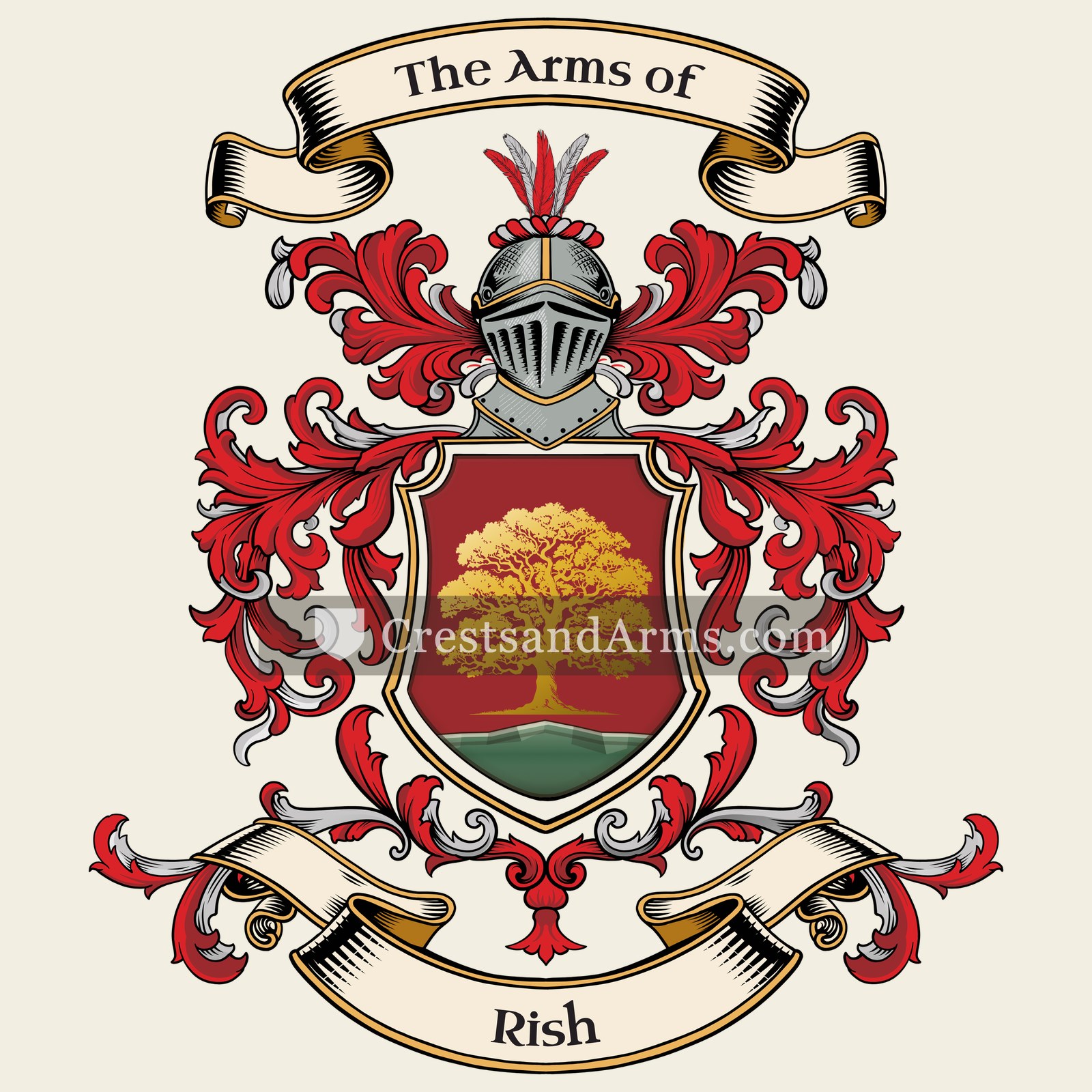
A record of documented arms, meaning and origin, researched for the Rish family of Switzerland.
Reg. 3009 · Swiss, P–S
Coat of Arms & Family Crest Details
Symbols on this shield
mountThe ground held, and steadfastness upon it
treeLife, endurance and deep roots
Colours
Red (Gules)Means: Military strength
Green (Vert)Means: Hope
Gold (Or)Means: Generosity
Historical info
Source
J. B. Rietstap, Armorial Général, Gouda: G. B. van Goor Zonen, 1884–87
Blazon (the actual original written record)
“De gu. à une tige feuillée de quatre feuilles allongées, la feuille supérieure courbée vers sen., les trois autres vers dextre, l'une sur l'autre, le tout d'or, la tige posée sur un tertre de trois coupeaux escarpés de sin. C.: un homme iss., hab. de gu., au rabat d'arg., coiffé d'un bonnet albanais de gu., retr. d'arg., tenant de sa main dextre la tige feuillée de l'écu, la sen. appuyée sur sa hanche. L. d'or et de gu.”
SwitzerlandCoire, c. 1725
Digital archive packCoat of arms PNG, gold border print PDF, vector SVG and the certificate of authenticity. Sent to your email in minutes.
Map of Switzerland showing where the Rish arms are recorded
The Rish arms were recorded in Coire, c. 1725.
This is where the arms were entered in the register. Families often moved to other parts of the country, so the same name can turn up in more than one region.
The body that granted and recorded arms in Switzerland in this period.
How Arms Worked in Switzerland
In Switzerland, coats of arms were not restricted to the nobility and were often adopted by common citizens and families. These symbols were passed down through generations to show family identity. When branches of a family grew, they often changed small details of the design to distinguish their own line from the original group.
Granting authority
Cantonal and civic authorities managed the use of coats of arms within their specific regions and local jurisdictions.
How they got arms
Families typically assumed their own coats of arms based on local custom rather than receiving them from a central monarch.
Where arms were recorded
Arms were recorded in various cantonal and civic registers starting from the fourteenth century throughout the Swiss region.
The family's standing
Recorded among the armigerous families of Switzerland.
Origin & History of the Rish Family in Switzerland
The family name Rish traces its documented roots to the city of Coire, which is known today as Chur, Switzerland. By the year 1725, records confirm that members of the family were established residents within this historic Alpine community. During the eighteenth century, Coire served as a vital crossroads for trade and political activity in the Grisons region. Families living there often participated in the local guilds or served in the administrative offices that governed the city. Because Coire was a center for both German and Romansh speakers, the name likely evolved within this multilingual environment. The early Rish family members were part of a society that valued craftsmanship and civic duty, helping to shape the cultural fabric of the oldest city in Switzerland.
Related Branches & Arms
Root word
Risch
Derived from the Middle High German word for a reed or rush.
This name
RishA topographic name for someone who lived near a patch of reeds or marshland.
also spelled
Rish
Rysch
Rische
Documented Sources
J. B. Rietstap, Armorial Général, Gouda: G. B. van Goor Zonen, 1884–87
Staatsarchiv Graubünden, Kirchenbücher der Stadt Chur (Parish records of the city of Chur)
Stadtarchiv Chur, Bürgerrodel der Stadt Chur (Citizenship registers of the city of Chur)
Pieth, Friedrich, Bündnergeschichte, 1982
Simonett, Jürg, Chur: Von der prähistorischen Siedlung zur modernen Stadt, 2003
Digital archive packCoat of arms PNG, gold border print PDF, vector SVG and the certificate of authenticity. Sent to your email in minutes.


 mountThe ground held, and steadfastness upon it
 treeLife, endurance and deep roots
 mountThe ground held, and steadfastness upon it
 treeLife, endurance and deep roots