Map of France showing where the Rizal arms are recorded
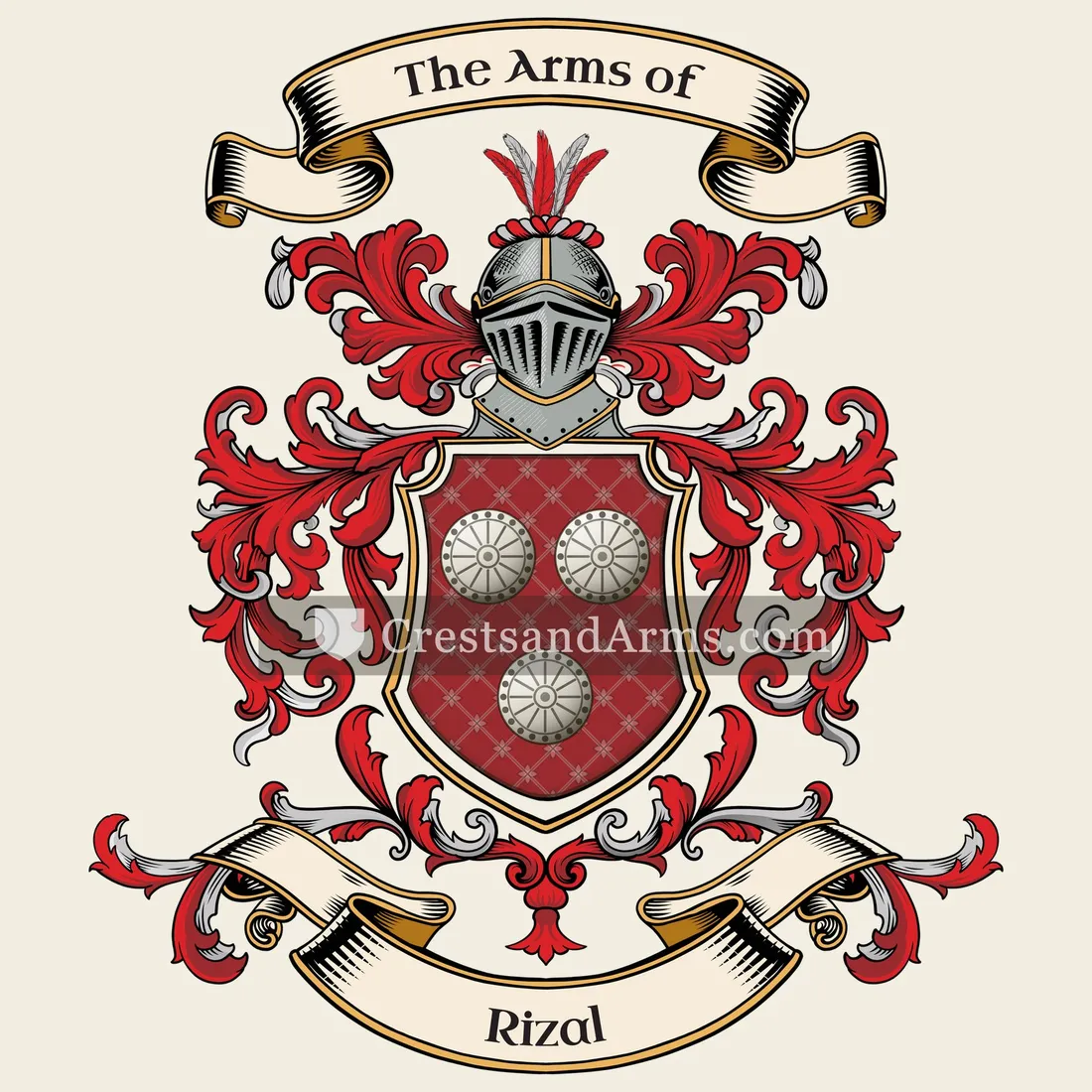
The Rizal arms were recorded in Bordeaux, c. 1663.
This is where the arms were entered in the register. Families often moved to other parts of the country, so the same name can turn up in more than one region.
The body that granted and recorded arms in France in this period.
Louis XIV of France
Sovereign of the period
Louis XIV of France
1643–1715
Reigning in France when the Rizal arms are first recorded.
How Arms Worked in France
In France, a coat of arms was a mark of honor that passed down through the male line to all legitimate descendants. Families often used the same shield without changes to show their shared heritage. If a branch wanted to stand out, they could add a small mark to their shield to show their specific place in the family tree.
Granting authority
The Juge d'armes de France acted as the official authority that regulated and verified coats of arms across the country.
How they got arms
Families typically inherited their arms from ancestors, though they could also receive them through royal grants or by proving their noble status.
Where arms were recorded
Coats of arms were officially recorded in the Armorial Général de France, which began its main collection in the year 1696.
The family's standing
Recorded among the armigerous families of France.
Origin & History of the Rizal Family in France
The history of the Rizal family name finds its earliest documented roots in the port city of Bordeaux, France, during the mid-seventeenth century. Records from 1663 confirm that members of the family were established in this region, which was a major hub for trade and cultural exchange at the time. The name itself is believed to be a variation of the Spanish word *ricial*, which refers to a field of green regrowth or a second crop of grain. This linguistic connection suggests that the family’s ancestors were likely connected to agriculture or land management in the fertile areas surrounding the Garonne River. As the family moved across borders, the spelling evolved to fit different regional dialects and languages. Their presence in Bordeaux highlights how families often shifted between French and Spanish territories during this period due to the fluid nature of regional boundaries and economic opportunities. This early chapter in their history reflects a background rooted in the land and the movement of people across the European continent long before the name became famous in the Philippines.
Meaning of the Rizal family crest colors & symbols
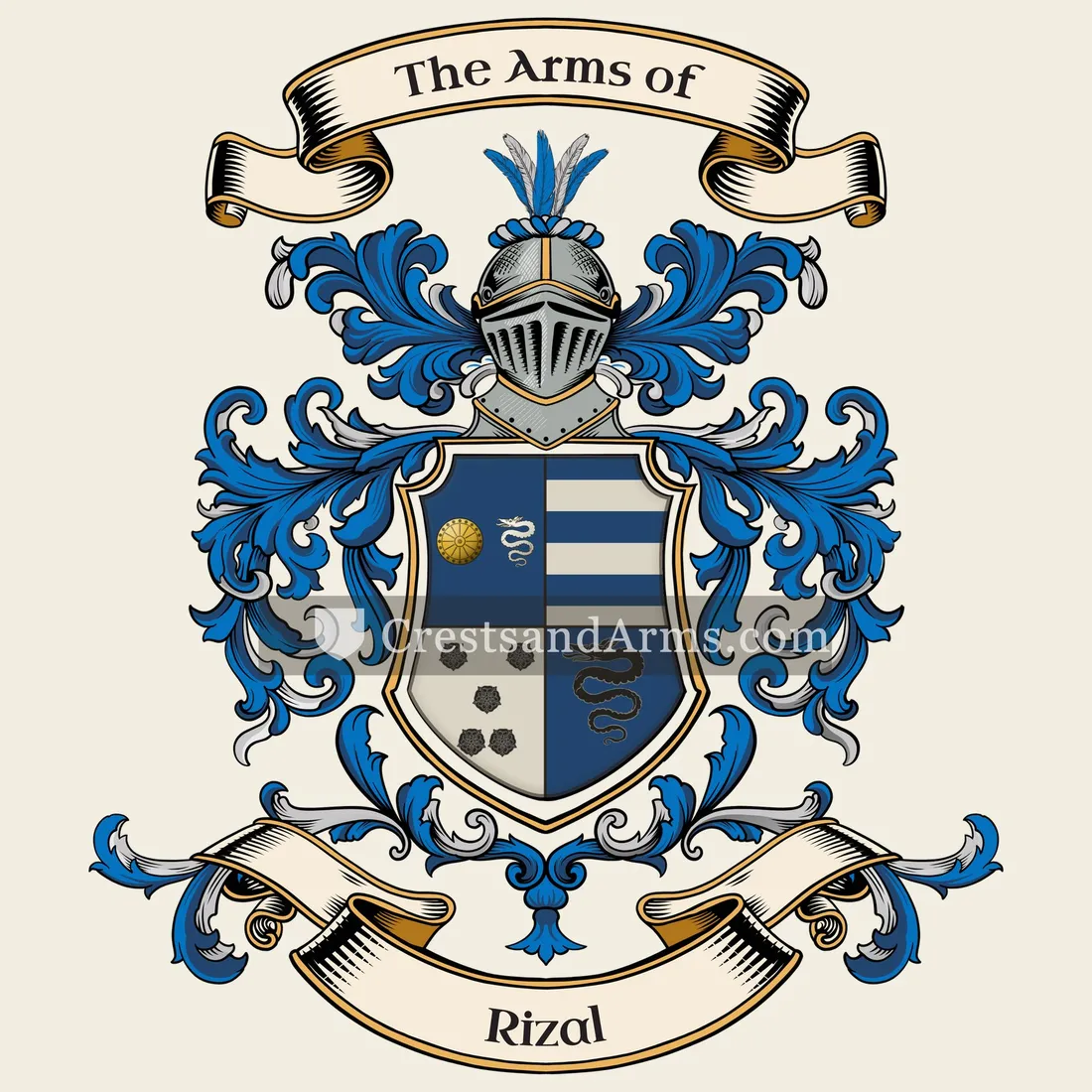
Symbols on this shield
fessThe military belt, and readiness to serve
roundelA coin, and one who has been to the crusades
serpentWisdom, healing and prudence
roseThe seventh son, and beauty with grace
Colours
Blue (Azure)Means: Loyalty and truth
Silver (Argent)Means: Peace and sincerity
Gold (Or)Means: Generosity
Black (Sable)Means: Constancy
Historical info
Source
J. B. Rietstap, Armorial Général, Gouda: G. B. van Goor Zonen, 1884–87
Blazon (the actual original written record)
“Ec.: au 1 d'azur à un miroir ovale d'or, le manche accolé d'un serpent d'arg. qui se mire dans la glace; au 2 fascé d'arg. et d'azur; au 3 de gu. à cinq roses d'arg., 2, 1 et 2; au 4 d'or à un lézard de sa., posé en bande. Cq. cour. C.: cinq pl. d'aut., celle du milieu d'or, les deux ext. d'arg., les deux autres d'azur. L.: à dextre d'or et d'azur, à sen. d'arg. et d'azur.”
Germanyc. 1808
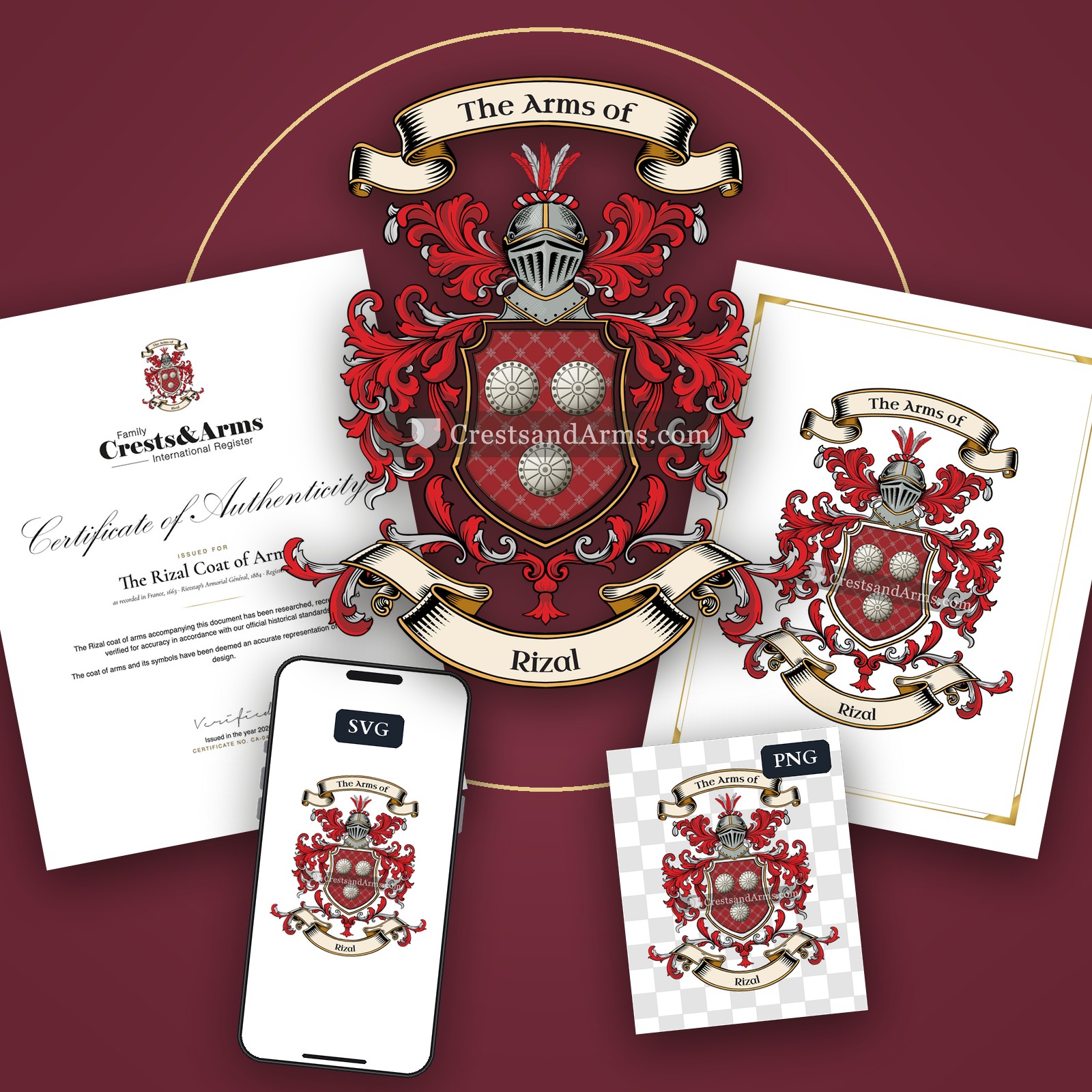
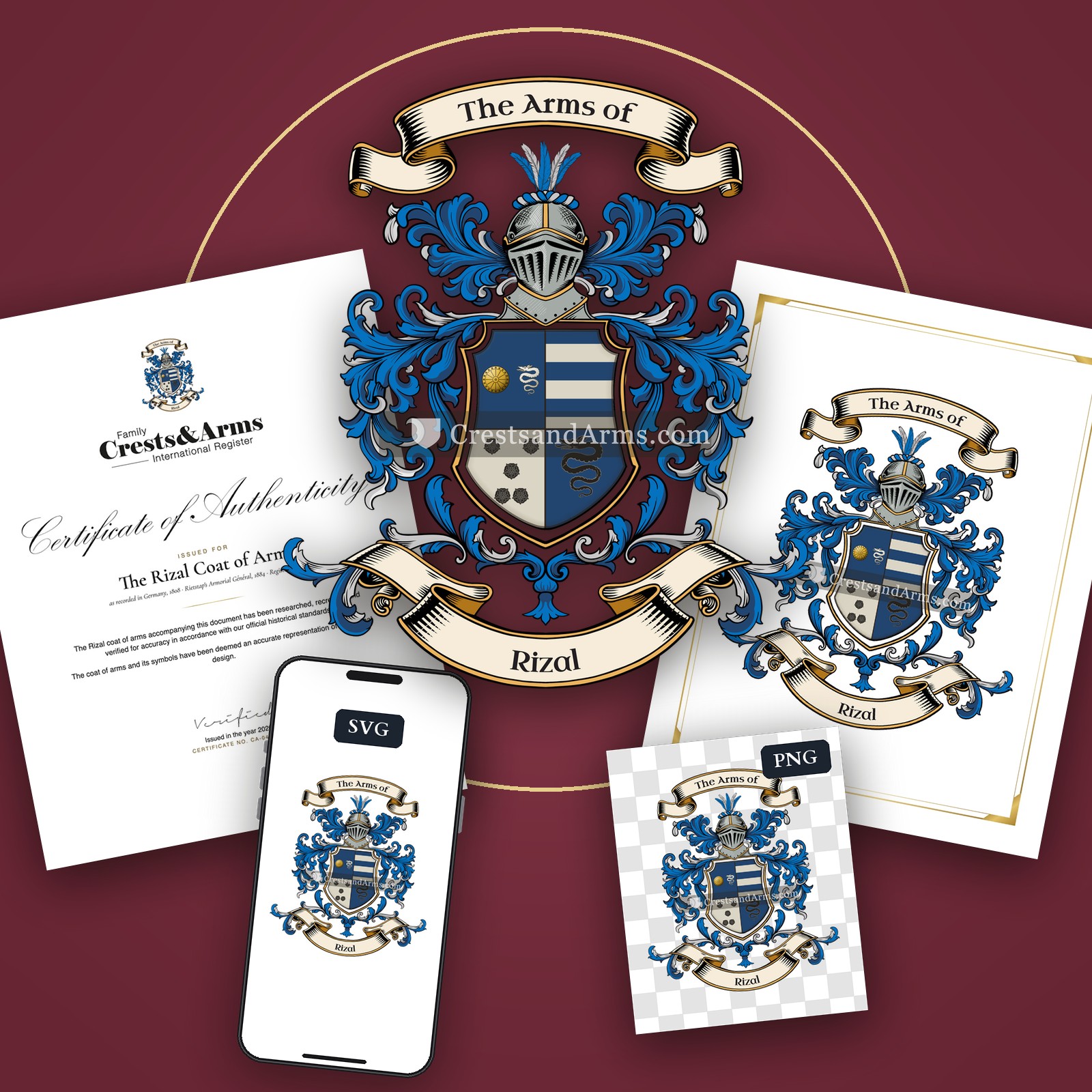
Digital archive packCoat of arms PNG, gold border print PDF, vector SVG and the certificate of authenticity. Sent to your email in minutes.
Map of Germany showing where the Rizal arms are recorded
The Rizal arms were recorded in Germany, c. 1808.
Arms such as these were typically recorded in Bavaria.
Bavaria was a country of old landed families and walled market towns. Estates passed down the same line for centuries, and both the landowners and the leading townsmen kept arms, which is why so many Bavarian names sit in the registers.
This is where the arms were entered in the register. Families often moved to other parts of the country, so the same name can turn up in more than one region.
The body that granted and recorded arms in Germany in this period.
Frederick William III of Prussia
Sovereign of the period
Frederick William III of Prussia
1797–1840
Reigning in France when the Rizal arms are first recorded.
How Arms Worked in Germany
Prussian heraldry was strictly tied to social rank and noble status rather than being a free choice for every citizen. These symbols were treated as permanent family property that moved through the generations to all legitimate heirs. If a family branch wanted to change their design to stand out, they had to apply for official permission to alter their specific version of the shield.
Granting authority
The Prussian Heroldsamt acted as the central state office that managed and strictly controlled all noble titles and coats of arms.
How they got arms
Families usually obtained their arms through formal royal grants or by proving their long-standing noble status to the state authorities.
Where arms were recorded
All official coats of arms were kept in the rolls of the Prussian Heroldsamt, which functioned from 1706 until 1918.
The family's standing
Recorded among the armigerous families of Germany.
Origin & History of the Rizal Family in Germany
The history of the Rizal family name finds a unique connection to the German region of Bavaria during the early nineteenth century. Records indicate that members of the family were present in this area by 1808, a time when the region was undergoing significant political and social shifts under the influence of the Napoleonic Wars. The name itself is thought to be derived from the Spanish word *ricial*, which refers to a field where a second crop grows after the harvest. While the family is most famously associated with the Philippines, their presence in Bavaria suggests a history of movement and adaptation across different cultural landscapes. This early period in Germany highlights how the family name was carried through Europe before eventually becoming a central part of Philippine national history. By tracing these roots, we see that the family was already part of a broader global narrative long before the name became a symbol of intellectual and political change.
Rizal Meaning & Related Branches
Root word
ric
Old Germanic element meaning powerful ruler or brave leader.
This name
RizalDerived from the Spanish word for green field or pasture, symbolizing agricultural prosperity.
also spelled
Rigail
Reegal
Rigall
Documented Sources
J. B. Rietstap, Armorial Général, Gouda: G. B. van Goor Zonen, 1884–87
Coates, Austin, Rizal: Philippine Nationalist and Martyr, 1968
Quirino, Carlos, The Young Rizal, 1963
Archives Départementales de la Gironde, Registres paroissiaux et d'état civil
Digital archive packCoat of arms PNG, gold border print PDF, vector SVG and the certificate of authenticity. Sent to your email in minutes.


 roundelA coin, and one who has been to the crusades
 roundelA coin, and one who has been to the crusades


 fessThe military belt, and readiness to serve
 serpentWisdom, healing and prudence
 roseThe seventh son, and beauty with grace