Map of France showing where the Roan arms are recorded
The Roan arms were recorded in Bretagne, c. 1008.
More families held coats of arms in Bretagne than anywhere else in France. The land was divided into many small estates rather than a few large ones, so far more households counted as gentry, and each needed a shield of its own to be told apart.
This is where the arms were entered in the register. Families often moved to other parts of the country, so the same name can turn up in more than one region.
The body that granted and recorded arms in France in this period.
How Arms Worked in France
In France, a coat of arms was a mark of honor that passed down through the male line to all legitimate descendants. Families often used the same shield without changes to show their shared heritage. If a branch wanted to stand out, they could add a small mark to their shield to show their specific place in the family tree.
Granting authority
The Juge d'armes de France acted as the official authority that regulated and verified coats of arms across the country.
How they got arms
Families typically inherited their arms from ancestors, though they could also receive them through royal grants or by proving their noble status.
Where arms were recorded
Coats of arms were officially recorded in the Armorial Général de France, which began its main collection in the year 1696.
The family's standing
Recorded among the armigerous families of Bretagne.
Origin & History of the Roan Family in France
The family name Roan traces its roots back to the rugged landscape of Brittany in northwestern France. Historical records confirm that members of the family were established in this region as early as 1008. During this period, Brittany functioned as a distinct cultural entity with its own language and traditions that were separate from the rest of the French kingdom. The name likely developed as a descriptive identifier for individuals living near specific geographic landmarks or within particular settlements in the Breton countryside. As the family grew, they became integrated into the local social structure of the Middle Ages. They lived through a time of significant political change as the Duchy of Brittany navigated complex relationships with neighboring powers. By maintaining their presence in the region for centuries, the early Roan family helped shape the local history of their community.
Meaning of the Roan family crest colors & symbols
Symbols on this shield
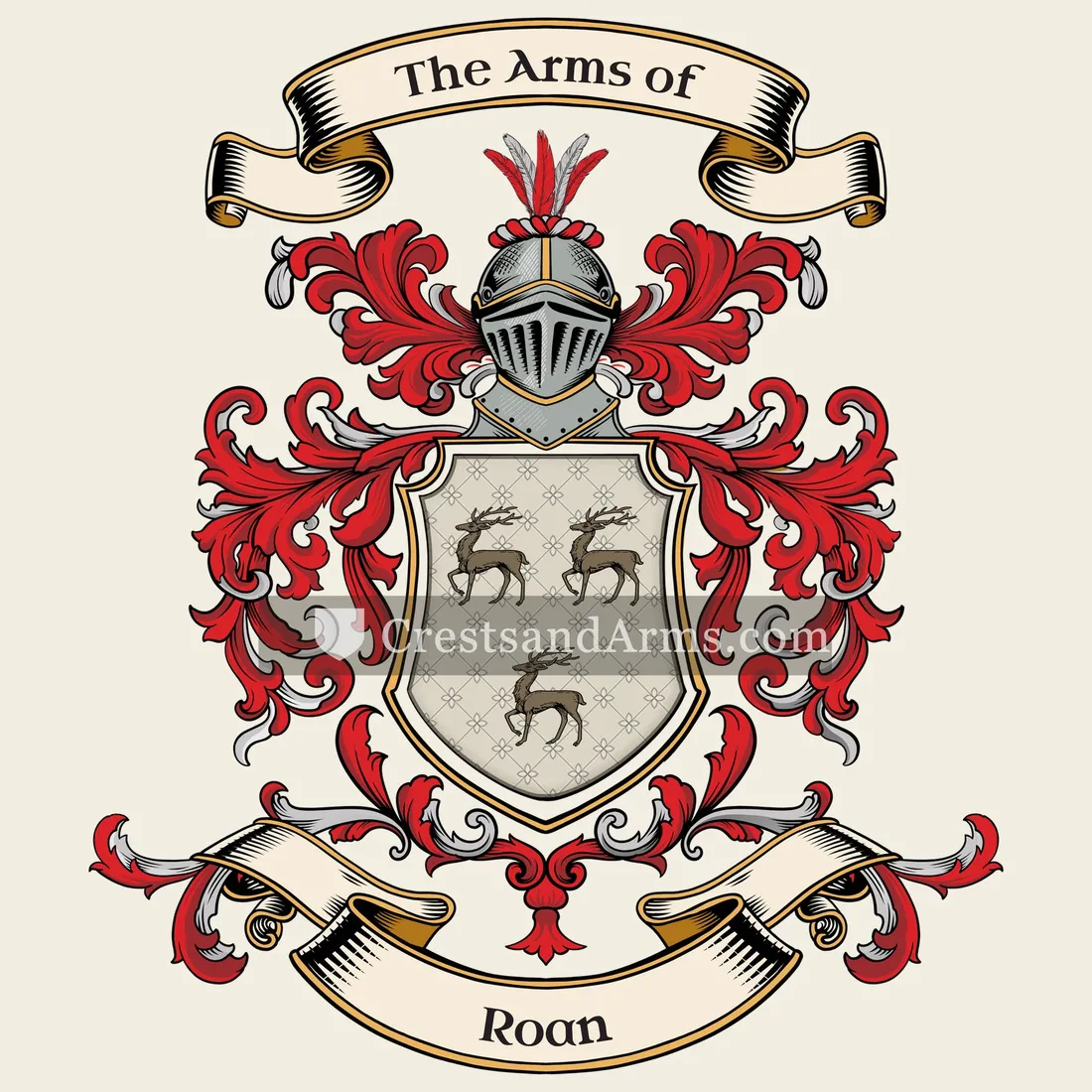
stagPeace and harmony, and one who will not fight unprovoked
Colours
Silver (Argent)Means: Peace and sincerity
Historical info
Source
Sir Bernard Burke, The General Armory of England, Scotland, Ireland and Wales, London: Harrison & Sons, 1884
Blazon (the actual original written record)
“Ar. three bucks trippant ppr”
EssexSamborne Hall · Essex, c. 1620
Digital archive packCoat of arms PNG, gold border print PDF, vector SVG and the certificate of authenticity. Sent to your email in minutes.
Map of England showing where the Roan arms are recorded
The Roan arms were recorded in Essex, c. 1620.
Essex lay close enough to London for City money to buy land there. Merchants who prospered moved out to estates within a day's ride, and a new landowner almost always wanted arms to go with the ground.
This is where the arms were entered in the register. Families often moved to other parts of the country, so the same name can turn up in more than one region.
The body that granted and recorded arms in England in this period.
James VI and I
Sovereign of the period
James VI and I
1603–1625
Reigning in France when the Roan arms are first recorded.
How Arms Worked in England
English heraldry allowed arms to be shared by all legitimate descendants of the original owner. These symbols were treated as personal property that moved through the generations to all children. While the eldest son kept the original design, other family members could use the same shield without needing to change it or register their own unique versions.
Granting authority
The College of Arms in London has regulated the use of coats of arms throughout England and Wales since 1484.
How they got arms
Families typically obtained their coats of arms through a formal grant from the Crown or by proving their ancient right to them.
Where arms were recorded
All official coats of arms are recorded in the registers kept at the College of Arms, which date back to the fifteenth century.
The family's standing
Recorded among the armigerous families of Essex.
Origin & History of the Roan Family in England
The family name Roan has deep roots in the English county of Essex, where records confirm members of the family were living as early as 1620. During this period, Essex was a bustling region shaped by its proximity to London and its strong ties to the wool and textile trades. Families like the Roans often lived in small rural parishes where they worked as farmers or skilled laborers. The name itself likely evolved from a nickname based on physical appearance, specifically referring to someone with a reddish-brown complexion or hair, similar to the color of a roan horse. As the seventeenth century progressed, these early residents of Essex helped form the backbone of local community life, participating in parish governance and contributing to the agricultural development of the English countryside. Their presence in the historical record during this time offers a window into the lives of common families who helped shape the social landscape of eastern England.
Meaning of the Roan family crest colors & symbols
Symbols on this shield
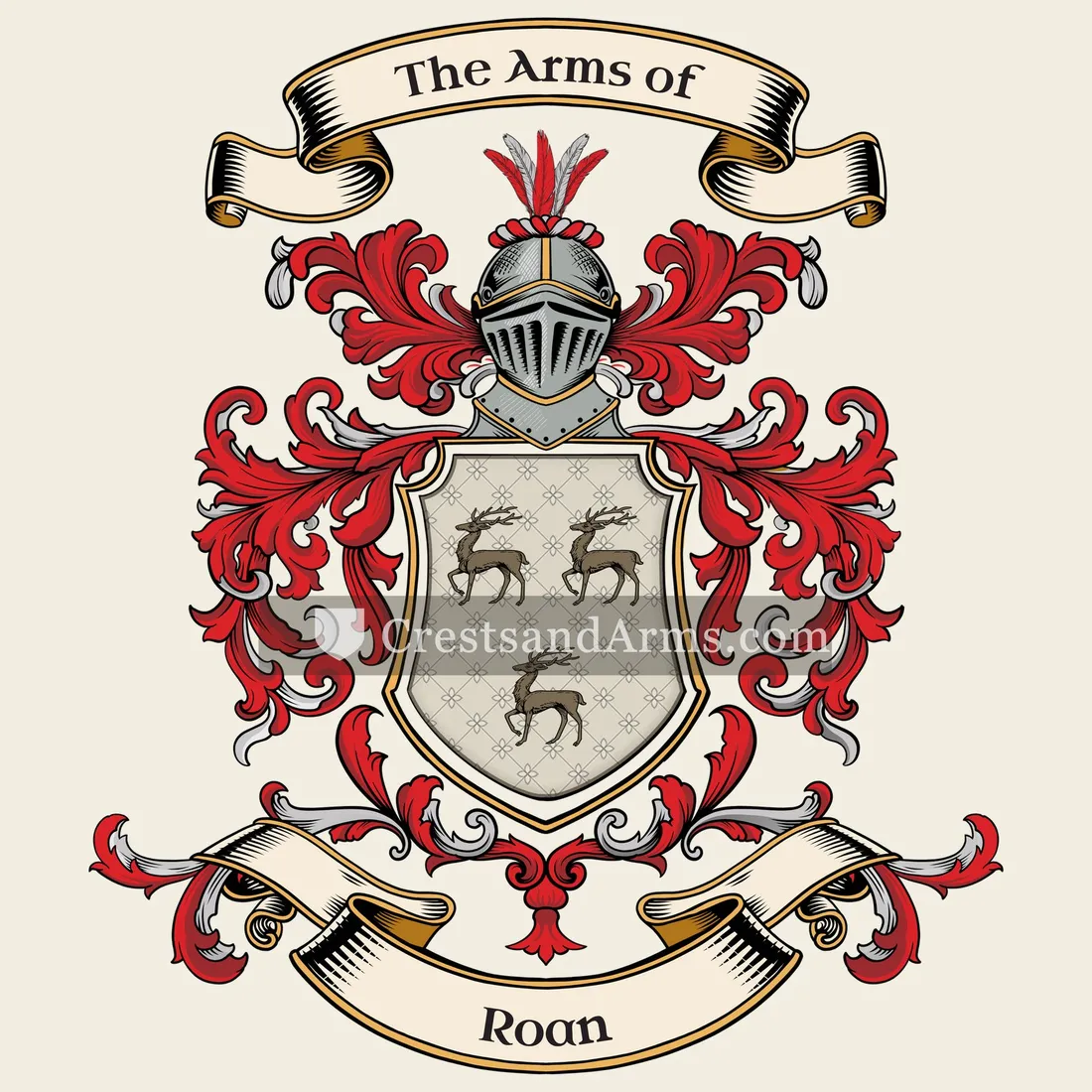
stagPeace and harmony, and one who will not fight unprovoked
Colours
Silver (Argent)Means: Peace and sincerity
Historical info
Source
Sir Bernard Burke, The General Armory of England, Scotland, Ireland and Wales, London: Harrison & Sons, 1884
Blazon (the actual original written record)
“Ar. three bucks trippant ppr. attired or”
SalopSalop, c. 1645
Digital archive packCoat of arms PNG, gold border print PDF, vector SVG and the certificate of authenticity. Sent to your email in minutes.
Map of Ireland showing where the Roan arms are recorded
The Roan arms were recorded in Salop, c. 1645.
Shropshire lay on the Welsh border, and border country needed men who could fight. Families held their land in return for service, and service in arms is what a coat of arms was originally for.
This is where the arms were entered in the register. Families often moved to other parts of the country, so the same name can turn up in more than one region.
The body that granted and recorded arms in Ireland in this period.
Charles I of England
Sovereign of the period
Charles I of England
1625–1649
Reigning in France when the Roan arms are first recorded.
How Arms Worked in Ireland
The Ulster King of Arms granted coats of arms to individuals who proved their social standing and good character. These symbols were typically inherited by all legitimate descendants of the original holder. If a family branch wanted a unique look, they could apply for a specific change to their design through the office to ensure their identity remained distinct.
Granting authority
The Ulster King of Arms acted as the official body that regulated and issued all coats of arms throughout Ireland.
How they got arms
Families obtained their arms through formal grants issued by the office after proving their eligibility and paying the required fees.
Where arms were recorded
All official grants were recorded in the registers held by the Ulster King of Arms starting from the year 1552.
The family's standing
Recorded among the armigerous families of Salop.
Origin & History of the Roan Family in Ireland
The surname Roan, often linked to the Gaelic name Ó Ruadháin, has deep roots in the Irish province of Connacht. The name is derived from the word ruadh, which translates to red, suggesting that it was originally a descriptive nickname for an ancestor with red hair or a ruddy complexion. While the family was well-established in Ireland for centuries, the political and social instability of the 17th century led to significant migration patterns. By 1645, records confirm that members of the family had settled in the county of Salop in England. This movement was likely part of the broader displacement caused by the conflicts of the mid-1600s, which forced many Irish families to seek new lives across the Irish Sea. Over time, the name evolved in spelling as it adapted to English linguistic conventions, yet it remains a testament to the family's long history of movement and resilience.
Roan Meaning & Related Branches
Root word
Rau
Old Germanic term referring to a rough or shaggy appearance.
This name
RoanA descriptive nickname for a person with reddish-brown or coarse hair.
also spelled
Roan
Rohan-Soubise
Rohann
Rohen
Documented Sources
J. B. Rietstap, Armorial Général, Gouda: G. B. van Goor Zonen, 1884–87
Poterin du Motel, Nobiliaire et armorial de Bretagne, 1890
Archives départementales d'Ille-et-Vilaine, Fonds de la famille de Roan, Series E
Courcy, Pol Potier de, Nobiliaire et armorial de Bretagne, 1846
Digital archive packCoat of arms PNG, gold border print PDF, vector SVG and the certificate of authenticity. Sent to your email in minutes.


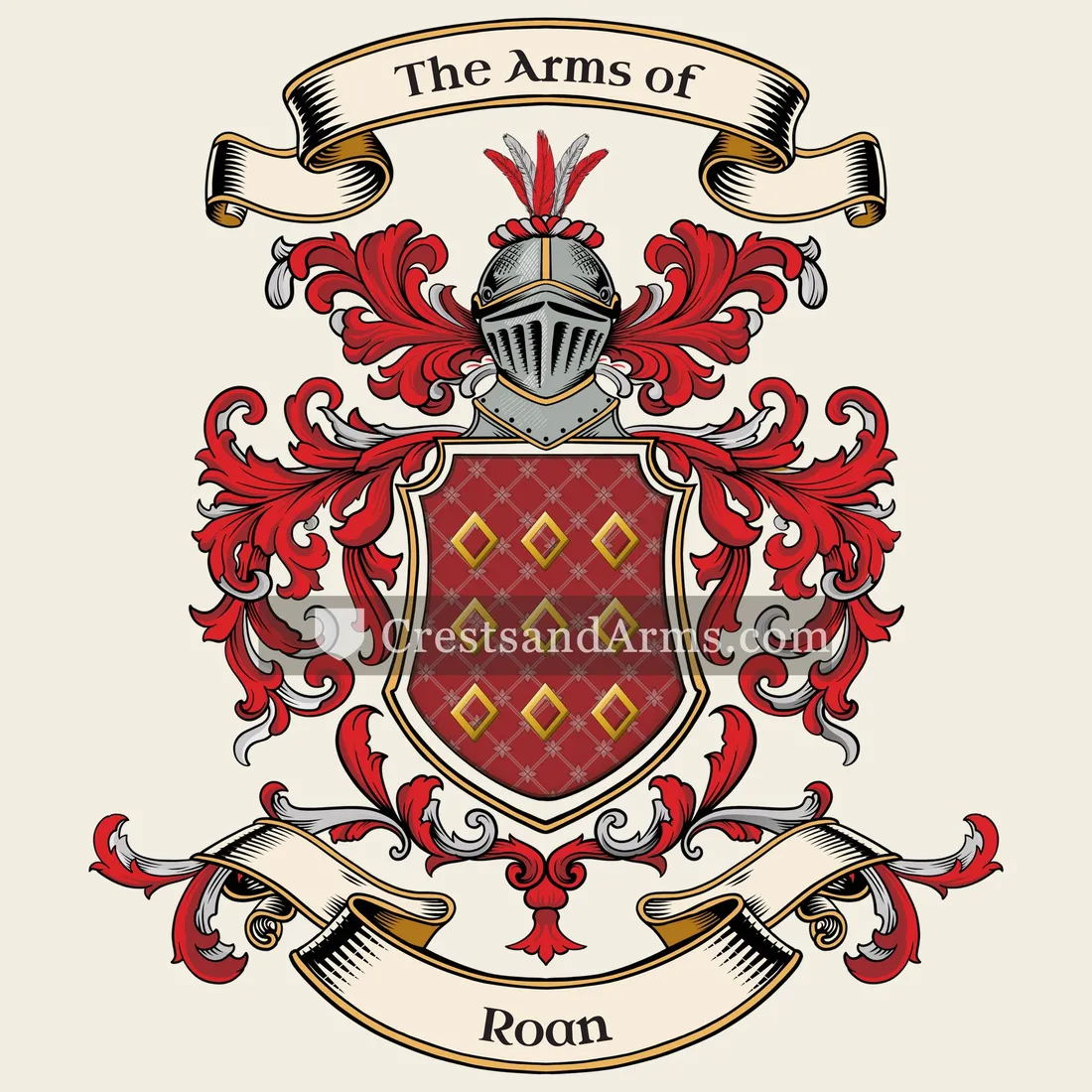
 masclePersuasion and the mail of a knight's coat
 masclePersuasion and the mail of a knight's coat

 stagPeace and harmony, and one who will not fight unprovoked