Map of Scotland showing where the Robb arms are recorded
The Robb arms were recorded in Bristol, c. 1809.
Arms such as these were typically recorded in Edinburgh.
Edinburgh was the seat of Scotland's government, its courts and its heralds. Families with business there settled nearby, and being close to where arms were recorded is exactly why so many of them appear.
This is where the arms were entered in the register. Families often moved to other parts of the country, so the same name can turn up in more than one region.
The body that granted and recorded arms in Scotland in this period.
George III of Great Britain
Sovereign of the period
George III of Great Britain
1801–1820
Reigning in Scotland when the Robb arms are first recorded.
How Arms Worked in Scotland
Scottish heraldry is unique because it treats a coat of arms as a piece of personal property protected by law. Only one person can own a specific design at any given time. When a family grows, the head keeps the original shield while other relatives must apply for their own distinct version with slight changes to prove their specific identity.
Granting authority
The Court of the Lord Lyon acts as the official body that regulates and controls all heraldic matters throughout Scotland.
How they got arms
Individuals obtain a legal right to their arms through a formal petition process that confirms their identity and family connection.
Where arms were recorded
All valid coats of arms are officially entered into the Public Register of All Arms and Bearings starting from 1672.
The family's standing
Recorded among the armigerous families of Scotland.
Origin & History of the Robb Family in Scotland
The surname Robb is a shortened form of the name Robert, which became a popular given name in Scotland during the Middle Ages. Families often adopted these short nicknames to distinguish themselves within their local communities. By the early 19th century, the name was firmly established in urban centers like Edinburgh, where families played a part in the city's growing industrial and social life. Records from 1809 show that individuals bearing the name were active participants in the capital’s economy during a time of significant expansion. These early ancestors were likely tradespeople or laborers who helped build the infrastructure of modern Edinburgh. Over time, the name spread from these central hubs into the surrounding regions, reflecting the movement of people seeking new opportunities across the Scottish Lowlands.
Meaning of the Robb family crest colors & symbols
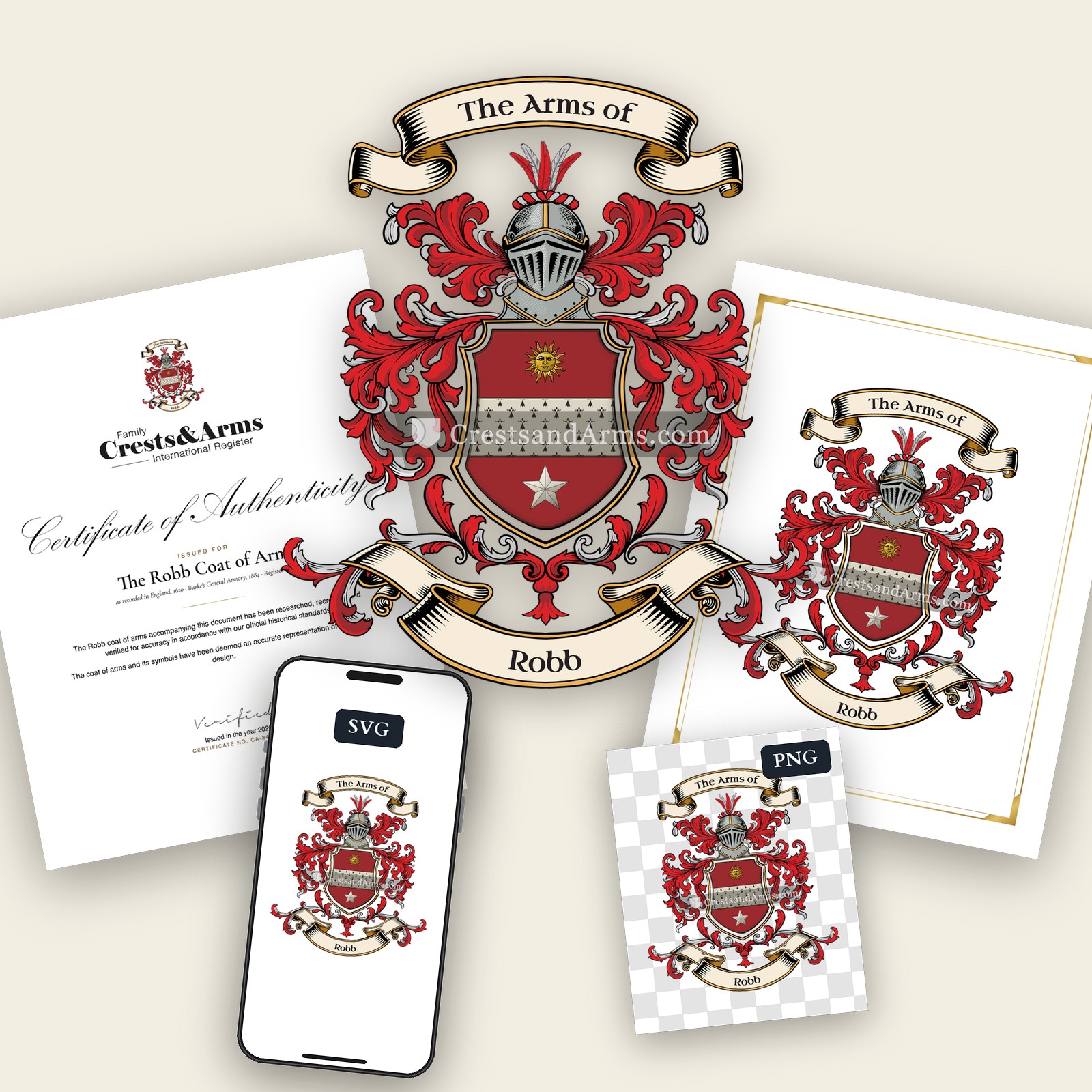
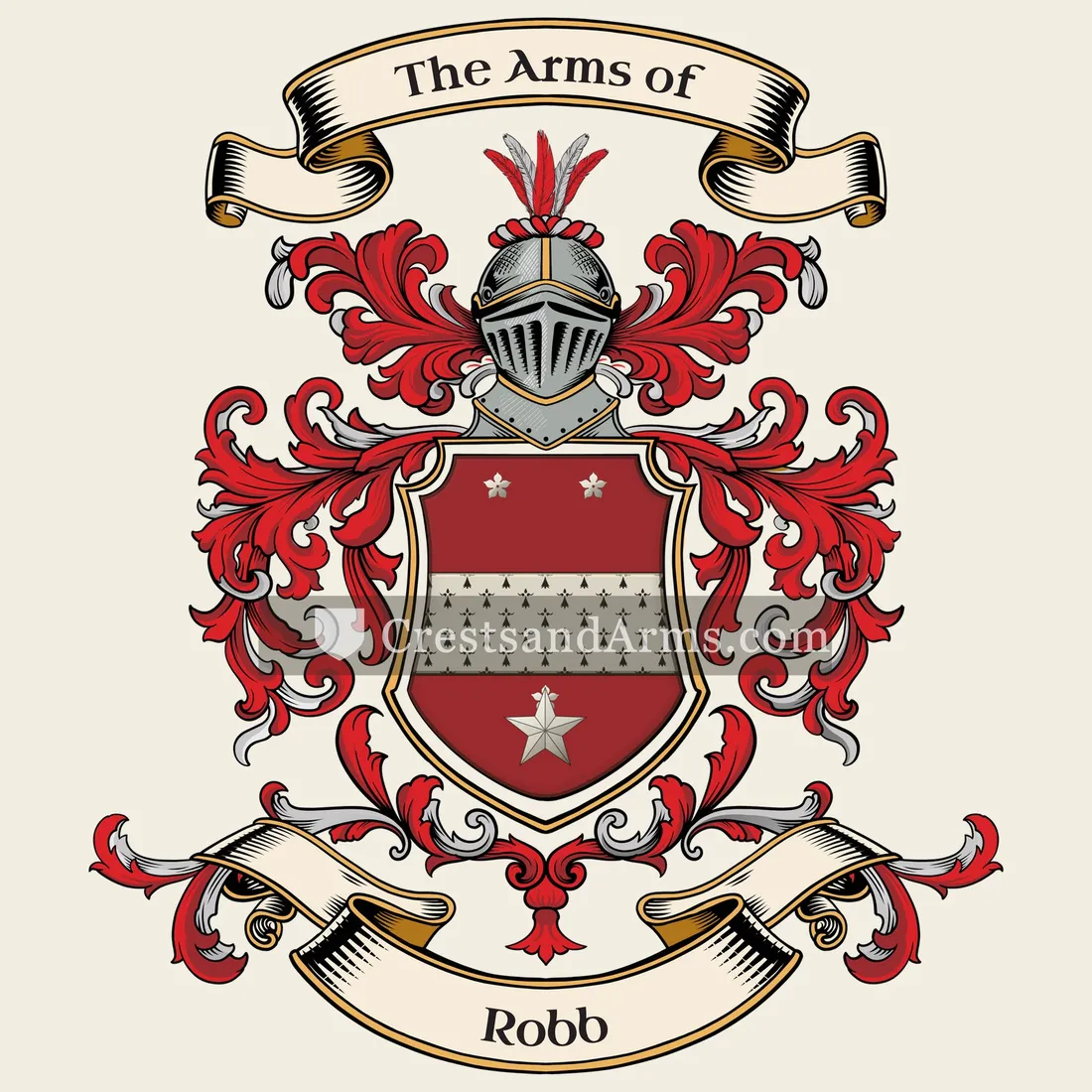
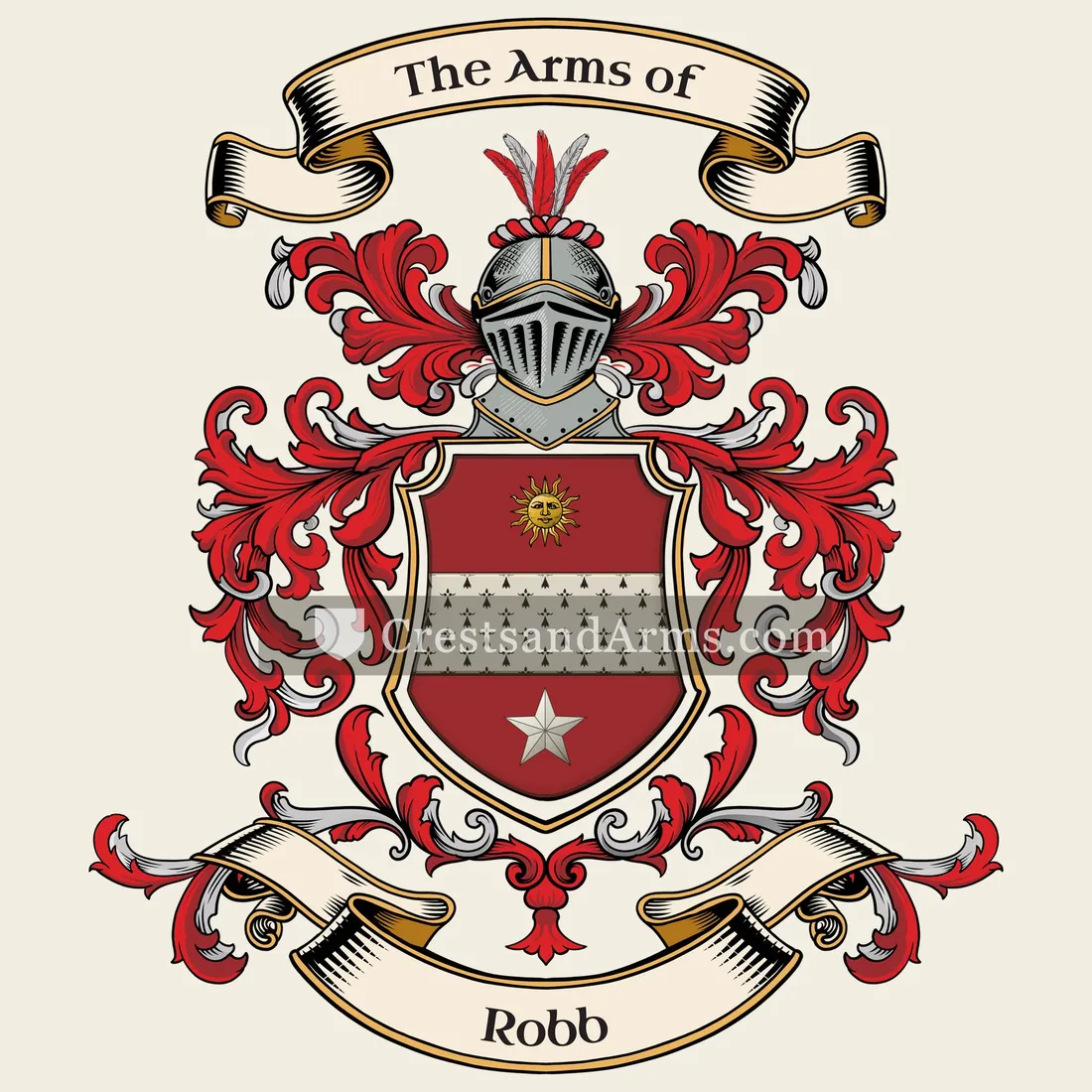
Symbols on this shield
fessThe military belt, and readiness to serve
sunGlory, splendour and the source of life
mulletThe third son, and a divine quality from above
Colours
Red (Gules)Means: Military strength
ErmineMeans: Dignity
Gold (Or)Means: Generosity
Silver (Argent)Means: Peace and sincerity
Historical info
Source
Sir Bernard Burke, The General Armory of England, Scotland, Ireland and Wales, London: Harrison & Sons, 1884
Blazon (the actual original written record)
“Gu. a fess erm. betw. the sun in chief or, and a mullet in base ar. Crest and Motto, as the last”
EnglandLondon, c. 1620
Digital archive packCoat of arms PNG, gold border print PDF, vector SVG and the certificate of authenticity. Sent to your email in minutes.
Map of England showing where the Robb arms are recorded
The Robb arms were recorded in London, c. 1620.
This is where the arms were entered in the register. Families often moved to other parts of the country, so the same name can turn up in more than one region.
The body that granted and recorded arms in England in this period.
James VI and I
Sovereign of the period
James VI and I
1603–1625
Reigning in Scotland when the Robb arms are first recorded.
How Arms Worked in England
English heraldry allowed arms to be shared by all legitimate descendants of the original owner. These symbols were treated as personal property that moved through the generations to all children. While the eldest son kept the original design, other family members could use the same shield without needing to change it or register their own unique versions.
Granting authority
The College of Arms in London has regulated the use of coats of arms throughout England and Wales since 1484.
How they got arms
Families typically obtained their coats of arms through a formal grant from the Crown or by proving their ancient right to them.
Where arms were recorded
All official coats of arms are recorded in the registers kept at the College of Arms, which date back to the fifteenth century.
The family's standing
Recorded among the armigerous families of England.
Origin & History of the Robb Family in England
The surname Robb originated as a shortened form of the name Robert, which became popular across England following the Norman Conquest. By the early 17th century, the name was well-established among families living in the bustling urban environment of London. Records from 1620 show that individuals bearing this name were active participants in the city’s growing trade and social networks during the reign of King James I. As London expanded into a global center for commerce, families like the Robbs often moved between different parishes to find work as merchants, craftsmen, or laborers. This period of history highlights how the name evolved from a simple nickname into a formal family identifier that helped people navigate the complex social structures of early modern England.
Meaning of the Robb family crest colors & symbols
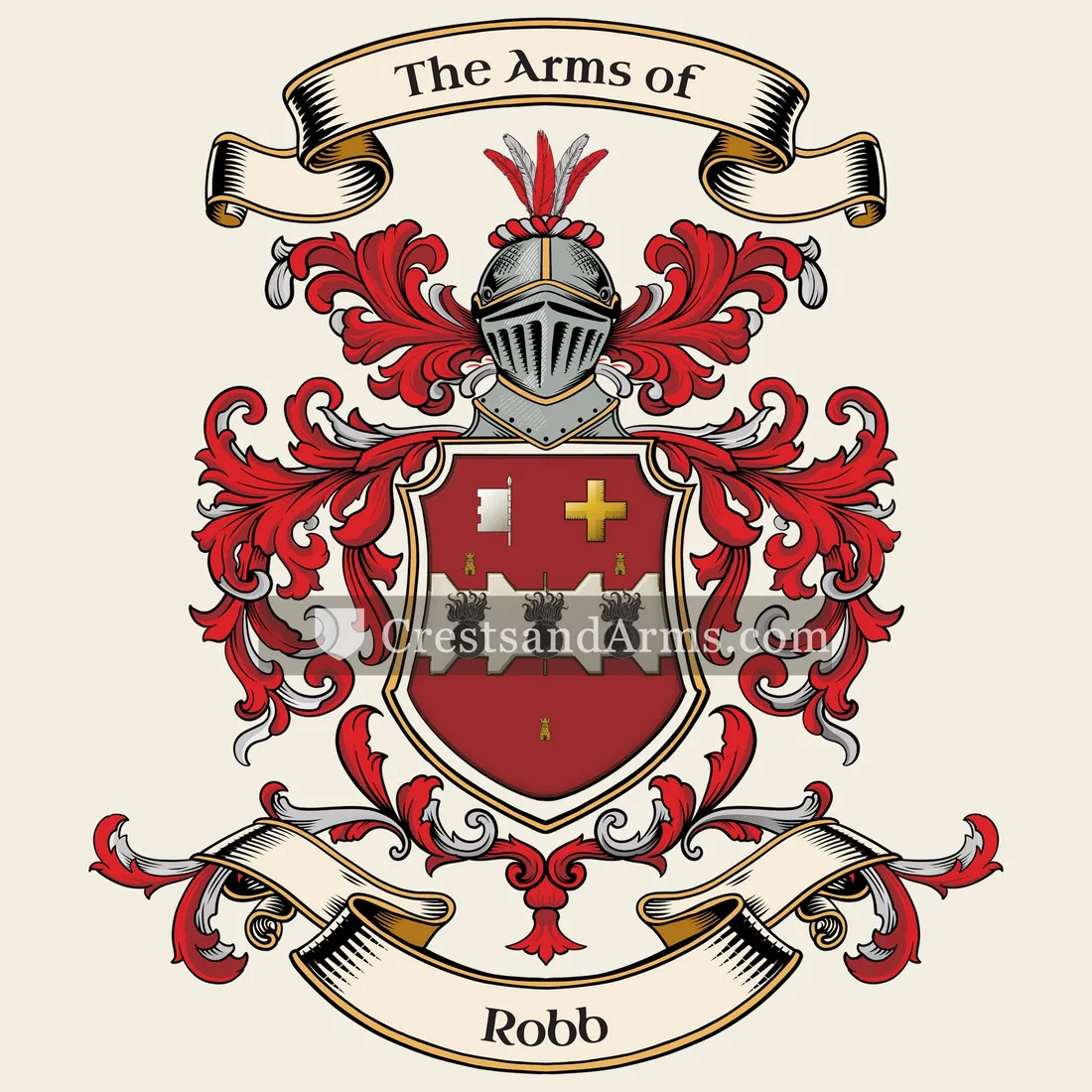
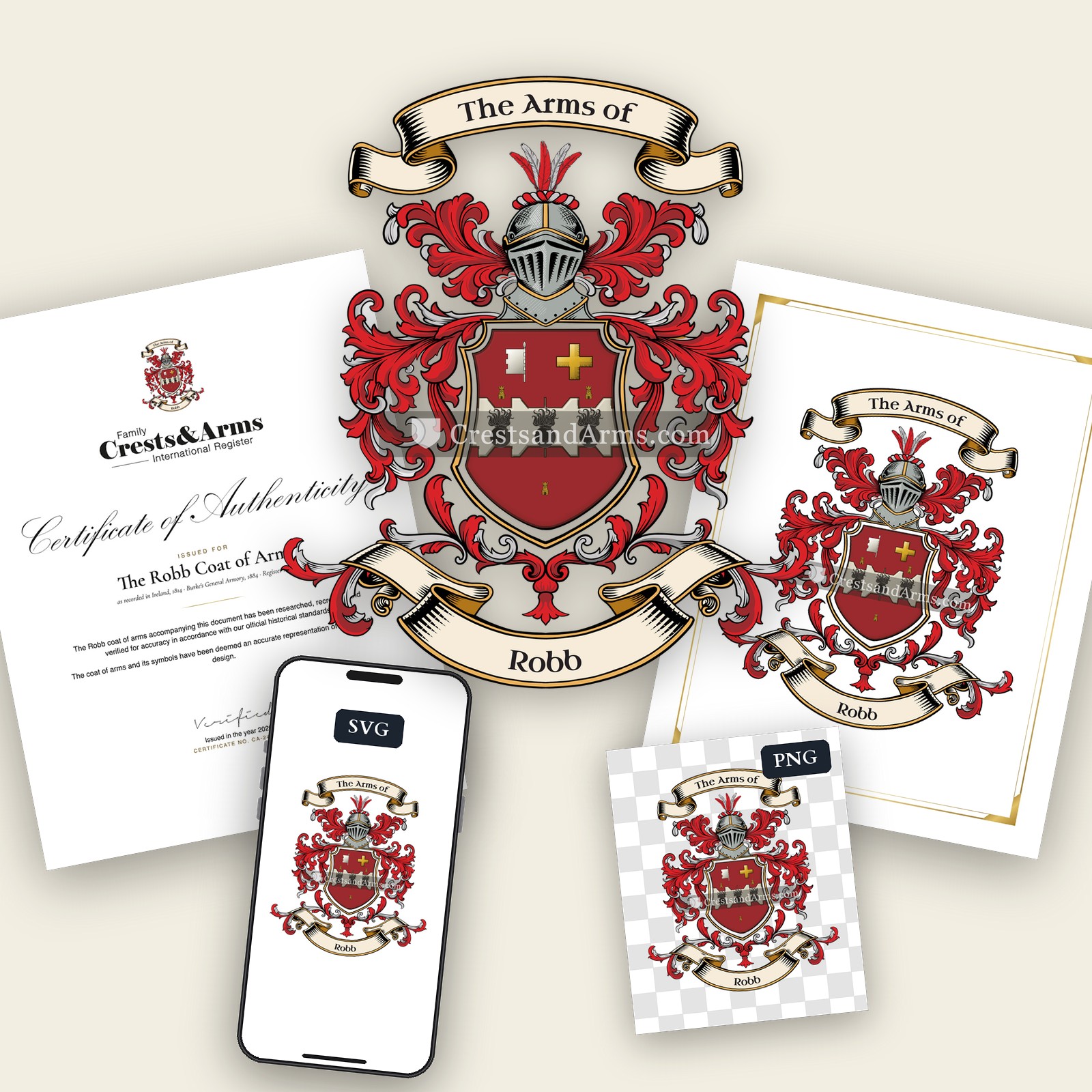
Symbols on this shield
fessThe military belt, and readiness to serve
cross symbolChristian faith and service
towerGrandeur and solidity, and a stronghold defended
bombOne who has faced a great siege
flag / pennantA command held, and a following kept
Colours
Red (Gules)Means: Military strength
Silver (Argent)Means: Peace and sincerity
Gold (Or)Means: Generosity
Black (Sable)Means: Constancy
Historical info
Source
Sir Bernard Burke, The General Armory of England, Scotland, Ireland and Wales, London: Harrison & Sons, 1884
Blazon (the actual original written record)
“Gu. on a fess counter-embattled ar. betw. three towers or, as many bombs sa. the fuses fixed ppr. pendent from a red ribbon in the centre chief a representation of the golden cross presented to Lieut.-Col. ROBE by the King”
Irelandc. 1814
Digital archive packCoat of arms PNG, gold border print PDF, vector SVG and the certificate of authenticity. Sent to your email in minutes.
Map of Ireland showing where the Robb arms are recorded
The Robb arms were recorded in Ireland, c. 1814.
Arms such as these were typically recorded in Dublin.
Dublin was the seat of government in Ireland and the place where grants were sought and recorded. Families with business at the castle or the courts settled nearby, and settling there put their arms on record.
This is where the arms were entered in the register. Families often moved to other parts of the country, so the same name can turn up in more than one region.
The body that granted and recorded arms in Ireland in this period.
George III of Great Britain
Sovereign of the period
George III of Great Britain
1801–1820
Reigning in Scotland when the Robb arms are first recorded.
How Arms Worked in Ireland
The Ulster King of Arms granted coats of arms to individuals who proved their social standing and good character. These symbols were typically inherited by all legitimate descendants of the original holder. If a family branch wanted a unique look, they could apply for a specific change to their design through the office to ensure their identity remained distinct.
Granting authority
The Ulster King of Arms acted as the official body that regulated and issued all coats of arms throughout Ireland.
How they got arms
Families obtained their arms through formal grants issued by the office after proving their eligibility and paying the required fees.
Where arms were recorded
All official grants were recorded in the registers held by the Ulster King of Arms starting from the year 1552.
The family's standing
Recorded among the armigerous families of Ireland.
Origin & History of the Robb Family in Ireland
The surname Robb has roots that stretch back to the northern regions of the British Isles, eventually establishing a notable presence in Ireland by the early nineteenth century. While the name is often associated with Scottish origins as a shortened form of Robert, families bearing this name were well-documented in Dublin by 1814. During this period, Dublin was a bustling center of trade and administration, and families like the Robbs often integrated into the city’s growing professional and merchant classes. These early settlers likely arrived as part of the broader movement of people between Scotland and Ireland, settling into urban life and contributing to the local economy. By maintaining a presence in the capital, the family became part of the social fabric of a city undergoing significant change, leaving behind records in parish registers and municipal documents that track their transition into Irish society.
Robb Meaning & Related Branches
Root word
Robert
Derived from Germanic elements meaning bright fame or shining glory.
This name
RobbA Scottish patronymic surname meaning son of the bright and famous one.
also spelled
Robbe
Roobe
Robee
Robb
Documented Sources
Sir Bernard Burke, The General Armory of England, Scotland, Ireland and Wales, London: Harrison & Sons, 1884
Black, George Fraser. The Surnames of Scotland: Their Origin, Meaning, and History. 1946
National Records of Scotland. Old Parish Registers, Edinburgh. 1809
Digital archive packCoat of arms PNG, gold border print PDF, vector SVG and the certificate of authenticity. Sent to your email in minutes.


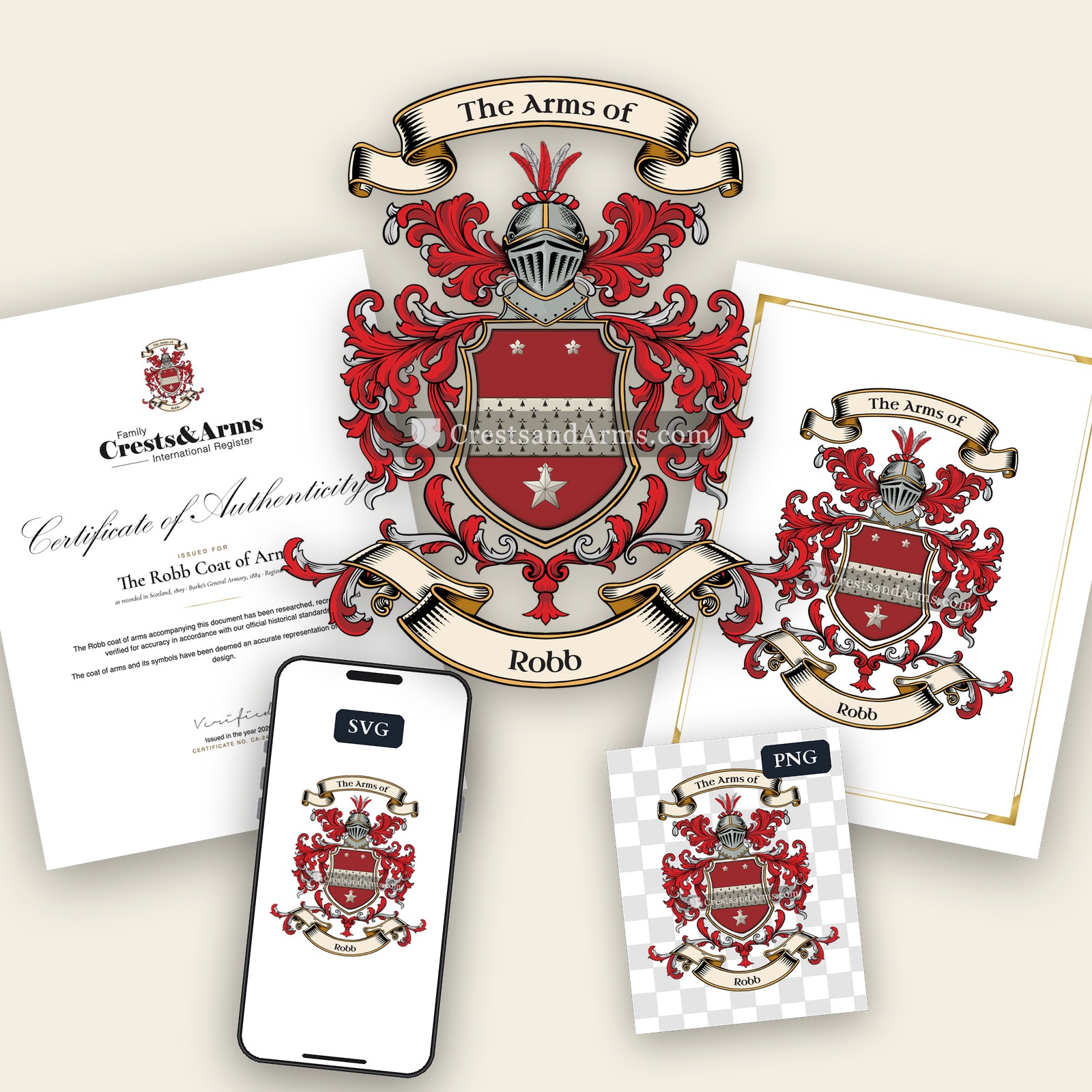
 fessThe military belt, and readiness to serve
 cinquefoilHope and joy
 mulletThe third son, and a divine quality from above
 fessThe military belt, and readiness to serve
 cinquefoilHope and joy
 mulletThe third son, and a divine quality from above


 sunGlory, splendour and the source of life


 cross symbolChristian faith and service
 towerGrandeur and solidity, and a stronghold defended
 bombOne who has faced a great siege
 flag / pennantA command held, and a following kept