Map of Belgium showing where the Robbie arms are recorded
The Robbie arms were recorded in Flandre, c. 1663.
Flandre grew rich on cloth, and its towns were among the busiest in Europe. Merchant families bought land with their profits and took arms to go with it, so trade put as many names in the registers here as land did.
This is where the arms were entered in the register. Families often moved to other parts of the country, so the same name can turn up in more than one region.
The body that granted and recorded arms in Belgium in this period.
Philip IV of Spain
Sovereign of the period
Philip IV of Spain
1621–1665
Reigning in Belgium when the Robbie arms are first recorded.
How Arms Worked in Belgium
In Belgium, a coat of arms is considered personal property that is passed down through the male line to legitimate descendants. Families often use the same shield design across generations to show their shared heritage. If a branch of the family wants to change the design, they must apply for an official update to their specific version of the arms.
Granting authority
The Conseil héraldique is the official body that regulates and approves all coats of arms in Belgium.
How they got arms
Families obtain their coats of arms through formal royal grants or by confirming their historical right to use existing designs.
Where arms were recorded
All approved coats of arms are officially recorded in the public registers of the Conseil héraldique since 1844.
The family's standing
Recorded among the armigerous families of Flandre.
Origin & History of the Robbie Family in Belgium
The family name Robbie has deep roots in the historical region of Flanders, where records confirm members of the family were established by 1663. During this period, Flanders was a vibrant center of trade and agriculture, and families like the Robbies often lived in small, industrious communities near the coast or along the river networks. The name likely evolved from local naming customs that identified individuals by their trade or their connection to a specific village. As the region faced shifting political borders and economic changes in the late seventeenth century, the family remained part of the local social fabric. They participated in the daily life of the Flemish provinces, contributing to the growth of the local economy through farming or craftsmanship. By staying rooted in this area, the early Robbie family helped shape the cultural identity of the region during a time of significant transition in European history.
Meaning of the Robbie family crest colors & symbols
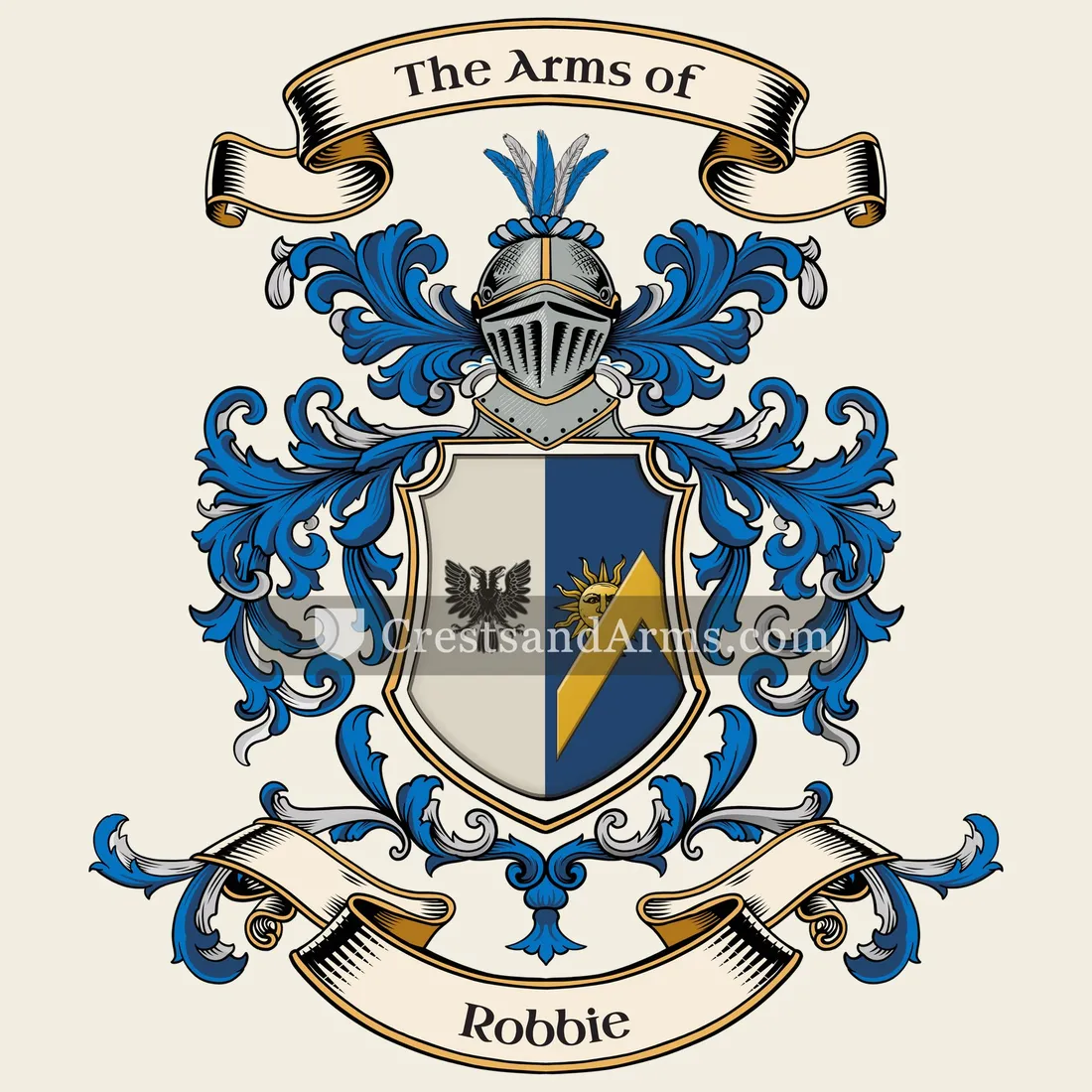
Symbols on this shield
chevronProtection, and faithful service completed
eagleNobility, strength and a keen mind
sunGlory, splendour and the source of life
Colours
Silver (Argent)Means: Peace and sincerity
Blue (Azure)Means: Loyalty and truth
Gold (Or)Means: Generosity
Black (Sable)Means: Constancy
Historical info
Source
J. B. Rietstap, Armorial Général, Gouda: G. B. van Goor Zonen, 1884–87
Blazon (the actual original written record)
“Parti: au 1 d'arg. à la demi-aigle de sa., bq. et m. d'or, mouv. du parti; au 2 coupé: a. d'azur à un soleil d'or; b. de gu. au chev. d'or. Cq. cour. C.: un vol, de sa. et d'arg. L.: à dextre d'arg. et de sa., à sen. d'or et d'azur.”
Germanyc. 1737
Digital archive packCoat of arms PNG, gold border print PDF, vector SVG and the certificate of authenticity. Sent to your email in minutes.
Map of Germany showing where the Robbie arms are recorded
The Robbie arms were recorded in Germany, c. 1737.
Arms such as these were typically recorded in Bavaria.
Bavaria was a country of old landed families and walled market towns. Estates passed down the same line for centuries, and both the landowners and the leading townsmen kept arms, which is why so many Bavarian names sit in the registers.
This is where the arms were entered in the register. Families often moved to other parts of the country, so the same name can turn up in more than one region.
The body that granted and recorded arms in Germany in this period.
Charles VI, Holy Roman Emperor
Sovereign of the period
Charles VI, Holy Roman Emperor
1711–1740
Reigning in Belgium when the Robbie arms are first recorded.
How Arms Worked in Germany
In the Holy Roman Empire, coats of arms were often granted to individuals by the Emperor or his representatives. These arms were then passed down through the generations to all legitimate descendants of the original holder. Younger branches of a family usually kept the same shield design without needing to change it, as the arms belonged to the entire lineage.
Granting authority
The Holy Roman Emperor held the sole power to grant new coats of arms throughout his vast imperial territories.
How they got arms
Families typically obtained their coats of arms through a formal imperial grant or by proving their noble status to the authorities.
Where arms were recorded
These grants were officially recorded in the Imperial Chancery registers, which began keeping formal records of such honors during the Middle Ages.
The family's standing
Recorded among the armigerous families of Germany.
Origin & History of the Robbie Family in Germany
The family name Robbie carries a distinct history rooted in the cultural landscape of southern Germany. By the year 1737, records confirm that members of the family were well-established residents of Bavaria. During this period, the region was characterized by a strong emphasis on agrarian life and local craftsmanship, which likely defined the daily experiences of the early Robbie ancestors. The name itself often functioned as a patronymic or a diminutive form, suggesting that it evolved from a personal name used to identify specific family lines within their local villages. As these individuals navigated the social structures of eighteenth-century Bavaria, they contributed to the local economy and community life that defined the rural landscape of the time. Their presence in these historical records provides a clear window into the movement and settlement patterns of families who helped shape the identity of the region before the modern era.
Meaning of the Robbie family crest colors & symbols
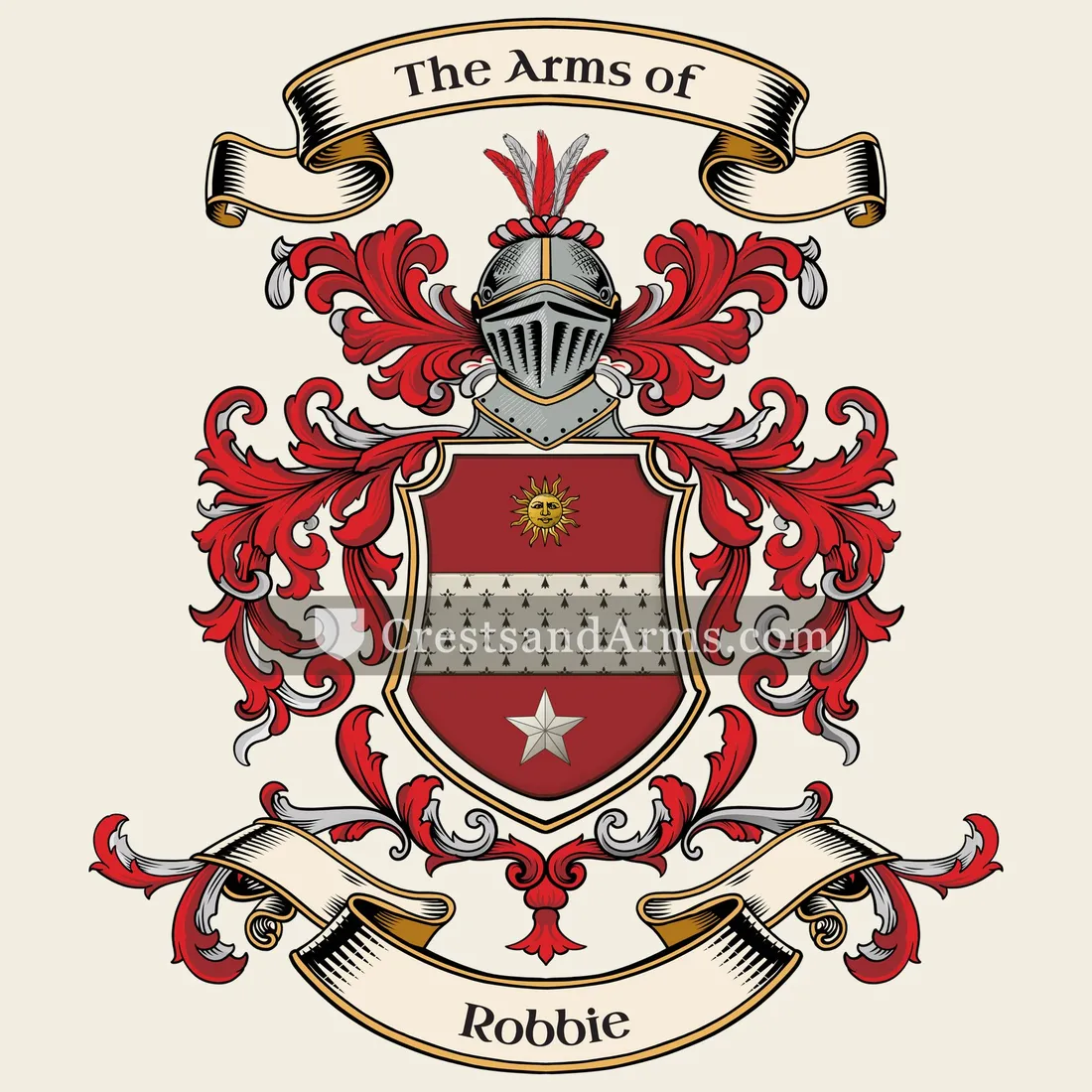
Symbols on this shield
fessThe military belt, and readiness to serve
sunGlory, splendour and the source of life
mulletThe third son, and a divine quality from above
Colours
Red (Gules)Means: Military strength
ErmineMeans: Dignity
Gold (Or)Means: Generosity
Silver (Argent)Means: Peace and sincerity
Historical info
Source
Sir Bernard Burke, The General Armory of England, Scotland, Ireland and Wales, London: Harrison & Sons, 1884
Blazon (the actual original written record)
“Gu. a fess erm. betw. the sun in chief or, and a mullet in base ar. Crest and Motto, as the last”
EnglandLondon, c. 1620
Digital archive packCoat of arms PNG, gold border print PDF, vector SVG and the certificate of authenticity. Sent to your email in minutes.
Map of England showing where the Robbie arms are recorded
The Robbie arms were recorded in London, c. 1620.
This is where the arms were entered in the register. Families often moved to other parts of the country, so the same name can turn up in more than one region.
The body that granted and recorded arms in England in this period.
James VI and I
Sovereign of the period
James VI and I
1603–1625
Reigning in Belgium when the Robbie arms are first recorded.
How Arms Worked in England
English heraldry allowed arms to be shared by all legitimate descendants of the original owner. These symbols were treated as personal property that moved through the generations to all children. While the eldest son kept the original design, other family members could use the same shield without needing to change it or register their own unique versions.
Granting authority
The College of Arms in London has regulated the use of coats of arms throughout England and Wales since 1484.
How they got arms
Families typically obtained their coats of arms through a formal grant from the Crown or by proving their ancient right to them.
Where arms were recorded
All official coats of arms are recorded in the registers kept at the College of Arms, which date back to the fifteenth century.
The family's standing
Recorded among the armigerous families of England.
Origin & History of the Robbie Family in England
The surname Robbie is a patronymic name, meaning it originated as a way to identify someone as the son or descendant of a man named Robert. During the early seventeenth century, the name became established within the bustling social landscape of London. By 1620, individuals carrying this name were integrated into the city’s growing population, likely participating in the vibrant trade and craft industries that defined the capital at the time. Because London was a major center for migration and commerce, families like the Robbies often lived in parishes where records of baptisms and marriages were carefully kept by local churches. These early residents were part of a period of significant urban expansion, where surnames were becoming more fixed and essential for legal and tax purposes. As the family settled into the rhythms of London life, the name served as a link to their ancestral roots while they contributed to the evolving identity of the city.
Robbie Meaning & Related Branches
Root word
Hrodberht
A Germanic compound meaning bright fame or renowned glory.
This name
RobbieA diminutive form of Robert, signifying a person of bright and shining reputation.
also spelled
Robbe
Roobe
Robee
Robb
Documented Sources
J. B. Rietstap, Armorial Général, Gouda: G. B. van Goor Zonen, 1884–87
State Archives in Belgium (Rijksarchief), Parochieregisters van de provincie West-Vlaanderen
State Archives in Belgium (Rijksarchief), Registers van de Burgerlijke Stand
Debrabandere, Frans, Woordenboek van de familienamen in België en Noord-Frankrijk, 2003
Pirenne, Henri, Histoire de Belgique, 1900
Digital archive packCoat of arms PNG, gold border print PDF, vector SVG and the certificate of authenticity. Sent to your email in minutes.


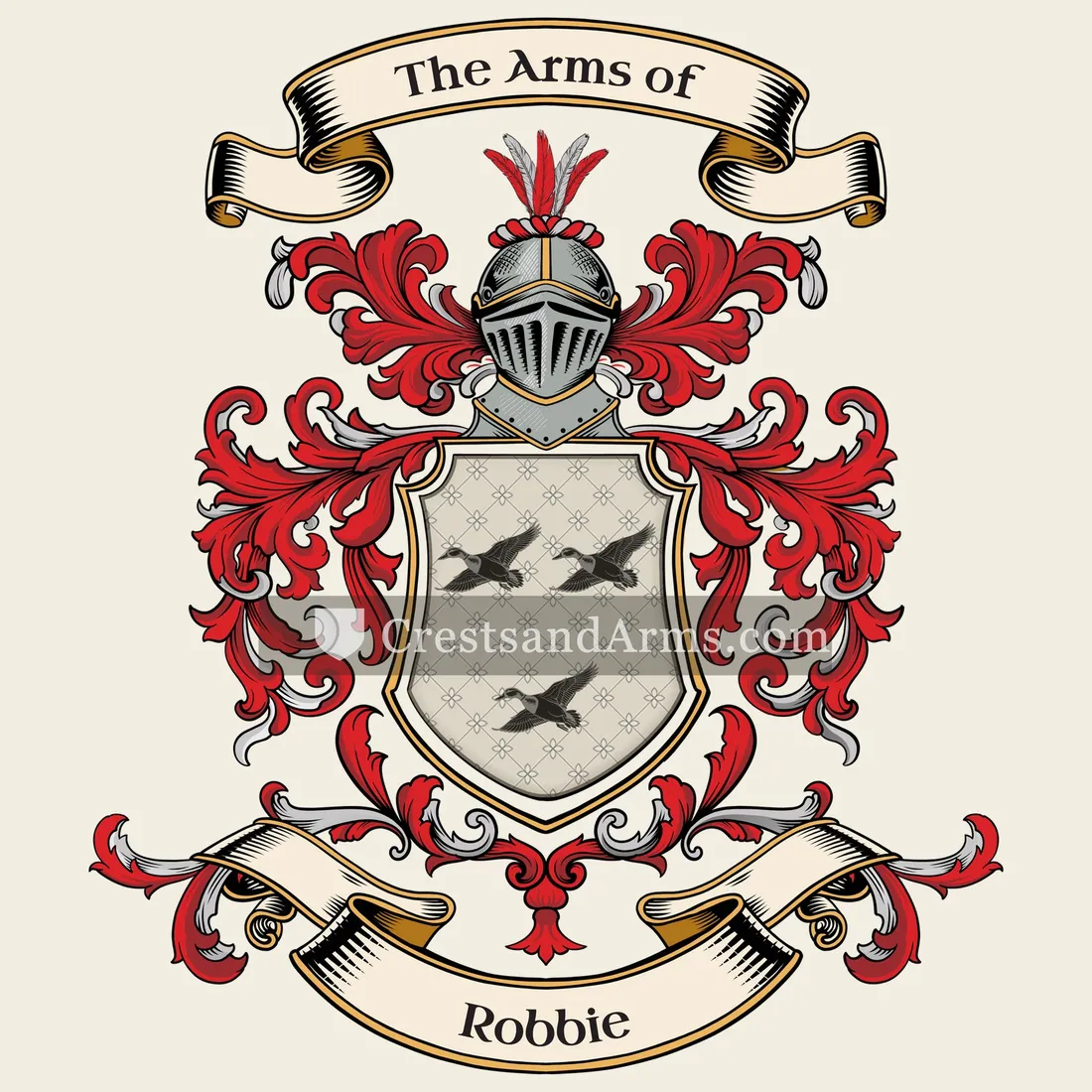
 duckResourcefulness on land and water
 duckResourcefulness on land and water


 chevronProtection, and faithful service completed
 eagleNobility, strength and a keen mind
 sunGlory, splendour and the source of life


 fessThe military belt, and readiness to serve
 mulletThe third son, and a divine quality from above