Map of England showing where the Robertshaw arms are recorded
The Robertshaw arms were recorded in Somerset, c. 1578.
Somerset was rich farming country with a thick scattering of manor houses. Its gentry were numerous and long-settled, and a settled landed family almost always ended up with arms.
This is where the arms were entered in the register. Families often moved to other parts of the country, so the same name can turn up in more than one region.
The body that granted and recorded arms in England in this period.
Elizabeth I of England
Sovereign of the period
Elizabeth I of England
1558–1603
Reigning in England when the Robertshaw arms are first recorded.
How Arms Worked in England
English heraldry allowed arms to be shared by all legitimate descendants of the original owner. These symbols were treated as personal property that moved through the generations to all children. While the eldest son kept the original design, other family members could use the same shield without needing to change it or register their own unique versions.
Granting authority
The College of Arms in London has regulated the use of coats of arms throughout England and Wales since 1484.
How they got arms
Families typically obtained their coats of arms through a formal grant from the Crown or by proving their ancient right to them.
Where arms were recorded
All official coats of arms are recorded in the registers kept at the College of Arms, which date back to the fifteenth century.
The family's standing
Recorded among the armigerous families of Somerset.
Origin & History of the Robertshaw Family in England
The surname Robertshaw is a locative name, meaning it originated from a specific place where the family once lived. In Old English, the name combines the personal name Robert with the word shaw, which refers to a small wood or a thicket. This suggests that the earliest ancestors likely resided near a wooded area that became associated with their name. While the name is often linked to the northern regions of England, records confirm that members of the Robertshaw family were established in Somerset by 1578. During this period, families often moved across the country to seek new opportunities in farming or trade. As they settled into these new communities, they helped shape the local history of the region while maintaining the unique identity tied to their ancestral name.
Coat of Arms & Family Crest Details
Symbols on this shield
bendDefence, and the scarf of a commander
lionCourage, strength and royalty
arms pheon arrowheadReadiness for battle, and the broad arrow of the sovereign
Colours
Red (Gules)Means: Military strength
Gold (Or)Means: Generosity
Historical info
Source
Sir Bernard Burke, The General Armory of England, Scotland, Ireland and Wales, London: Harrison & Sons, 1884
Blazon (the actual original written record)
“Per bend dovetailed gu. and or, a lion ramp. betw. in sinister chief and dexter base two pheons all counterchanged”
MonmouthDrybridge · Monmouth, c. 1647
Digital archive packCoat of arms PNG, gold border print PDF, vector SVG and the certificate of authenticity. Sent to your email in minutes.
Map of Wales showing where the Robertshaw arms are recorded
The Robertshaw arms were recorded in Monmouth, c. 1647.
Monmouthshire lay on the Welsh border, where land was held in return for military service. Families were expected to arm and to fight, and fighting households carried shields of their own.
This is where the arms were entered in the register. Families often moved to other parts of the country, so the same name can turn up in more than one region.
The body that granted and recorded arms in Wales in this period.
Charles I of England
Sovereign of the period
Charles I of England
1625–1649
Reigning in England when the Robertshaw arms are first recorded.
How Arms Worked in Wales
English heraldry allowed arms to be shared by all legitimate descendants of the original owner. These symbols were treated as personal property that moved through the generations to all children. While the eldest son kept the original design, other family members could use the same shield without needing to change it or register their own unique versions.
Granting authority
The College of Arms in London has regulated the use of coats of arms throughout England and Wales since 1484.
How they got arms
Families typically obtained their coats of arms through a formal grant from the Crown or by proving their ancient right to them.
Where arms were recorded
All official coats of arms are recorded in the registers kept at the College of Arms, which date back to the fifteenth century.
The family's standing
Recorded among the armigerous families of Monmouth.
Origin & History of the Robertshaw Family in Wales
The surname Robertshaw is traditionally associated with Northern England, but its presence in Monmouth by 1647 suggests an intriguing migration into Wales during a period of significant social upheaval. During the mid-17th century, the Welsh borderlands were heavily impacted by the English Civil War, which likely influenced the movement of families seeking stability or new opportunities in trade and land management. The name itself is topographical, derived from the Old English words for a clearing or wood belonging to a man named Robert, indicating that the family likely originated from a rural community before establishing roots in the Welsh Marches. Settling in Monmouth, a strategic town at the confluence of the rivers Wye and Monnow, the family would have integrated into a vibrant local economy that served as a gateway between the Welsh highlands and the English lowlands. By establishing themselves in this region, the Robertshaws became part of the complex cultural exchange that defined the border counties during the seventeenth century.
Coat of Arms & Family Crest Details
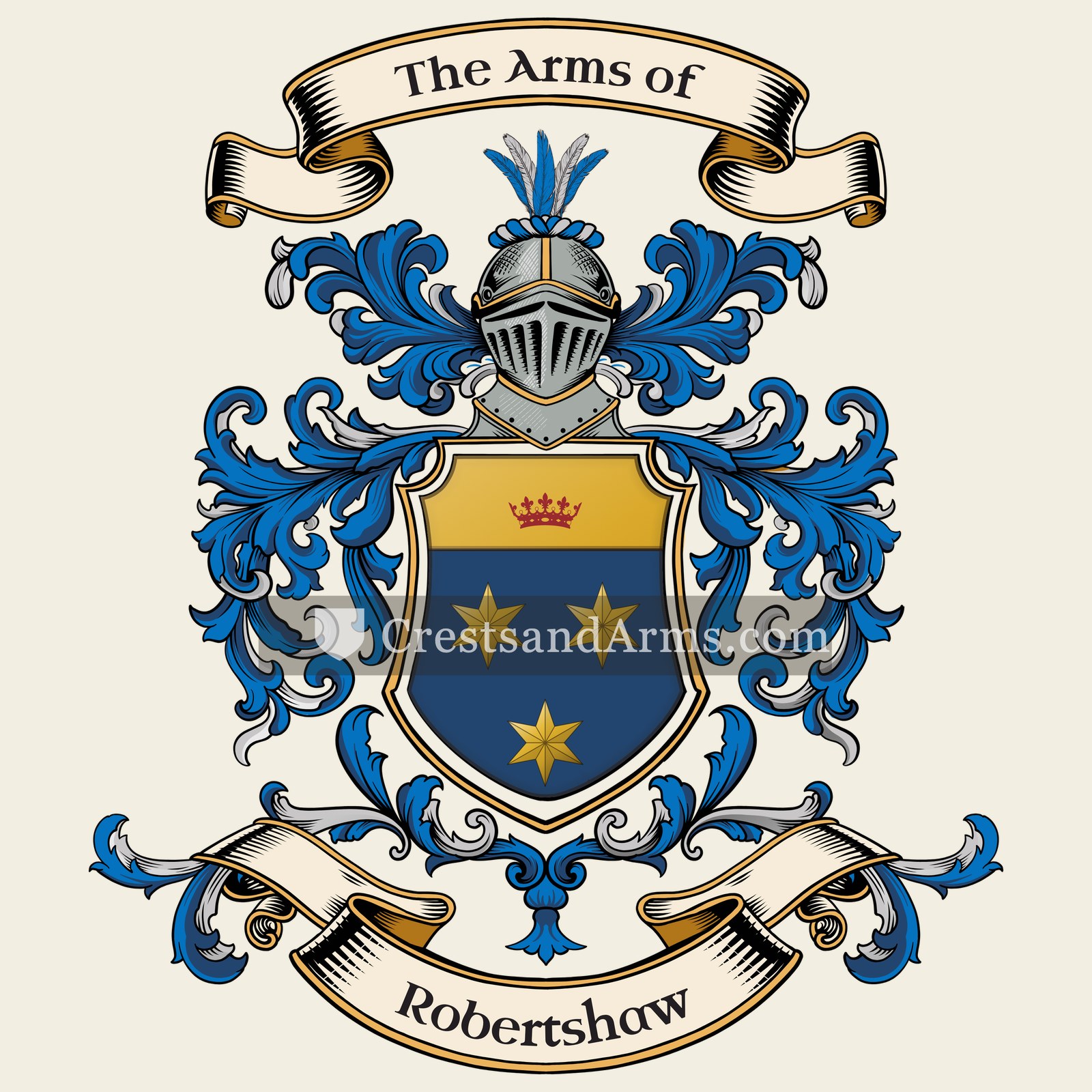
Symbols on this shield
chiefAuthority, wisdom and dominion
starThe celestial goddess, and nobility
crownSovereignty, authority and just reward
Colours
Blue (Azure)Means: Loyalty and truth
Gold (Or)Means: Generosity
Red (Gules)Means: Military strength
Historical info
Source
Sir Bernard Burke, The General Armory of England, Scotland, Ireland and Wales, London: Harrison & Sons, 1884
Blazon (the actual original written record)
“Az. three estoiles or, on a chief wavy of the second an Eastern crown gu”
Irelandc. 1645
Digital archive packCoat of arms PNG, gold border print PDF, vector SVG and the certificate of authenticity. Sent to your email in minutes.
Map of Ireland showing where the Robertshaw arms are recorded
The Robertshaw arms were recorded in Ireland, c. 1645.
Arms such as these were typically recorded in Dublin.
Dublin was the seat of government in Ireland and the place where grants were sought and recorded. Families with business at the castle or the courts settled nearby, and settling there put their arms on record.
This is where the arms were entered in the register. Families often moved to other parts of the country, so the same name can turn up in more than one region.
The body that granted and recorded arms in Ireland in this period.
Charles I of England
Sovereign of the period
Charles I of England
1625–1649
Reigning in England when the Robertshaw arms are first recorded.
How Arms Worked in Ireland
The Ulster King of Arms granted coats of arms to individuals who proved their social standing and good character. These symbols were typically inherited by all legitimate descendants of the original holder. If a family branch wanted a unique look, they could apply for a specific change to their design through the office to ensure their identity remained distinct.
Granting authority
The Ulster King of Arms acted as the official body that regulated and issued all coats of arms throughout Ireland.
How they got arms
Families obtained their arms through formal grants issued by the office after proving their eligibility and paying the required fees.
Where arms were recorded
All official grants were recorded in the registers held by the Ulster King of Arms starting from the year 1552.
The family's standing
Recorded among the armigerous families of Ireland.
Origin & History of the Robertshaw Family in Ireland
The Robertshaw name is primarily of English origin, derived from a locational term meaning a wood or clearing belonging to a man named Robert. While the family roots are deep in the northern counties of England, historical evidence confirms that members of the Robertshaw family were established in Dublin by 1645. During this period, Dublin was a center of significant political and social transition, and settlers from Britain often moved to the city to participate in trade or administrative roles. The presence of the family in the capital during the mid-seventeenth century suggests they were part of a wave of migration that integrated English surnames into the urban fabric of Ireland. Over the following generations, these early settlers became part of the local community, contributing to the diverse demographic history of the city.
Related Branches & Arms
Root word
Robert and sceaga
Bright fame and a small wood or thicket.
This name
RobertshawRefers to a person who lived near a small wood belonging to someone named Robert.
also spelled
Robberts
Robertz
Roberds
Robartes
Robarts
Documented Sources
Sir Bernard Burke, The General Armory of England, Scotland, Ireland and Wales, London: Harrison & Sons, 1884
Bardsley, Charles Wareing, A Dictionary of English and Welsh Surnames, 1901
Reaney, P.H., A Dictionary of British Surnames, 1958
Somerset Archives, Quarter Sessions Records, 1578
Digital archive packCoat of arms PNG, gold border print PDF, vector SVG and the certificate of authenticity. Sent to your email in minutes.


 fessThe military belt, and readiness to serve
 stagPeace and harmony, and one who will not fight unprovoked
 fessThe military belt, and readiness to serve
 stagPeace and harmony, and one who will not fight unprovoked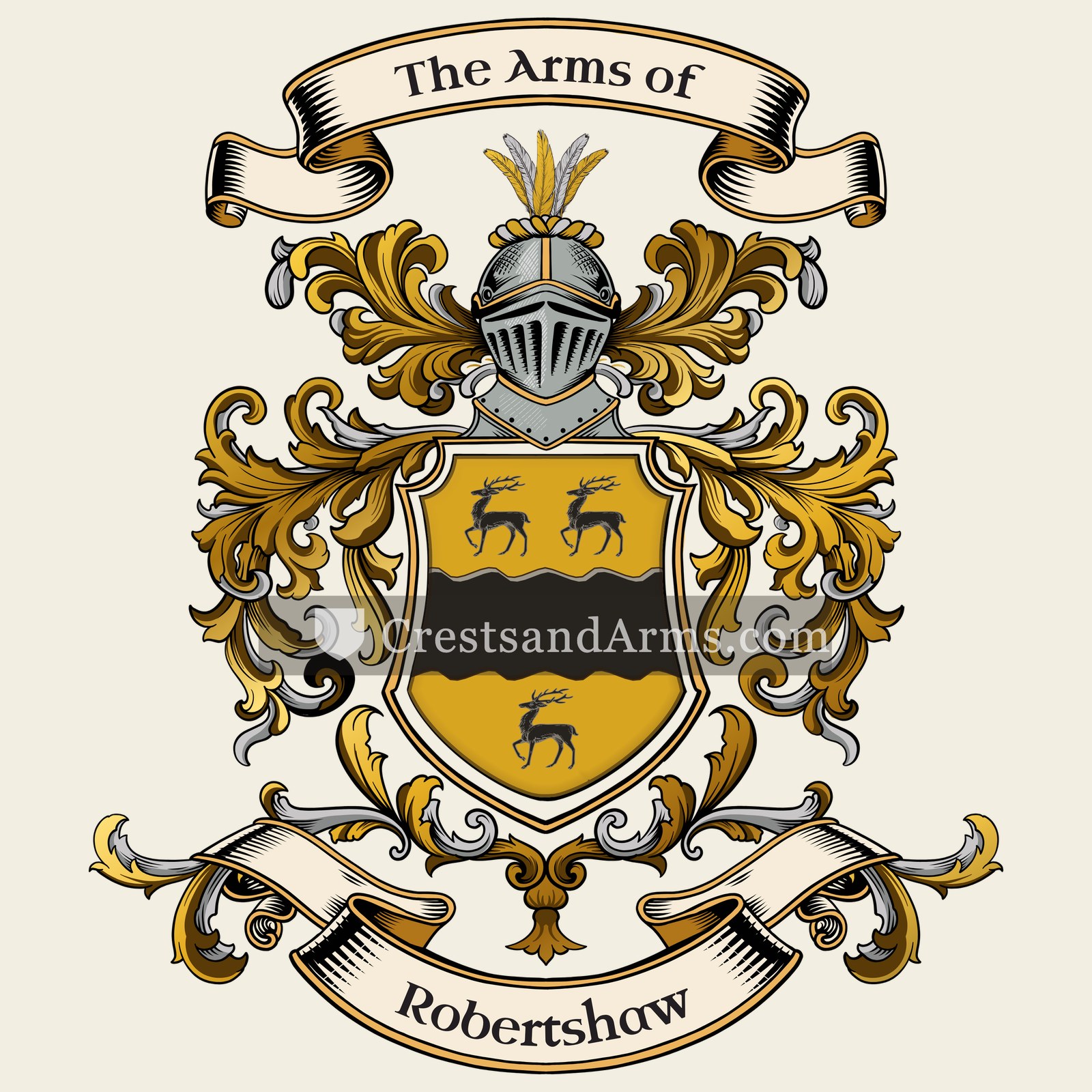


 bendDefence, and the scarf of a commander
 lionCourage, strength and royalty
 arms pheon arrowheadReadiness for battle, and the broad arrow of the sovereign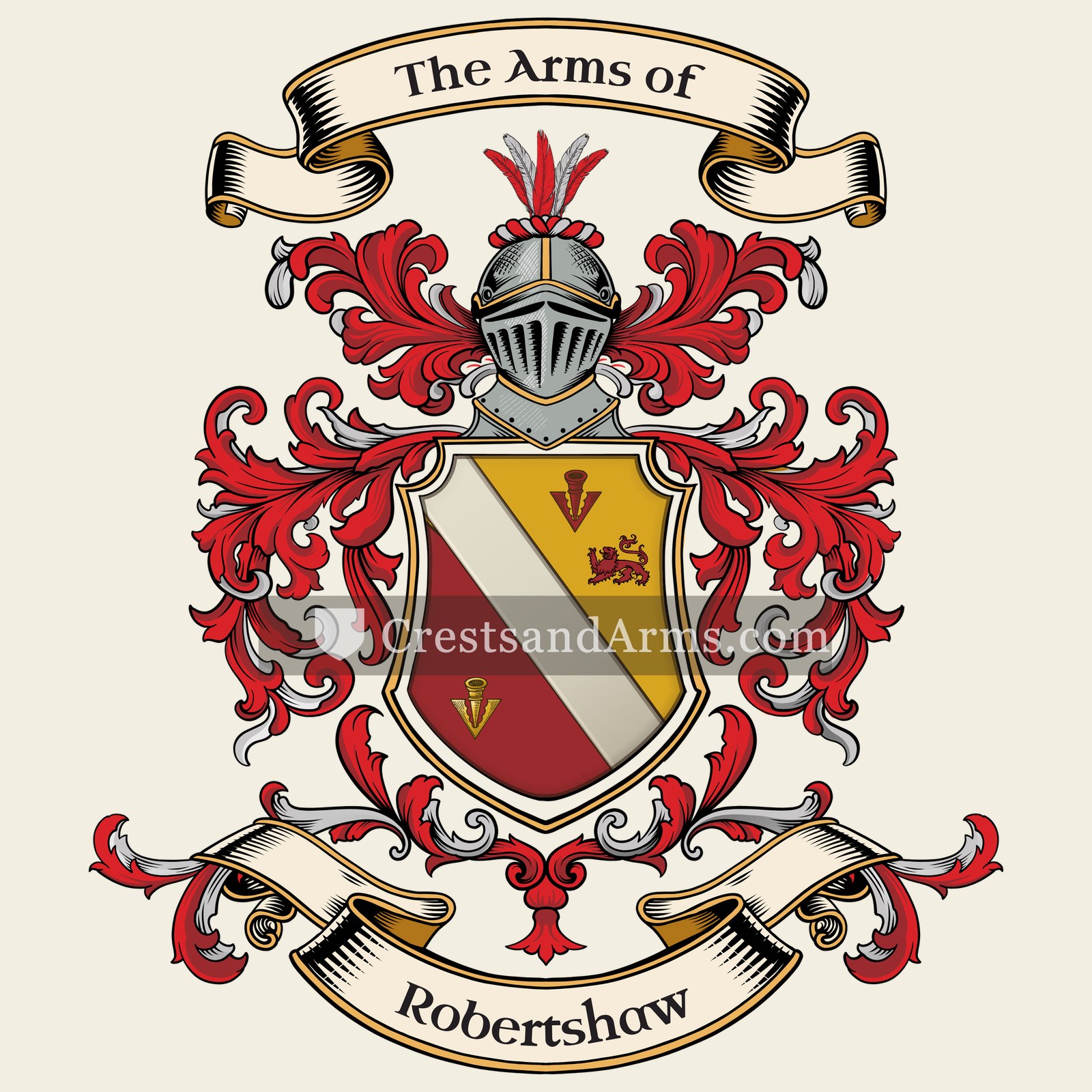

 chiefAuthority, wisdom and dominion
 starThe celestial goddess, and nobility
 crownSovereignty, authority and just reward