A record of documented arms, meaning and origin, researched for the Robinson family lines. Documented in 3 countries.
Reg. 5817 · Britain, P–S
Coat of Arms & Family Crest Details
Symbols on this shield
stagPeace and harmony, and one who will not fight unprovoked
trefoilPerpetuity, and the Trinity
towerGrandeur and solidity, and a stronghold defended
lionCourage, strength and royalty
Colours
Green (Vert)Means: Hope
Red (Gules)Means: Military strength
Gold (Or)Means: Generosity
Silver (Argent)Means: Peace and sincerity
Historical info
Source
J. B. Rietstap, Armorial Général, Gouda: G. B. van Goor Zonen, 1884–87
Blazon (the actual original written record)
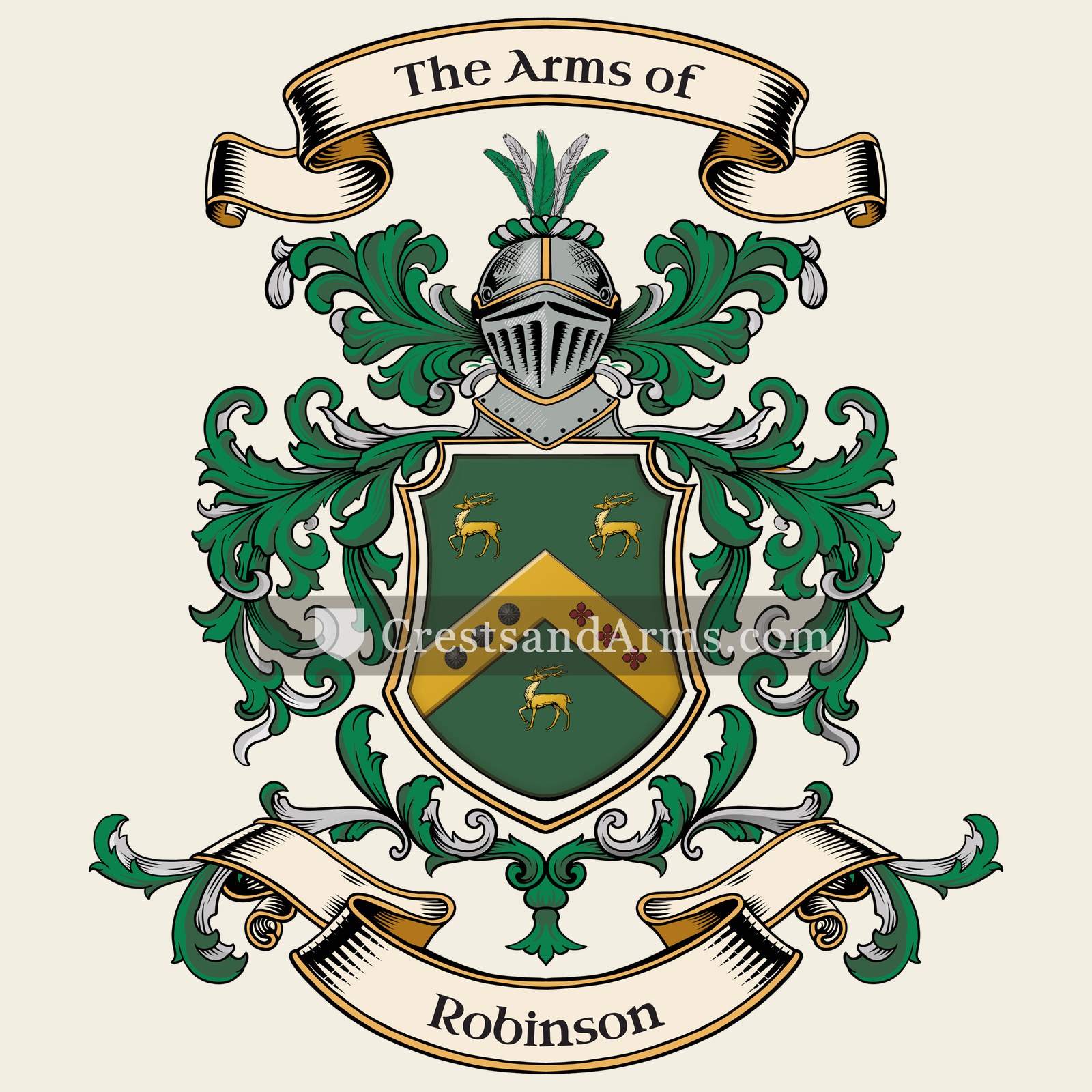
“Ec.: aux 1 et 4 de sin. à un cerf pass. d'or, acc. de huit trèfles du même, rangés en orle: aux 2 et 3 écartelé-crén. de gu. et d'or, le 1 ch. d'une tour d'arg. supp. un léopard d'or. C.: un cerf pass. d'or, orné d'un collier de sin. ch. de trois trèfles d'or.”
NorthamptonshireNorthamptonshire, c. 1660
Digital archive packCoat of arms PNG, gold border print PDF, vector SVG and the certificate of authenticity. Sent to your email in minutes.
Map of Britain showing where the Robinson arms are recorded
The Robinson arms were recorded in Northamptonshire, c. 1660.
This is where the arms were entered in the register. Families often moved to other parts of the country, so the same name can turn up in more than one region.
The body that granted and recorded arms in Britain in this period.
Charles II of England
Sovereign of the period
Charles II of England
1660–1685
Reigning in Britain when the Robinson arms are first recorded.
How Arms Worked in Britain
English heraldry allowed arms to be shared by all legitimate descendants of the original owner. These symbols were treated as personal property that moved through the generations to all children. While the eldest son kept the original design, other family members could use the same shield without needing to change it or register their own unique versions.
Granting authority
The College of Arms in London has regulated the use of coats of arms throughout England and Wales since 1484.
How they got arms
Families typically obtained their coats of arms through a formal grant from the Crown or by proving their ancient right to them.
Where arms were recorded
All official coats of arms are recorded in the registers kept at the College of Arms, which date back to the fifteenth century.
The family's standing
Recorded among the armigerous families of Northamptonshire.
Origin & History of the Robinson Family in Britain
The surname Robinson is a patronymic name, which means it was created to identify a person as the son of Robin. Robin was a popular medieval nickname for the name Robert. During the Middle Ages, surnames became necessary as populations grew and people moved into larger towns. By the time the family was firmly established in Northamptonshire in 1660, the name had already been in use across Britain for several centuries. Many families with this name were part of the growing middle class of farmers, tradespeople, and merchants. Because the name was linked to a common first name, it emerged independently in many different regions rather than coming from a single ancestor. This explains why the name became so widespread across the English countryside during the seventeenth century.
Coat of Arms & Family Crest Details
Symbols on this shield
chevronProtection, and faithful service completed
cinquefoilHope and joy
stagPeace and harmony, and one who will not fight unprovoked
Colours
Green (Vert)Means: Hope
Gold (Or)Means: Generosity
Historical info
Source
Sir Bernard Burke, The General Armory of England, Scotland, Ireland and Wales, London: Harrison & Sons, 1884
Blazon (the actual original written record)
“Vert a chev. betw. two cinquefoils pierced in chief and a stag trippant in base or”
DurhamHerrington · Durham, c. 1502
Digital archive packCoat of arms PNG, gold border print PDF, vector SVG and the certificate of authenticity. Sent to your email in minutes.
Map of England showing where the Robinson arms are recorded
The Robinson arms were recorded in Durham, c. 1502.
Durham was governed by its bishop rather than the crown for most of its history, with its own courts and its own landed class. That separate world produced a tight group of families, nearly all of whom held arms.
This is where the arms were entered in the register. Families often moved to other parts of the country, so the same name can turn up in more than one region.
The body that granted and recorded arms in England in this period.
Henry VII of England
Sovereign of the period
Henry VII of England
1485–1509
Reigning in Britain when the Robinson arms are first recorded.
How Arms Worked in England
English heraldry allowed arms to be shared by all legitimate descendants of the original owner. These symbols were treated as personal property that moved through the generations to all children. While the eldest son kept the original design, other family members could use the same shield without needing to change it or register their own unique versions.
Granting authority
The College of Arms in London has regulated the use of coats of arms throughout England and Wales since 1484.
How they got arms
Families typically obtained their coats of arms through a formal grant from the Crown or by proving their ancient right to them.
Where arms were recorded
All official coats of arms are recorded in the registers kept at the College of Arms, which date back to the fifteenth century.
The family's standing
Recorded among the armigerous families of Durham.
Origin & History of the Robinson Family in England
The surname Robinson is a patronymic name, which means it was originally created to identify a person as the son of Robin. Robin was a common medieval nickname for Robert, a name that gained immense popularity in England following the Norman Conquest. By the early 16th century, the name was firmly established in the northern regions of England, specifically within the County Palatine of Durham. Records from 1502 confirm that families bearing this name were already active participants in the local community of Durham during this period. As the name spread, it became a common identifier for families living in rural villages and growing market towns. Because the name was based on a popular first name rather than a specific location or trade, it emerged independently in various parts of the country, though it remained particularly strong in the north of England throughout the late Middle Ages and the early modern era.
Coat of Arms & Family Crest Details
Symbols on this shield
chevronProtection, and faithful service completed
stagPeace and harmony, and one who will not fight unprovoked
roundelA coin, and one who has been to the crusades
plant quatrefoilGood fortune and the fourfold gospel
Colours
Green (Vert)Means: Hope
Gold (Or)Means: Generosity
Black (Sable)Means: Constancy
Red (Gules)Means: Military strength
Historical info
Source
Sir Bernard Burke, The General Armory of England, Scotland, Ireland and Wales, London: Harrison & Sons, 1884
Blazon (the actual original written record)
“Vert on a chev. or, betw. three bucks trippant of the last and pellettée, as many quatrefoils gu”
LouthRokeby Hall · Louth, c. 1645
Digital archive packCoat of arms PNG, gold border print PDF, vector SVG and the certificate of authenticity. Sent to your email in minutes.
Map of Ireland showing where the Robinson arms are recorded
The Robinson arms were recorded in Louth, c. 1645.
Louth is the smallest Irish county but sat on the road north from Dublin. Norman families took it early, held it under arms, and stayed, which is what put their shields on record.
This is where the arms were entered in the register. Families often moved to other parts of the country, so the same name can turn up in more than one region.
The body that granted and recorded arms in Ireland in this period.
Charles I of England
Sovereign of the period
Charles I of England
1625–1649
Reigning in Britain when the Robinson arms are first recorded.
How Arms Worked in Ireland
The Ulster King of Arms granted coats of arms to individuals who proved their social standing and good character. These symbols were typically inherited by all legitimate descendants of the original holder. If a family branch wanted a unique look, they could apply for a specific change to their design through the office to ensure their identity remained distinct.
Granting authority
The Ulster King of Arms acted as the official body that regulated and issued all coats of arms throughout Ireland.
How they got arms
Families obtained their arms through formal grants issued by the office after proving their eligibility and paying the required fees.
Where arms were recorded
All official grants were recorded in the registers held by the Ulster King of Arms starting from the year 1552.
The family's standing
Recorded among the armigerous families of Louth.
Origin & History of the Robinson Family in Ireland
The surname Robinson is a patronymic name, meaning it originated as a way to identify someone as the son of Robin, which was a common medieval nickname for Robert. While the name has deep roots in England and Scotland, it became established in Ireland through the movement of settlers during the seventeenth century. By 1645, records confirm that members of the Robinson family were living in County Louth. This area was a significant location for families arriving from across the Irish Sea, as its coastal position made it a hub for trade and migration. These early settlers often integrated into the local economy as farmers, merchants, or tradespeople. Over time, the name became firmly rooted in the Irish landscape, reflecting the broader patterns of movement and social change that defined the island during that period.
Robinson Meaning & Related Branches
Root word
Robert
Derived from Germanic elements meaning bright fame or shining glory.
This name
RobinsonA patronymic surname meaning son of the bright and famous one.
also spelled
Robynson
Robin
Robins
Robynsone
Related arms
Robisonsimilar arms
Robinvariant spelling
Robinsvariant spelling
Robynsvariant spelling
Documented Sources
J. B. Rietstap, Armorial Général, Gouda: G. B. van Goor Zonen, 1884–87
Reaney, P.H., A Dictionary of English Surnames, 1958
Bardsley, Charles Wareing, A Dictionary of English and Welsh Surnames, 1901
The National Archives, Hearth Tax Returns for Northamptonshire, 1662–1666
Northamptonshire Archives, Parish Registers of Northamptonshire, 1600–1700
Digital archive packCoat of arms PNG, gold border print PDF, vector SVG and the certificate of authenticity. Sent to your email in minutes.


 stagPeace and harmony, and one who will not fight unprovoked
 trefoilPerpetuity, and the Trinity
 towerGrandeur and solidity, and a stronghold defended
 lionCourage, strength and royalty
 stagPeace and harmony, and one who will not fight unprovoked
 trefoilPerpetuity, and the Trinity
 towerGrandeur and solidity, and a stronghold defended
 lionCourage, strength and royalty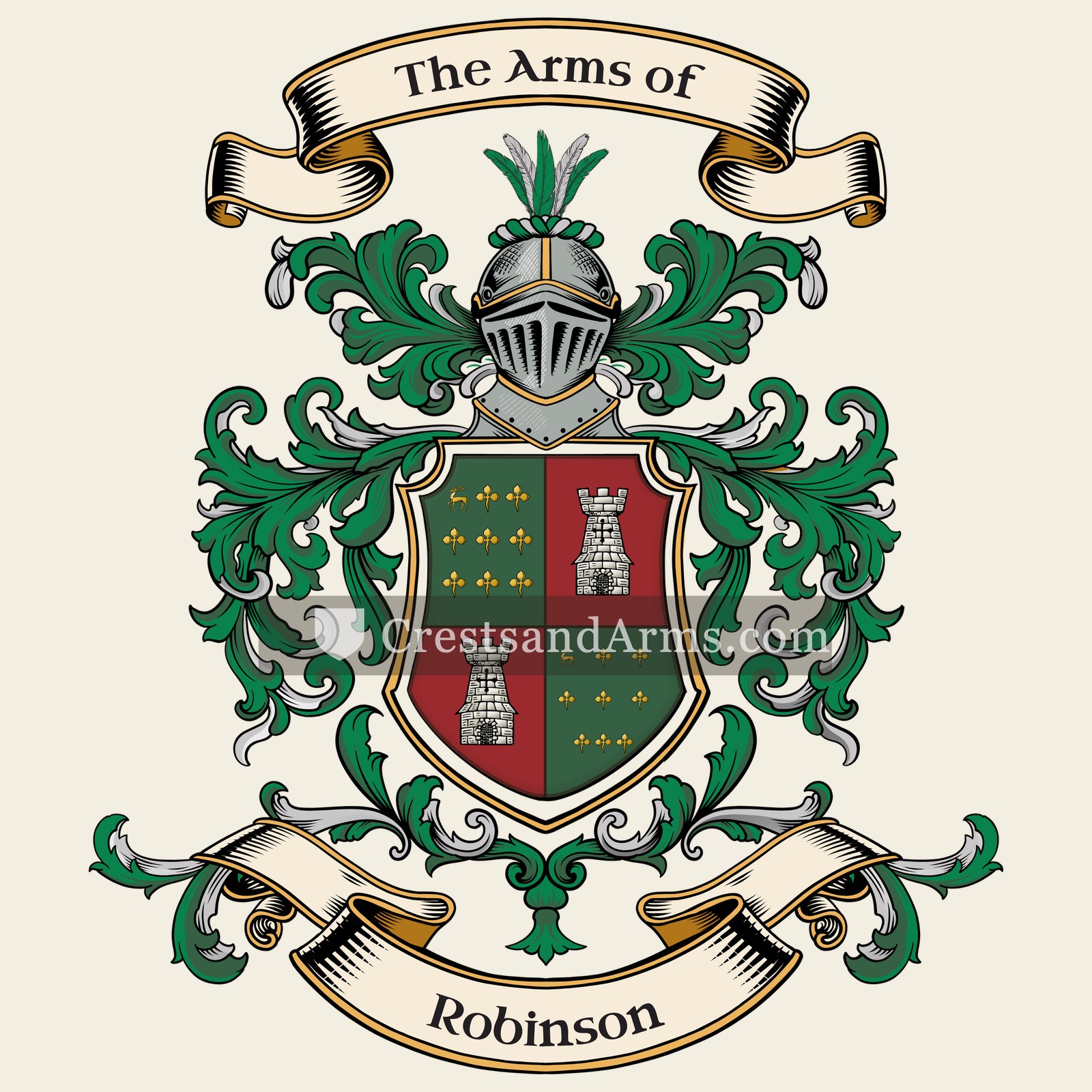


 chevronProtection, and faithful service completed
 cinquefoilHope and joy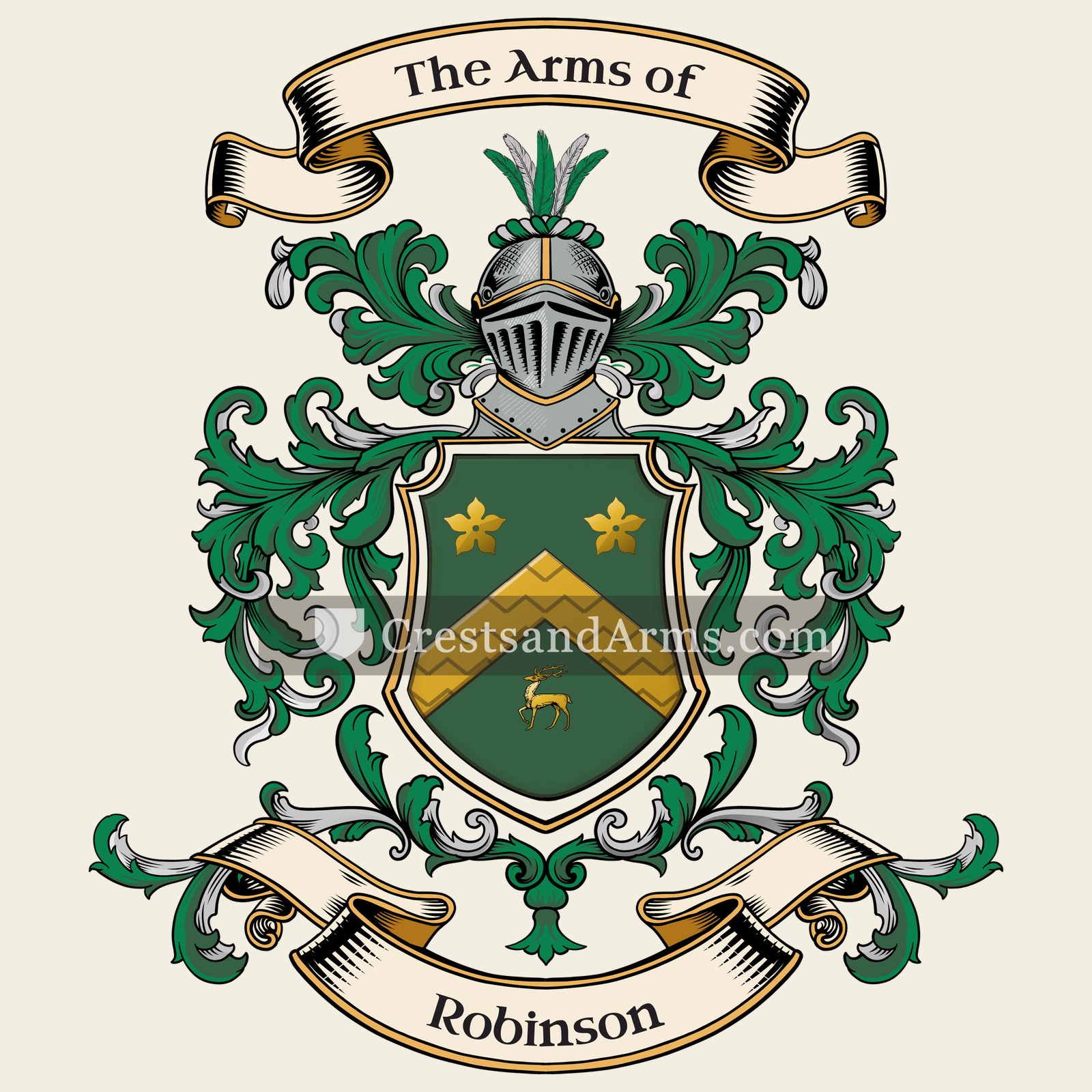

 roundelA coin, and one who has been to the crusades
 plant quatrefoilGood fortune and the fourfold gospel