Map of Spain showing where the Roca arms are recorded
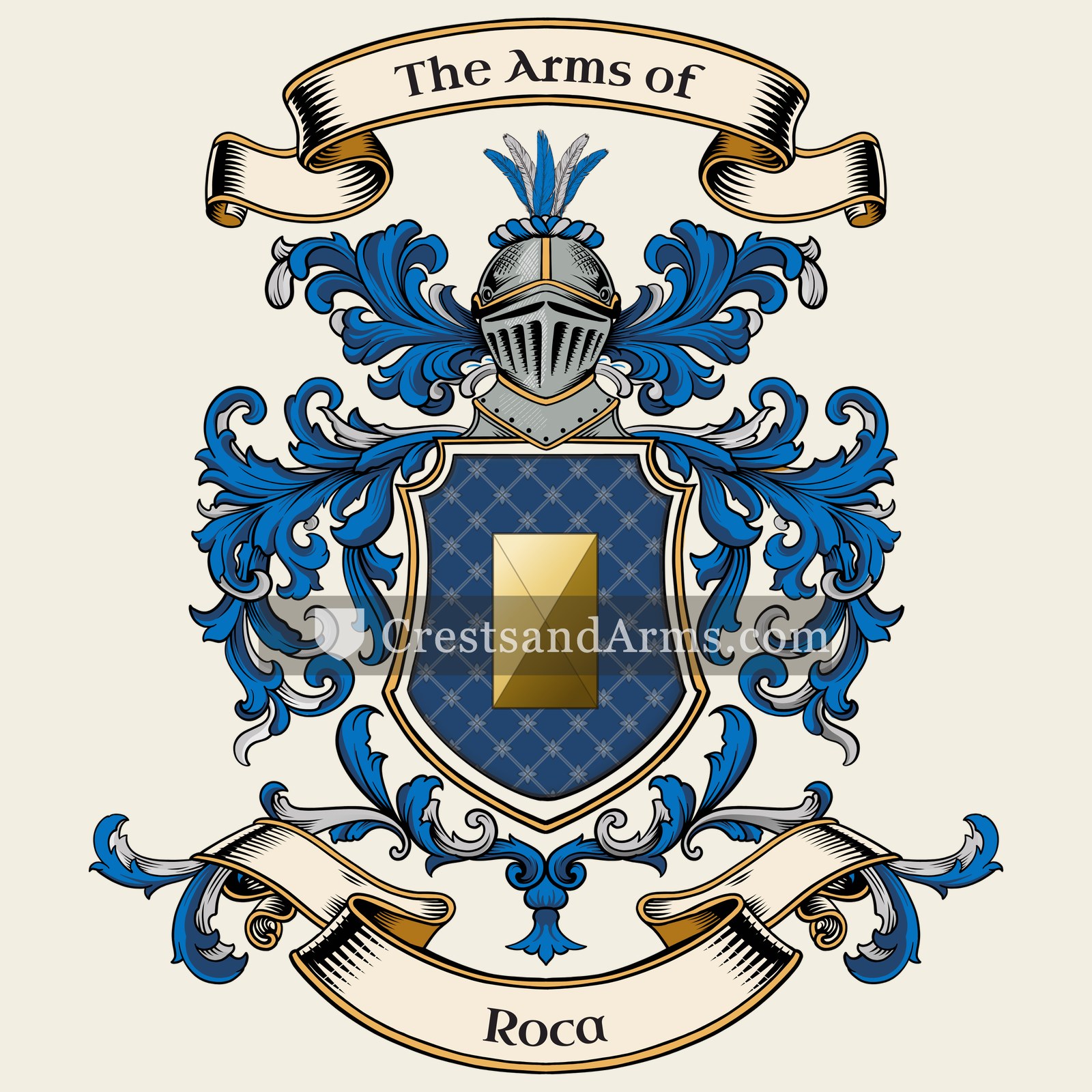
The Roca arms were recorded in Spain, c. 1722.
Arms such as these were typically recorded in Castile.
Castile was the heart of Spain and the source of most of its noble families. Land won in the long wars against the Moors was granted out to fighting men, and a man granted land was granted arms along with it.
This is where the arms were entered in the register. Families often moved to other parts of the country, so the same name can turn up in more than one region.
The body that granted and recorded arms in Spain in this period.
Philip V of Spain
Sovereign of the period
Philip V of Spain
1714–1724
Reigning in Spain when the Roca arms are first recorded.
How Arms Worked in Spain
In Spain, a coat of arms was considered a form of property that belonged to the entire family line. These arms were passed down from a father to all his children equally. Younger branches of the family usually kept the original design without needing to add any special marks to distinguish their specific line.
Granting authority
The Cronista Rey de Armas was the official body that regulated and granted coats of arms throughout Spain.
How they got arms
Families often obtained their arms through royal grants or by proving their noble status to the official heraldic authority.
Where arms were recorded
Coats of arms were officially recorded in the registers of the Cronista Rey de Armas starting in 1496.
The family's standing
Recorded among the armigerous families of Spain.
Origin & History of the Roca Family in Spain
The surname Roca is a topographic name that originated from the Catalan and Spanish word for rock or crag. Families who adopted this name often lived near prominent rock formations, cliffs, or fortified stone structures. While the name has deep roots in the eastern regions of the Iberian Peninsula, historical records confirm that members of the Roca family were well-established in the kingdom of Castile by 1722. During this period, families in Castile were often involved in local administration, agriculture, or the military service of the Spanish Crown. As the family moved across different regions of Spain, they maintained their identity through this descriptive name, which served as a permanent link to the rugged landscapes of their ancestral homes.
Related Branches & Arms
Root word
Rocca
A Latin term referring to a crag, cliff, or rocky outcrop.
This name
RocaA topographic surname for someone who lived near a prominent rock formation.
also spelled
Rocca
Roka
Rock
Related arms
Roccavariant spelling
Rochavariant spelling
Documented Sources
J. B. Rietstap, Armorial Général, Gouda: G. B. van Goor Zonen, 1884–87
Moll, Francesc de Borja, Els llinatges catalans, 1959
Pescador del Hoyo, María del Carmen, Archivo de la Real Chancillería de Valladolid, 1960
Archivo General de Simancas, Registro del Sello de Corte, 1722
Digital archive packCoat of arms PNG, gold border print PDF, vector SVG and the certificate of authenticity. Sent to your email in minutes.


 billetThe sealed letter, and a message delivered
 billetThe sealed letter, and a message delivered