Map of France showing where the Rocchetti arms are recorded
The Rocchetti arms were recorded in Dauphine, c. 1663.
Dauphine lay in the mountains of south-eastern France, a country of small estates and scattered valleys. Its gentry were many and mostly modest, and even a small landholding was enough to justify arms.
This is where the arms were entered in the register. Families often moved to other parts of the country, so the same name can turn up in more than one region.
The body that granted and recorded arms in France in this period.
Louis XIV of France
Sovereign of the period
Louis XIV of France
1643–1715
Reigning in France when the Rocchetti arms are first recorded.
How Arms Worked in France
In France, a coat of arms was a mark of honor that passed down through the male line to all legitimate descendants. Families often used the same shield without changes to show their shared heritage. If a branch wanted to stand out, they could add a small mark to their shield to show their specific place in the family tree.
Granting authority
The Juge d'armes de France acted as the official authority that regulated and verified coats of arms across the country.
How they got arms
Families typically inherited their arms from ancestors, though they could also receive them through royal grants or by proving their noble status.
Where arms were recorded
Coats of arms were officially recorded in the Armorial Général de France, which began its main collection in the year 1696.
The family's standing
Recorded among the armigerous families of Dauphine.
Origin & History of the Rocchetti Family in France
The family name Rocchetti finds its historical roots in the rugged landscape of the Dauphiné region in southeastern France. By the year 1663, records confirm that members of the family were firmly established within this mountainous territory, which served as a gateway between the French kingdom and the Italian peninsula. The name itself is linked to the linguistic traditions of the region, likely evolving from terms describing rocky terrain or small fortified structures that dotted the alpine foothills. During the seventeenth century, families in this area often played vital roles in local agriculture and trade, navigating the complex social shifts of a province that balanced provincial autonomy with the growing influence of the French monarchy. As the Rocchetti family settled into the valleys of the Dauphiné, they became part of a resilient community that defined the cultural and economic character of the region for generations.
Meaning of the Rocchetti family crest colors & symbols
Symbols on this shield
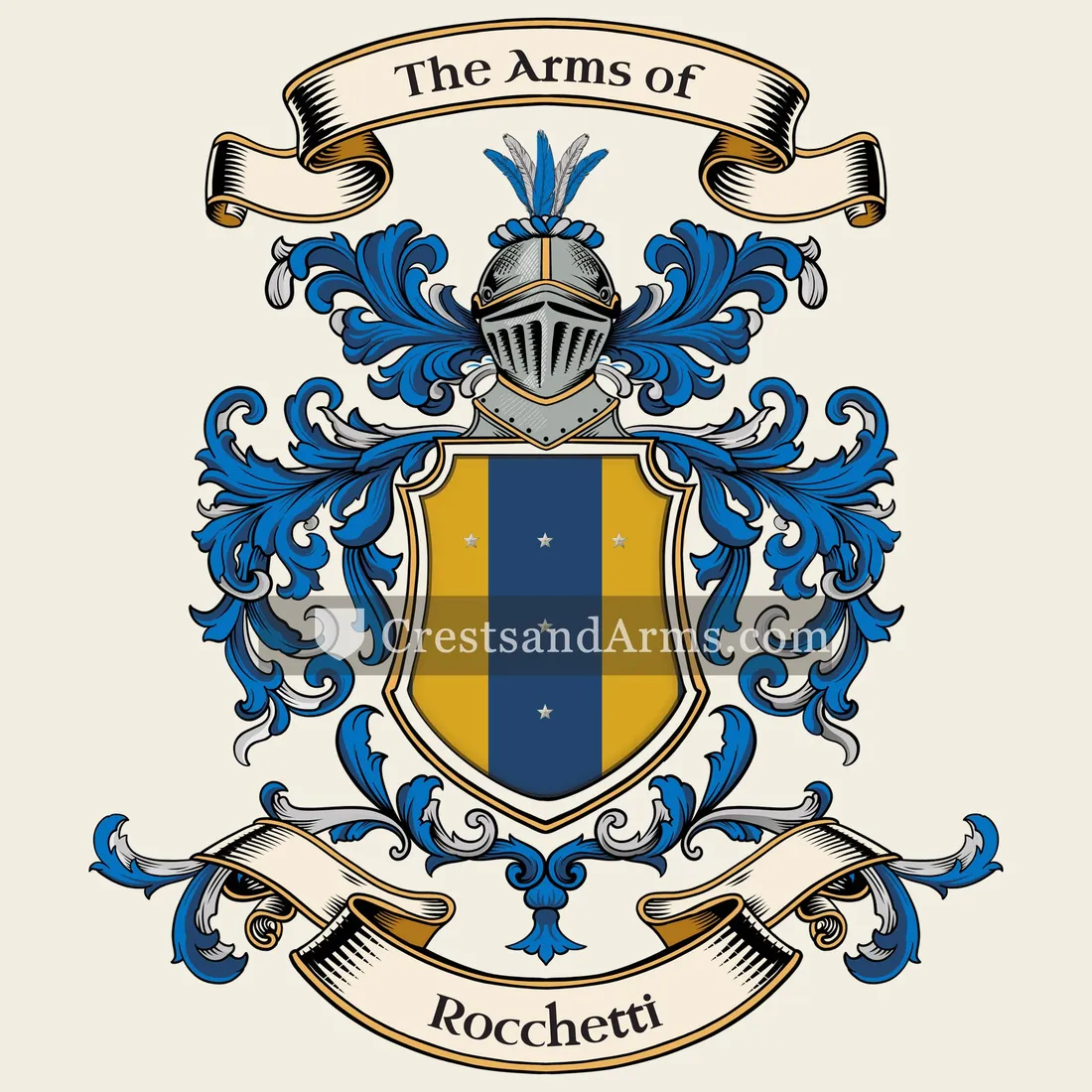
paleMilitary strength, and a fortified defence
mulletThe third son, and a divine quality from above
Colours
Blue (Azure)Means: Loyalty and truth
Gold (Or)Means: Generosity
Silver (Argent)Means: Peace and sincerity
Historical info
Source
J. B. Rietstap, Armorial Général, Gouda: G. B. van Goor Zonen, 1884–87
Blazon (the actual original written record)
“D'azur à cinq étoiles (5) d'arg., 3, 1 et 1, les deux dernières entre deux filets en pals d'or, se réunissant aux flancs par un filet en fasce d'or.”
SwitzerlandGenève, c. 1745
Digital archive packCoat of arms PNG, gold border print PDF, vector SVG and the certificate of authenticity. Sent to your email in minutes.
Map of Switzerland showing where the Rocchetti arms are recorded
The Rocchetti arms were recorded in Genève, c. 1745.
This is where the arms were entered in the register. Families often moved to other parts of the country, so the same name can turn up in more than one region.
The body that granted and recorded arms in Switzerland in this period.
How Arms Worked in Switzerland
In Switzerland, coats of arms were not restricted to the nobility and were often adopted by common citizens and families. These symbols were passed down through generations to show family identity. When branches of a family grew, they often changed small details of the design to distinguish their own line from the original group.
Granting authority
Cantonal and civic authorities managed the use of coats of arms within their specific regions and local jurisdictions.
How they got arms
Families typically assumed their own coats of arms based on local custom rather than receiving them from a central monarch.
Where arms were recorded
Arms were recorded in various cantonal and civic registers starting from the fourteenth century throughout the Swiss region.
The family's standing
Recorded among the armigerous families of Switzerland.
Origin & History of the Rocchetti Family in Switzerland
The Rocchetti family name has deep roots in the history of Geneva, with documented evidence confirming their presence in the city as early as 1745. During the eighteenth century, Geneva was a bustling center of trade and intellectual exchange, attracting families from across the border in Italy who sought new opportunities in a city known for its independence and craft expertise. The name itself is derived from the Italian word for a small rock or a spindle, suggesting that the family may have originally been associated with a specific geographic location or a traditional trade in textiles. As they settled into the social fabric of Geneva, the Rocchetti family became part of the city’s unique blend of Swiss and European influences. By establishing themselves in this region, they participated in the growth of a city that was rapidly becoming a hub for watchmaking and banking. Their presence in the local records from 1745 reflects a period of stability and integration, marking the beginning of a long-standing connection to the Swiss landscape.
Rocchetti Meaning & Related Branches
Root word
Rocca
A rocky crag or a fortified castle structure.
This name
RocchettiDerived from a topographic descriptor for someone living near a rocky outcrop or fortress.
also spelled
Roshet
Documented Sources
J. B. Rietstap, Armorial Général, Gouda: G. B. van Goor Zonen, 1884–87
Archives départementales de l'Isère, Registres paroissiaux de l'état civil, 1663
Borel d'Hauterive, André, Annuaire de la noblesse de France et des maisons souveraines de l'Europe, 1855
Chorier, Nicolas, Histoire générale de Dauphiné, 1661
Digital archive packCoat of arms PNG, gold border print PDF, vector SVG and the certificate of authenticity. Sent to your email in minutes.


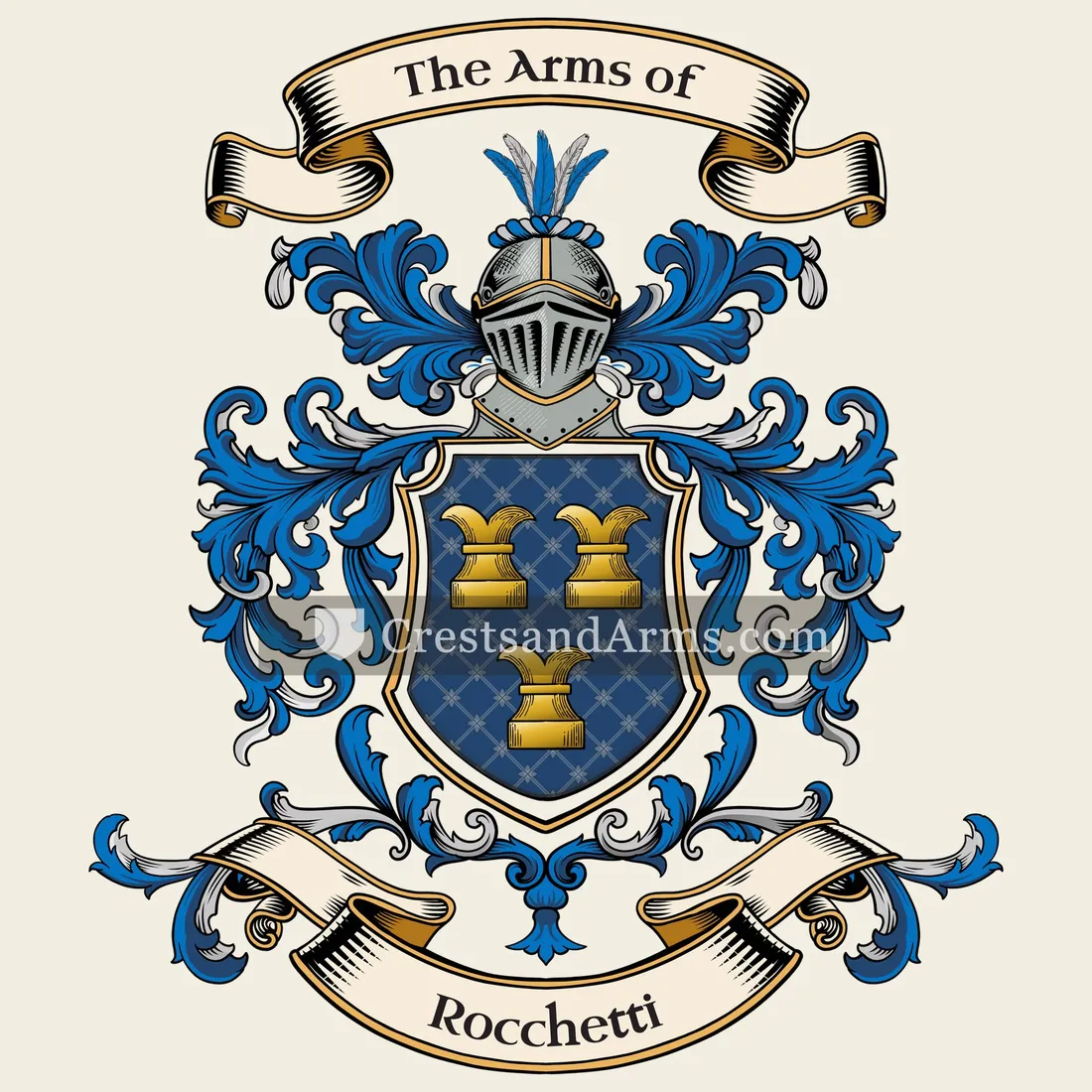
 chess rookStrategy, and the defence of a position
 chess rookStrategy, and the defence of a position


 paleMilitary strength, and a fortified defence
 mulletThe third son, and a divine quality from above