A record of documented arms, meaning and origin, researched for the Rode family lines. Documented in 3 countries.
Reg. 3603 · German, P–S
Meaning of the Rode family crest colors & symbols
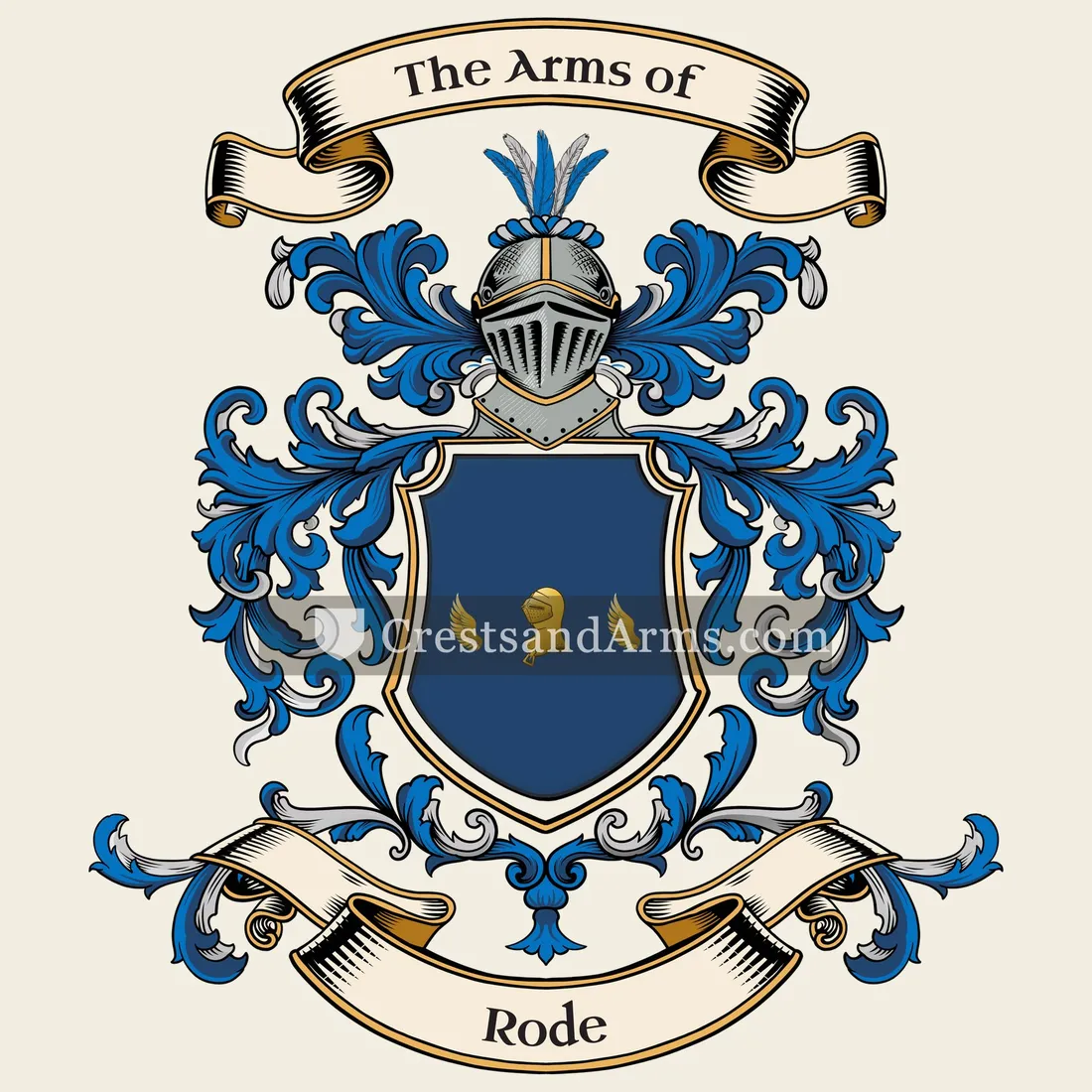
Symbols on this shield
helmetWisdom and security in defence
wingSwiftness, and protection under a raised wing
Colours
Blue (Azure)Means: Loyalty and truth
Gold (Or)Means: Generosity
Historical info
Source
J. B. Rietstap, Armorial Général, Gouda: G. B. van Goor Zonen, 1884–87
Blazon (the actual original written record)
“D'azur à un casque fermé d'or, accosté de deux demi-vols adossés du même. C.: deux prob. fascées d'azur et d'arg. de huit pièces. L. d'arg. et d'azur.”
GermanyBrême, c. 1765
Digital archive packCoat of arms PNG, gold border print PDF, vector SVG and the certificate of authenticity. Sent to your email in minutes.
Map of Germany showing where the Rode arms are recorded
The Rode arms were recorded in Brême, c. 1765.
This is where the arms were entered in the register. Families often moved to other parts of the country, so the same name can turn up in more than one region.
The body that granted and recorded arms in Germany in this period.
Francis I, Holy Roman Emperor
Sovereign of the period
Francis I, Holy Roman Emperor
1745–1765
Reigning in Germany when the Rode arms are first recorded.
How Arms Worked in Germany
In the Holy Roman Empire, coats of arms were often granted to individuals by the Emperor or his representatives. These arms were then passed down through the generations to all legitimate descendants of the original holder. Younger branches of a family usually kept the same shield design without needing to change it, as the arms belonged to the entire lineage.
Granting authority
The Holy Roman Emperor held the sole power to grant new coats of arms throughout his vast imperial territories.
How they got arms
Families typically obtained their coats of arms through a formal imperial grant or by proving their noble status to the authorities.
Where arms were recorded
These grants were officially recorded in the Imperial Chancery registers, which began keeping formal records of such honors during the Middle Ages.
The family's standing
Recorded among the armigerous families of Germany.
Origin & History of the Rode Family in Germany
The surname Rode is deeply rooted in the linguistic history of Northern Germany, where it functioned as a topographic name for families living near a forest clearing. In the Middle Ages, the term "rode" referred to land that had been cleared of trees to make space for farming or settlements. This suggests that the earliest ancestors of the family were likely rural pioneers who helped transform the rugged landscape of the region into productive farmland. By the time the family was documented in Bremen in 1765, they were part of a long-standing tradition of Northern German citizens who had transitioned from agrarian roots into the bustling urban life of a major trading city. This movement reflected a broader trend in German history where families moved from the countryside into growing commercial hubs to participate in the expanding economy of the eighteenth century.
Meaning of the Rode family crest colors & symbols
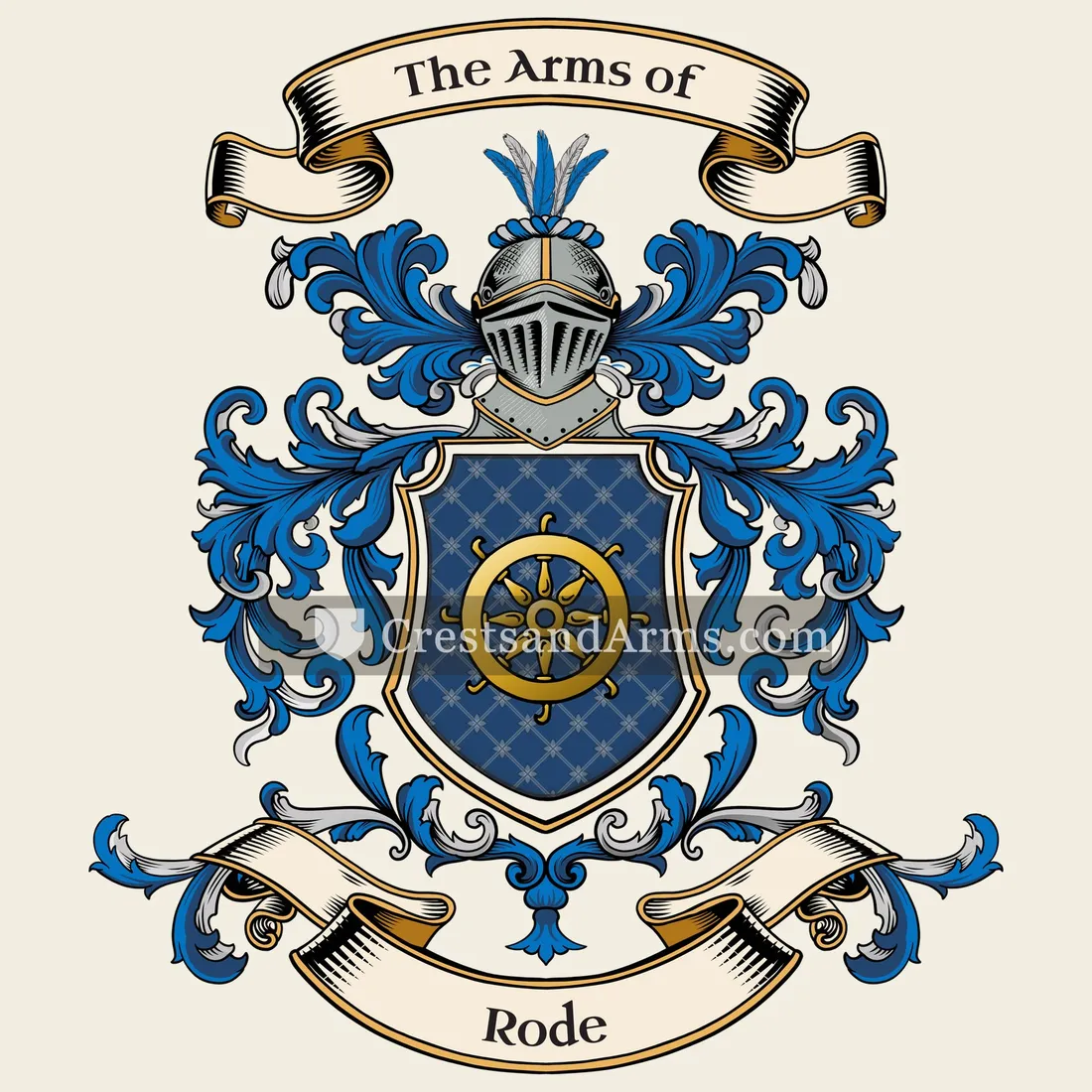
Symbols on this shield
wheelFortune's turning, and the carter's trade
Colours
Blue (Azure)Means: Loyalty and truth
Gold (Or)Means: Generosity
Historical info
Source
J. B. Rietstap, Armorial Général, Gouda: G. B. van Goor Zonen, 1884–87
Blazon (the actual original written record)
“D'azur à une roue d'or.”
RouergueRouergue, c. 1663
Digital archive packCoat of arms PNG, gold border print PDF, vector SVG and the certificate of authenticity. Sent to your email in minutes.
Map of France showing where the Rode arms are recorded
The Rode arms were recorded in Rouergue, c. 1663.
Rouergue was high, stony country in southern France, with more castles than money. Its families were numerous and modest, and even a small holding was enough for a shield of one's own.
This is where the arms were entered in the register. Families often moved to other parts of the country, so the same name can turn up in more than one region.
The body that granted and recorded arms in France in this period.
Louis XIV of France
Sovereign of the period
Louis XIV of France
1643–1715
Reigning in Germany when the Rode arms are first recorded.
How Arms Worked in France
In France, a coat of arms was a mark of honor that passed down through the male line to all legitimate descendants. Families often used the same shield without changes to show their shared heritage. If a branch wanted to stand out, they could add a small mark to their shield to show their specific place in the family tree.
Granting authority
The Juge d'armes de France acted as the official authority that regulated and verified coats of arms across the country.
How they got arms
Families typically inherited their arms from ancestors, though they could also receive them through royal grants or by proving their noble status.
Where arms were recorded
Coats of arms were officially recorded in the Armorial Général de France, which began its main collection in the year 1696.
The family's standing
Recorded among the armigerous families of Rouergue.
Origin & History of the Rode Family in France
The history of the Rode family in France is deeply rooted in the rugged landscape of the Rouergue region. By the year 1663, records confirm that members of the family were well established in this area, which is located in the southern part of the country. The name itself likely originated as a topographical descriptor, often used to identify people who lived near a clearing or a specific type of cultivated land. During the seventeenth century, families in this rural province were typically tied to the rhythms of agriculture and local trade. As the Rode family navigated life in Rouergue, they became part of the social fabric of the region, living through a period of significant transition in French provincial administration. Their presence in these historical documents suggests that they were settled members of the community who contributed to the local economy and culture of the Aveyron area for generations.
Meaning of the Rode family crest colors & symbols
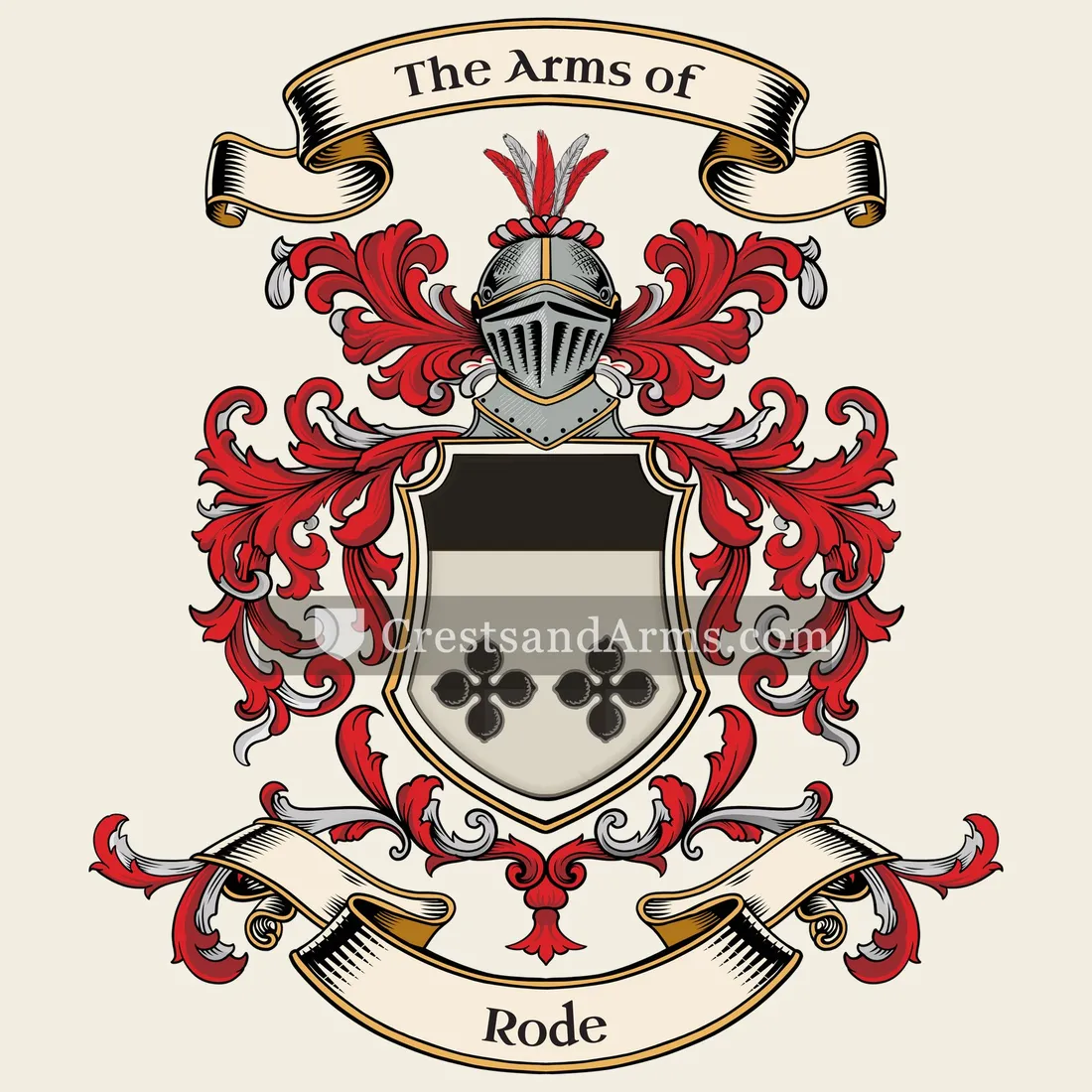
Symbols on this shield
chiefAuthority, wisdom and dominion
plant quatrefoilGood fortune and the fourfold gospel
Colours
Silver (Argent)Means: Peace and sincerity
Black (Sable)Means: Constancy
Historical info
Source
Sir Bernard Burke, The General Armory of England, Scotland, Ireland and Wales, London: Harrison & Sons, 1884
Blazon (the actual original written record)
“Ar. two quatrefoils slipped sa. a chief of the last”
ChesterRode · Chester, c. 1620
Digital archive packCoat of arms PNG, gold border print PDF, vector SVG and the certificate of authenticity. Sent to your email in minutes.
Map of England showing where the Rode arms are recorded
The Rode arms were recorded in Chester, c. 1620.
Cheshire was governed apart from the rest of England for much of its history, with its own courts and its own gentry. That separateness bred a strong local landed class, and landed families carried arms.
This is where the arms were entered in the register. Families often moved to other parts of the country, so the same name can turn up in more than one region.
The body that granted and recorded arms in England in this period.
James VI and I
Sovereign of the period
James VI and I
1603–1625
Reigning in Germany when the Rode arms are first recorded.
How Arms Worked in England
English heraldry allowed arms to be shared by all legitimate descendants of the original owner. These symbols were treated as personal property that moved through the generations to all children. While the eldest son kept the original design, other family members could use the same shield without needing to change it or register their own unique versions.
Granting authority
The College of Arms in London has regulated the use of coats of arms throughout England and Wales since 1484.
How they got arms
Families typically obtained their coats of arms through a formal grant from the Crown or by proving their ancient right to them.
Where arms were recorded
All official coats of arms are recorded in the registers kept at the College of Arms, which date back to the fifteenth century.
The family's standing
Recorded among the armigerous families of Chester.
Origin & History of the Rode Family in England
The surname Rode is rooted in the landscape of medieval England, where it functioned as a topographic name for families living near a forest clearing or a piece of land that had been grubbed up for cultivation. By the early 17th century, the name had established a firm presence in the city of Chester. Records from 1620 confirm that members of the Rode family were active within this historic walled city, which served as a major hub for trade and administration in the northwest. During this period, families in Chester often held roles in local commerce or civic life, benefiting from the city’s status as a gateway to North Wales and a center for regional governance. The survival of the name in these early parish and legal documents reflects the family's integration into the social fabric of Cheshire, marking them as long-standing participants in the local history of the region.
Rode Meaning & Related Branches
Root word
Rod
Old High German term for a forest clearing or piece of land.
This name
RodeA topographic name for someone who lived near a cleared area of woodland.
also spelled
Rodde
Rhode
Road
Roade
Rood
Related arms
Roddevariant spelling
Rohdvariant spelling
Rohdevariant spelling
Roodvariant spelling
Documented Sources
J. B. Rietstap, Armorial Général, Gouda: G. B. van Goor Zonen, 1884–87
Bahlow, Hans, Deutsches Namenlexikon: Familien- und Vornamen nach Ursprung und Sinn erklärt, 1967
Gottschald, Max, Deutsche Namenkunde: Unsere Familiennamen, 1971
Staatsarchiv Bremen, Kirchenbücher der St. Ansgarii-Gemeinde, 1765
Digital archive packCoat of arms PNG, gold border print PDF, vector SVG and the certificate of authenticity. Sent to your email in minutes.


 helmetWisdom and security in defence
 wingSwiftness, and protection under a raised wing
 helmetWisdom and security in defence
 wingSwiftness, and protection under a raised wing


 wheelFortune's turning, and the carter's trade


 chiefAuthority, wisdom and dominion
 plant quatrefoilGood fortune and the fourfold gospel