Map of Belgium showing where the Roelle arms are recorded
The Roelle arms were recorded in Flandre, c. 1663.
Flandre grew rich on cloth, and its towns were among the busiest in Europe. Merchant families bought land with their profits and took arms to go with it, so trade put as many names in the registers here as land did.
This is where the arms were entered in the register. Families often moved to other parts of the country, so the same name can turn up in more than one region.
The body that granted and recorded arms in Belgium in this period.
Philip IV of Spain
Sovereign of the period
Philip IV of Spain
1621–1665
Reigning in Belgium when the Roelle arms are first recorded.
How Arms Worked in Belgium
In Belgium, a coat of arms is considered personal property that is passed down through the male line to legitimate descendants. Families often use the same shield design across generations to show their shared heritage. If a branch of the family wants to change the design, they must apply for an official update to their specific version of the arms.
Granting authority
The Conseil héraldique is the official body that regulates and approves all coats of arms in Belgium.
How they got arms
Families obtain their coats of arms through formal royal grants or by confirming their historical right to use existing designs.
Where arms were recorded
All approved coats of arms are officially recorded in the public registers of the Conseil héraldique since 1844.
The family's standing
Recorded among the armigerous families of Flandre.
Origin & History of the Roelle Family in Belgium
The history of the Roelle family in Belgium is deeply rooted in the cultural landscape of the Flanders region during the seventeenth century. Official records confirm that members of the family were established in this area by 1663, a time when the region was navigating the complex political shifts of the Spanish Netherlands. During this era, families with the name Roelle were often associated with the local agricultural and merchant communities that defined Flemish life. Because the name appears in parish registers and local administrative documents from this period, it suggests that the family was well-integrated into the social fabric of their towns. These early ancestors lived through a time of significant transition, as the region moved between different European powers while maintaining its distinct linguistic and cultural identity. By remaining in Flanders, the Roelle family contributed to the long-standing traditions of the region, leaving behind a legacy that is preserved in the historical archives of Belgian municipalities.
Coat of Arms & Family Crest Details
Symbols on this shield
mountThe ground held, and steadfastness upon it
fessThe military belt, and readiness to serve
wheelFortune's turning, and the carter's trade
Colours
Blue (Azure)Means: Loyalty and truth
Silver (Argent)Means: Peace and sincerity
Gold (Or)Means: Generosity
Historical info
Source
J. B. Rietstap, Armorial Général, Gouda: G. B. van Goor Zonen, 1884–87
Blazon (the actual original written record)
“D'azur à un mont de quatre coupeaux d'arg., surm. d'une roue de huit rayons d'or. C.: la roue. - Armes mod.: Ec.: aux 1 et 4 d'azur au lion d'or, celui du 1 cont.; aux 2 et 3 de gu. à la fasce d'arg., acc. en chef d'une roue d'or et en p. d'un coeur d'arg. Cq. cour. C.: un lion iss. d'or, tenant entre ses pattes une roue du même. L.: à dextre d'or et d'azur, à sen. d'arg. et de gu.”
SwitzerlandGenève, c. 1745
Digital archive packCoat of arms PNG, gold border print PDF, vector SVG and the certificate of authenticity. Sent to your email in minutes.
Map of Switzerland showing where the Roelle arms are recorded
The Roelle arms were recorded in Genève, c. 1745.
This is where the arms were entered in the register. Families often moved to other parts of the country, so the same name can turn up in more than one region.
The body that granted and recorded arms in Switzerland in this period.
How Arms Worked in Switzerland
In Switzerland, coats of arms were not restricted to the nobility and were often adopted by common citizens and families. These symbols were passed down through generations to show family identity. When branches of a family grew, they often changed small details of the design to distinguish their own line from the original group.
Granting authority
Cantonal and civic authorities managed the use of coats of arms within their specific regions and local jurisdictions.
How they got arms
Families typically assumed their own coats of arms based on local custom rather than receiving them from a central monarch.
Where arms were recorded
Arms were recorded in various cantonal and civic registers starting from the fourteenth century throughout the Swiss region.
The family's standing
Recorded among the armigerous families of Switzerland.
Origin & History of the Roelle Family in Switzerland
The family name Roelle carries a deep connection to the history of Geneva, where records confirm members of the family were established by 1745. During this period, Geneva was a thriving center of trade and intellectual growth, and families like the Roelles were often integrated into the city’s unique social structure as citizens or residents. The name itself likely evolved from regional dialects common in the French-speaking parts of Switzerland, where surnames were often adapted from nicknames or descriptions of a person's trade. As the family settled into the urban environment of Geneva, they became part of the city's long tradition of craftsmanship and civic participation. Their presence in the mid-18th century suggests they were part of the steady population growth that defined Geneva as it transitioned into the modern era. By maintaining their roots in this influential city, the early Roelle family helped shape the local heritage that continues to define the region today.
Coat of Arms & Family Crest Details
Symbols on this shield
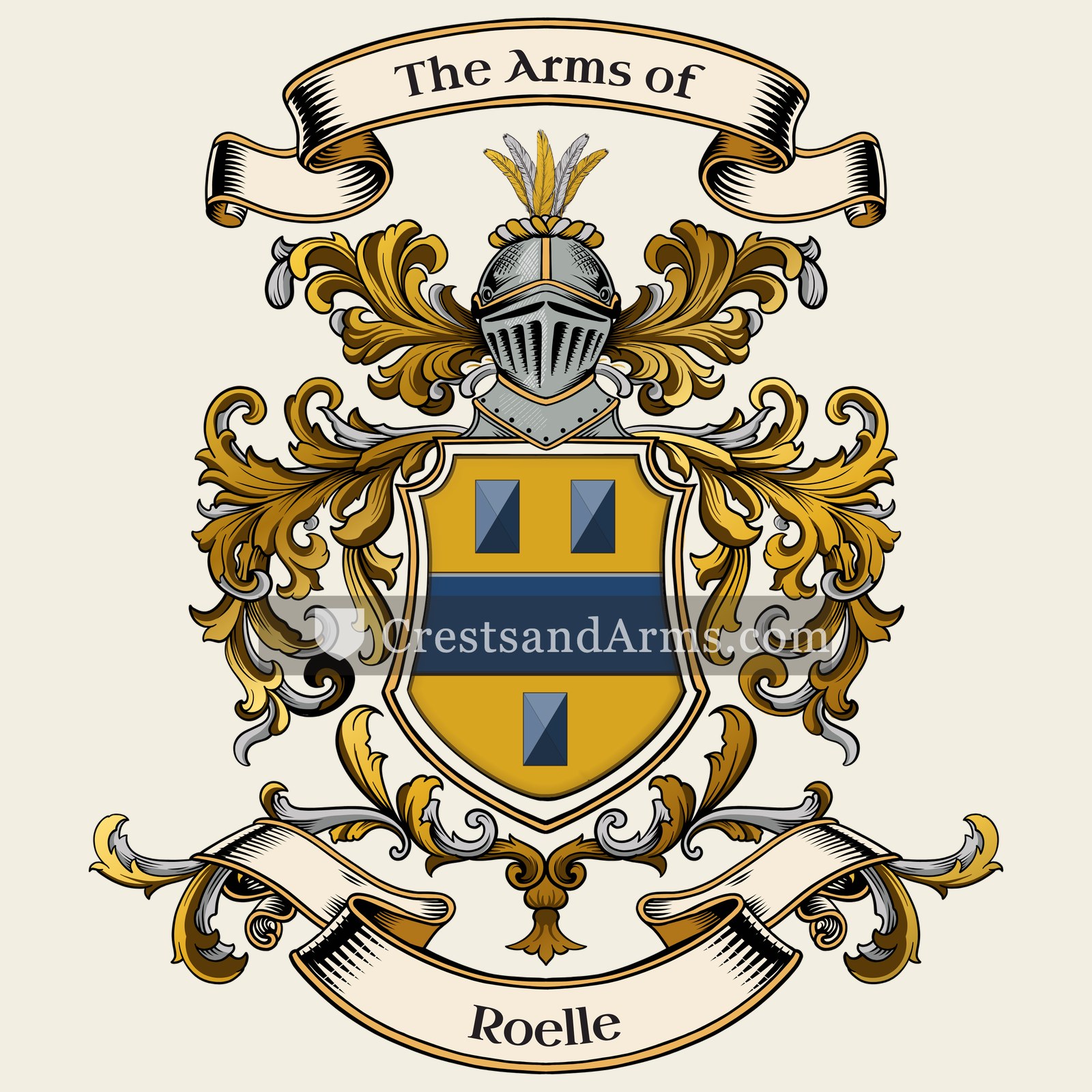
fessThe military belt, and readiness to serve
billetThe sealed letter, and a message delivered
Colours
Gold (Or)Means: Generosity
Blue (Azure)Means: Loyalty and truth
Historical info
Source
Sir Bernard Burke, The General Armory of England, Scotland, Ireland and Wales, London: Harrison & Sons, 1884
Blazon (the actual original written record)
“Or, on a fess dancettée betw. three billets az. each charged with a lion ramp. of the field, as many bezants”
DevonStevenston · Devon, c. 1540
Digital archive packCoat of arms PNG, gold border print PDF, vector SVG and the certificate of authenticity. Sent to your email in minutes.
Map of England showing where the Roelle arms are recorded
The Roelle arms were recorded in Devon, c. 1540.
Devon was a county of small manors and seafaring families. Its gentry were spread thickly across the countryside, and money made at sea often bought an estate, which in turn brought a coat of arms.
This is where the arms were entered in the register. Families often moved to other parts of the country, so the same name can turn up in more than one region.
The body that granted and recorded arms in England in this period.
Henry VIII of England
Sovereign of the period
Henry VIII of England
1509–1547
Reigning in Belgium when the Roelle arms are first recorded.
How Arms Worked in England
English heraldry allowed arms to be shared by all legitimate descendants of the original owner. These symbols were treated as personal property that moved through the generations to all children. While the eldest son kept the original design, other family members could use the same shield without needing to change it or register their own unique versions.
Granting authority
The College of Arms in London has regulated the use of coats of arms throughout England and Wales since 1484.
How they got arms
Families typically obtained their coats of arms through a formal grant from the Crown or by proving their ancient right to them.
Where arms were recorded
All official coats of arms are recorded in the registers kept at the College of Arms, which date back to the fifteenth century.
The family's standing
Recorded among the armigerous families of Devon.
Origin & History of the Roelle Family in England
The history of the Roelle family in England is rooted in the rural landscapes of Devon, where records confirm their presence as early as 1540. During the sixteenth century, the name likely emerged as a localized variation of names derived from the Old French or Germanic roots associated with the name Roland or Roul. Families in this region were typically tied to the land, working as tenant farmers or tradespeople within the small parish communities that defined Devon life during the Tudor period. Because surnames were still becoming standardized at this time, the spelling of Roelle likely shifted depending on how a local clerk recorded the name in parish registers. These early ancestors lived through a time of significant religious and social change in England, and their survival in the historical record suggests they were established members of their local villages. By remaining in the West Country for generations, the Roelle family became part of the long-standing agricultural tradition that shaped the identity of Devon for centuries.
Related Branches & Arms
Root word
Roland
Derived from Germanic elements meaning famous land or renowned in the land.
This name
RoelleA diminutive form of the name Roland, often used as a patronymic surname.
also spelled
Roll
Rollee
Role
Rol
Rowle
Documented Sources
J. B. Rietstap, Armorial Général, Gouda: G. B. van Goor Zonen, 1884–87
State Archives in Belgium (Rijksarchief te Gent), Parochieregisters van het Bisdom Gent
De Smet, J., Geschiedenis van Vlaanderen, 1952
Pirenne, H., Histoire de Belgique, 1900
Digital archive packCoat of arms PNG, gold border print PDF, vector SVG and the certificate of authenticity. Sent to your email in minutes.


 cross symbolChristian faith and service
 cantonA mark of honour granted by the sovereign
 cross symbolChristian faith and service
 cantonA mark of honour granted by the sovereign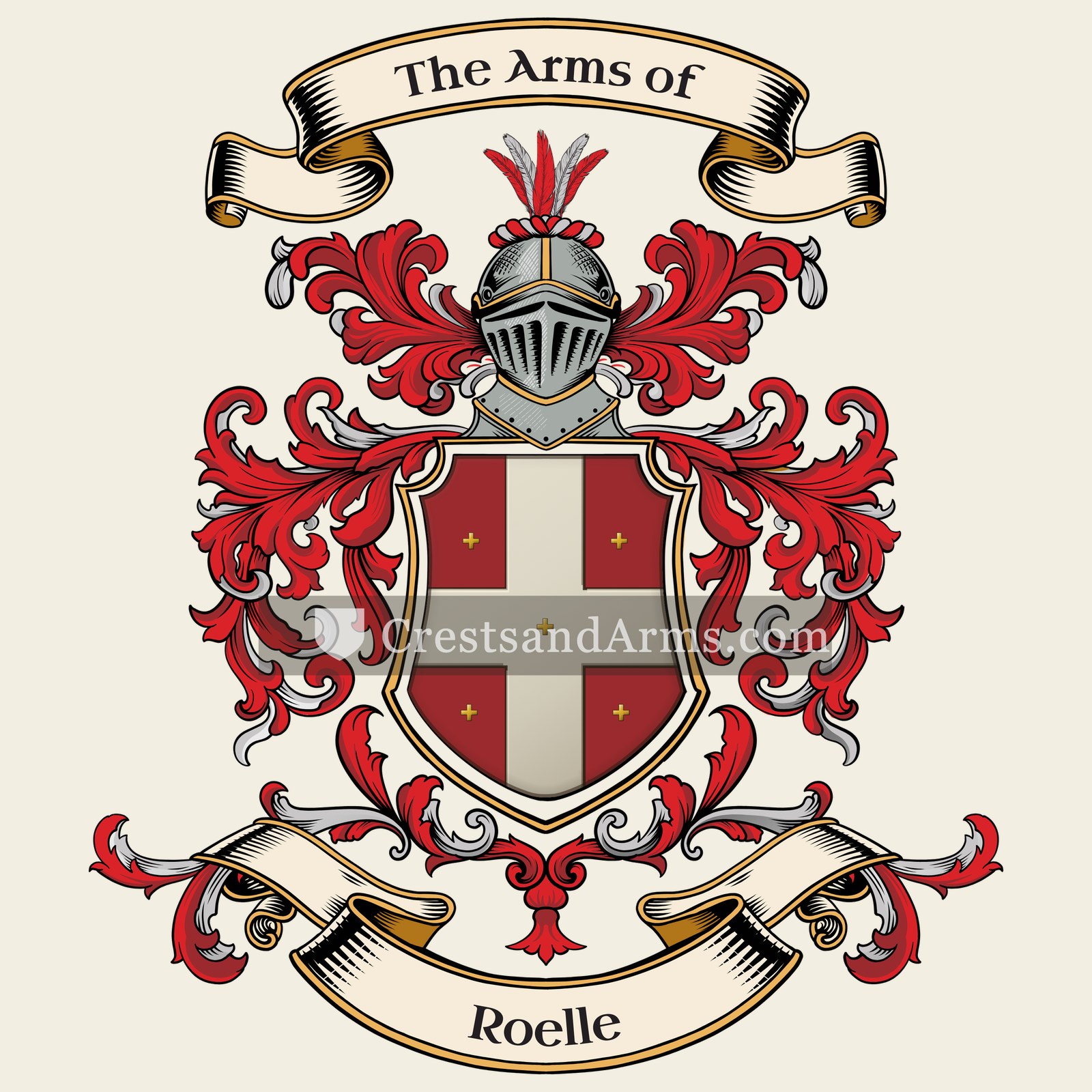


 mountThe ground held, and steadfastness upon it
 fessThe military belt, and readiness to serve
 wheelFortune's turning, and the carter's trade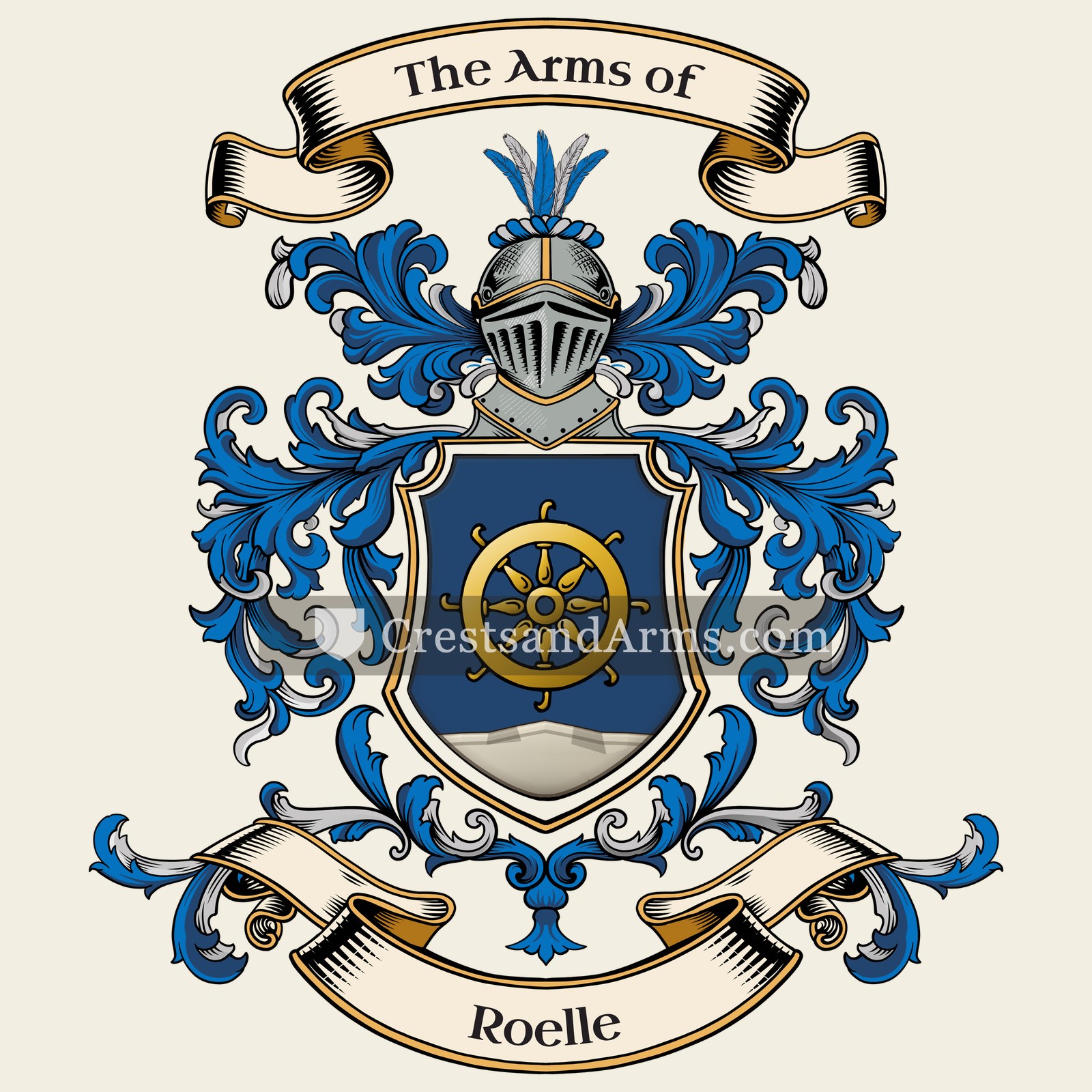

 billetThe sealed letter, and a message delivered