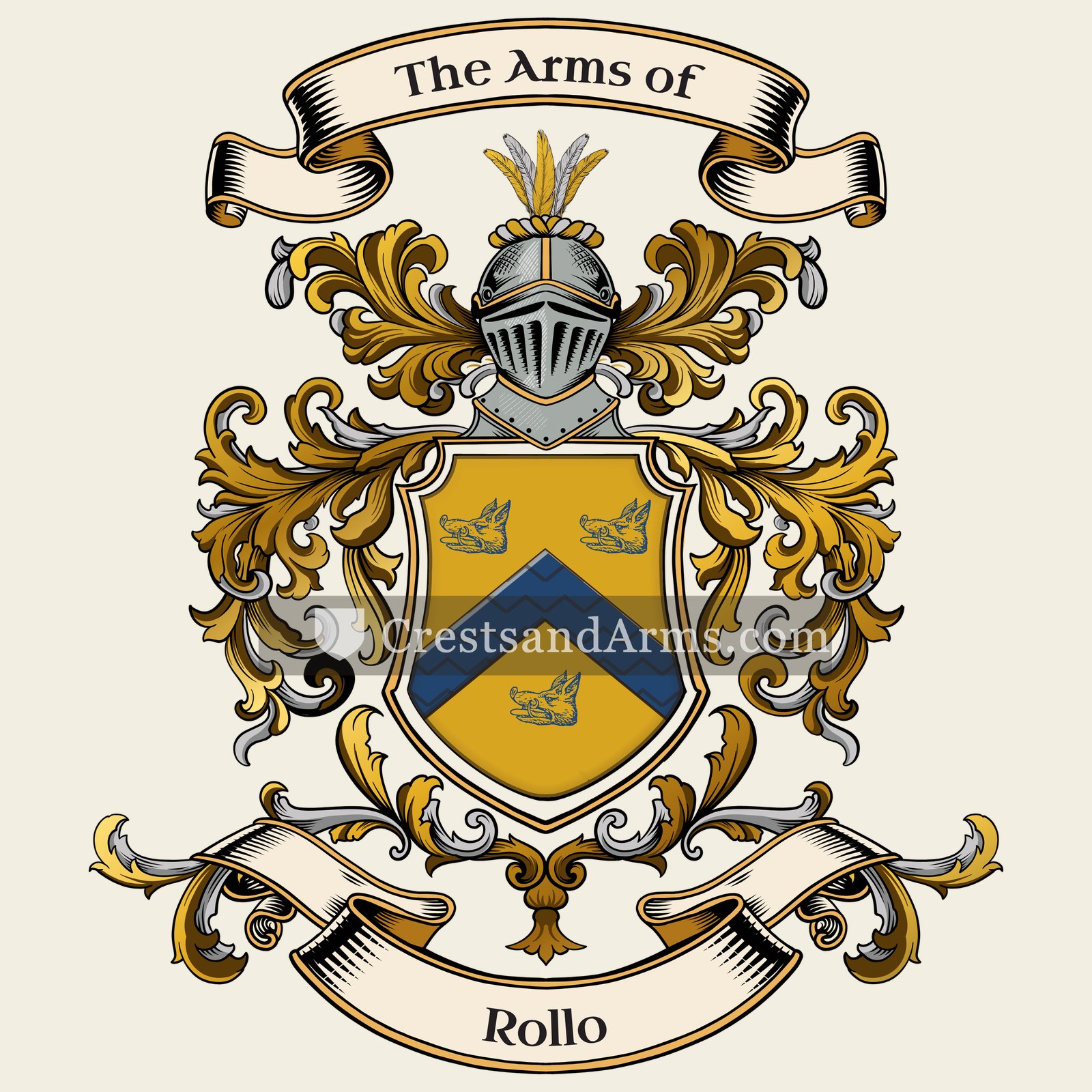
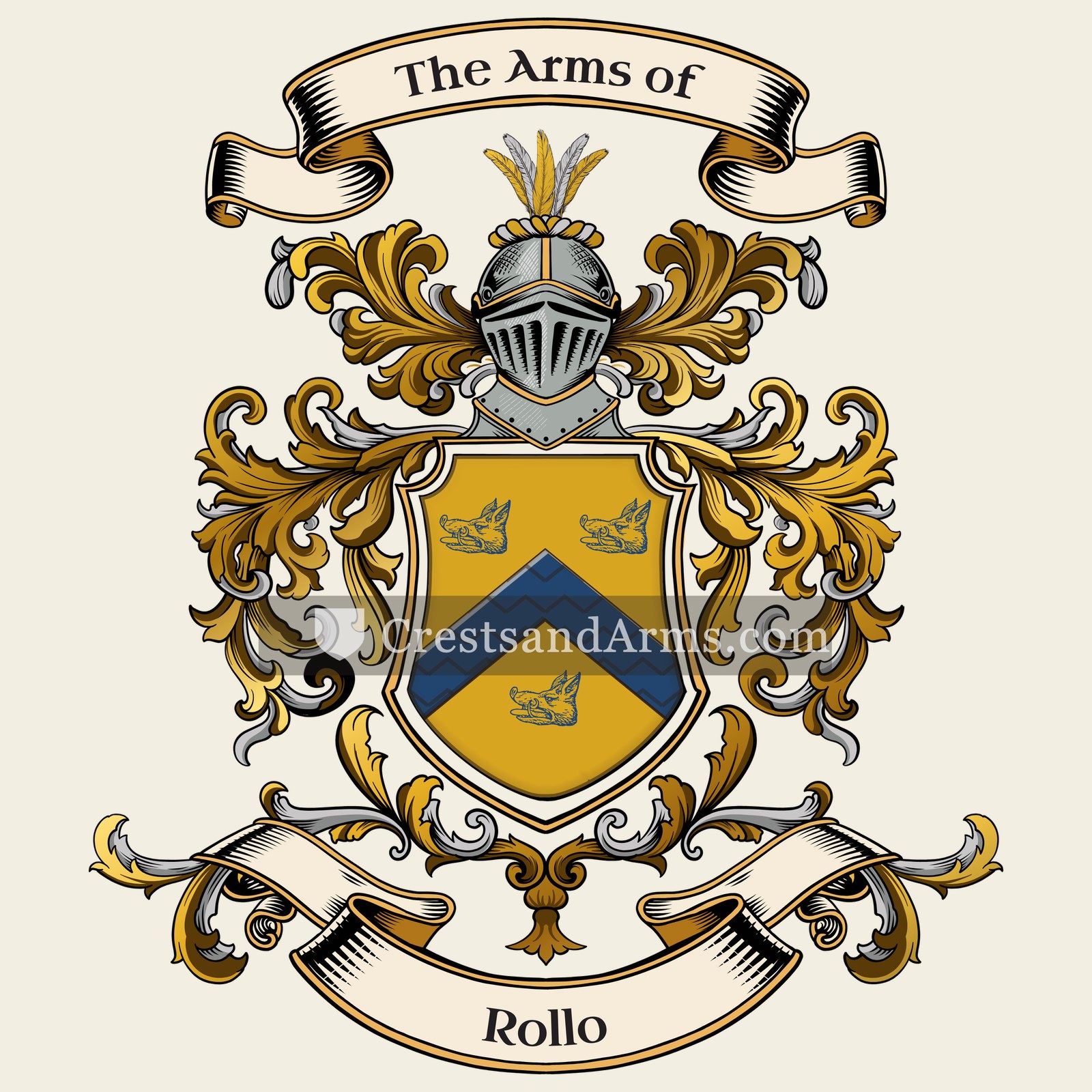
A record of documented arms, meaning and origin, researched for the Rollo family lines. Documented in 2 countries.
Reg. 5907 · French, P–S
Coat of Arms & Family Crest Details
Symbols on this shield
chevronProtection, and faithful service completed
boars headA fierce fighter who battles to the end
Colours
Gold (Or)Means: Generosity
Blue (Azure)Means: Loyalty and truth
Historical info
Source
J. B. Rietstap, Armorial Général, Gouda: G. B. van Goor Zonen, 1884–87
Blazon (the actual original written record)
“D'or au chev. d'azur, acc. de trois hures de sanglier du même. C.: une tête et col de cerf au nat. S.: deux cerfs au nat. D.: LA FORTUNE PASSE PARTOUT.”
Francec. 1651
Digital archive packCoat of arms PNG, gold border print PDF, vector SVG and the certificate of authenticity. Sent to your email in minutes.
Map of France showing where the Rollo arms are recorded
The Rollo arms were recorded in France, c. 1651.
Arms such as these were typically recorded in Bretagne.
More families held coats of arms in Bretagne than anywhere else in France. The land was divided into many small estates rather than a few large ones, so far more households counted as gentry, and each needed a shield of its own to be told apart.
This is where the arms were entered in the register. Families often moved to other parts of the country, so the same name can turn up in more than one region.
The body that granted and recorded arms in France in this period.
Louis XIV of France
Sovereign of the period
Louis XIV of France
1643–1715
Reigning in France when the Rollo arms are first recorded.
How Arms Worked in France
In France, a coat of arms was a mark of honor that passed down through the male line to all legitimate descendants. Families often used the same shield without changes to show their shared heritage. If a branch wanted to stand out, they could add a small mark to their shield to show their specific place in the family tree.
Granting authority
The Juge d'armes de France acted as the official authority that regulated and verified coats of arms across the country.
How they got arms
Families typically inherited their arms from ancestors, though they could also receive them through royal grants or by proving their noble status.
Where arms were recorded
Coats of arms were officially recorded in the Armorial Général de France, which began its main collection in the year 1696.
The family's standing
Recorded among the armigerous families of France.
Origin & History of the Rollo Family in France
The surname Rollo finds its roots in the ancient Germanic name Hrolf, which signifies a famous wolf. This name gained significant prominence in France during the Middle Ages, largely due to the influence of the Norse leader Rollo, who became the first ruler of Normandy in the early tenth century. Over the following centuries, the name evolved and spread across various French provinces as families adopted it as a hereditary surname. By the middle of the seventeenth century, records confirm that members of the Rollo family were well established in the region of Bretagne. These early families were often integrated into the local social fabric, living as farmers, tradespeople, or minor officials within the rural communities of western France. Their presence in Bretagne by 1651 reflects the broader movement of families across the French landscape during a time of significant social and agricultural development.
Coat of Arms & Family Crest Details
Symbols on this shield
chevronProtection, and faithful service completed
boars headA fierce fighter who battles to the end
Colours
Gold (Or)Means: Generosity
Blue (Azure)Means: Loyalty and truth
Historical info
Source
Sir Bernard Burke, The General Armory of England, Scotland, Ireland and Wales, London: Harrison & Sons, 1884
Blazon (the actual original written record)
“Or, a chev. betw. three boars' heads erased az”
PerthDuncrub · Perth, c. 1748
Digital archive packCoat of arms PNG, gold border print PDF, vector SVG and the certificate of authenticity. Sent to your email in minutes.
Map of Scotland showing where the Rollo arms are recorded
The Rollo arms were recorded in Perth, c. 1748.
Perth sat where the Highlands meet the Lowlands, and its families held land on both sides of that line. Estates passed down whole for centuries, and unbroken tenure is what puts a name in the register.
This is where the arms were entered in the register. Families often moved to other parts of the country, so the same name can turn up in more than one region.
The body that granted and recorded arms in Scotland in this period.
George II of Great Britain
Sovereign of the period
George II of Great Britain
1727–1760
Reigning in France when the Rollo arms are first recorded.
How Arms Worked in Scotland
Scottish heraldry is unique because it treats a coat of arms as a piece of personal property protected by law. Only one person can own a specific design at any given time. When a family grows, the head keeps the original shield while other relatives must apply for their own distinct version with slight changes to prove their specific identity.
Granting authority
The Court of the Lord Lyon acts as the official body that regulates and controls all heraldic matters throughout Scotland.
How they got arms
Individuals obtain a legal right to their arms through a formal petition process that confirms their identity and family connection.
Where arms were recorded
All valid coats of arms are officially entered into the Public Register of All Arms and Bearings starting from 1672.
The family's standing
Recorded among the armigerous families of Perth.
Origin & History of the Rollo Family in Scotland
The name Rollo has deep roots in Scotland, where it is often associated with the ancient Norse name Hrolf. While the family established a strong presence in the Perth area by the mid-eighteenth century, their history in the region stretches back much further to the medieval period. Early members of the family were granted lands in Perthshire, specifically around Duncrub, which became the long-standing seat of the family line. These early figures were often involved in local governance and land management, helping to shape the social landscape of the Scottish Lowlands. By the time the family records become more detailed in the 1700s, they were already well-integrated into the local community as established landowners and respected citizens. This transition from early landholders to the prominent figures seen in 1748 reflects the steady growth and influence of the family over several centuries in Scotland.
Related Branches & Arms
Root word
Hrolfr
Old Norse name meaning wolf or renowned wolf.
This name
RolloA French surname derived from the Germanic name meaning famous wolf.
also spelled
Rolo
Rollow
Rollowe
Related arms
Chenu de Thuetsimilar arms
Gaspardsimilar arms
Genevièressimilar arms
Hunésimilar arms
Documented Sources
J. B. Rietstap, Armorial Général, Gouda: G. B. van Goor Zonen, 1884–87
Dauzat, Albert. Dictionnaire étymologique des noms et prénoms de France. 1951
Morlet, Marie-Thérèse. Dictionnaire étymologique des noms de famille. 1991
Archives départementales d'Ille-et-Vilaine. Registres paroissiaux et d'état civil de Bretagne. 1651
Digital archive packCoat of arms PNG, gold border print PDF, vector SVG and the certificate of authenticity. Sent to your email in minutes.


 chevronProtection, and faithful service completed
 boars headA fierce fighter who battles to the end
 chevronProtection, and faithful service completed
 boars headA fierce fighter who battles to the end