Map of Netherlands showing where the Rom arms are recorded
The Rom arms were recorded in Netherlands, c. 1815.
Arms such as these were typically recorded in Friesland.
Friesland was low, wet country on the northern coast of the Netherlands, farmed by families who had held the same land for centuries. Free landholders were unusually common there, and a free landholder could carry arms.
This is where the arms were entered in the register. Families often moved to other parts of the country, so the same name can turn up in more than one region.
Region
Friesland
First recorded
1815
Granting Authority for the Rom Arms
Hoge Raad van Adel
Photograph made by me · CC BY-SA 3.0
The body that granted and recorded arms in Netherlands in this period.
William I of the Netherlands
Sovereign of the period
William I of the Netherlands
1815–1840
Reigning in Netherlands when the Rom arms are first recorded.
How Arms Worked in Netherlands
In the Netherlands, coats of arms were often used by noble families and those who held specific public offices. These arms were passed down through the generations to legitimate descendants. Younger branches of a family usually kept the original design without needing to add special marks. This system ensured that the family identity remained clear and consistent over many years.
Granting authority
The Hoge Raad van Adel is the official body that regulates and manages noble titles and coats of arms in the Netherlands.
How they got arms
Families typically obtained their coats of arms through official royal grants or by proving their long-standing historical use of the symbols.
Where arms were recorded
Coats of arms are officially recorded in the registers held by the Hoge Raad van Adel, which began its work in 1814.
The family's standing
Recorded among the armigerous families of Netherlands.
Origin & History of the Rom Family in Netherlands
The family name Rom has deep roots in the northern province of Friesland, where records confirm members of the family were living by 1815. During this era, the Netherlands underwent significant changes in how citizens registered their identities. In 1811, Napoleon Bonaparte ordered all Dutch citizens to adopt formal, permanent surnames to improve tax collection and military conscription. Before this mandate, many people in rural Friesland used patronymic naming systems, where a child’s last name was simply based on their father’s first name. The emergence of Rom as a fixed surname suggests that the family likely chose or solidified this name during this period of administrative reform. The name itself may have evolved from local Frisian dialects or shortened versions of older Germanic personal names common in the region. By settling into a permanent surname, the family became part of the modern bureaucratic structure that defined Dutch society throughout the nineteenth century.
Meaning of the Rom family crest colors & symbols
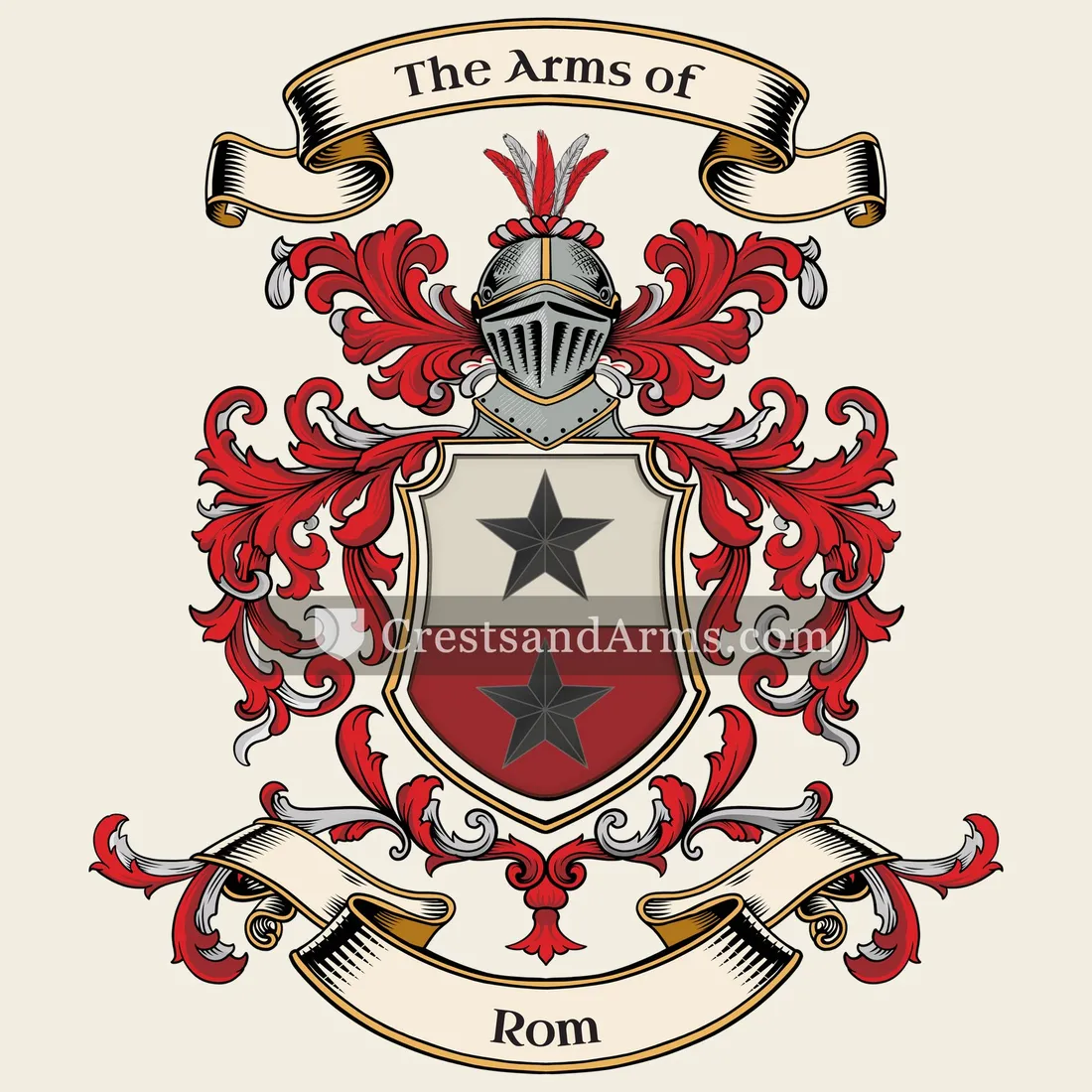
Symbols on this shield
mulletThe third son, and a divine quality from above
Colours
Silver (Argent)Means: Peace and sincerity
Red (Gules)Means: Military strength
Historical info
Source
J. B. Rietstap, Armorial Général, Gouda: G. B. van Goor Zonen, 1884–87
Blazon (the actual original written record)
“Coupé d'arg. sur gu.; à deux étoiles, de l'un à l'autre. C.: un vol à l'antique, aux armes de l'écu.”
BavariaBavaria, c. 1765
Digital archive packCoat of arms PNG, gold border print PDF, vector SVG and the certificate of authenticity. Sent to your email in minutes.
Map of Germany showing where the Rom arms are recorded
The Rom arms were recorded in Bavaria, c. 1765.
Bavaria was a country of old landed families and walled market towns. Estates passed down the same line for centuries, and both the landowners and the leading townsmen kept arms, which is why so many Bavarian names sit in the registers.
This is where the arms were entered in the register. Families often moved to other parts of the country, so the same name can turn up in more than one region.
The body that granted and recorded arms in Germany in this period.
Francis I, Holy Roman Emperor
Sovereign of the period
Francis I, Holy Roman Emperor
1745–1765
Reigning in Netherlands when the Rom arms are first recorded.
How Arms Worked in Germany
In the Holy Roman Empire, coats of arms were often granted to individuals by the Emperor or his representatives. These arms were then passed down through the generations to all legitimate descendants of the original holder. Younger branches of a family usually kept the same shield design without needing to change it, as the arms belonged to the entire lineage.
Granting authority
The Holy Roman Emperor held the sole power to grant new coats of arms throughout his vast imperial territories.
How they got arms
Families typically obtained their coats of arms through a formal imperial grant or by proving their noble status to the authorities.
Where arms were recorded
These grants were officially recorded in the Imperial Chancery registers, which began keeping formal records of such honors during the Middle Ages.
The family's standing
Recorded among the armigerous families of Bavaria.
Origin & History of the Rom Family in Germany
The family name Rom has deep roots in the southern German region of Bavaria, where records confirm the family was established by at least 1765. During this period, the name was often associated with individuals living in rural or semi-rural communities where surnames were becoming more fixed as a way to track tax payments and church registrations. Because Bavaria was a collection of smaller territories and principalities at the time, families like the Rom line were often deeply tied to the local agricultural economy or regional trade guilds. The name itself is thought to be a topographic or locational identifier, potentially referring to individuals who traveled or maintained connections to specific paths or settlements. By the mid-18th century, the family was part of the steady social fabric of the region, participating in the parish life that defined daily existence in the Holy Roman Empire. These early ancestors were likely craftsmen or landholders who helped shape the local culture of their village before the major political shifts of the 19th century transformed the German landscape.
Rom Meaning & Related Branches
Root word
Romanus
Latin term meaning a citizen of Rome or from Rome.
This name
RomA locative surname denoting an individual who originated from Rome or Italy.
also spelled
Rohm
Rome
Romm
Related arms
Gerlachrecorded with Rom, same area
Documented Sources
J. B. Rietstap, Armorial Général, Gouda: G. B. van Goor Zonen, 1884–87
Meertens, P.J., De betekenis van de Nederlandse familienamen, 1957
Van der Schaar, J., Woordenboek van voornamen, 1964
Tresoar (Fries Historisch en Letterkundig Centrum), Burgerlijke Stand Friesland
Nationaal Archief, Registers van de Burgerlijke Stand
Digital archive packCoat of arms PNG, gold border print PDF, vector SVG and the certificate of authenticity. Sent to your email in minutes.


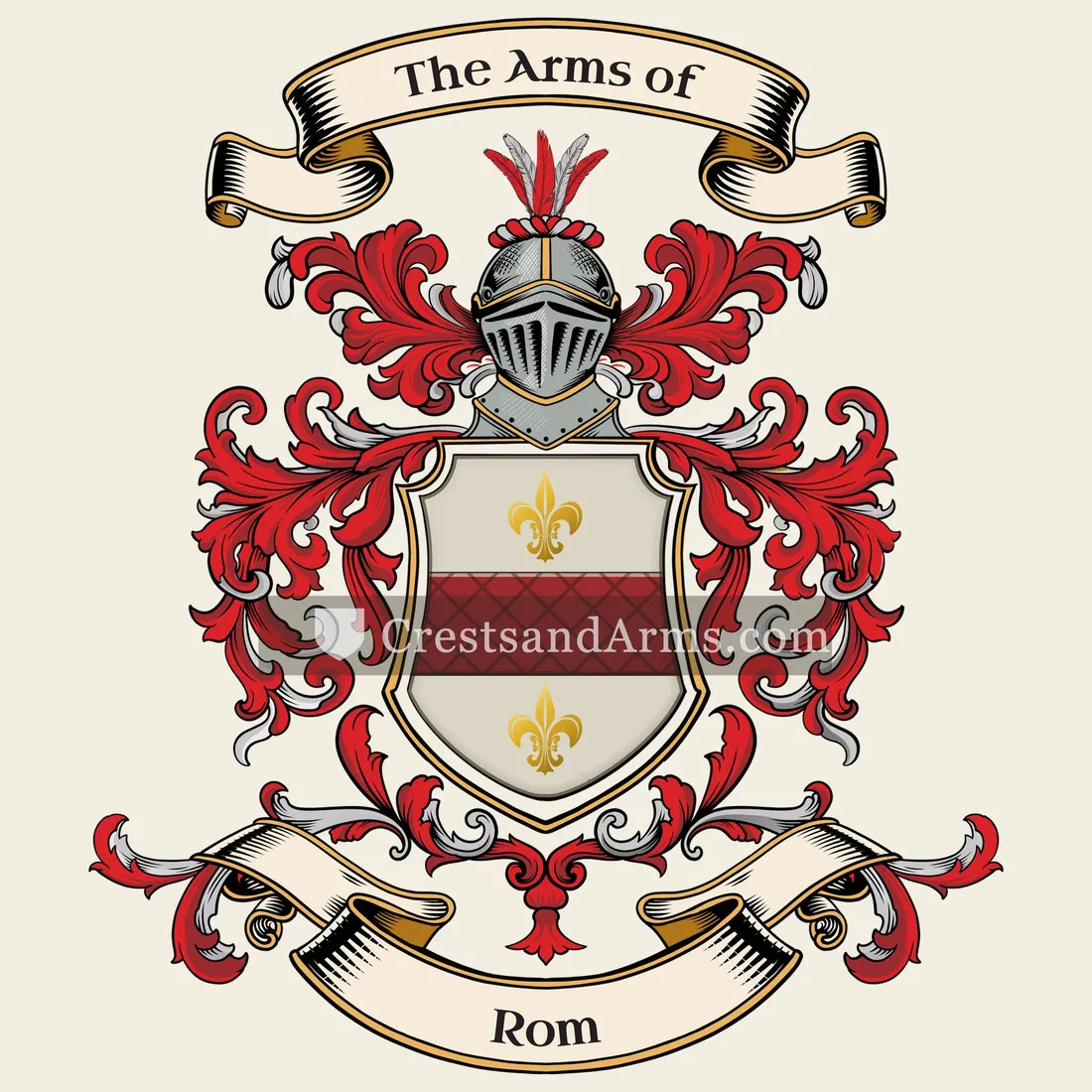
 fessThe military belt, and readiness to serve
 fleur de lisPurity, light, and the sixth son
 fessThe military belt, and readiness to serve
 fleur de lisPurity, light, and the sixth son


 mulletThe third son, and a divine quality from above