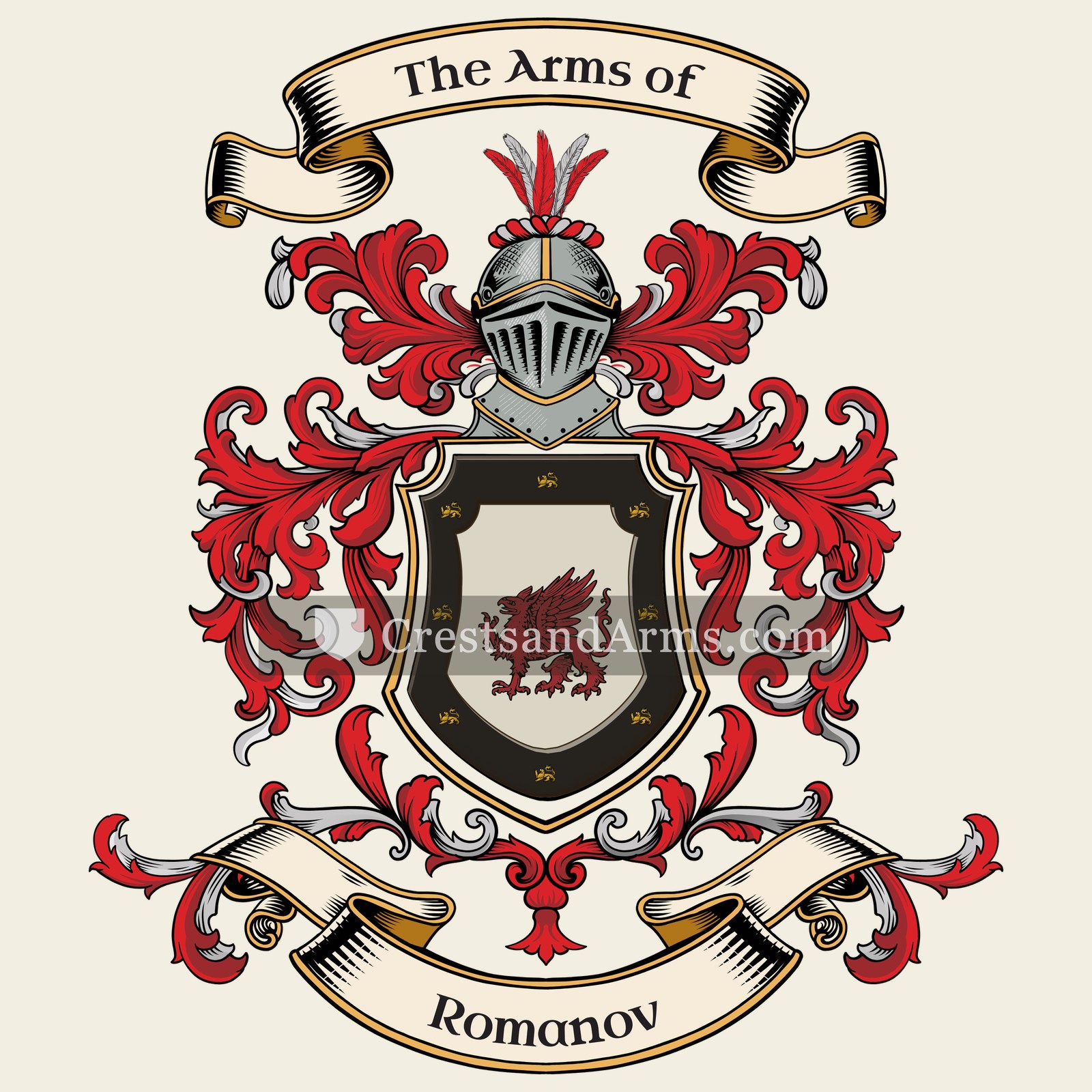
A record of documented arms, meaning and origin, researched for the Romanov family of Russia.
Reg. 4053 · Russian, P–S
Coat of Arms & Family Crest Details
Symbols on this shield
griffinValour and vigilance, guarding great treasure
lionCourage, strength and royalty
Colours
Silver (Argent)Means: Peace and sincerity
Black (Sable)Means: Constancy
Red (Gules)Means: Military strength
Gold (Or)Means: Generosity
Historical info
Source
J. B. Rietstap, Armorial Général, Gouda: G. B. van Goor Zonen, 1884–87
Blazon (the actual original written record)
“D'arg. à un griffon de gu., tenant de sa patte dextre une épée d'or, et de sa sen. un bouclier ovale du même ch. d'une aigle de sa.; à la bord. de sa., ch. de huit têtes de lion arr., quatre d'or et quatre d'arg., allumées et lamp. de gu.”
Russiac. 1784
Digital archive packCoat of arms PNG, gold border print PDF, vector SVG and the certificate of authenticity. Sent to your email in minutes.
Map of Russia showing where the Romanov arms are recorded
The Romanov arms were recorded in Russia, c. 1784.
Arms such as these were typically recorded in Moscow.
Moscow held the Russian court, and rank there came from service rather than land. Families who served the Tsar were entered in the registers of nobility, and that entry is where their arms are recorded.
This is where the arms were entered in the register. Families often moved to other parts of the country, so the same name can turn up in more than one region.
The body that granted and recorded arms in Russia in this period.
Catherine II of Russia
Sovereign of the period
Catherine II of Russia
1762–1796
Reigning in Russia when the Romanov arms are first recorded.
How Arms Worked in Russia
Russian heraldry was strictly tied to the nobility and the state service system. Families proved their ancient status or earned new rank to receive an official grant from the Tsar. These symbols were then inherited by all legitimate children of the noble line. If a family lacked proof of their status, they were often excluded from the official records entirely.
Granting authority
The Herald Master's Office acted as the central state body that strictly regulated and verified all noble heraldic symbols.
How they got arms
Families typically received their arms through a formal state grant or by proving their noble status to the government authorities.
Where arms were recorded
All approved coats of arms were officially recorded in the General Armorial of the Noble Families of the Russian Empire starting in 1797.
The family's standing
Recorded among the armigerous families of Russia.
Origin & History of the Romanov Family in Russia
The Romanov family name originated from a boyar named Roman Yuryevich Zakharin-Yuryev, who served the Grand Prince of Moscow during the sixteenth century. His daughter, Anastasia Romanovna, became the first wife of Ivan the Terrible, which helped elevate the family’s status within the Russian nobility. Following the death of the last tsar from the Rurik dynasty, the Russian people elected Anastasia’s grand-nephew, Mikhail Romanov, to the throne in 1613. This transition established the Romanovs as the ruling house of Russia for over three hundred years. By the late eighteenth century, the family had firmly solidified its influence across the region, maintaining a significant presence in Moscow by 1784 as they continued to manage the vast affairs of the Russian Empire.
Related Branches & Arms
Root word
Romanus
A Latin term meaning a citizen of Rome.
This name
RomanovDerived from the name Roman, signifying a person of Roman origin or descent.
also spelled
Romanov
Romanoff
Documented Sources
J. B. Rietstap, Armorial Général, Gouda: G. B. van Goor Zonen, 1884–87
Bushkovitch, Paul, A Concise History of Russia, 2011
Dunning, Chester, Russia's First Civil War: The Time of Troubles and the Founding of the Romanov Dynasty, 2001
State Archive of the Russian Federation (GARF), Romanov Family Papers (Fond 601)
Digital archive packCoat of arms PNG, gold border print PDF, vector SVG and the certificate of authenticity. Sent to your email in minutes.


 griffinValour and vigilance, guarding great treasure
 lionCourage, strength and royalty
 griffinValour and vigilance, guarding great treasure
 lionCourage, strength and royalty