Map of France showing where the Romansky arms are recorded
The Romansky arms were recorded in Tour, c. 1725.
This is where the arms were entered in the register. Families often moved to other parts of the country, so the same name can turn up in more than one region.
The body that granted and recorded arms in France in this period.
Louis XV of France
Sovereign of the period
Louis XV of France
1715–1774
Reigning in France when the Romansky arms are first recorded.
How Arms Worked in France
In France, a coat of arms was a mark of honor that passed down through the male line to all legitimate descendants. Families often used the same shield without changes to show their shared heritage. If a branch wanted to stand out, they could add a small mark to their shield to show their specific place in the family tree.
Granting authority
The Juge d'armes de France acted as the official authority that regulated and verified coats of arms across the country.
How they got arms
Families typically inherited their arms from ancestors, though they could also receive them through royal grants or by proving their noble status.
Where arms were recorded
Coats of arms were officially recorded in the Armorial Général de France, which began its main collection in the year 1696.
The family's standing
Recorded among the armigerous families of France.
Origin & History of the Romansky Family in France
The history of the Romansky family in France begins with roots firmly planted in the city of Tours by the year 1725. During this period, the name likely emerged as a descriptive identifier for individuals who had connections to the Roman Empire or who had traveled from regions associated with Roman influence. Families living in Tours at this time were often part of a vibrant urban culture centered around the Loire Valley, where trade and craftsmanship defined daily life. As the name took hold in the local community, it became a way to distinguish the family within the bustling social landscape of eighteenth-century France. By establishing themselves in a city known for its historical significance and religious importance, the early members of the Romansky family participated in the steady growth of a society transitioning toward the modern era. Their presence in the regional records of Tours serves as a testament to their integration into the fabric of French provincial life long before the political upheavals of the later century.
Meaning of the Romansky family crest colors & symbols
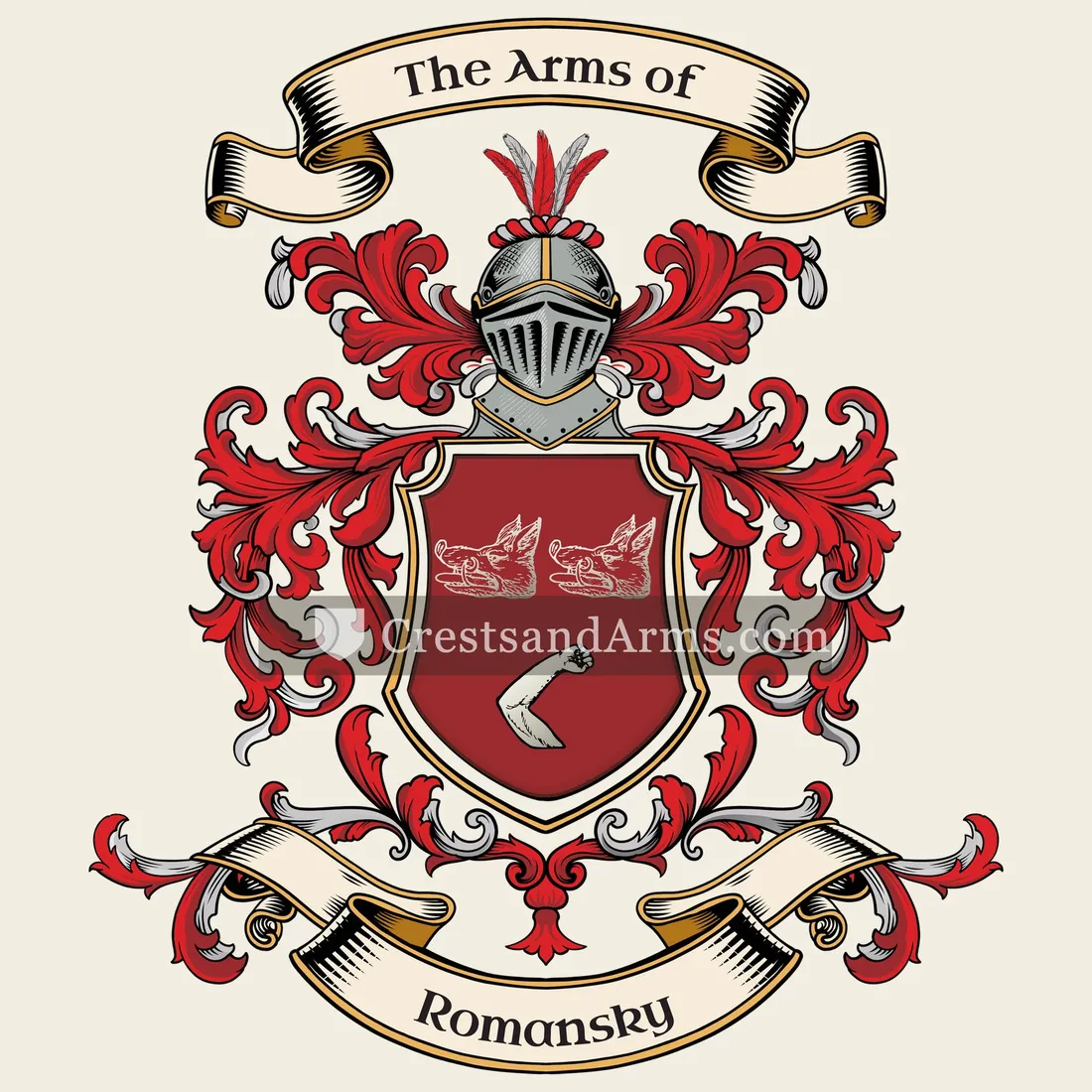
Symbols on this shield
boars headA fierce fighter who battles to the end
armA person of action, industrious and laborious
Colours
Red (Gules)Means: Military strength
Silver (Argent)Means: Peace and sincerity
Historical info
Source
Sir Bernard Burke, The General Armory of England, Scotland, Ireland and Wales, London: Harrison & Sons, 1884
Blazon (the actual original written record)
“Gu. two boars' heads erased ar. in chief and in base a dexter arm in armour couped below the elbow erect, the hand naked, and the forefinger pointing upwards ppr”
EdinburghNewton Grange · Edinburgh, c. 1748
Digital archive packCoat of arms PNG, gold border print PDF, vector SVG and the certificate of authenticity. Sent to your email in minutes.
Map of Scotland showing where the Romansky arms are recorded
The Romansky arms were recorded in Edinburgh, c. 1748.
Edinburgh was the seat of Scotland's government, its courts and its heralds. Families with business there settled nearby, and being close to where arms were recorded is exactly why so many of them appear.
This is where the arms were entered in the register. Families often moved to other parts of the country, so the same name can turn up in more than one region.
The body that granted and recorded arms in Scotland in this period.
George II of Great Britain
Sovereign of the period
George II of Great Britain
1727–1760
Reigning in France when the Romansky arms are first recorded.
How Arms Worked in Scotland
Scottish heraldry is unique because it treats a coat of arms as a piece of personal property protected by law. Only one person can own a specific design at any given time. When a family grows, the head keeps the original shield while other relatives must apply for their own distinct version with slight changes to prove their specific identity.
Granting authority
The Court of the Lord Lyon acts as the official body that regulates and controls all heraldic matters throughout Scotland.
How they got arms
Individuals obtain a legal right to their arms through a formal petition process that confirms their identity and family connection.
Where arms were recorded
All valid coats of arms are officially entered into the Public Register of All Arms and Bearings starting from 1672.
The family's standing
Recorded among the armigerous families of Edinburgh.
Origin & History of the Romansky Family in Scotland
The history of the Romansky family in Scotland begins with a modest but documented presence in Edinburgh by the year 1748. During this period, the city was a bustling center of trade and intellectual growth known as the Scottish Enlightenment. Families with this surname likely arrived as part of the movement of people across Europe seeking new opportunities in the rapidly developing urban landscape of Scotland’s capital. While the name itself suggests roots connected to the broader European continent, the members who settled in Edinburgh integrated into the local community by participating in the city’s growing craft and merchant guilds. These early ancestors lived through a time of significant social change, as Scotland transitioned from a traditional agrarian society into a modern industrial power. By establishing themselves in the heart of Edinburgh, the Romansky family became part of the diverse tapestry of residents who helped shape the city during the mid-eighteenth century.
Romansky Meaning & Related Branches
Root word
Romanus
A Latin term referring to a citizen of Rome.
This name
RomanskyA locative or ethnic surname denoting someone who originated from Rome or Italy.
also spelled
Rommans
Romance
Romantz
Documented Sources
J. B. Rietstap, Armorial Général, Gouda: G. B. van Goor Zonen, 1884–87
Archives départementales d’Indre-et-Loire, Registres paroissiaux et d'état civil de la ville de Tours, 1725
Boutier, Jean, Les noms de famille en France: histoire et société, 2006
Digital archive packCoat of arms PNG, gold border print PDF, vector SVG and the certificate of authenticity. Sent to your email in minutes.


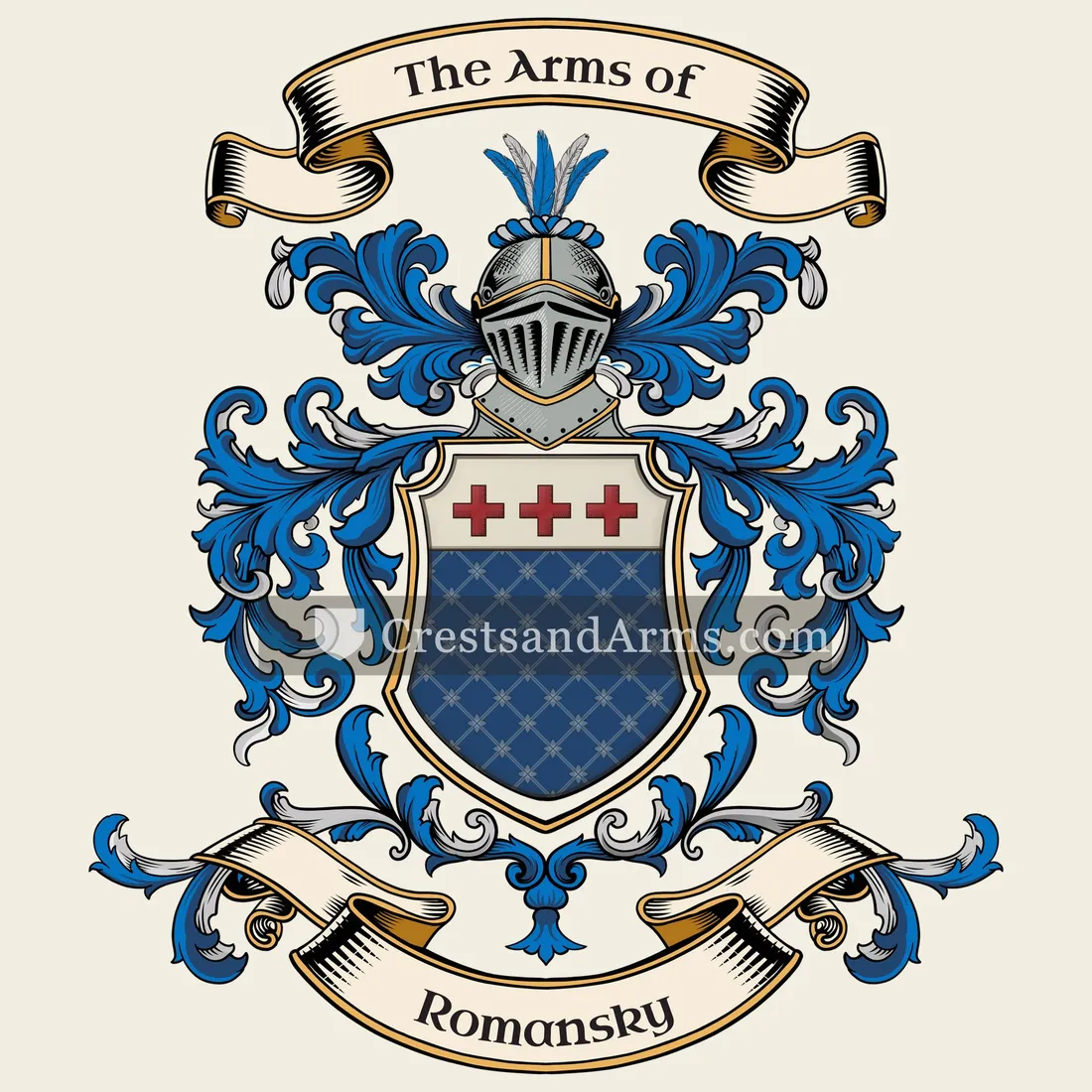
 chiefAuthority, wisdom and dominion
 cross symbolChristian faith and service
 chiefAuthority, wisdom and dominion
 cross symbolChristian faith and service


 boars headA fierce fighter who battles to the end
 armA person of action, industrious and laborious