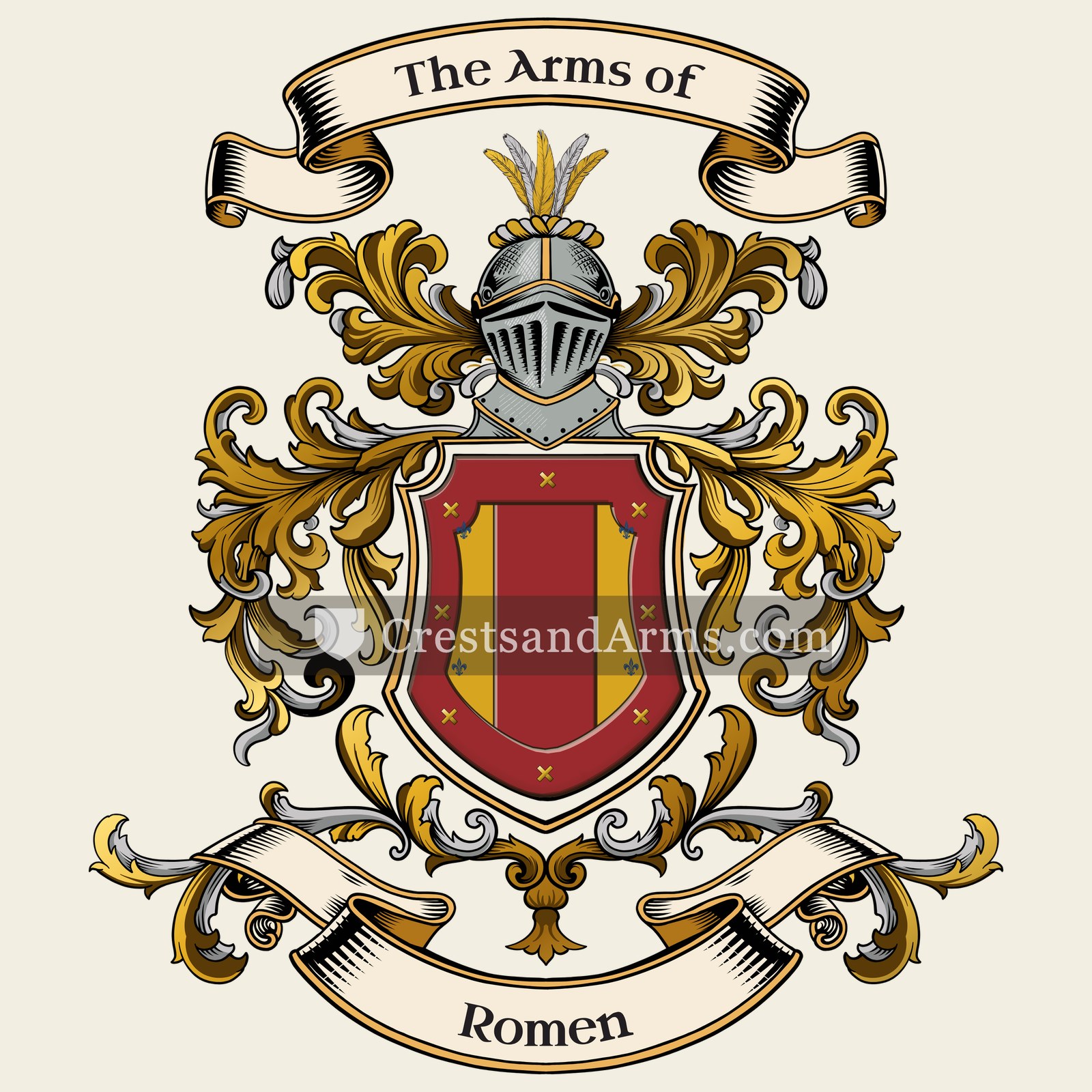
A record of documented arms, meaning and origin, researched for the Romen family lines. Documented in 3 countries.
Reg. 7092 · Dutch, P–S
Coat of Arms & Family Crest Details
Symbols on this shield
fessThe military belt, and readiness to serve
mulletThe third son, and a divine quality from above
martletA younger son, who must win his own land
Colours
Silver (Argent)Means: Peace and sincerity
Red (Gules)Means: Military strength
Historical info
Source
J. B. Rietstap, Armorial Général, Gouda: G. B. van Goor Zonen, 1884–87
Blazon (the actual original written record)
“D'arg. à deux fasces, acc. d'une étoile en abîme, et de trois merlettes, 2 en chef et 1 en p., le tout de gu. C.: une tête de lion de gu., entre un vol d'arg.”
NetherlandsAmsterdam, c. 1815
Digital archive packCoat of arms PNG, gold border print PDF, vector SVG and the certificate of authenticity. Sent to your email in minutes.
Map of Netherlands showing where the Romen arms are recorded
The Romen arms were recorded in Amsterdam, c. 1815.
This is where the arms were entered in the register. Families often moved to other parts of the country, so the same name can turn up in more than one region.
Region
Amsterdam
Town
Amsterdam
First recorded
1815
Granting Authority for the Romen Arms
Hoge Raad van Adel
Photograph made by me · CC BY-SA 3.0
The body that granted and recorded arms in Netherlands in this period.
William I of the Netherlands
Sovereign of the period
William I of the Netherlands
1815–1840
Reigning in Netherlands when the Romen arms are first recorded.
How Arms Worked in Netherlands
In the Netherlands, coats of arms were often used by noble families and those who held specific public offices. These arms were passed down through the generations to legitimate descendants. Younger branches of a family usually kept the original design without needing to add special marks. This system ensured that the family identity remained clear and consistent over many years.
Granting authority
The Hoge Raad van Adel is the official body that regulates and manages noble titles and coats of arms in the Netherlands.
How they got arms
Families typically obtained their coats of arms through official royal grants or by proving their long-standing historical use of the symbols.
Where arms were recorded
Coats of arms are officially recorded in the registers held by the Hoge Raad van Adel, which began its work in 1814.
The family's standing
Recorded among the armigerous families of Netherlands.
Origin & History of the Romen Family in Netherlands
The history of the Romen family in the Netherlands is deeply connected to the urban growth of Amsterdam during the early nineteenth century. By 1815, the name appeared in official city registers, marking a period when the Netherlands was transitioning into a centralized kingdom following the Napoleonic era. During this time, the government required citizens to formalize their surnames for tax and census purposes. Families carrying the name Romen were likely part of the emerging middle class, working in the bustling trade and craft sectors that defined Amsterdam’s economy after the French occupation ended. Because the name is linked to the Latin word for Rome, it is possible that early ancestors were either travelers from southern Europe or individuals who adopted the name to reflect a connection to classical history or religious traditions. As the family settled into the city, they became part of the local fabric of Amsterdam, contributing to the social and economic life of a nation that was just beginning to define its modern identity.
Coat of Arms & Family Crest Details
Symbols on this shield
hunting horn stringedOne who delights in the chase
skullMortality remembered, and courage in the face of death
Colours
Gold (Or)Means: Generosity
Historical info
Source
J. B. Rietstap, Armorial Général, Gouda: G. B. van Goor Zonen, 1884–87
Blazon (the actual original written record)
“D'or à deux cornes de bélier attachées au crâne, au nat. Cq. cour. C.: trois pl. d'aut. d'or.”
Polandc. 1772
Digital archive packCoat of arms PNG, gold border print PDF, vector SVG and the certificate of authenticity. Sent to your email in minutes.
Map of Poland showing where the Romen arms are recorded
The Romen arms were recorded in Poland, c. 1772.
Arms such as these were typically recorded in Mazovia.
Mazovia held Warsaw, the Polish court and the assemblies where the szlachta met. Poland's nobles were unusually numerous and every one of them bore arms, and Warsaw is where those arms were argued over and recorded.
This is where the arms were entered in the register. Families often moved to other parts of the country, so the same name can turn up in more than one region.
Region
Mazovia
First recorded
1772
Granting Authority for the Romen Arms
Ennoblement by the Sejm
Author: Olek Remesz · CC BY-SA 3.0
The body that granted and recorded arms in Poland in this period.
Stanisław August Poniatowski
Sovereign of the period
Stanisław August Poniatowski
1764–1795
Reigning in Netherlands when the Romen arms are first recorded.
How Arms Worked in Poland
Polish noble families shared a single coat of arms across many different surnames, creating large clans rather than individual designs. These symbols were held collectively by all members of the clan regardless of their specific family name. When a new family joined the nobility, they were adopted into an existing clan and began using that group's established shield.
Granting authority
The Sejm, which was the Polish parliament, held the power to grant noble status and the right to bear arms.
How they got arms
Families typically received their coat of arms through a formal act of ennoblement granted by the Sejm for distinguished service.
Where arms were recorded
These grants were officially recorded in the Crown Metrica, which served as the central archive for state documents starting in the sixteenth century.
The family's standing
Recorded among the armigerous families of Poland.
Origin & History of the Romen Family in Poland
The history of the Romen family in Poland is deeply connected to the landscape of the Mazovia region during the late eighteenth century. By 1772, members of the family were already established in this central part of the country, a time when Poland was undergoing significant political shifts and territorial changes. The name itself likely evolved from local linguistic roots, reflecting the diverse cultural influences present in the Vistula river basin. Families in this area often lived in rural communities where they worked as farmers or skilled tradespeople, contributing to the local economy and the social fabric of the Mazovian plains. Because record-keeping in the 1700s was often handled by local parish churches, the Romen name appears in historical documents as a testament to the family's long-standing presence in the region. These early ancestors helped shape the identity of their local villages, leaving behind a legacy that persisted through generations of Polish history.
Coat of Arms & Family Crest Details
Symbols on this shield
paleMilitary strength, and a fortified defence
fleur de lisPurity, light, and the sixth son
saltire coupedResolution, and the cross of St Andrew
Colours
Gold (Or)Means: Generosity
Red (Gules)Means: Military strength
Blue (Azure)Means: Loyalty and truth
Historical info
Source
J. B. Rietstap, Armorial Général, Gouda: G. B. van Goor Zonen, 1884–87
Blazon (the actual original written record)
“D'or au pal de gu., accosté de quatre fleurs-de-lis d'azur; à la bord. de gu., ch. de huit flanchis d'or.”
AragonAragon, c. 1722
Digital archive packCoat of arms PNG, gold border print PDF, vector SVG and the certificate of authenticity. Sent to your email in minutes.
Map of Spain showing where the Romen arms are recorded
The Romen arms were recorded in Aragon, c. 1722.
Aragon was mountain and river country in north-eastern Spain, with a strong tradition of small independent landholders. A great many families counted as gentry there, and each one needed a shield to be told apart.
This is where the arms were entered in the register. Families often moved to other parts of the country, so the same name can turn up in more than one region.
The body that granted and recorded arms in Spain in this period.
Philip V of Spain
Sovereign of the period
Philip V of Spain
1714–1724
Reigning in Netherlands when the Romen arms are first recorded.
How Arms Worked in Spain
In Spain, a coat of arms was considered a form of property that belonged to the entire family line. These arms were passed down from a father to all his children equally. Younger branches of the family usually kept the original design without needing to add any special marks to distinguish their specific line.
Granting authority
The Cronista Rey de Armas was the official body that regulated and granted coats of arms throughout Spain.
How they got arms
Families often obtained their arms through royal grants or by proving their noble status to the official heraldic authority.
Where arms were recorded
Coats of arms were officially recorded in the registers of the Cronista Rey de Armas starting in 1496.
The family's standing
Recorded among the armigerous families of Aragon.
Origin & History of the Romen Family in Spain
The family name Romen has deep roots in the northeastern region of Spain, specifically within the historic Kingdom of Aragon. By the early 18th century, the family was well-established in this area, which was a hub for trade and agricultural development during the Bourbon reforms. In 1722, records confirm that members of the Romen family were active participants in the local social and economic life of Aragon. During this period, families in the region often centered their lives around parish communities and local land management. Because Aragon served as a vital crossroads between the Mediterranean coast and the interior of the Iberian Peninsula, the Romen family likely benefited from the movement of goods and ideas that defined the era. Their presence in the official documentation of the time suggests they were integrated into the administrative structures of the Spanish crown, which required careful record-keeping of its citizens for tax and census purposes.
Related Branches & Arms
Root word
Romanus
Latin term meaning a person from Rome or a Roman citizen.
This name
RomenA habitational or ethnic surname indicating an ancestor who originated from Rome or Italy.
also spelled
Romann
Romane
Romain
Documented Sources
J. B. Rietstap, Armorial Général, Gouda: G. B. van Goor Zonen, 1884–87
Stadsarchief Amsterdam, Bevolkingsregister van Amsterdam (Population Register of Amsterdam)
Nationaal Archief, Burgerlijke Stand (Civil Registry)
Blok, D.P., Algemene Geschiedenis der Nederlanden (1977)
Fokkens, A., Geschiedenis van Amsterdam (1998)
Digital archive packCoat of arms PNG, gold border print PDF, vector SVG and the certificate of authenticity. Sent to your email in minutes.


 fessThe military belt, and readiness to serve
 mulletThe third son, and a divine quality from above
 martletA younger son, who must win his own land
 fessThe military belt, and readiness to serve
 mulletThe third son, and a divine quality from above
 martletA younger son, who must win his own land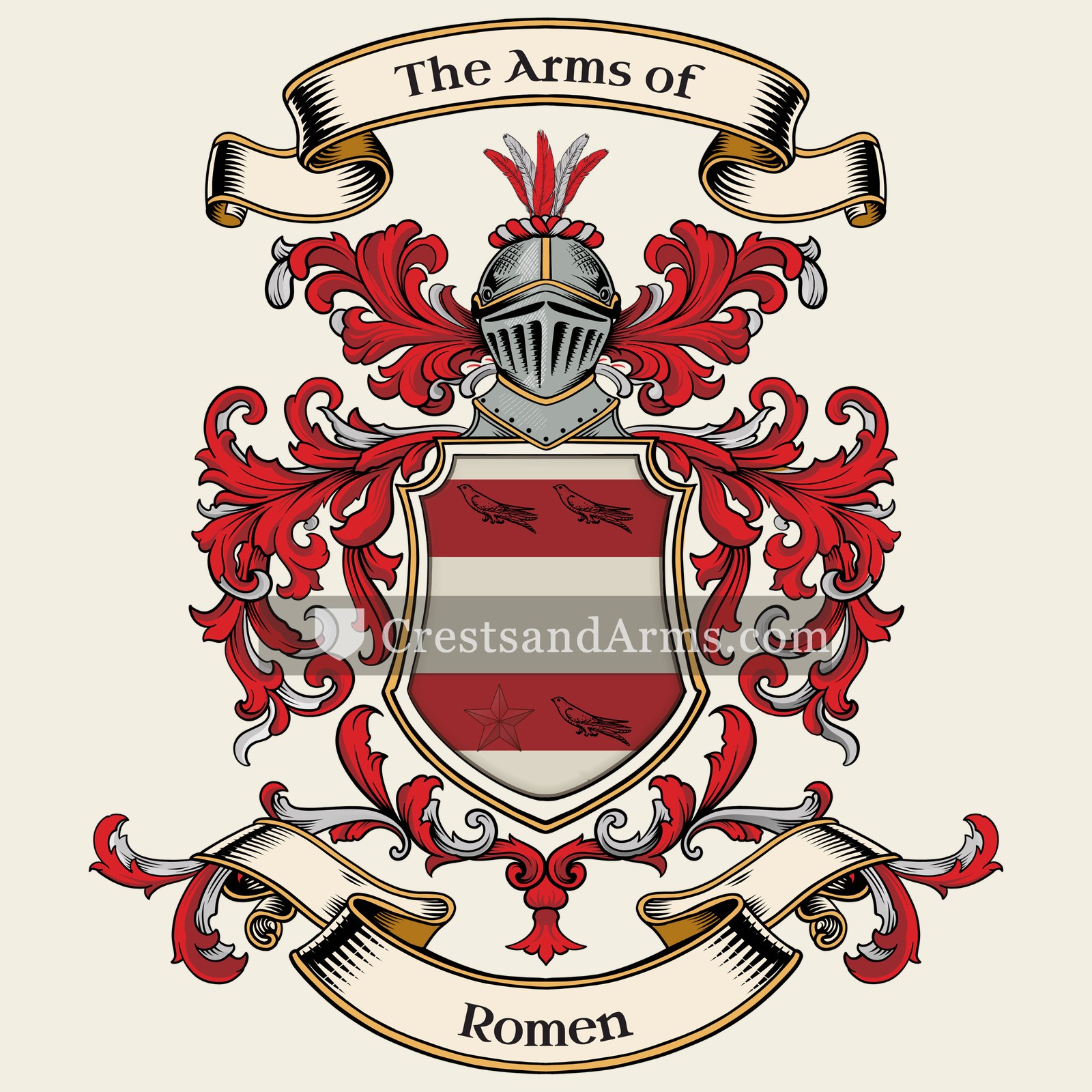


 hunting horn stringedOne who delights in the chase
 skullMortality remembered, and courage in the face of death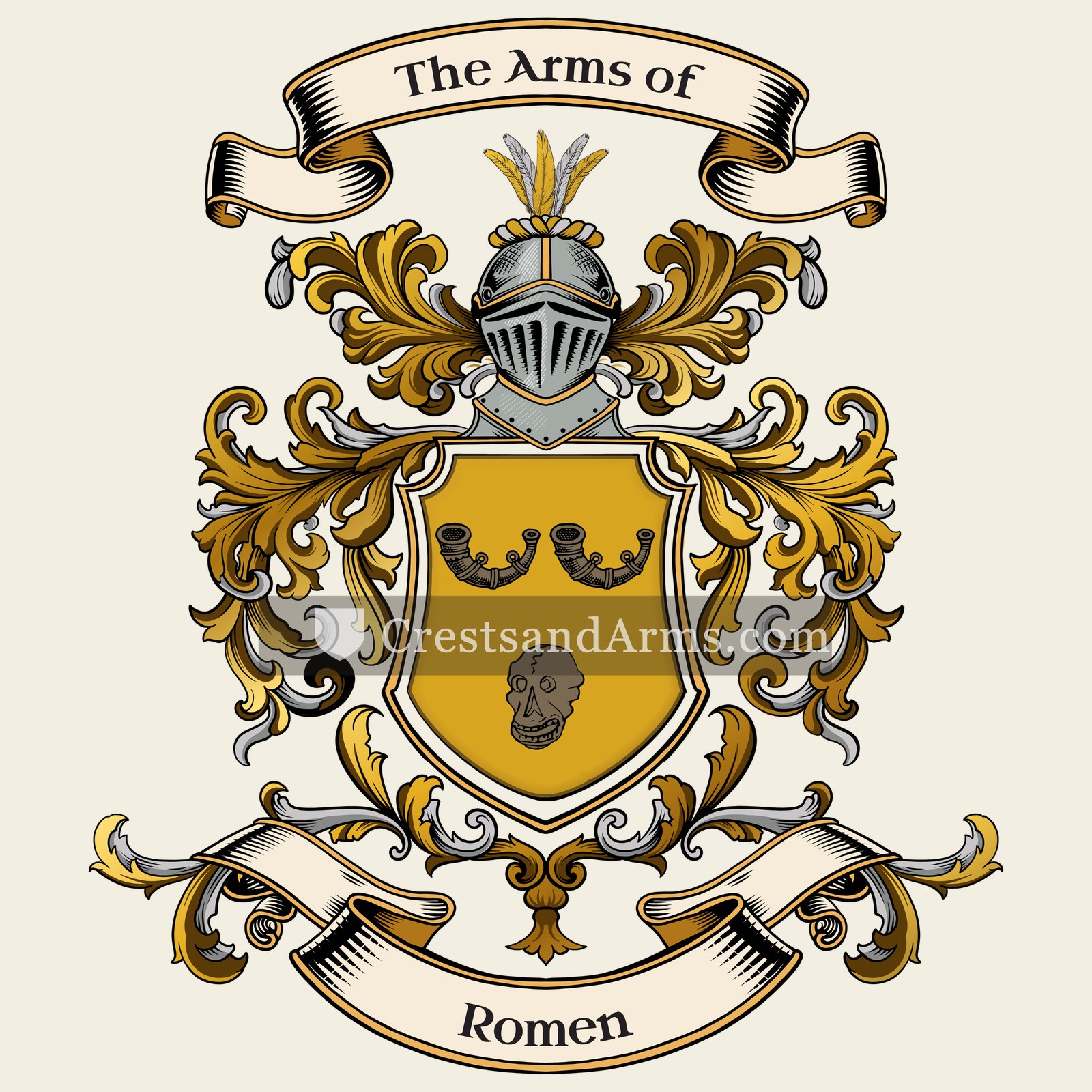


 paleMilitary strength, and a fortified defence
 fleur de lisPurity, light, and the sixth son
 saltire coupedResolution, and the cross of St Andrew