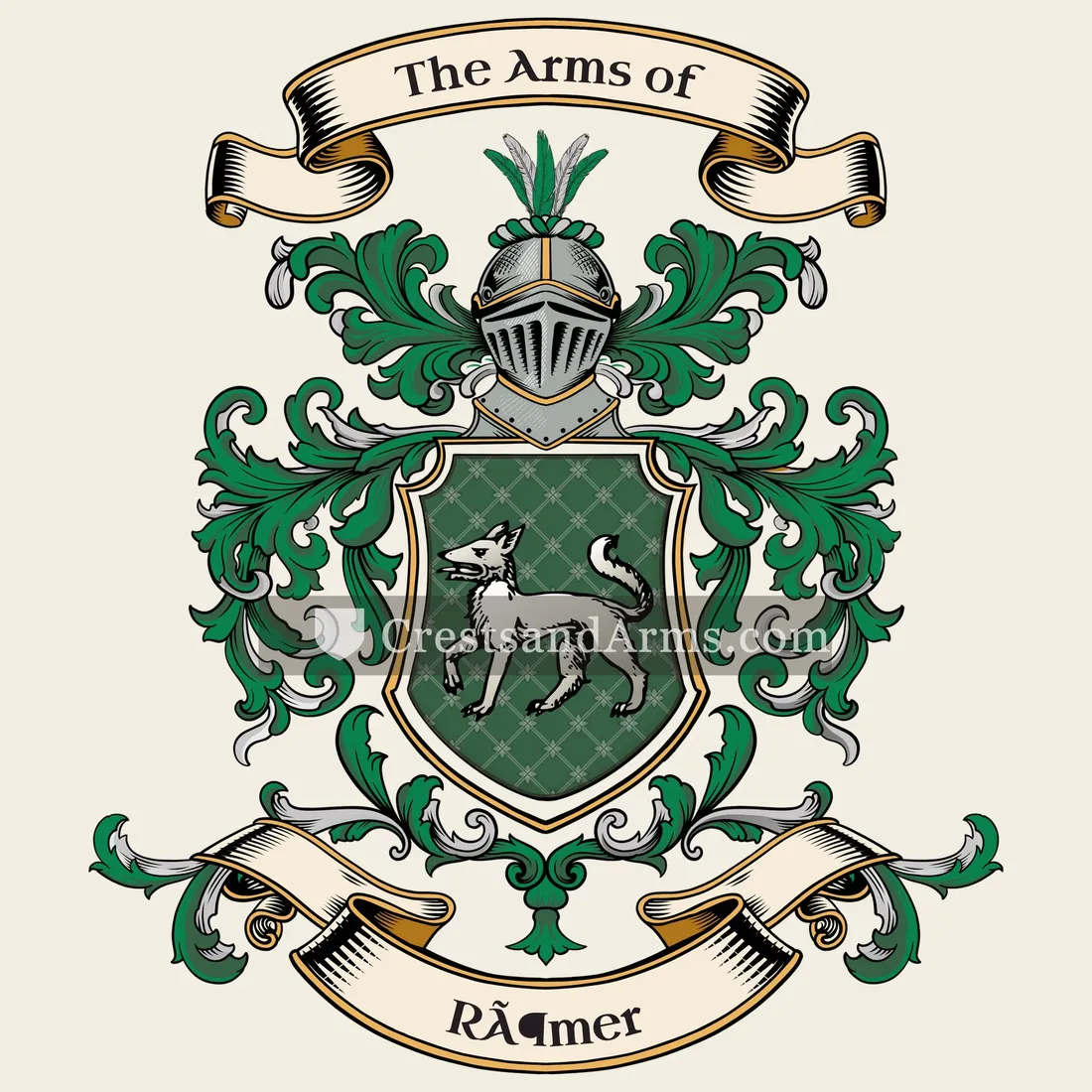
A record of documented arms, meaning and origin, researched for the Römer family lines. Documented in 3 countries.
Reg. 5673 · German, P–S
Meaning of the Römer family crest colors & symbols
Symbols on this shield
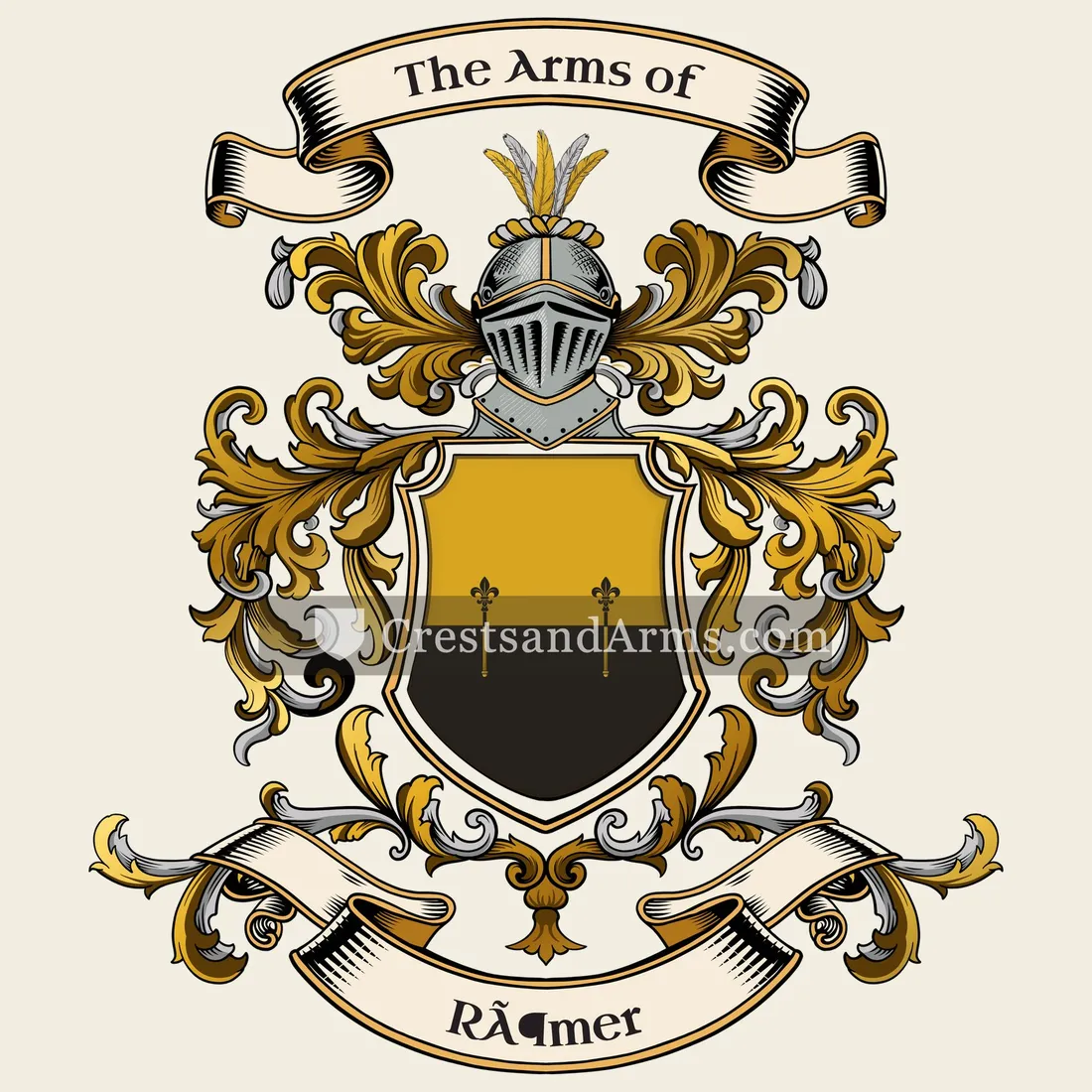
batonAuthority and office held under the crown
Colours
Gold (Or)Means: Generosity
Black (Sable)Means: Constancy
Historical info
Source
J. B. Rietstap, Armorial Général, Gouda: G. B. van Goor Zonen, 1884–87
Blazon (the actual original written record)
“Coupé d'or sur sa.; à deux bourdons de pélerin, passés en saut., de l'un en l'autre. C.: un bonnet d'or, retr. du même, supp. deux bourdons de pélerin de sa., sommés chacun de cinq plumes de coq d'or.”
Germanyc. 1470
Digital archive packCoat of arms PNG, gold border print PDF, vector SVG and the certificate of authenticity. Sent to your email in minutes.
Map of Germany showing where the Römer arms are recorded
The Römer arms were recorded in Germany, c. 1470.
Arms such as these were typically recorded in Bavaria.
Bavaria was a country of old landed families and walled market towns. Estates passed down the same line for centuries, and both the landowners and the leading townsmen kept arms, which is why so many Bavarian names sit in the registers.
This is where the arms were entered in the register. Families often moved to other parts of the country, so the same name can turn up in more than one region.
The body that granted and recorded arms in Germany in this period.
Frederick III, Holy Roman Emperor
Sovereign of the period
Frederick III, Holy Roman Emperor
1440–1493
Reigning in Germany when the Römer arms are first recorded.
How Arms Worked in Germany
In the Holy Roman Empire, coats of arms were often granted to individuals by the Emperor or his representatives. These arms were then passed down through the generations to all legitimate descendants of the original holder. Younger branches of a family usually kept the same shield design without needing to change it, as the arms belonged to the entire lineage.
Granting authority
The Holy Roman Emperor held the sole power to grant new coats of arms throughout his vast imperial territories.
How they got arms
Families typically obtained their coats of arms through a formal imperial grant or by proving their noble status to the authorities.
Where arms were recorded
These grants were officially recorded in the Imperial Chancery registers, which began keeping formal records of such honors during the Middle Ages.
The family's standing
Recorded among the armigerous families of Germany.
Origin & History of the Römer Family in Germany
The surname Römer is a classic example of a name derived from a person’s origin or travel history. In medieval Germany, it was common for individuals to receive a nickname based on their experiences, and the term Römer literally means a person who had traveled to Rome. During the Middle Ages, making a pilgrimage to the Eternal City was a significant journey that marked a person as worldly and devout. By the time records place the family in Bavaria in 1470, the name had likely transitioned from a descriptive nickname to a formal hereditary surname passed down through generations. Families with this name were often associated with the merchant classes or skilled tradesmen who moved along the established trade routes connecting Southern Germany to Italy. As these families settled into Bavarian towns, they became part of the local social fabric, contributing to the regional growth and economic life of the Holy Roman Empire.
Meaning of the Römer family crest colors & symbols
Symbols on this shield
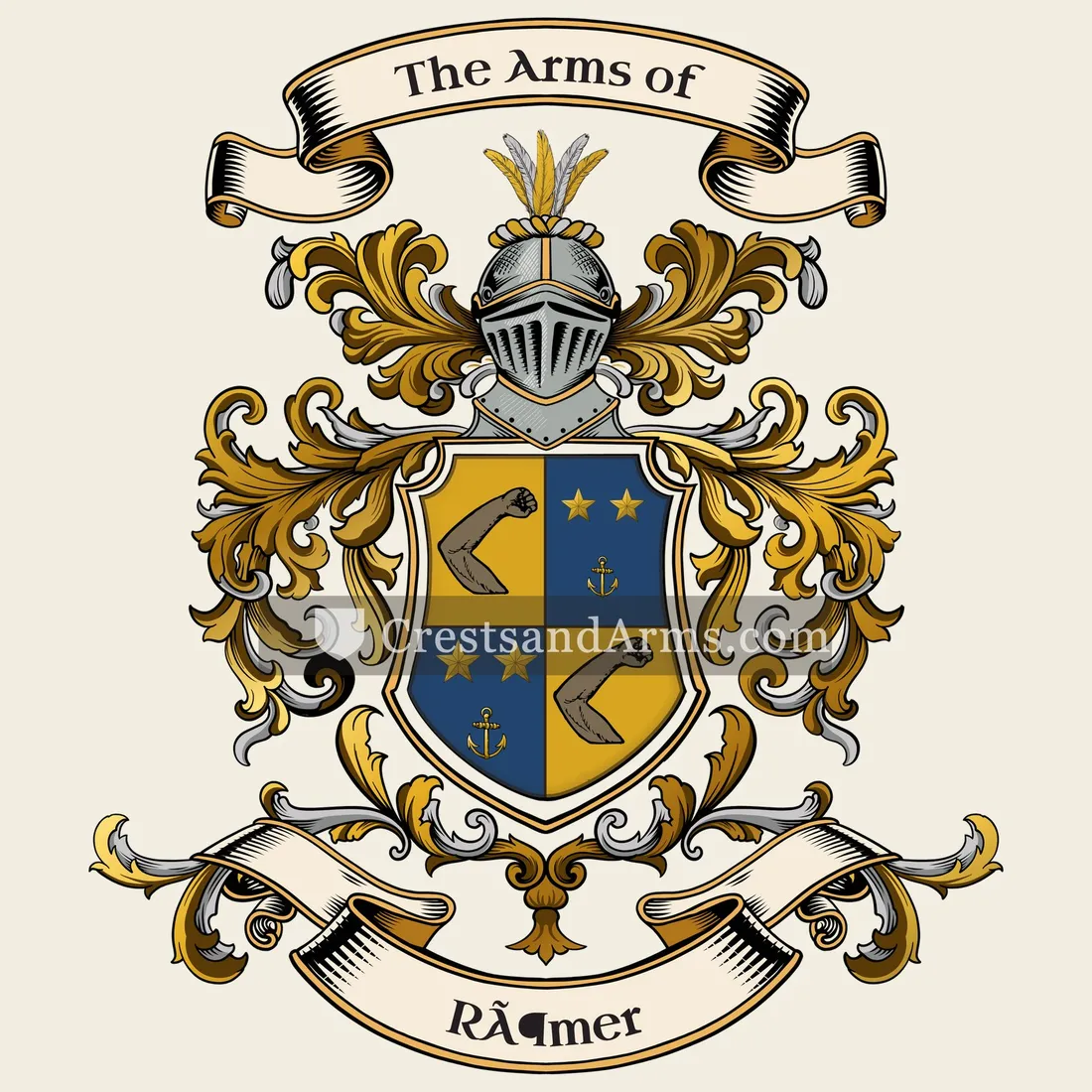
armA person of action, industrious and laborious
anchorHope, and steadfastness in trouble
mulletThe third son, and a divine quality from above
Colours
Gold (Or)Means: Generosity
Blue (Azure)Means: Loyalty and truth
Historical info
Source
J. B. Rietstap, Armorial Général, Gouda: G. B. van Goor Zonen, 1884–87
Blazon (the actual original written record)
“Ec.: aux 1 et 4 d'or à un senestrochère, arm. au nat., brandissant un sabre; aux 2 et 3 d'azur à une ancre d'or, posée en barre, acc. de deux étoiles du même, 1 en chef à dextre et 1 en p. à sen. Cq. cour. C.: un bras armé, brandissant un sabre, au nat.; entre six bannières, alt. d'azur et de gu., bordées d'or.”
Denmarkc. 1759
Digital archive packCoat of arms PNG, gold border print PDF, vector SVG and the certificate of authenticity. Sent to your email in minutes.
Map of Denmark showing where the Römer arms are recorded
The Römer arms were recorded in Denmark, c. 1759.
Arms such as these were typically recorded in Sjaælland.
Zealand held the Danish court, the crown's offices and Copenhagen itself. Families who served the king kept estates within reach of it, and royal service was the ordinary route to a coat of arms.
This is where the arms were entered in the register. Families often moved to other parts of the country, so the same name can turn up in more than one region.
The body that granted and recorded arms in Denmark in this period.
Frederick V of Denmark
Sovereign of the period
Frederick V of Denmark
1746–1766
Reigning in Germany when the Römer arms are first recorded.
How Arms Worked in Denmark
Danish heraldry during this period was closely tied to noble status and royal favor rather than being open to all citizens. Arms were typically granted by the monarch to individuals, and these symbols were then shared by all members of the noble house. If a family line died out, the right to use those specific arms ended with them.
Granting authority
The Danish royal chancery held the power to issue and regulate official coats of arms for the kingdom.
How they got arms
Families usually received their arms through a formal royal grant that confirmed their noble status and rights.
Where arms were recorded
These grants were officially recorded in the Danish Royal Chancery records starting in the sixteenth century.
The family's standing
Recorded among the armigerous families of Denmark.
Origin & History of the Römer Family in Denmark
The family name Römer has deep roots in the history of the Danish island of Sjælland, where records confirm the presence of family members as early as 1759. The name itself is of German origin and translates to someone who has traveled to Rome, often referring to pilgrims or merchants who journeyed to the city during the Middle Ages. When the family settled in Denmark, they integrated into a society that was rapidly changing during the eighteenth century. Many people with this name during that era were part of the growing middle class, often working as skilled craftsmen, soldiers, or local administrators. Their presence in Sjælland suggests they were part of the movement of people across Northern Europe who sought new opportunities in the Danish kingdom. By establishing themselves in this region, the Römer family became a small but permanent part of the local community, contributing to the professional and social life of the island for generations.
Meaning of the Römer family crest colors & symbols
Symbols on this shield
wolfReward from long service and hard work
Colours
Green (Vert)Means: Hope
Black (Sable)Means: Constancy
Historical info
Source
J. B. Rietstap, Armorial Général, Gouda: G. B. van Goor Zonen, 1884–87
Blazon (the actual original written record)
“Taillé de sin. sur sa.; à un loup pass. au nat., br. sur le taillé. C.: une lance de tournoi d'arg., posée en pal, entre un vol de sa. L. d'arg. et de sin.”
LivoniaLivonia, c. 1792
Digital archive packCoat of arms PNG, gold border print PDF, vector SVG and the certificate of authenticity. Sent to your email in minutes.
Map of Poland showing where the Römer arms are recorded
The Römer arms were recorded in Livonia, c. 1792.
Livonia was Baltic country held by a small number of landed families who kept their estates for centuries. Land there passed down whole rather than being divided, and long unbroken tenure is what fills a register.
This is where the arms were entered in the register. Families often moved to other parts of the country, so the same name can turn up in more than one region.
Region
Livonia
First recorded
1792
Granting Authority for the Römer Arms
Ennoblement by the Sejm
Author: Olek Remesz · CC BY-SA 3.0
The body that granted and recorded arms in Poland in this period.
Stanisław August Poniatowski
Sovereign of the period
Stanisław August Poniatowski
1764–1795
Reigning in Germany when the Römer arms are first recorded.
How Arms Worked in Poland
Polish noble families shared a single coat of arms across many different surnames, creating large clans rather than individual designs. These symbols were held collectively by all members of the clan regardless of their specific family name. When a new family joined the nobility, they were adopted into an existing clan and began using that group's established shield.
Granting authority
The Sejm, which was the Polish parliament, held the power to grant noble status and the right to bear arms.
How they got arms
Families typically received their coat of arms through a formal act of ennoblement granted by the Sejm for distinguished service.
Where arms were recorded
These grants were officially recorded in the Crown Metrica, which served as the central archive for state documents starting in the sixteenth century.
The family's standing
Recorded among the armigerous families of Livonia.
Origin & History of the Römer Family in Poland
The history of the Römer family in the Polish-Lithuanian Commonwealth is deeply connected to the movement of German-speaking families into the Baltic region. While the name itself points to ancient roots in the Roman Empire, the family established a significant presence in Livonia by the late 18th century. By 1792, members of the family were well-integrated into the local administrative and social structures of the region. They eventually moved further into Polish lands, where they became prominent landowners and public figures. Their transition from the Baltic territories into the broader Polish cultural sphere reflects the way many families of Germanic origin adapted to the customs and political life of the Polish state. Over time, the name became associated with the intellectual and political history of the region as the family took on roles in education and government.
Römer Meaning & Related Branches
Root word
Romanus
A Latin term referring to a person from Rome.
This name
RömerAn occupational or habitational name for someone who traveled to or originated from Rome.
also spelled
Roemer
Rommer
Remer
Related arms
Pilgramsimilar arms
Roemersimilar arms
Clermont de Vaalsbroichrecorded with Römer, same area
Ellerbornrecorded with Römer, same area
Documented Sources
J. B. Rietstap, Armorial Général, Gouda: G. B. van Goor Zonen, 1884–87
Bahlow, Hans. Deutsches Namenlexikon: Familien- und Vornamen nach Ursprung und Sinn erklärt. 1967
Heintze, Albert. Die deutschen Familien-Namen: geschichtlich, geographisch, sprachlich. 1903
Bayerisches Hauptstaatsarchiv. Bayerische Urkunden und Amtsbücher. 1470
Digital archive packCoat of arms PNG, gold border print PDF, vector SVG and the certificate of authenticity. Sent to your email in minutes.


 batonAuthority and office held under the crown
 batonAuthority and office held under the crown


 armA person of action, industrious and laborious
 anchorHope, and steadfastness in trouble
 mulletThe third son, and a divine quality from above

 wolfReward from long service and hard work