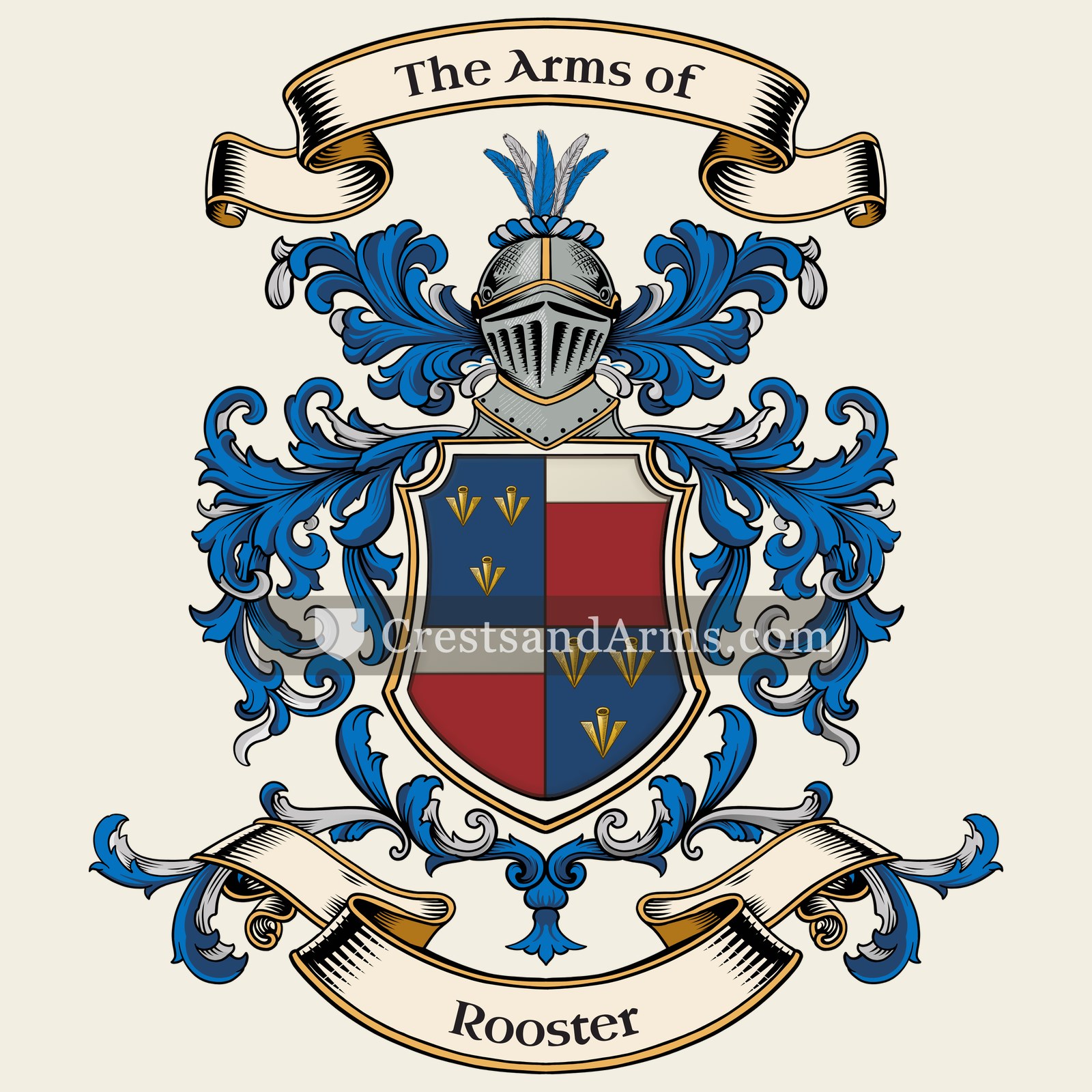
A record of documented arms, meaning and origin, researched for the Rooster family of Netherlands.
Reg. 5113 · Dutch, P–S
Coat of Arms & Family Crest Details
Symbols on this shield
paleMilitary strength, and a fortified defence
chiefAuthority, wisdom and dominion
arrowReadiness for battle, and affliction endured
Colours
Blue (Azure)Means: Loyalty and truth
Red (Gules)Means: Military strength
Silver (Argent)Means: Peace and sincerity
Gold (Or)Means: Generosity
Historical info
Source
J. B. Rietstap, Armorial Général, Gouda: G. B. van Goor Zonen, 1884–87
Blazon (the actual original written record)
“Ec.: aux 1 et 4 d'azur à trois flèches d'or, posées en pals, rangées en fasce, les pointes en haut; aux 2 et 3 de gu. au chef d'arg. Brl. d'azur et d'or. C.: un homme iss., arm. d'azur, le bassinet du même sommé de deux pl. d'aut. au nat., tenant sa main dextre une flèche d'or, en pal, la pointe en haut, la sen. appuyée sur sa hanche. L. d'or et d'azur.”
Netherlandsc. 1815
Digital archive packCoat of arms PNG, gold border print PDF, vector SVG and the certificate of authenticity. Sent to your email in minutes.
Map of Netherlands showing where the Rooster arms are recorded
The Rooster arms were recorded in Netherlands, c. 1815.
Arms such as these were typically recorded in Friesland.
Friesland was low, wet country on the northern coast of the Netherlands, farmed by families who had held the same land for centuries. Free landholders were unusually common there, and a free landholder could carry arms.
This is where the arms were entered in the register. Families often moved to other parts of the country, so the same name can turn up in more than one region.
Region
Friesland
First recorded
1815
Granting Authority for the Rooster Arms
Hoge Raad van Adel
Photograph made by me · CC BY-SA 3.0
The body that granted and recorded arms in Netherlands in this period.
William I of the Netherlands
Sovereign of the period
William I of the Netherlands
1815–1840
Reigning in Netherlands when the Rooster arms are first recorded.
How Arms Worked in Netherlands
In the Netherlands, coats of arms were often used by noble families and those who held specific public offices. These arms were passed down through the generations to legitimate descendants. Younger branches of a family usually kept the original design without needing to add special marks. This system ensured that the family identity remained clear and consistent over many years.
Granting authority
The Hoge Raad van Adel is the official body that regulates and manages noble titles and coats of arms in the Netherlands.
How they got arms
Families typically obtained their coats of arms through official royal grants or by proving their long-standing historical use of the symbols.
Where arms were recorded
Coats of arms are officially recorded in the registers held by the Hoge Raad van Adel, which began its work in 1814.
The family's standing
Recorded among the armigerous families of Netherlands.
Origin & History of the Rooster Family in Netherlands
The surname Rooster is deeply connected to the historical landscape of Friesland, a province in the northern Netherlands known for its distinct culture and language. By the early 19th century, the family was firmly established in this region, appearing in official civil records around 1815. During this period, the Netherlands underwent a major transition as the government began requiring all citizens to adopt permanent, hereditary surnames to improve tax collection and military conscription. It is likely that the name was chosen as a descriptive nickname or a reference to a specific location, as many Frisian families at the time selected names based on their trade, personality traits, or the natural surroundings of their farmsteads. Because Friesland has a long history of maritime trade and agricultural innovation, the Rooster family likely played an active role in the local economy, contributing to the development of their community during a time of significant political change in Europe.
Related Branches & Arms
Root word
Roster
Derived from the Middle Dutch word for a grid or grate.
This name
RoosterAn occupational name for someone who worked with a gridiron or a gatekeeper.
also spelled
Rosterman
Documented Sources
J. B. Rietstap, Armorial Général, Gouda: G. B. van Goor Zonen, 1884–87
Tresoar (Frisian Historical and Literary Centre), Burgerlijke Stand (Civil Registration) Friesland, 1811-1950
Meertens Instituut, Nederlandse Familienamenbank
Dijkstra, F. and Van der Meer, G., Friese familienamen: een overzicht, 1998
Digital archive packCoat of arms PNG, gold border print PDF, vector SVG and the certificate of authenticity. Sent to your email in minutes.


 paleMilitary strength, and a fortified defence
 chiefAuthority, wisdom and dominion
 arrowReadiness for battle, and affliction endured
 paleMilitary strength, and a fortified defence
 chiefAuthority, wisdom and dominion
 arrowReadiness for battle, and affliction endured