A record of documented arms, meaning and origin, researched for the Rosenberg family lines. Documented in 3 countries.
Reg. 3088 · German, P–S
Coat of Arms & Family Crest Details
Symbols on this shield
paleMilitary strength, and a fortified defence
Colours
Red (Gules)Means: Military strength
Silver (Argent)Means: Peace and sincerity
Historical info
Source
J. B. Rietstap, Armorial Général, Gouda: G. B. van Goor Zonen, 1884–87
Blazon (the actual original written record)
“Palé-contre-palé de gu. et d'arg. de six pièces. C.: une rose de gu., entre deux têtes et cols de cygne adossées d'arg. -- Ou: Coupé: au 1 d'arg. à une rose de gu., bout. du champ; au 2 palé contre-palé de trois pièces d'arg. et de gu. C.: la rose, entre deux têtes et cols de cygne adossées, coupées alt. de gu. et d'arg., bq. d'or.”
BavariaBavaria, c. 1632
Digital archive packCoat of arms PNG, gold border print PDF, vector SVG and the certificate of authenticity. Sent to your email in minutes.
Map of Germany showing where the Rosenberg arms are recorded
The Rosenberg arms were recorded in Bavaria, c. 1632.
Bavaria was a country of old landed families and walled market towns. Estates passed down the same line for centuries, and both the landowners and the leading townsmen kept arms, which is why so many Bavarian names sit in the registers.
This is where the arms were entered in the register. Families often moved to other parts of the country, so the same name can turn up in more than one region.
The body that granted and recorded arms in Germany in this period.
Ferdinand II, Holy Roman Emperor
Sovereign of the period
Ferdinand II, Holy Roman Emperor
1619–1637
Reigning in Germany when the Rosenberg arms are first recorded.
How Arms Worked in Germany
In the Holy Roman Empire, coats of arms were often granted to individuals by the Emperor or his representatives. These arms were then passed down through the generations to all legitimate descendants of the original holder. Younger branches of a family usually kept the same shield design without needing to change it, as the arms belonged to the entire lineage.
Granting authority
The Holy Roman Emperor held the sole power to grant new coats of arms throughout his vast imperial territories.
How they got arms
Families typically obtained their coats of arms through a formal imperial grant or by proving their noble status to the authorities.
Where arms were recorded
These grants were officially recorded in the Imperial Chancery registers, which began keeping formal records of such honors during the Middle Ages.
The family's standing
Recorded among the armigerous families of Bavaria.
Origin & History of the Rosenberg Family in Germany
The surname Rosenberg emerged in German-speaking lands as a topographic name, which means it was originally used to describe a person who lived near a prominent hill or mountain covered in roses. By the time members of the family were documented in Bavaria in 1632, the name had already become well-established across various regions of Central Europe. During the seventeenth century, Germany was deeply affected by the Thirty Years' War, a period of intense religious and political conflict that caused many families to move in search of safety or economic stability. The presence of the Rosenberg name in Bavarian records from this era suggests that the family was part of a settled population that navigated the challenges of a landscape defined by small towns and agricultural life. Over time, the name transitioned from a simple description of a place into a permanent family identifier that was passed down through generations. This evolution reflects the broader history of German surnames, which often began as ways to distinguish individuals based on their local surroundings before becoming formal markers of ancestry.
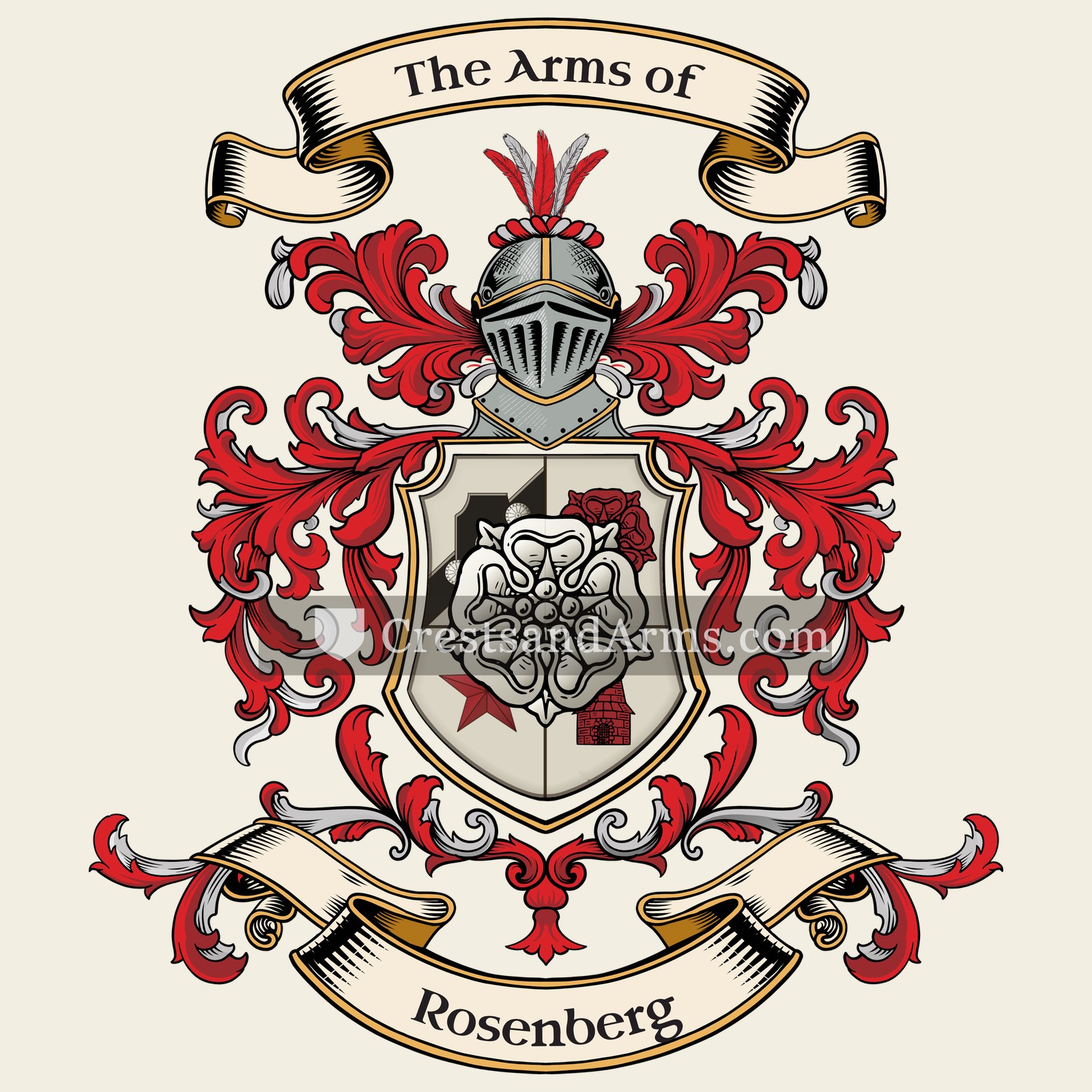
Coat of Arms & Family Crest Details
Symbols on this shield
roseThe seventh son, and beauty with grace
roundelA coin, and one who has been to the crusades
mulletThe third son, and a divine quality from above
towerGrandeur and solidity, and a stronghold defended
Colours
Silver (Argent)Means: Peace and sincerity
Black (Sable)Means: Constancy
Red (Gules)Means: Military strength
Historical info
Source
J. B. Rietstap, Armorial Général, Gouda: G. B. van Goor Zonen, 1884–87
Blazon (the actual original written record)
“Ec.: au 1 d'arg. à la barre de sa., ch. de trois boules du champ (Klöch); au 2 parti d'arg. et de gu., à une rose de l'un en l'autre, bout. d'or, barbée de sin. (Hagendorf); au 3 d'or à une étoile de gu.; au 4 tranché d'arg. sur gu., à un bris d'huis de l'un en l'autre, posé en barre (les 3 et 4 sont les armes de Spangenstein). Sur le tout un écusson d'arg., timbré d'une couronne princière et ch. d'une rose de gu., bout. d'or, barbée de sin. (Rosenberg). Cinq cq. d'or, les 1, 2, 3 et 5 cour. C.: 1º un demi-vol cont. aux armes du 3; 2º un demi-vol cont. aux armes du 1; 3º la rose du surtout; 4º un chapeau pyramidal parti d'arg. et de gu., retr. de l'un en l'autre, sommé d'une rose partie de gu. et d'arg., bout. d'or, barbée de sin.; 5º un ours iss. de sa., tenant de ses pattes une pique d'or en pal. L. d'arg. et de gu. S.: deux ours reg. de sa.”
CarinthiaCarinthia, c. 1634
Digital archive packCoat of arms PNG, gold border print PDF, vector SVG and the certificate of authenticity. Sent to your email in minutes.
Map of Austria showing where the Rosenberg arms are recorded
The Rosenberg arms were recorded in Carinthia, c. 1634.
Carinthia was Alpine country in southern Austria with iron and lead in its mountains. Mining and landholding both made money, and families who held either kind of property took arms.
This is where the arms were entered in the register. Families often moved to other parts of the country, so the same name can turn up in more than one region.
Region
Carinthia
First recorded
1634
Granting Authority for the Rosenberg Arms
Imperial and Royal chancery
Sodacan · CC BY-SA 3.0
The body that granted and recorded arms in Austria in this period.
Ferdinand II, Holy Roman Emperor
Sovereign of the period
Ferdinand II, Holy Roman Emperor
1619–1637
Reigning in Germany when the Rosenberg arms are first recorded.
How Arms Worked in Austria
Austrian coats of arms were often linked directly to noble titles granted by the Emperor. These symbols belonged to the entire family line rather than just one individual. When a family grew, new branches kept the original design without needing to change it. This system allowed all members of a noble house to share the same identity across many generations.
Granting authority
The Imperial and Royal chancery managed all heraldic matters and controlled the official granting of arms throughout the Austrian lands.
How they got arms
Families typically received their arms through a formal imperial decree that often accompanied the elevation of a person to noble status.
Where arms were recorded
Official records of these grants were kept in the Imperial Register of Nobility which began its formal documentation process in 1453.
The family's standing
Recorded among the armigerous families of Carinthia.
Origin & History of the Rosenberg Family in Austria
The name Rosenberg has deep roots in the Austrian region of Carinthia, where records confirm the family was established by at least 1634. During this period, the name functioned as a topographic identifier, likely linking the family to a specific mountain or hillside settlement known for its wild roses. In the seventeenth century, Carinthia was a vital crossroads for trade and cultural exchange within the Habsburg lands, and families like the Rosenbergs often played roles in local administration or land management. As the family grew, they integrated into the social fabric of the region, transitioning from local inhabitants to established members of the provincial community. This early presence in Carinthia suggests that the family was well-positioned to navigate the complex social and economic shifts that defined life in the Austrian Alps during the early modern era.
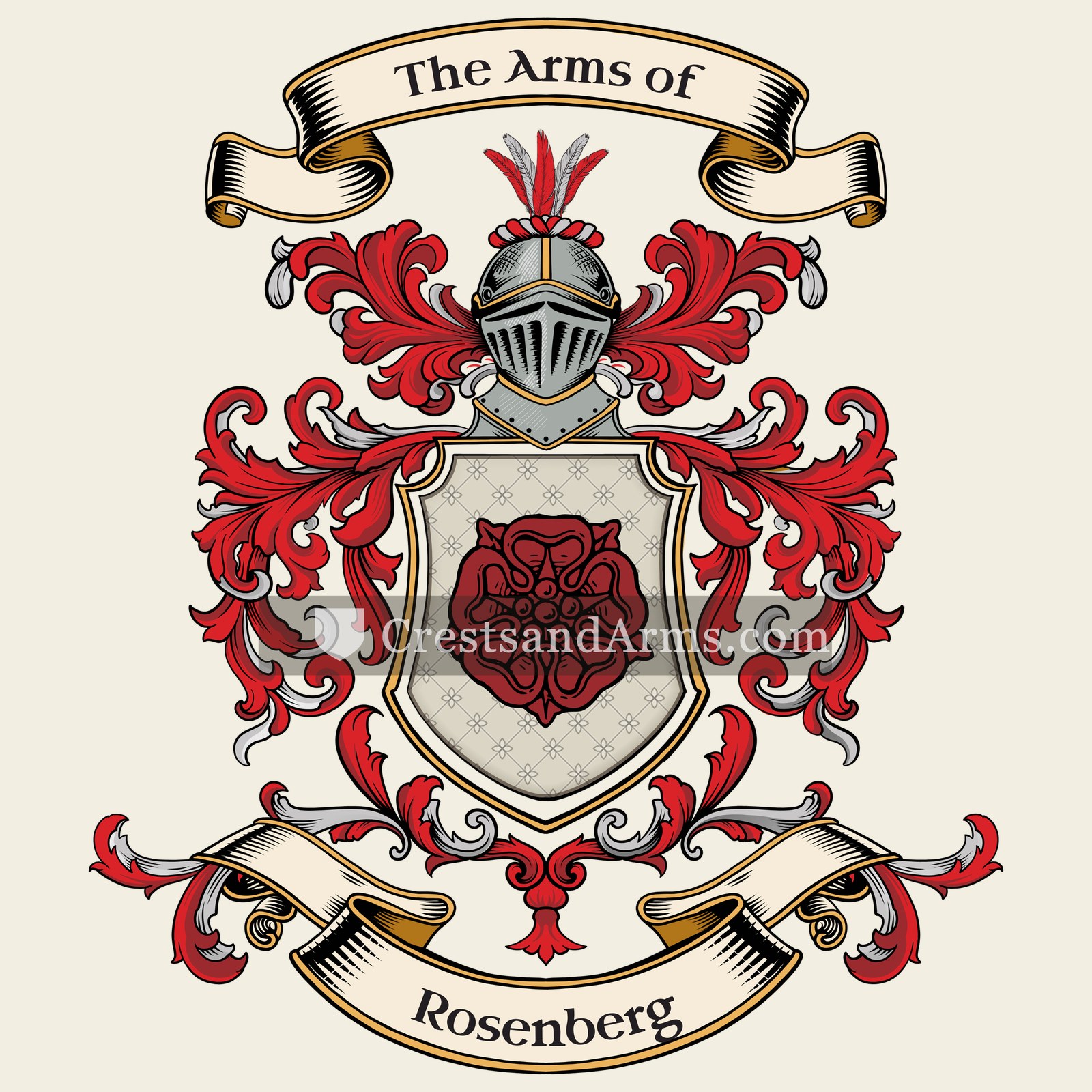
Coat of Arms & Family Crest Details
Symbols on this shield
roseThe seventh son, and beauty with grace
Colours
Silver (Argent)Means: Peace and sincerity
Red (Gules)Means: Military strength
Historical info
Source
J. B. Rietstap, Armorial Général, Gouda: G. B. van Goor Zonen, 1884–87
Blazon (the actual original written record)
“D'arg. à une rose de gu., bout. d'or. C.: la rose, soutenue d'un coussin de gu. et ornée à l'entour de cinq panaches de plumes de coq de sa., mouv. des feuilles de la rose et non des refentes.”
SwitzerlandArgovie, c. 1745
Digital archive packCoat of arms PNG, gold border print PDF, vector SVG and the certificate of authenticity. Sent to your email in minutes.
Map of Switzerland showing where the Rosenberg arms are recorded
The Rosenberg arms were recorded in Argovie, c. 1745.
This is where the arms were entered in the register. Families often moved to other parts of the country, so the same name can turn up in more than one region.
The body that granted and recorded arms in Switzerland in this period.
How Arms Worked in Switzerland
In Switzerland, coats of arms were not restricted to the nobility and were often adopted by common citizens and families. These symbols were passed down through generations to show family identity. When branches of a family grew, they often changed small details of the design to distinguish their own line from the original group.
Granting authority
Cantonal and civic authorities managed the use of coats of arms within their specific regions and local jurisdictions.
How they got arms
Families typically assumed their own coats of arms based on local custom rather than receiving them from a central monarch.
Where arms were recorded
Arms were recorded in various cantonal and civic registers starting from the fourteenth century throughout the Swiss region.
The family's standing
Recorded among the armigerous families of Switzerland.
Origin & History of the Rosenberg Family in Switzerland
The Rosenberg family name has deep roots in the Swiss region of Aargau, where records confirm their presence as early as 1745. During this period, the name was closely tied to the agricultural and social structures of the Swiss cantons. Families like the Rosenbergs often lived in small, tight-knit rural communities where they contributed to the local economy through farming or skilled craftsmanship. Because Switzerland was composed of independent cantons with their own local laws, the family likely navigated a life defined by regional traditions and the specific customs of the Aargau landscape. Over time, the name became a permanent part of the local history, reflecting the steady growth and movement of families across the Swiss plateau during the eighteenth century. By settling in this area, the early members of the Rosenberg family helped shape the demographic identity of the region, leaving a lasting mark on the community records that still exist today.
Related Branches & Arms
Root word
Rōse and Berg
Germanic terms for a rose flower and a mountain or hill.
This name
RosenbergA topographic name for someone who lived near a mountain or hill covered in roses.
also spelled
Rosenbergh
Rosenberk
Rosenberc
Rozenberg
Documented Sources
J. B. Rietstap, Armorial Général, Gouda: G. B. van Goor Zonen, 1884–87
Bahlow, Hans, Deutsches Namenlexikon: Familien- und Vornamen nach Ursprung und Sinn erklärt, 1967
Gottschald, Max, Deutsche Namenkunde: Unsere Familiennamen nach ihrer Entstehung und Bedeutung, 1971


 paleMilitary strength, and a fortified defence
 paleMilitary strength, and a fortified defence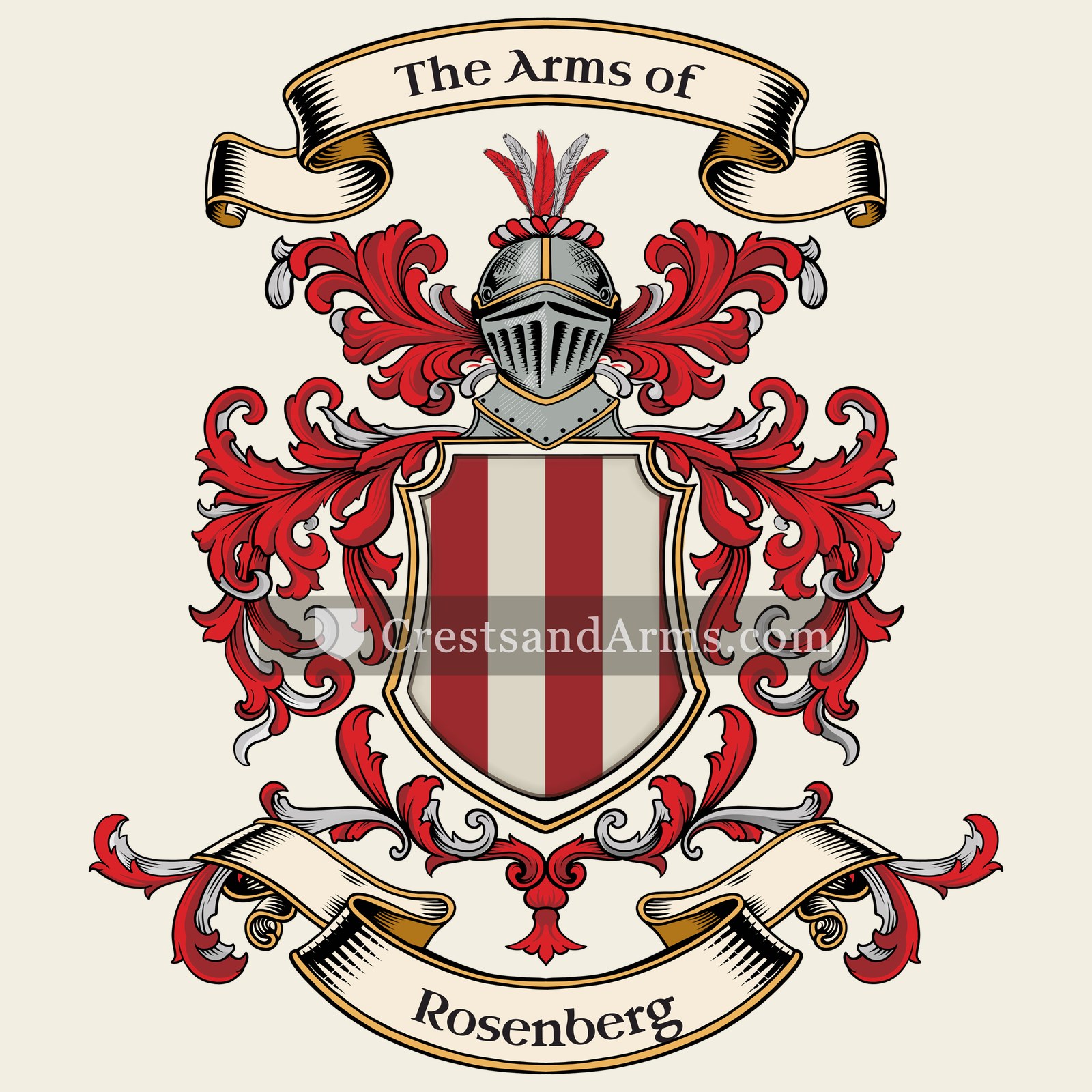


 roseThe seventh son, and beauty with grace
 roundelA coin, and one who has been to the crusades
 mulletThe third son, and a divine quality from above
 towerGrandeur and solidity, and a stronghold defended