A record of documented arms, meaning and origin, researched for the Roser family lines. Documented in 2 countries.
Reg. 2394 · German, P–S
Meaning of the Roser family crest colors & symbols
Symbols on this shield
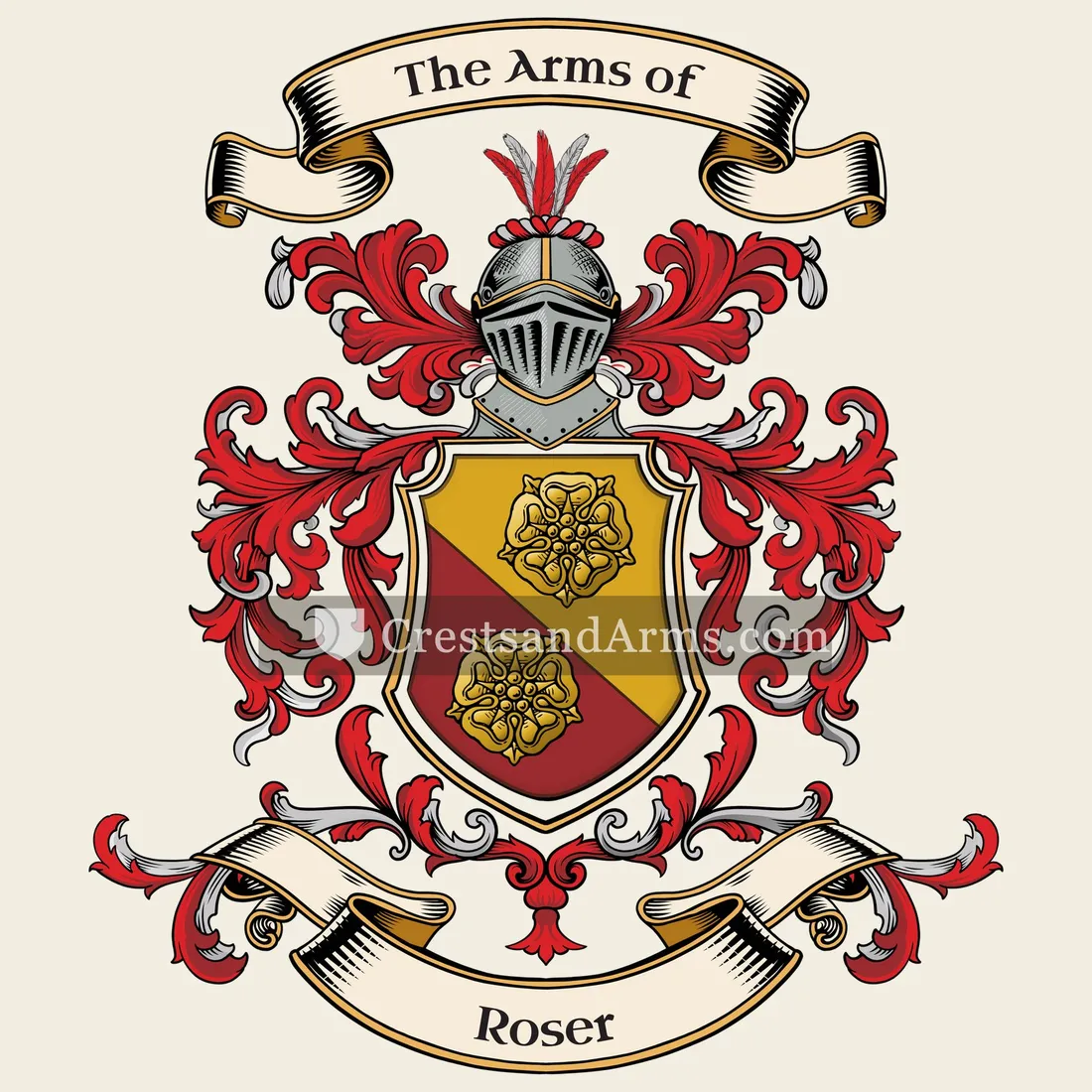
roseThe seventh son, and beauty with grace
Colours
Red (Gules)Means: Military strength
Gold (Or)Means: Generosity
Historical info
Source
J. B. Rietstap, Armorial Général, Gouda: G. B. van Goor Zonen, 1884–87
Blazon (the actual original written record)
“Tranché de gu. sur or; à deux roses de l'un à l'autre. C.: un rosier de sin., fleuri d'une rose, de deux grands boutons et de quatre petits boutons, le tout de gu.”
GermanyPalatinat, c. 1765
Digital archive packCoat of arms PNG, gold border print PDF, vector SVG and the certificate of authenticity. Sent to your email in minutes.
Map of Germany showing where the Roser arms are recorded
The Roser arms were recorded in Palatinat, c. 1765.
This is where the arms were entered in the register. Families often moved to other parts of the country, so the same name can turn up in more than one region.
The body that granted and recorded arms in Germany in this period.
Francis I, Holy Roman Emperor
Sovereign of the period
Francis I, Holy Roman Emperor
1745–1765
Reigning in Germany when the Roser arms are first recorded.
How Arms Worked in Germany
In the Holy Roman Empire, coats of arms were often granted to individuals by the Emperor or his representatives. These arms were then passed down through the generations to all legitimate descendants of the original holder. Younger branches of a family usually kept the same shield design without needing to change it, as the arms belonged to the entire lineage.
Granting authority
The Holy Roman Emperor held the sole power to grant new coats of arms throughout his vast imperial territories.
How they got arms
Families typically obtained their coats of arms through a formal imperial grant or by proving their noble status to the authorities.
Where arms were recorded
These grants were officially recorded in the Imperial Chancery registers, which began keeping formal records of such honors during the Middle Ages.
The family's standing
Recorded among the armigerous families of Germany.
Origin & History of the Roser Family in Germany
The family name Roser finds its roots in the linguistic traditions of southern Germany, where it likely developed as a descriptive surname. In the Middle Ages, names were often derived from a person’s occupation, physical traits, or the environment in which they lived. The name Roser is closely linked to the Middle High German word for a rose, suggesting that early ancestors may have lived near a prominent rose garden or worked as gardeners. By the mid-eighteenth century, historical records confirm that the family was well-established in the Palatinate region. This area, located in the southwest of Germany, was a hub of agricultural activity and social change during the 1760s. Families like the Rosers were deeply connected to the local village life, often participating in the tight-knit farming communities that defined the Rhine valley. Their presence in the region during this time reflects the broader patterns of German families who maintained strong ties to their ancestral lands before the waves of migration that would later shape the family’s global history.
Meaning of the Roser family crest colors & symbols
Symbols on this shield
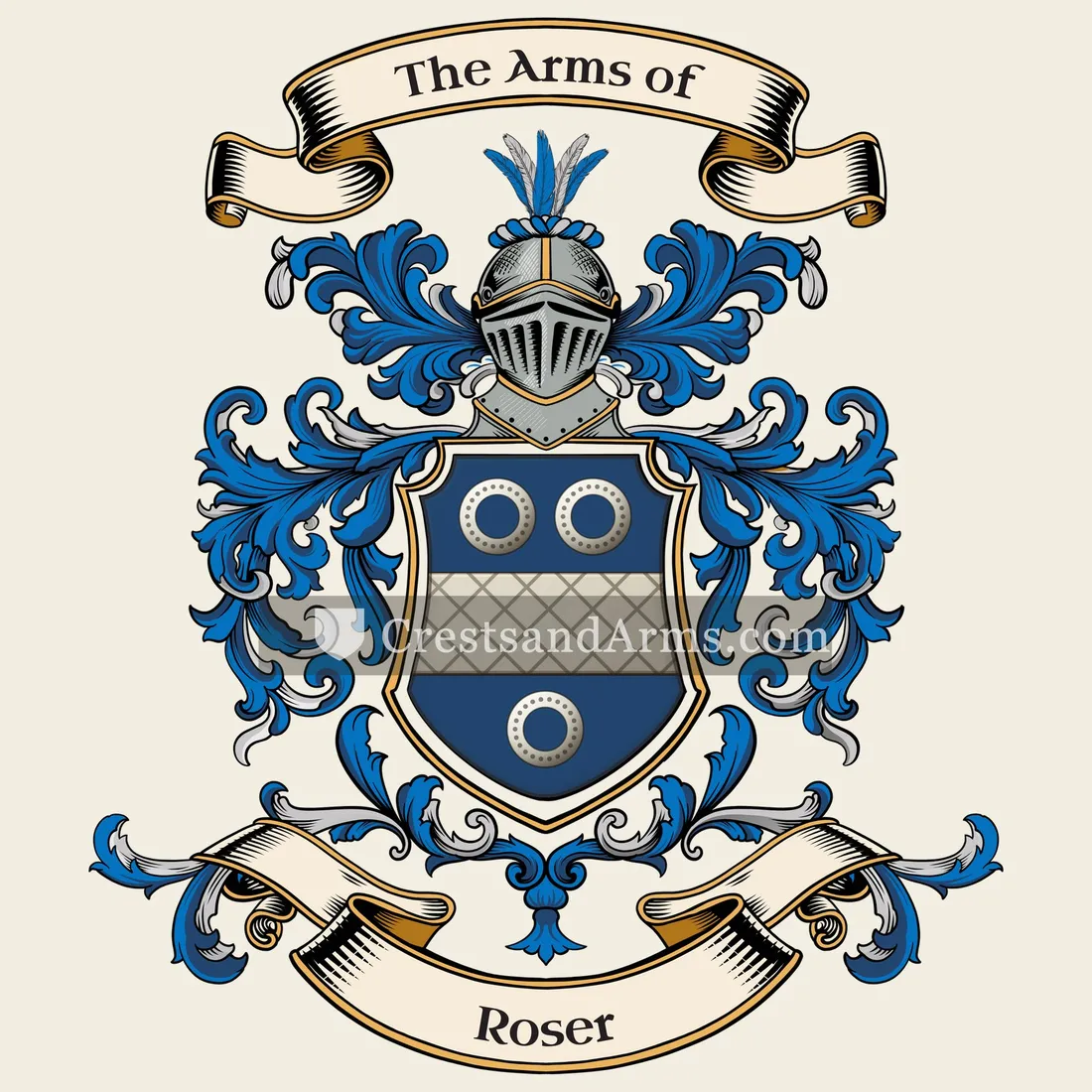
fessThe military belt, and readiness to serve
ringFidelity, and a promise kept
Colours
Blue (Azure)Means: Loyalty and truth
Silver (Argent)Means: Peace and sincerity
Historical info
Source
Sir Bernard Burke, The General Armory of England, Scotland, Ireland and Wales, London: Harrison & Sons, 1884
Blazon (the actual original written record)
“Az. a fess betw. three annulets ar.; another, Ar. on a chief indented gu. three roses or; another, Ar. a fess betw. three annulets az”
Englandc. 1620
Digital archive packCoat of arms PNG, gold border print PDF, vector SVG and the certificate of authenticity. Sent to your email in minutes.
Map of England showing where the Roser arms are recorded
The Roser arms were recorded in England, c. 1620.
Arms such as these were typically recorded in York.
Yorkshire is the largest of the English counties, and it held more gentry families than any other. Land there was split among a great many households rather than a few, so a great many of them carried arms.
This is where the arms were entered in the register. Families often moved to other parts of the country, so the same name can turn up in more than one region.
The body that granted and recorded arms in England in this period.
James VI and I
Sovereign of the period
James VI and I
1603–1625
Reigning in Germany when the Roser arms are first recorded.
How Arms Worked in England
English heraldry allowed arms to be shared by all legitimate descendants of the original owner. These symbols were treated as personal property that moved through the generations to all children. While the eldest son kept the original design, other family members could use the same shield without needing to change it or register their own unique versions.
Granting authority
The College of Arms in London has regulated the use of coats of arms throughout England and Wales since 1484.
How they got arms
Families typically obtained their coats of arms through a formal grant from the Crown or by proving their ancient right to them.
Where arms were recorded
All official coats of arms are recorded in the registers kept at the College of Arms, which date back to the fifteenth century.
The family's standing
Recorded among the armigerous families of England.
Origin & History of the Roser Family in England
The family name Roser has roots in England that stretch back several centuries, with a notable presence in the historic city of York by the year 1620. During this period, the name was likely associated with individuals who lived near a prominent rose bush or perhaps those who worked as rose growers in the fertile lands surrounding the city. Life in seventeenth-century York was defined by the city's role as a major northern trade hub, meaning the early Roser family members were likely integrated into the bustling merchant or artisan classes of the region. As the name became established in local parish registers, it moved from being a simple descriptive label to a permanent family identifier. This transition reflects the broader social changes in England, where families began to settle in specific areas and maintain their identities across generations. By establishing themselves in York, the early members of this family became part of the long and complex history of Northern England.
Roser Meaning & Related Branches
Root word
Rosa
Latin word for the flower known as a rose.
This name
RoserOccupational or topographic name for someone who lived near rose bushes or cultivated them.
also spelled
Rosser
Rozer
Rosar
Rozier
Related arms
Behuchetsimilar arms
Friissimilar arms
Keuchensimilar arms
Rosservariant spelling
Documented Sources
J. B. Rietstap, Armorial Général, Gouda: G. B. van Goor Zonen, 1884–87
Bahlow, Hans. Deutsches Namenlexikon: Familien- und Vornamen nach Ursprung und Sinn erklärt. 1967
Heintze, Albert. Die deutschen Familien-Namen: geschichtlich, geographisch, sprachlich. 1903
Landesarchiv Speyer, Kirchenbücher der Pfalz (Church records of the Palatinate)
Digital archive packCoat of arms PNG, gold border print PDF, vector SVG and the certificate of authenticity. Sent to your email in minutes.


 roseThe seventh son, and beauty with grace
 roseThe seventh son, and beauty with grace


 fessThe military belt, and readiness to serve
 ringFidelity, and a promise kept