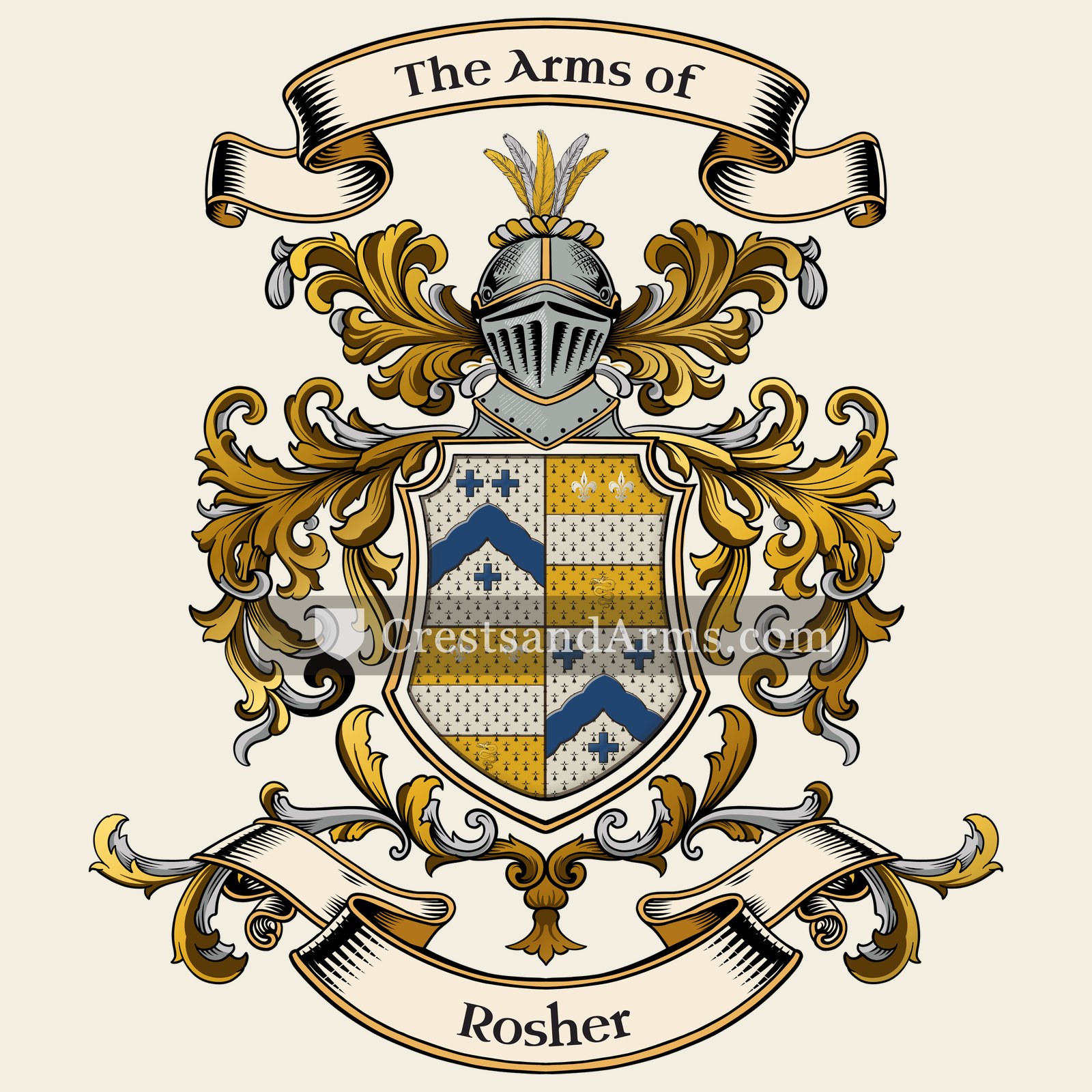
A record of documented arms, meaning and origin, researched for the Rosher family of England.
Reg. 5146 · English, P–S
Coat of Arms & Family Crest Details
Symbols on this shield
chevronProtection, and faithful service completed
cross symbolChristian faith and service
paleMilitary strength, and a fortified defence
fessThe military belt, and readiness to serve
fleur de lisPurity, light, and the sixth son
serpentWisdom, healing and prudence
Colours
ErmineMeans: Dignity
Blue (Azure)Means: Loyalty and truth
Silver (Argent)Means: Peace and sincerity
Gold (Or)Means: Generosity
Historical info
Source
Sir Bernard Burke, The General Armory of England, Scotland, Ireland and Wales, London: Harrison & Sons, 1884
Blazon (the actual original written record)
“Quarterly, 1st and 4th, per chev. engr. erm. and erminois three crosses pattée az. each charged with an estoile or, for ROSHER; 2nd and 3rd, per pale gu. and az. a fess erm. betw. two fleurs-de-lis in chief ar. and a writhed snake paleway in base or, for BURCH; on an escutcheon of pretence as Lord of the Manor of Trewyn, the arms of the Manor, viz., Az. a chev. betw. three oak trees eradicated or”
HerefordTrewyn House · Hereford, c. 1620
Digital archive packCoat of arms PNG, gold border print PDF, vector SVG and the certificate of authenticity. Sent to your email in minutes.
Map of England showing where the Rosher arms are recorded
The Rosher arms were recorded in Hereford, c. 1620.
Herefordshire lay on the Welsh border, where land was held in return for military service. Families there were expected to arm and to fight, and a fighting household needed a shield it could be known by.
This is where the arms were entered in the register. Families often moved to other parts of the country, so the same name can turn up in more than one region.
The body that granted and recorded arms in England in this period.
James VI and I
Sovereign of the period
James VI and I
1603–1625
Reigning in England when the Rosher arms are first recorded.
How Arms Worked in England
English heraldry allowed arms to be shared by all legitimate descendants of the original owner. These symbols were treated as personal property that moved through the generations to all children. While the eldest son kept the original design, other family members could use the same shield without needing to change it or register their own unique versions.
Granting authority
The College of Arms in London has regulated the use of coats of arms throughout England and Wales since 1484.
How they got arms
Families typically obtained their coats of arms through a formal grant from the Crown or by proving their ancient right to them.
Where arms were recorded
All official coats of arms are recorded in the registers kept at the College of Arms, which date back to the fifteenth century.
The family's standing
Recorded among the armigerous families of Hereford.
Origin & History of the Rosher Family in England
The Rosher family name has deep roots in the English county of Herefordshire, where records confirm members of the family were living as early as 1620. During the seventeenth century, families in this region were often closely tied to the land and the local agricultural economy. The name itself likely evolved from a descriptive term or a nickname used to identify individuals in small, tight-knit rural communities. As the family became established in Hereford, they integrated into the local social structure, participating in the daily life and trade of the West Midlands. Over time, the name persisted through generations, marking the family as a stable presence in the area long before the industrial changes of later centuries. By remaining in the same geographic region for generations, the early Roshers helped shape the local history of their community through their work and their presence in parish records.
Related Branches & Arms
Root word
Hros
An Old Germanic term referring to a horse.
This name
RosherA habitational name for someone living near a horse pasture or a keeper of horses.
also spelled
Roshear
Rosshere
Rosier
Related arms
Rosiervariant spelling
Documented Sources
Sir Bernard Burke, The General Armory of England, Scotland, Ireland and Wales, London: Harrison & Sons, 1884


 chevronProtection, and faithful service completed
 cross symbolChristian faith and service
 paleMilitary strength, and a fortified defence
 fessThe military belt, and readiness to serve
 fleur de lisPurity, light, and the sixth son
 serpentWisdom, healing and prudence
 chevronProtection, and faithful service completed
 cross symbolChristian faith and service
 paleMilitary strength, and a fortified defence
 fessThe military belt, and readiness to serve
 fleur de lisPurity, light, and the sixth son
 serpentWisdom, healing and prudence