Map of Germany showing where the Ross arms are recorded
The Ross arms were recorded in Nördlingen Bav, c. 1765.
This is where the arms were entered in the register. Families often moved to other parts of the country, so the same name can turn up in more than one region.
The body that granted and recorded arms in Germany in this period.
Francis I, Holy Roman Emperor
Sovereign of the period
Francis I, Holy Roman Emperor
1745–1765
Reigning in Germany when the Ross arms are first recorded.
How Arms Worked in Germany
In the Holy Roman Empire, coats of arms were often granted to individuals by the Emperor or his representatives. These arms were then passed down through the generations to all legitimate descendants of the original holder. Younger branches of a family usually kept the same shield design without needing to change it, as the arms belonged to the entire lineage.
Granting authority
The Holy Roman Emperor held the sole power to grant new coats of arms throughout his vast imperial territories.
How they got arms
Families typically obtained their coats of arms through a formal imperial grant or by proving their noble status to the authorities.
Where arms were recorded
These grants were officially recorded in the Imperial Chancery registers, which began keeping formal records of such honors during the Middle Ages.
The family's standing
Recorded among the armigerous families of Germany.
Origin & History of the Ross Family in Germany
The surname Ross has deep roots in the German-speaking regions of Europe, where it often functioned as a descriptive name or a topographic identifier. In the context of the Holy Roman Empire, the name is frequently linked to the Middle High German word "ros," which translates to horse. This suggests that early ancestors may have been horse breeders, skilled riders, or individuals who lived near a location associated with horses. By the mid-18th century, the family had established a documented presence in the town of Nördlingen. During this period, Nördlingen was a significant center for trade and craftsmanship, and families living there were often deeply integrated into the local guild systems and civic administration. The presence of the Ross family in this historic walled city by 1765 reflects a lineage that was likely part of the industrious middle class, participating in the daily economic and social life of a thriving Bavarian community.
Meaning of the Ross family crest colors & symbols
Symbols on this shield
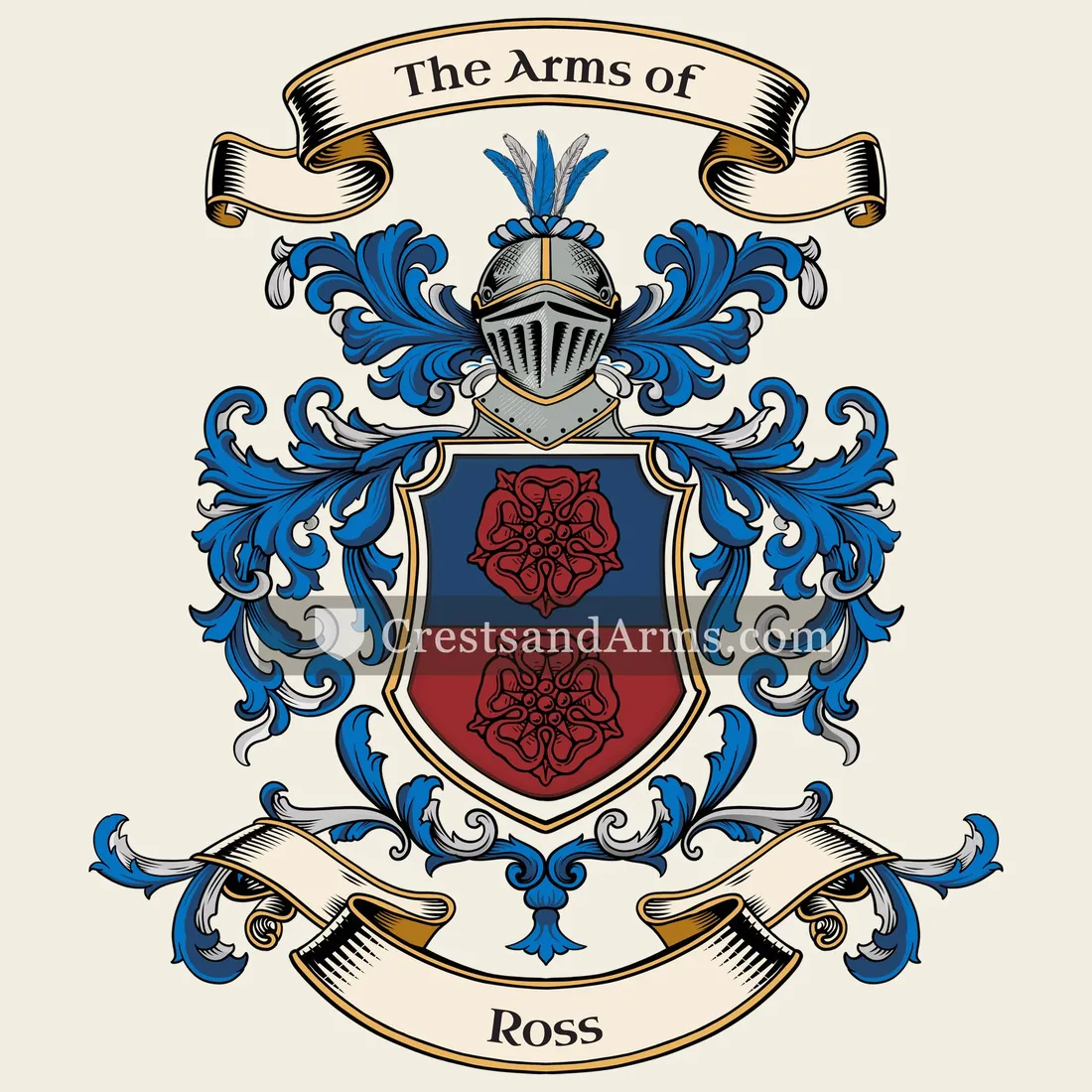
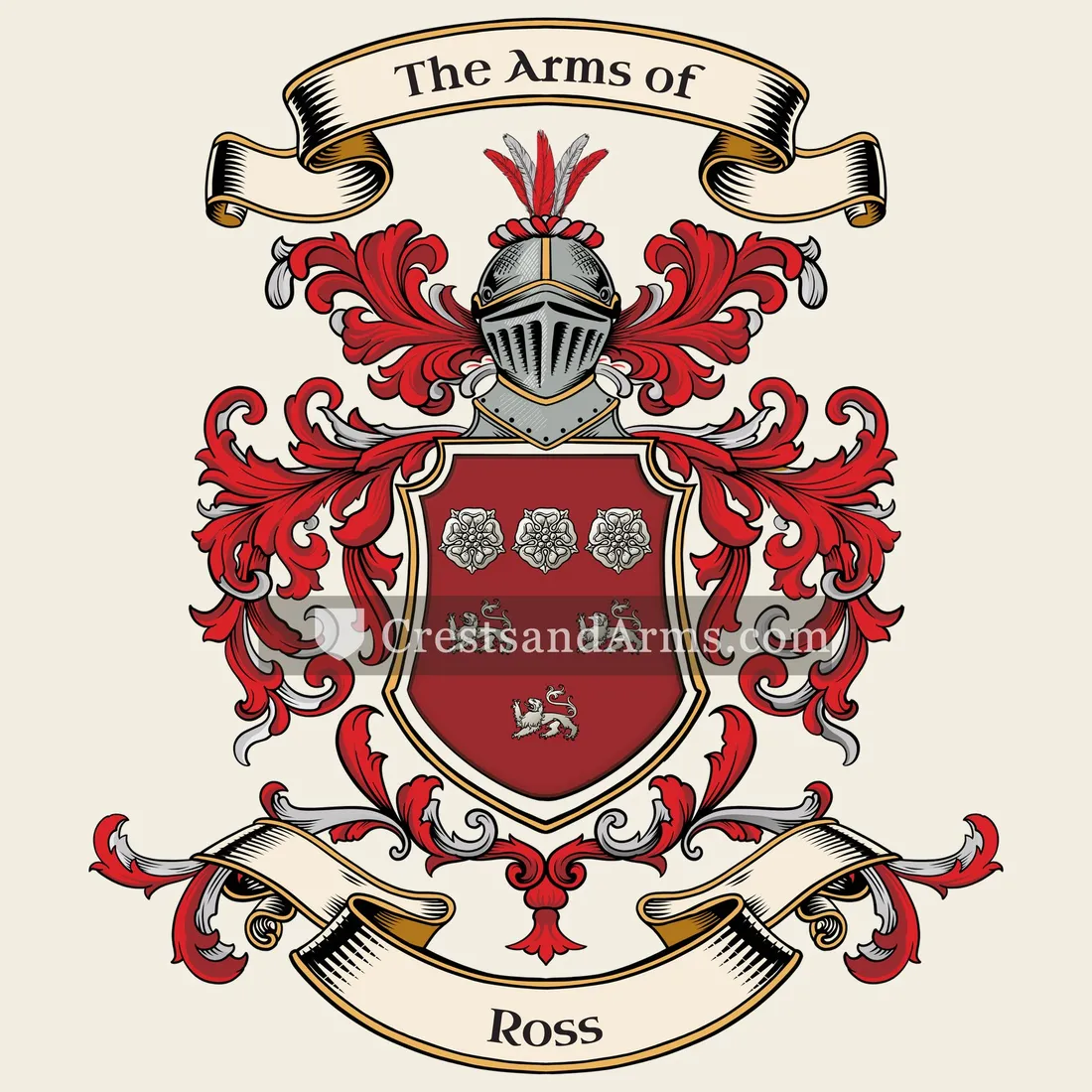
roseThe seventh son, and beauty with grace
lionCourage, strength and royalty
Colours
Red (Gules)Means: Military strength
Silver (Argent)Means: Peace and sincerity
Historical info
Source
Sir Bernard Burke, The General Armory of England, Scotland, Ireland and Wales, London: Harrison & Sons, 1884
Blazon (the actual original written record)
“Gu. three roses slipped ppr. in fess betw. as many lions ramp. ar”
Scotlandc. 1672
Digital archive packCoat of arms PNG, gold border print PDF, vector SVG and the certificate of authenticity. Sent to your email in minutes.
Map of Scotland showing where the Ross arms are recorded
The Ross arms were recorded in Scotland, c. 1672.
Arms such as these were typically recorded in Edinburgh.
Edinburgh was the seat of Scotland's government, its courts and its heralds. Families with business there settled nearby, and being close to where arms were recorded is exactly why so many of them appear.
This is where the arms were entered in the register. Families often moved to other parts of the country, so the same name can turn up in more than one region.
The body that granted and recorded arms in Scotland in this period.
Charles II of England
Sovereign of the period
Charles II of England
1660–1685
Reigning in Germany when the Ross arms are first recorded.
How Arms Worked in Scotland
Scottish heraldry is unique because it treats a coat of arms as a piece of personal property protected by law. Only one person can own a specific design at any given time. When a family grows, the head keeps the original shield while other relatives must apply for their own distinct version with slight changes to prove their specific identity.
Granting authority
The Court of the Lord Lyon acts as the official body that regulates and controls all heraldic matters throughout Scotland.
How they got arms
Individuals obtain a legal right to their arms through a formal petition process that confirms their identity and family connection.
Where arms were recorded
All valid coats of arms are officially entered into the Public Register of All Arms and Bearings starting from 1672.
The family's standing
Recorded among the armigerous families of Scotland.
Origin & History of the Ross Family in Scotland
The surname Ross has deep roots in the rugged landscape of Scotland, where it originated as a geographic descriptor for people living in the northern region of Ross. The name comes from the Gaelic word ros, which refers to a headland or a promontory jutting into the sea. Over time, families who lived in this territory adopted the name to identify their home and heritage. By the late 17th century, the family had established a clear presence in the capital city of Edinburgh. Records from 1672 show members of the Ross family living and working within the city, marking their transition from regional landowners to active participants in the urban life of Scotland’s administrative center. This movement reflects the broader history of Scottish families who migrated from the Highlands and rural areas toward the growing influence of Edinburgh during the early modern period.
Meaning of the Ross family crest colors & symbols
Symbols on this shield
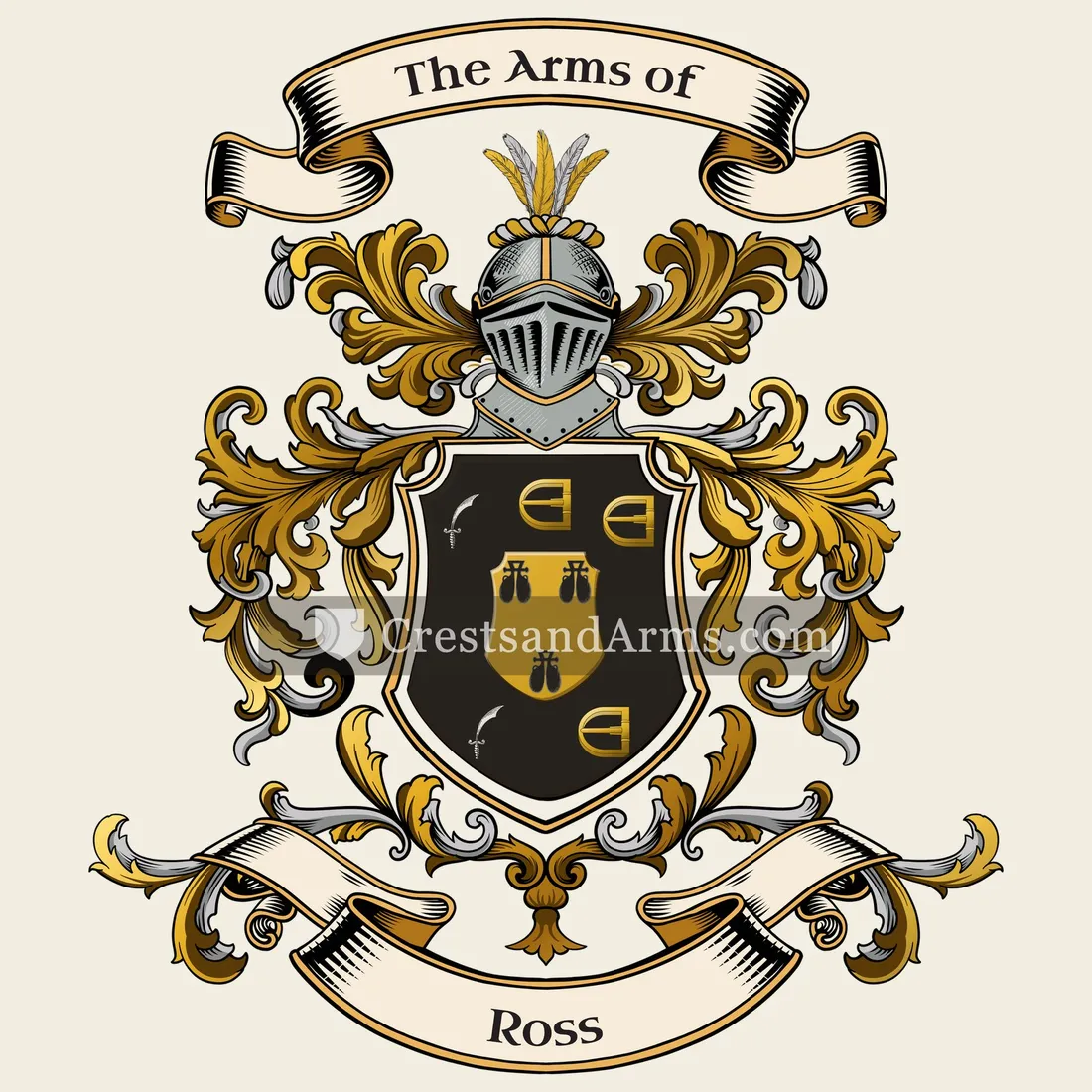
buckleFidelity, and a bond firmly held
swordJustice, and military honour
water bougetThe crusader's water carrier, and a journey made
Colours
Black (Sable)Means: Constancy
Gold (Or)Means: Generosity
Historical info
Source
Sir Bernard Burke, The General Armory of England, Scotland, Ireland and Wales, London: Harrison & Sons, 1884
Blazon (the actual original written record)
“Sa. three padlocks or, in fess, an escutcheon of the last betw. two swords erect ppr. hilts and pommels gold, the escutcheon charged with a boar's head erased gu. betw. three water bougets of the first”
HerefordLamer Park · Hereford, c. 1620
Digital archive packCoat of arms PNG, gold border print PDF, vector SVG and the certificate of authenticity. Sent to your email in minutes.
Map of England showing where the Ross arms are recorded
The Ross arms were recorded in Hereford, c. 1620.
Herefordshire lay on the Welsh border, where land was held in return for military service. Families there were expected to arm and to fight, and a fighting household needed a shield it could be known by.
This is where the arms were entered in the register. Families often moved to other parts of the country, so the same name can turn up in more than one region.
The body that granted and recorded arms in England in this period.
James VI and I
Sovereign of the period
James VI and I
1603–1625
Reigning in Germany when the Ross arms are first recorded.
How Arms Worked in England
English heraldry allowed arms to be shared by all legitimate descendants of the original owner. These symbols were treated as personal property that moved through the generations to all children. While the eldest son kept the original design, other family members could use the same shield without needing to change it or register their own unique versions.
Granting authority
The College of Arms in London has regulated the use of coats of arms throughout England and Wales since 1484.
How they got arms
Families typically obtained their coats of arms through a formal grant from the Crown or by proving their ancient right to them.
Where arms were recorded
All official coats of arms are recorded in the registers kept at the College of Arms, which date back to the fifteenth century.
The family's standing
Recorded among the armigerous families of Hereford.
Origin & History of the Ross Family in England
The family name Ross has deep roots in the English landscape, particularly within the border regions where history was often shaped by movement and trade. By the year 1620, records confirm that members of the family were established in Hereford, a city known for its strategic location near the Welsh border. During this period, the name was often associated with people who lived near a prominent headland or a specific geographical feature, as the word itself is linked to old terms for a promontory or a wooded area. Families in this region were frequently involved in local agriculture or the growing wool trade, which allowed them to settle into the community and become part of the social fabric of the county. As the family put down roots in Hereford, they became part of the local administrative and parish life that defined seventeenth-century England. This transition from regional wanderers to settled landholders reflects the broader patterns of English migration and social development during the early modern era.
Ross Meaning & Related Branches
Root word
Hros
An Old High German word meaning horse.
This name
RossA topographic name for someone living on a heath or a habitational name from various places named Ross.
also spelled
Rosse
Ros
Roos
Roose
Rose
Related arms
Houstonsimilar arms
Rosesimilar arms
Roosvariant spelling
Rosvariant spelling
Documented Sources
J. B. Rietstap, Armorial Général, Gouda: G. B. van Goor Zonen, 1884–87
Stadtarchiv Nördlingen, Bürgerbuch der Stadt Nördlingen
Evangelisch-Lutherisches Dekanat Nördlingen, Kirchenbücher der Pfarrei St. Georg
Bahlow, Hans, Deutsches Namenlexikon: Familien- und Vornamen nach Ursprung und Sinn erklärt, 1967
Gottschald, Max, Deutsche Namenkunde: Unsere Familiennamen nach ihrer Entstehung und Bedeutung, 1954
Digital archive packCoat of arms PNG, gold border print PDF, vector SVG and the certificate of authenticity. Sent to your email in minutes.


 roseThe seventh son, and beauty with grace
 roseThe seventh son, and beauty with grace


 lionCourage, strength and royalty


 buckleFidelity, and a bond firmly held
 swordJustice, and military honour
 water bougetThe crusader's water carrier, and a journey made