Map of France showing where the Rosson arms are recorded
The Rosson arms were recorded in Lorraine, c. 1610.
Lorraine sat on the border between France and the German lands, and border country bred soldiers. Families here held small estates and served in arms, and a fighting man was exactly the sort who carried a shield of his own.
This is where the arms were entered in the register. Families often moved to other parts of the country, so the same name can turn up in more than one region.
The body that granted and recorded arms in France in this period.
Henry IV of France
Sovereign of the period
Henry IV of France
1589–1610
Reigning in France when the Rosson arms are first recorded.
How Arms Worked in France
In France, a coat of arms was a mark of honor that passed down through the male line to all legitimate descendants. Families often used the same shield without changes to show their shared heritage. If a branch wanted to stand out, they could add a small mark to their shield to show their specific place in the family tree.
Granting authority
The Juge d'armes de France acted as the official authority that regulated and verified coats of arms across the country.
How they got arms
Families typically inherited their arms from ancestors, though they could also receive them through royal grants or by proving their noble status.
Where arms were recorded
Coats of arms were officially recorded in the Armorial Général de France, which began its main collection in the year 1696.
The family's standing
Recorded among the armigerous families of Lorraine.
Origin & History of the Rosson Family in France
The family name Rosson traces its historical roots to the region of Lorraine, a territory located in northeastern France that has long served as a crossroads for European culture. By the year 1610, records indicate that members of the family were established within this area, which was then a duchy with a distinct identity separate from the French crown. During this period, Lorraine was a center for trade and craftsmanship, and families living there were often influenced by the shifting borders and political tensions between the Holy Roman Empire and neighboring kingdoms. The name likely evolved as a descriptive identifier or a regional marker for those living in or near specific settlements within the duchy. As the seventeenth century progressed, the family members navigated the challenges of the Thirty Years' War, which brought significant upheaval to the Lorraine region and prompted many residents to seek new opportunities in surrounding territories.
Rosson Meaning & Related Branches
Root word
Rous
Derived from the Old French word for red or reddish.
This name
RossonA descriptive surname for someone with red hair or a ruddy complexion.
also spelled
Roussonn
Rooson
Documented Sources
J. B. Rietstap, Armorial Général, Gouda: G. B. van Goor Zonen, 1884–87
Archives départementales de Meurthe-et-Moselle, Série B: Cours et juridictions
Cabourdin, Guy, Histoire de la Lorraine, 1991
Martin, Jean-François, La vie quotidienne en Lorraine au XVIIe siècle, 1985
Digital archive packCoat of arms PNG, gold border print PDF, vector SVG and the certificate of authenticity. Sent to your email in minutes.


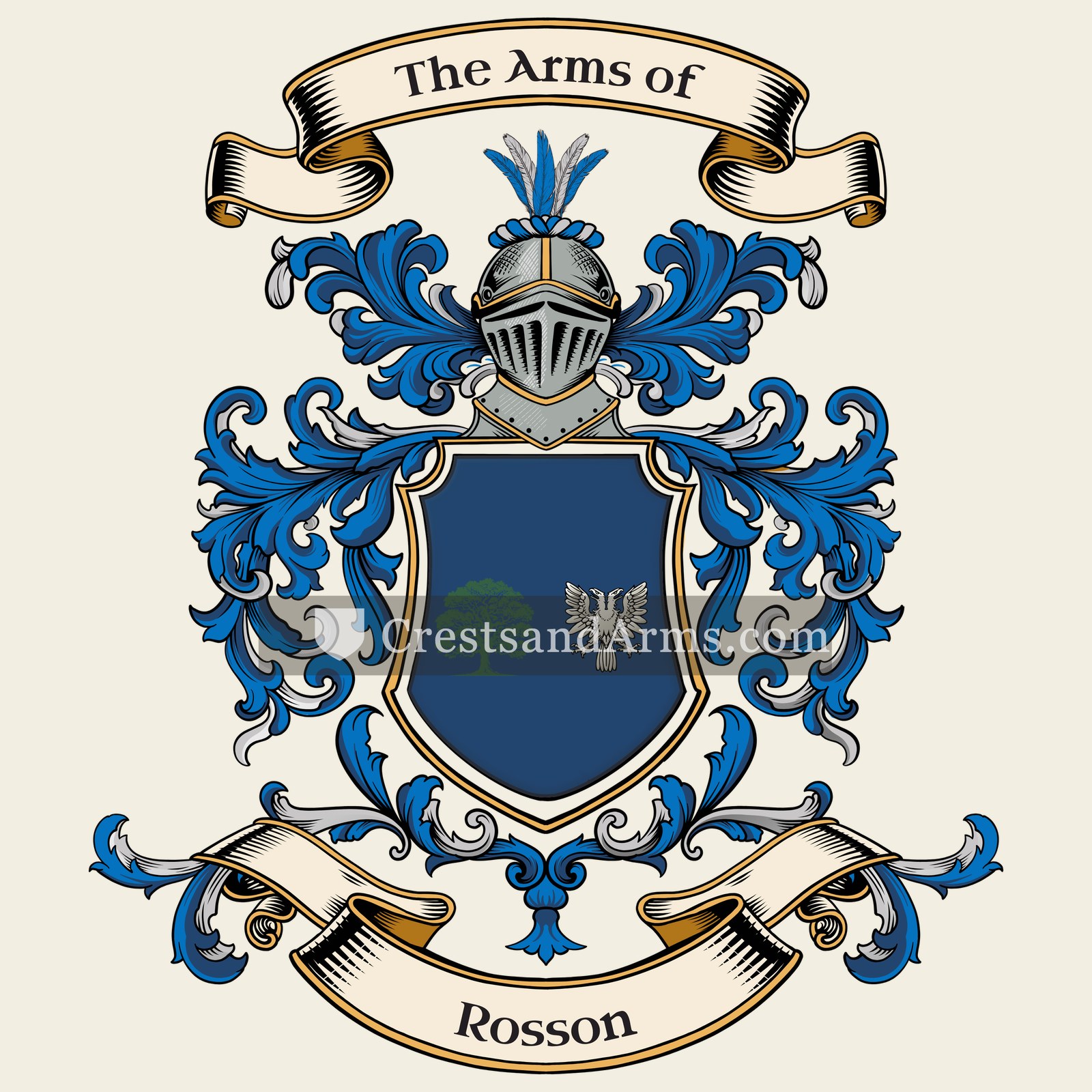
 treeLife, endurance and deep roots
 eagleNobility, strength and a keen mind
 treeLife, endurance and deep roots
 eagleNobility, strength and a keen mind