A record of documented arms, meaning and origin, researched for the Rousseau family lines. Documented in 2 countries.
Reg. 6666 · French, P–S
Coat of Arms & Family Crest Details
Symbols on this shield
chevronProtection, and faithful service completed
mulletThe third son, and a divine quality from above
fleur de lisPurity, light, and the sixth son
Colours
Blue (Azure)Means: Loyalty and truth
Gold (Or)Means: Generosity
Silver (Argent)Means: Peace and sincerity
Historical info
Source
J. B. Rietstap, Armorial Général, Gouda: G. B. van Goor Zonen, 1884–87
Blazon (the actual original written record)
“de sa main dextre un pin arr. de sin. et appuyant la main sen. sur sa hanche; au 3 d'azur au chev. d'or, acc. en chef de deux étoiles (8) d'arg. et en p. d'une fleur-de-lis du même. Sur le tout les armes des Rouph barons de Varicourt de la création de 1808. Deux cq. cour. C.: 1º le cimier des Rouph barons de Varicourt; 1.: à dextre d'arg. et d'azur, à sen. d'arg. et de sa.; 2º la femme iss. du 2; 1. d'or et d'azur. S.: deux lions reg. d'arg., lamp. de gu. D.: EN FYANCE ET FÉAULTÉ.”
Francec. 1663
Digital archive packCoat of arms PNG, gold border print PDF, vector SVG and the certificate of authenticity. Sent to your email in minutes.
Map of France showing where the Rousseau arms are recorded
The Rousseau arms were recorded in France, c. 1663.
Arms such as these were typically recorded in Bretagne.
More families held coats of arms in Bretagne than anywhere else in France. The land was divided into many small estates rather than a few large ones, so far more households counted as gentry, and each needed a shield of its own to be told apart.
This is where the arms were entered in the register. Families often moved to other parts of the country, so the same name can turn up in more than one region.
The body that granted and recorded arms in France in this period.
Louis XIV of France
Sovereign of the period
Louis XIV of France
1643–1715
Reigning in France when the Rousseau arms are first recorded.
How Arms Worked in France
In France, a coat of arms was a mark of honor that passed down through the male line to all legitimate descendants. Families often used the same shield without changes to show their shared heritage. If a branch wanted to stand out, they could add a small mark to their shield to show their specific place in the family tree.
Granting authority
The Juge d'armes de France acted as the official authority that regulated and verified coats of arms across the country.
How they got arms
Families typically inherited their arms from ancestors, though they could also receive them through royal grants or by proving their noble status.
Where arms were recorded
Coats of arms were officially recorded in the Armorial Général de France, which began its main collection in the year 1696.
The family's standing
Recorded among the armigerous families of France.
Origin & History of the Rousseau Family in France
The surname Rousseau originated in medieval France as a descriptive nickname, derived from the Old French word "rous," which means red. It was traditionally used to identify individuals with red hair or a ruddy complexion. By the time the family established a documented presence in the Brittany region during the mid-seventeenth century, the name had already become a well-distributed fixture across the French landscape. Families bearing this name were often integrated into the local agricultural and artisanal communities of the time. Because the name was rooted in a common physical trait, it emerged independently in many different provinces rather than originating from a single ancestral line. The records from 1663 confirm that by the seventeenth century, the name was firmly rooted in the social fabric of Brittany, where members of the family participated in the daily life and administrative record-keeping of their parishes.
Coat of Arms & Family Crest Details
Symbols on this shield
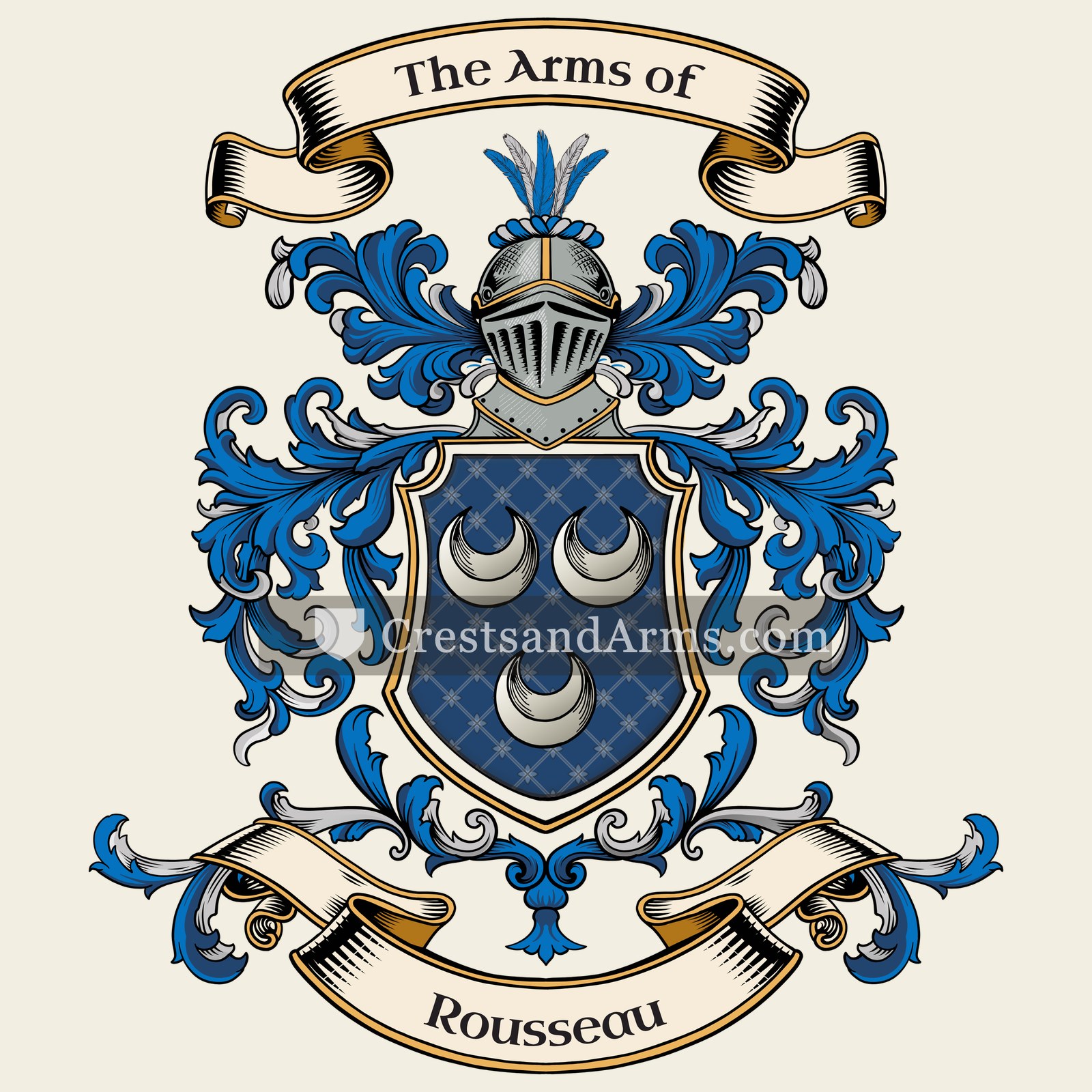
crescentHonour by the sovereign, and the second son
Colours
Blue (Azure)Means: Loyalty and truth
Silver (Argent)Means: Peace and sincerity
Historical info
Source
J. B. Rietstap, Armorial Général, Gouda: G. B. van Goor Zonen, 1884–87
Blazon (the actual original written record)
“D'azur à trois croiss. d'arg., surm. chacun d'une quintefeuille du même. C.: une quintefeuille d'arg.”
FlandreFlandre, c. 1663
Digital archive packCoat of arms PNG, gold border print PDF, vector SVG and the certificate of authenticity. Sent to your email in minutes.
Map of Belgium showing where the Rousseau arms are recorded
The Rousseau arms were recorded in Flandre, c. 1663.
Flandre grew rich on cloth, and its towns were among the busiest in Europe. Merchant families bought land with their profits and took arms to go with it, so trade put as many names in the registers here as land did.
This is where the arms were entered in the register. Families often moved to other parts of the country, so the same name can turn up in more than one region.
The body that granted and recorded arms in Belgium in this period.
Philip IV of Spain
Sovereign of the period
Philip IV of Spain
1621–1665
Reigning in France when the Rousseau arms are first recorded.
How Arms Worked in Belgium
In Belgium, a coat of arms is considered personal property that is passed down through the male line to legitimate descendants. Families often use the same shield design across generations to show their shared heritage. If a branch of the family wants to change the design, they must apply for an official update to their specific version of the arms.
Granting authority
The Conseil héraldique is the official body that regulates and approves all coats of arms in Belgium.
How they got arms
Families obtain their coats of arms through formal royal grants or by confirming their historical right to use existing designs.
Where arms were recorded
All approved coats of arms are officially recorded in the public registers of the Conseil héraldique since 1844.
The family's standing
Recorded among the armigerous families of Flandre.
Origin & History of the Rousseau Family in Belgium
The family name Rousseau has deep roots in the historical region of Flanders, where records confirm members of the family were established by 1663. The name itself is derived from the Old French word rous, which describes someone with red hair or a ruddy complexion. In the context of 17th-century Belgium, families with this name were often integrated into the local agricultural or artisan communities that defined the Flemish landscape. Because the region was a crossroads for trade and cultural exchange between French-speaking and Dutch-speaking populations, the name Rousseau became a common identifier for families moving across these linguistic borders. By the mid-1600s, these individuals were already documented in parish registers and local tax records, showing that they were active participants in the social and economic life of their towns. These early ancestors helped establish a lasting presence for the name in the region, reflecting the broader patterns of migration and family growth that shaped the history of the Low Countries.
Related Branches & Arms
Root word
Roux
A French term derived from Latin russus meaning red or reddish.
This name
RousseauA descriptive nickname for someone with red hair or a ruddy complexion.
also spelled
Roussault
Rooso
Related arms
Schönebecksimilar arms
le Rosseauvariant spelling
Documented Sources
J. B. Rietstap, Armorial Général, Gouda: G. B. van Goor Zonen, 1884–87
Dauzat, Albert. Dictionnaire étymologique des noms et prénoms de France. 1951
Morlet, Marie-Thérèse. Dictionnaire étymologique des noms de famille. 1991
Digital archive packCoat of arms PNG, gold border print PDF, vector SVG and the certificate of authenticity. Sent to your email in minutes.


 chevronProtection, and faithful service completed
 mulletThe third son, and a divine quality from above
 fleur de lisPurity, light, and the sixth son
 chevronProtection, and faithful service completed
 mulletThe third son, and a divine quality from above
 fleur de lisPurity, light, and the sixth son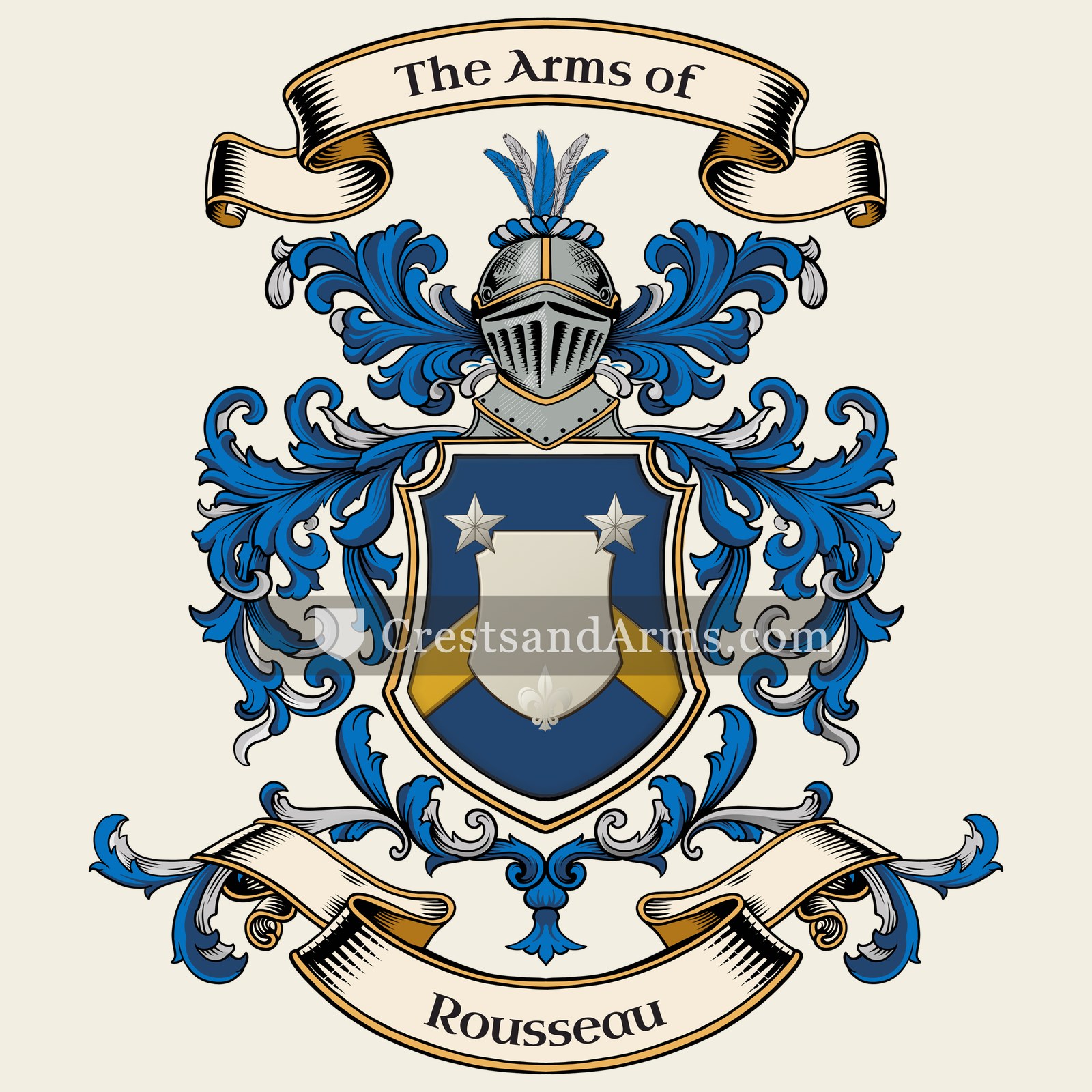


 crescentHonour by the sovereign, and the second son