Map of England showing where the Royse arms are recorded
The Royse arms were recorded in Kent, c. 1589.
Kent sits between London and the short crossing to Europe, and the trade passing through made it wealthy. Merchant families bought land with that money, and it was landowners who took coats of arms.
This is where the arms were entered in the register. Families often moved to other parts of the country, so the same name can turn up in more than one region.
The body that granted and recorded arms in England in this period.
Elizabeth I of England
Sovereign of the period
Elizabeth I of England
1558–1603
Reigning in England when the Royse arms are first recorded.
How Arms Worked in England
English heraldry allowed arms to be shared by all legitimate descendants of the original owner. These symbols were treated as personal property that moved through the generations to all children. While the eldest son kept the original design, other family members could use the same shield without needing to change it or register their own unique versions.
Granting authority
The College of Arms in London has regulated the use of coats of arms throughout England and Wales since 1484.
How they got arms
Families typically obtained their coats of arms through a formal grant from the Crown or by proving their ancient right to them.
Where arms were recorded
All official coats of arms are recorded in the registers kept at the College of Arms, which date back to the fifteenth century.
The family's standing
Recorded among the armigerous families of Kent.
Origin & History of the Royse Family in England
The surname Royse is a variant of the name Royce, which traces its linguistic roots back to the Old French name Roi, meaning king. In the context of medieval England, this name often functioned as a nickname for someone who acted in a regal or haughty manner, or perhaps for a person who played the role of a king in local pageants and festivals. By the late sixteenth century, the family had established a clear presence in the county of Kent. Records from 1589 confirm that members of the Royse family were living in this region, which was a hub of agricultural and maritime activity. During this era, families in Kent were often deeply connected to the local parish system, where their names were recorded in baptismal and burial registers as they navigated the social and economic changes of the Elizabethan period.
Meaning of the Royse family crest colors & symbols
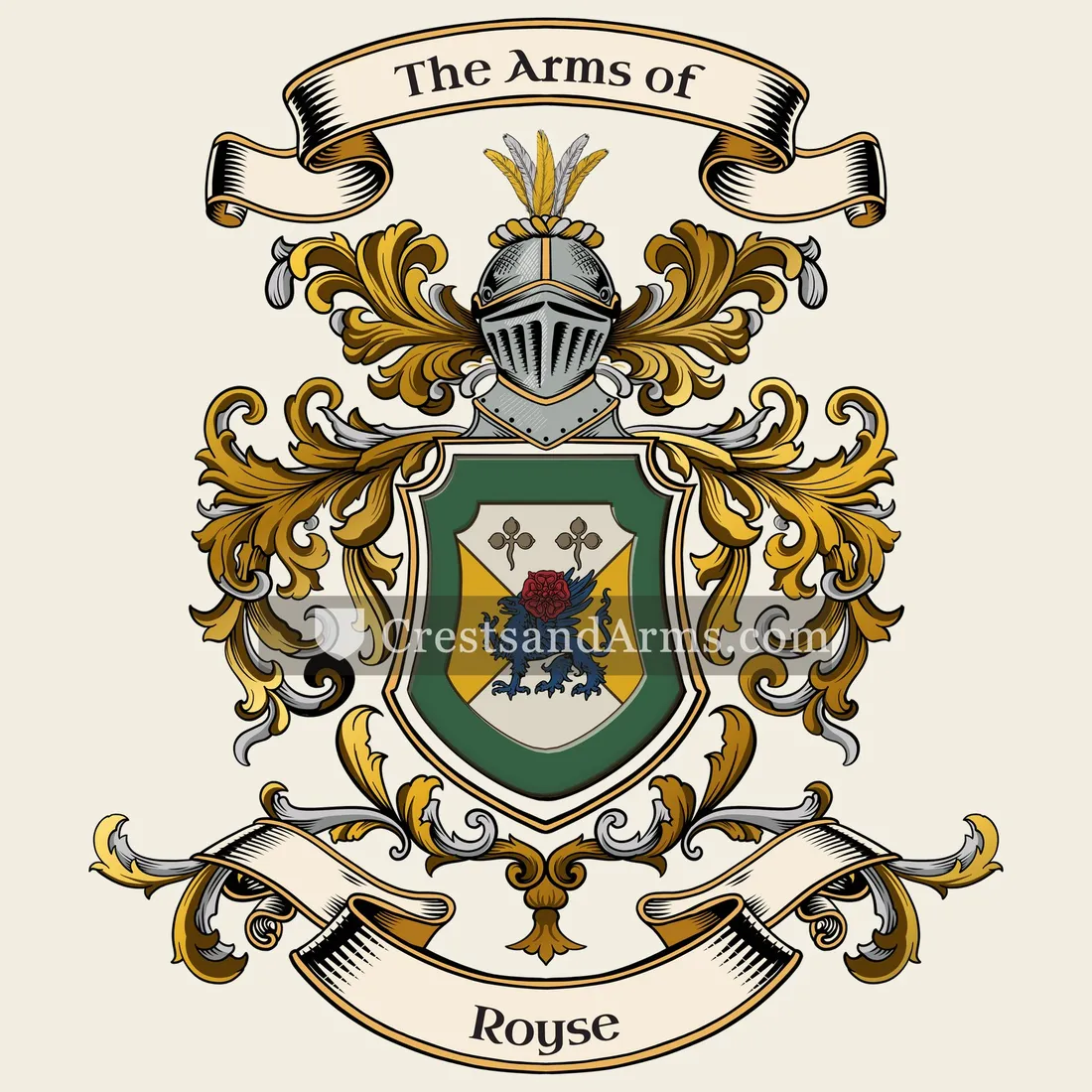
Symbols on this shield
bordureA difference between branches of one family
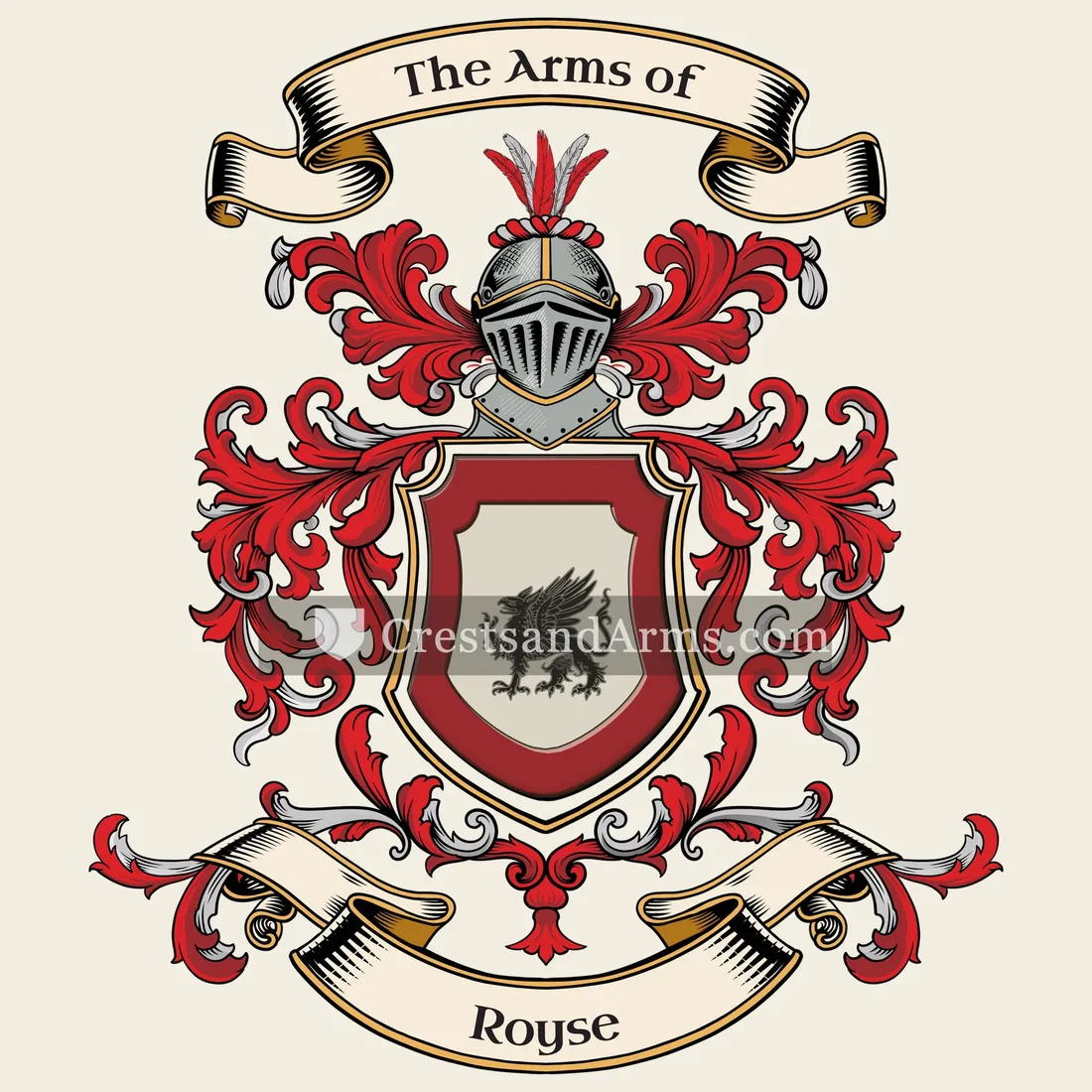
griffinValour and vigilance, guarding great treasure
roseThe seventh son, and beauty with grace
trefoilPerpetuity, and the Trinity
Colours
Gold (Or)Means: Generosity
Silver (Argent)Means: Peace and sincerity
Green (Vert)Means: Hope
Blue (Azure)Means: Loyalty and truth
Red (Gules)Means: Military strength
Historical info
Source
Sir Bernard Burke, The General Armory of England, Scotland, Ireland and Wales, London: Harrison & Sons, 1884
Blazon (the actual original written record)
“Per saltire or and ar. a griffin segreant az. in chief a rose gu. betw. two trefoils ppr. a border vert”
LimerickNantinan · Limerick, c. 1812
Digital archive packCoat of arms PNG, gold border print PDF, vector SVG and the certificate of authenticity. Sent to your email in minutes.
Map of Ireland showing where the Royse arms are recorded
The Royse arms were recorded in Limerick, c. 1812.
Limerick was river country in western Ireland with a walled city at its centre. Merchant families ran the city and bought land around it, and both the trade and the land brought arms.
This is where the arms were entered in the register. Families often moved to other parts of the country, so the same name can turn up in more than one region.
The body that granted and recorded arms in Ireland in this period.
George III of Great Britain
Sovereign of the period
George III of Great Britain
1801–1820
Reigning in England when the Royse arms are first recorded.
How Arms Worked in Ireland
The Ulster King of Arms granted coats of arms to individuals who proved their social standing and good character. These symbols were typically inherited by all legitimate descendants of the original holder. If a family branch wanted a unique look, they could apply for a specific change to their design through the office to ensure their identity remained distinct.
Granting authority
The Ulster King of Arms acted as the official body that regulated and issued all coats of arms throughout Ireland.
How they got arms
Families obtained their arms through formal grants issued by the office after proving their eligibility and paying the required fees.
Where arms were recorded
All official grants were recorded in the registers held by the Ulster King of Arms starting from the year 1552.
The family's standing
Recorded among the armigerous families of Limerick.
Origin & History of the Royse Family in Ireland
The family name Royse has deep roots in the history of County Limerick, where members of the family were well-established by the early nineteenth century. The name is often considered a variation of Royce or Rice, and it likely arrived in Ireland through the movement of settlers from England during the centuries of colonial expansion. By 1812, the Royse family had become part of the local social and economic landscape in Limerick, often associated with land ownership and the management of estates in the region. These families were typically integrated into the administrative life of the county, participating in the local governance and agricultural development that defined the era. While the name remains relatively rare, its presence in Limerick records highlights the way families moved across the Irish Sea to build new lives and contribute to the changing identity of the Irish countryside.
Royse Meaning & Related Branches
Root word
Rose
A prickly shrub or flower of the genus Rosa.
This name
RoyseA patronymic or locative surname derived from the flower, often signifying someone who lived near rose bushes.
also spelled
Roise
Roy
Related arms
Royvariant spelling
Documented Sources
Sir Bernard Burke, The General Armory of England, Scotland, Ireland and Wales, London: Harrison & Sons, 1884
Reaney, P.H. and Wilson, R.M., A Dictionary of English Surnames, 1991
Kent Archives and Local History Centre, Parish Registers of Kent, 1589
Digital archive packCoat of arms PNG, gold border print PDF, vector SVG and the certificate of authenticity. Sent to your email in minutes.


 bordureA difference between branches of one family
 griffinValour and vigilance, guarding great treasure
 bordureA difference between branches of one family
 griffinValour and vigilance, guarding great treasure


 roseThe seventh son, and beauty with grace
 trefoilPerpetuity, and the Trinity