A record of documented arms, meaning and origin, researched for the Rozen family lines. Documented in 3 countries.
Reg. 8874 · Swedish, P–S
Coat of Arms & Family Crest Details
Symbols on this shield
roseThe seventh son, and beauty with grace
Colours
Gold (Or)Means: Generosity
Red (Gules)Means: Military strength
Historical info
Source
J. B. Rietstap, Armorial Général, Gouda: G. B. van Goor Zonen, 1884–87
Blazon (the actual original written record)
“D'or à trois roses de gu., bout. d'or, barbées de sin Cq. cour. C.: une queue de paon au nat., accostée de deux hermines affr. au nat. L.: à dextre d'or et de gu., à sen. d'arg. et de gu. [La branche de France ne portait en cimier que la seule queue de paon et avait pris les deux hermines pour supports.]”
Swedenc. 1700
Digital archive packCoat of arms PNG, gold border print PDF, vector SVG and the certificate of authenticity. Sent to your email in minutes.
Map of Sweden showing where the Rozen arms are recorded
The Rozen arms were recorded in Sweden, c. 1700.
Arms such as these were typically recorded in Stockholm.
Stockholm held the Swedish court and the House of Nobility, where every noble family's arms were entered and kept. Families ennobled for service registered there, which is why so many are recorded around the city.
This is where the arms were entered in the register. Families often moved to other parts of the country, so the same name can turn up in more than one region.
The body that granted and recorded arms in Sweden in this period.
Carl XII of Sweden
Sovereign of the period
Carl XII of Sweden
1697–1718
Reigning in Sweden when the Rozen arms are first recorded.
How Arms Worked in Sweden
In Sweden, a coat of arms belonged to a noble family as a whole rather than just one individual. These arms were passed down through the generations to all legitimate descendants. Younger branches of the family used the same shield without needing to change it. This system ensured that the entire lineage shared the same identity and status under the law.
Granting authority
The Riddarhuset, or House of Nobility, regulated all noble coats of arms in Sweden under royal authority.
How they got arms
Families received their coats of arms through royal grants of nobility which were then officially registered with the House.
Where arms were recorded
Coats of arms were officially recorded in the Swedish House of Nobility register starting in the year 1626.
The family's standing
Recorded among the armigerous families of Sweden.
Origin & History of the Rozen Family in Sweden
The name Rozen emerged within the bustling urban landscape of Stockholm during the early 18th century. At this time, Sweden was transitioning through a period of significant social change, and families living in the capital often found themselves at the center of growing trade and administrative networks. Records indicate that members of the Rozen family were established residents of the city by 1700, likely participating in the skilled labor or merchant classes that defined Stockholm’s economy during the Swedish Empire. As the city expanded, the family name became part of the local fabric, reflecting the movement of people into urban centers to seek new opportunities. By settling in the capital, these early ancestors helped establish a lineage that navigated the complexities of Swedish society during a time of intense national development.
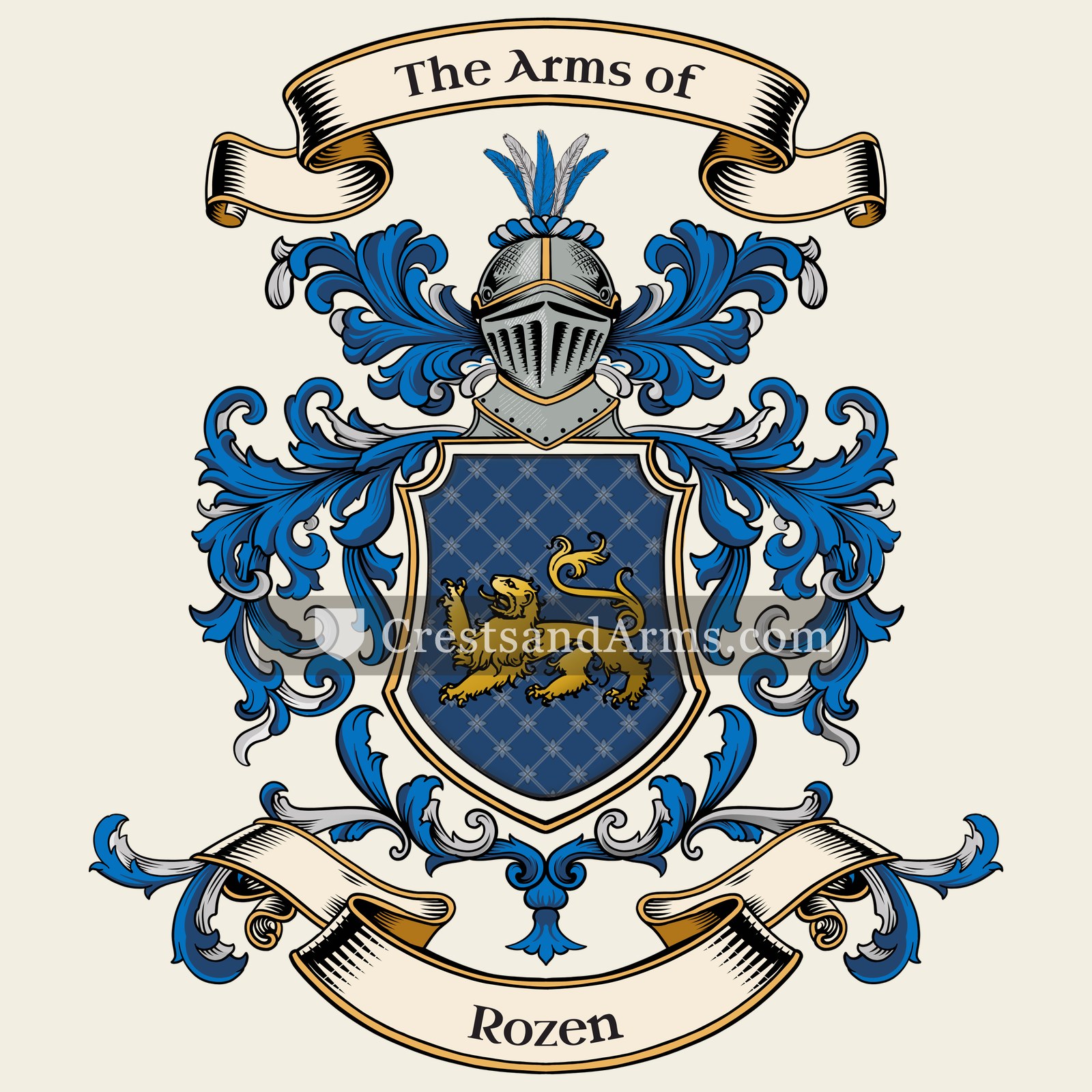
Coat of Arms & Family Crest Details
Symbols on this shield
lionCourage, strength and royalty
Colours
Blue (Azure)Means: Loyalty and truth
Gold (Or)Means: Generosity
Historical info
Source
J. B. Rietstap, Armorial Général, Gouda: G. B. van Goor Zonen, 1884–87
Blazon (the actual original written record)
“D'azur au lion d'or, acc. de trois roses d'arg. Deux cq. cour. C.: 1° le lion iss. et cont., surm. d'une rose d'arg.; 2° le lion, iss., surm d'une rose d'arg. L. d'or et d'azur. T.: deux hommes d'armes, la visière baissée, le casque panaché d'azur, tenant chacun une lance.”
Russiac. 1697
Digital archive packCoat of arms PNG, gold border print PDF, vector SVG and the certificate of authenticity. Sent to your email in minutes.
Map of Russia showing where the Rozen arms are recorded
The Rozen arms were recorded in Russia, c. 1697.
Arms such as these were typically recorded in Moscow.
Moscow held the Russian court, and rank there came from service rather than land. Families who served the Tsar were entered in the registers of nobility, and that entry is where their arms are recorded.
This is where the arms were entered in the register. Families often moved to other parts of the country, so the same name can turn up in more than one region.
The body that granted and recorded arms in Russia in this period.
Peter the Great
Sovereign of the period
Peter the Great
1682–1721
Reigning in Sweden when the Rozen arms are first recorded.
How Arms Worked in Russia
Russian heraldry was strictly tied to the nobility and the state service system. Families proved their ancient status or earned new rank to receive an official grant from the Tsar. These symbols were then inherited by all legitimate children of the noble line. If a family lacked proof of their status, they were often excluded from the official records entirely.
Granting authority
The Herald Master's Office acted as the central state body that strictly regulated and verified all noble heraldic symbols.
How they got arms
Families typically received their arms through a formal state grant or by proving their noble status to the government authorities.
Where arms were recorded
All approved coats of arms were officially recorded in the General Armorial of the Noble Families of the Russian Empire starting in 1797.
The family's standing
Recorded among the armigerous families of Russia.
Origin & History of the Rozen Family in Russia
The history of the Rozen family in Russia begins with documented evidence of their presence in Moscow as early as 1697. During this period, the family was part of the shifting social landscape of the Russian Empire, often associated with the service class that supported the modernization efforts of the state. As the family established itself in the capital, they became integrated into the administrative and military structures that defined the era of Peter the Great. Their name likely reflects a linguistic evolution common among families of diverse origins who settled in the region, adapting to the Russian phonetic system while maintaining their distinct identity. Over the following decades, members of the family navigated the complexities of imperial society, moving through various ranks of the bureaucracy and contributing to the development of the city. By rooting themselves in Moscow during the late seventeenth century, the Rozen family secured a place within the historical fabric of the nation during a time of significant cultural and political transition.
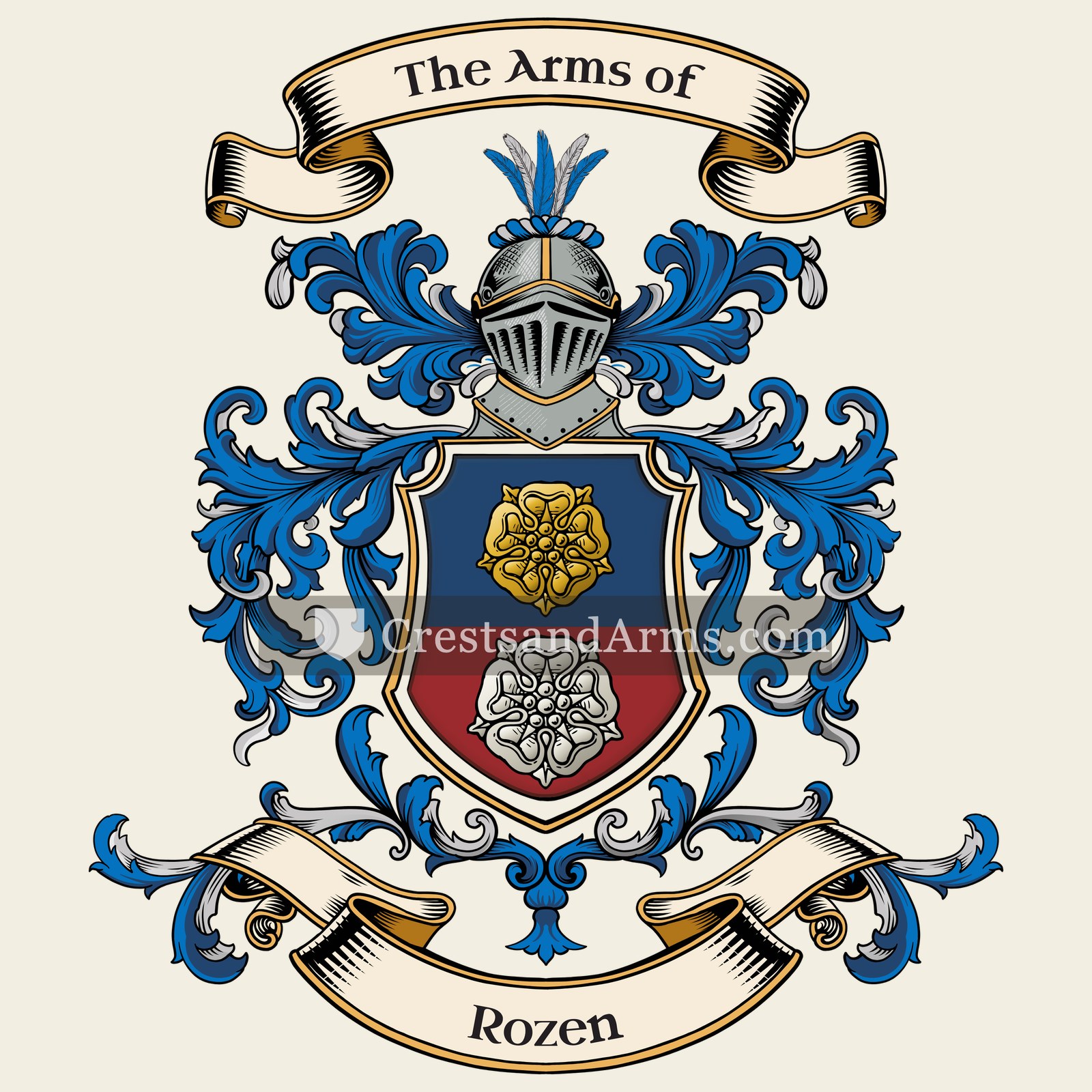
Coat of Arms & Family Crest Details
Symbols on this shield
roseThe seventh son, and beauty with grace
Colours
Blue (Azure)Means: Loyalty and truth
Red (Gules)Means: Military strength
Gold (Or)Means: Generosity
Silver (Argent)Means: Peace and sincerity
Historical info
Source
J. B. Rietstap, Armorial Général, Gouda: G. B. van Goor Zonen, 1884–87
Blazon (the actual original written record)
“Coupé: au 1 d'azur à une rose d'or; au 2 de gu. à une rose d'arg. C.: un bras, paré au nat., brandissant un sabre. L.: à dextre d'or et d'azur, à sen. d'arg. et de gu.”
Germanyc. 1765
Digital archive packCoat of arms PNG, gold border print PDF, vector SVG and the certificate of authenticity. Sent to your email in minutes.
Map of Germany showing where the Rozen arms are recorded
The Rozen arms were recorded in Germany, c. 1765.
Arms such as these were typically recorded in Bavaria.
Bavaria was a country of old landed families and walled market towns. Estates passed down the same line for centuries, and both the landowners and the leading townsmen kept arms, which is why so many Bavarian names sit in the registers.
This is where the arms were entered in the register. Families often moved to other parts of the country, so the same name can turn up in more than one region.
The body that granted and recorded arms in Germany in this period.
Francis I, Holy Roman Emperor
Sovereign of the period
Francis I, Holy Roman Emperor
1745–1765
Reigning in Sweden when the Rozen arms are first recorded.
How Arms Worked in Germany
In the Holy Roman Empire, coats of arms were often granted to individuals by the Emperor or his representatives. These arms were then passed down through the generations to all legitimate descendants of the original holder. Younger branches of a family usually kept the same shield design without needing to change it, as the arms belonged to the entire lineage.
Granting authority
The Holy Roman Emperor held the sole power to grant new coats of arms throughout his vast imperial territories.
How they got arms
Families typically obtained their coats of arms through a formal imperial grant or by proving their noble status to the authorities.
Where arms were recorded
These grants were officially recorded in the Imperial Chancery registers, which began keeping formal records of such honors during the Middle Ages.
The family's standing
Recorded among the armigerous families of Germany.
Origin & History of the Rozen Family in Germany
The family name Rozen has deep roots in the historical landscape of Bavaria, where records confirm the presence of family members as early as 1765. During this period, the region was part of the Holy Roman Empire and was defined by a complex system of local administration and agricultural life. Families with this name likely lived in small, tight-knit village communities where surnames were often tied to the local geography or the specific trade of the household. In the mid-18th century, Bavaria was undergoing significant social changes as the influence of the Enlightenment began to reach rural areas. The Rozen family would have navigated these shifts while participating in the traditional customs and religious life of the Bavarian countryside. By maintaining their presence in this region, the family became part of the long-standing demographic history of southern Germany, contributing to the local economy and the cultural development of their home province.
Related Branches & Arms
Root word
ros
A prickly shrub or flower of the genus Rosa.
This name
RozenA Swedish ornamental surname derived from the word for rose, often associated with heraldry.
also spelled
Rossen
Roosen
Rozen
Documented Sources
J. B. Rietstap, Armorial Général, Gouda: G. B. van Goor Zonen, 1884–87
Stockholm City Archives (Stockholms stadsarkiv), Mantalslängder för Stockholms stad (Taxation records for the city of Stockholm)
National Archives of Sweden (Riksarkivet), Kyrkoarkiv (Church records, specifically birth and marriage registers for Stockholm parishes)
Lars Nilsson, Stad i stöpsleven: Studier i Stockholms befolkningsutveckling 1550–1810, 1990
Bo Lindberg, Den svenska historien: Stormaktstiden, 1992
Digital archive packCoat of arms PNG, gold border print PDF, vector SVG and the certificate of authenticity. Sent to your email in minutes.


 roseThe seventh son, and beauty with grace
 roseThe seventh son, and beauty with grace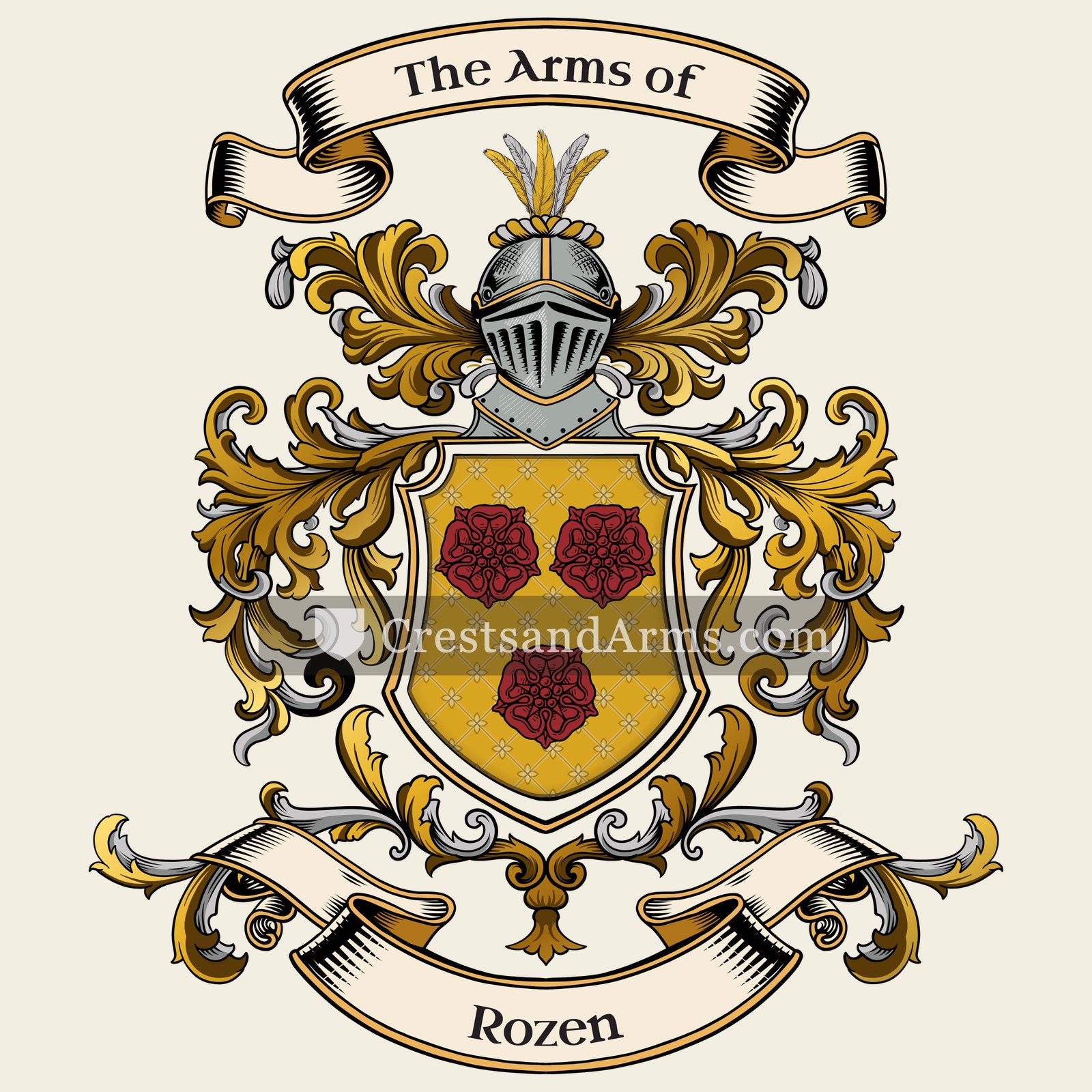


 lionCourage, strength and royalty