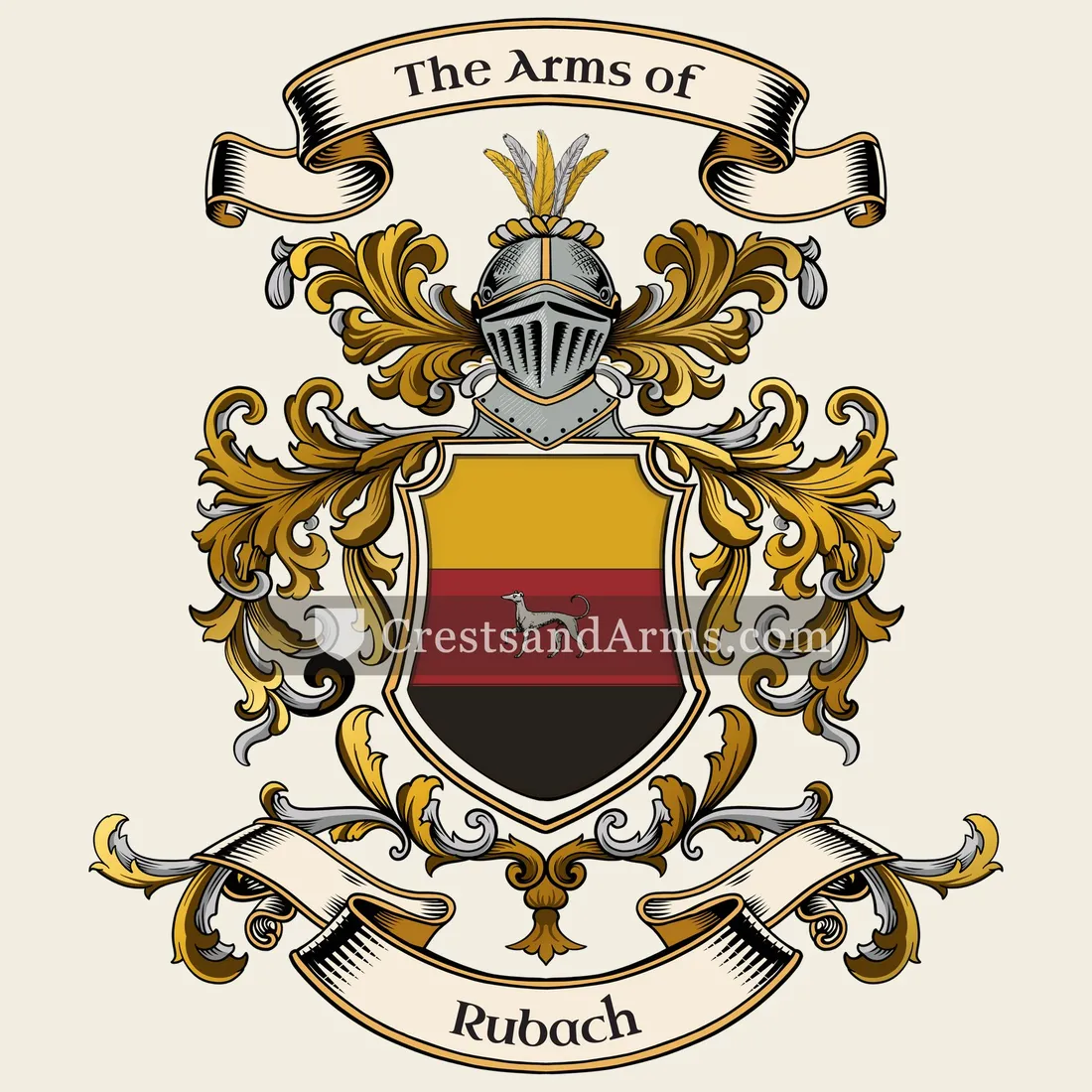
A record of documented arms, meaning and origin, researched for the Rubach family of Austria.
Reg. 5929 · Austrian, P–S
Meaning of the Rubach family crest colors & symbols
Symbols on this shield
greyhoundCourage, vigilance and loyalty
Colours
Gold (Or)Means: Generosity
Red (Gules)Means: Military strength
Black (Sable)Means: Constancy
Silver (Argent)Means: Peace and sincerity
Historical info
Source
J. B. Rietstap, Armorial Général, Gouda: G. B. van Goor Zonen, 1884–87
Blazon (the actual original written record)
“Tiercé en fasce: au 1 d'or plein; au 2 de gu. à un lévrier courant d'arg.; au 3 de sa. plein. C.: un lévrier d'arg., coll. d'or, assis sur un bonnet de sa., retr. de gu.”
TyrolTyrol, c. 1772
Digital archive packCoat of arms PNG, gold border print PDF, vector SVG and the certificate of authenticity. Sent to your email in minutes.
Map of Austria showing where the Rubach arms are recorded
The Rubach arms were recorded in Tyrol, c. 1772.
Tyrol was mountain country in western Austria, where the valleys were held by families who had been there a very long time. Old tenure counted for more than money, and old families carried arms.
This is where the arms were entered in the register. Families often moved to other parts of the country, so the same name can turn up in more than one region.
Region
Tyrol
First recorded
1772
Granting Authority for the Rubach Arms
Imperial and Royal chancery
Sodacan · CC BY-SA 3.0
The body that granted and recorded arms in Austria in this period.
Joseph II, Holy Roman Emperor
Sovereign of the period
Joseph II, Holy Roman Emperor
1765–1790
Reigning in Austria when the Rubach arms are first recorded.
How Arms Worked in Austria
Austrian coats of arms were often linked directly to noble titles granted by the Emperor. These symbols belonged to the entire family line rather than just one individual. When a family grew, new branches kept the original design without needing to change it. This system allowed all members of a noble house to share the same identity across many generations.
Granting authority
The Imperial and Royal chancery managed all heraldic matters and controlled the official granting of arms throughout the Austrian lands.
How they got arms
Families typically received their arms through a formal imperial decree that often accompanied the elevation of a person to noble status.
Where arms were recorded
Official records of these grants were kept in the Imperial Register of Nobility which began its formal documentation process in 1453.
The family's standing
Recorded among the armigerous families of Tyrol.
Origin & History of the Rubach Family in Austria
The family name Rubach is deeply rooted in the alpine landscape of the Tyrol region, where records confirm the family was established by at least 1772. The name likely originated as a topographic descriptor, derived from the German words for a mountain stream or a rocky brook. In the rugged terrain of the Austrian Alps, families were often identified by the specific natural features near their homesteads, suggesting that early ancestors lived alongside a rushing creek or a stony riverbed. During the late 18th century, the Rubach family would have been part of a tightly knit mountain community that relied on agriculture and trade within the isolated valleys. Their presence in the historical record during this period reflects the transition of rural families into more formal administrative systems as local parishes and governments began keeping detailed census and tax documents.
Rubach Meaning & Related Branches
Root word
Rube
A Middle High German term referring to a turnip or root vegetable.
This name
RubachAn occupational surname for a farmer or merchant who cultivated and sold turnips.
also spelled
Rubach
Documented Sources
J. B. Rietstap, Armorial Général, Gouda: G. B. van Goor Zonen, 1884–87


 greyhoundCourage, vigilance and loyalty
 greyhoundCourage, vigilance and loyalty