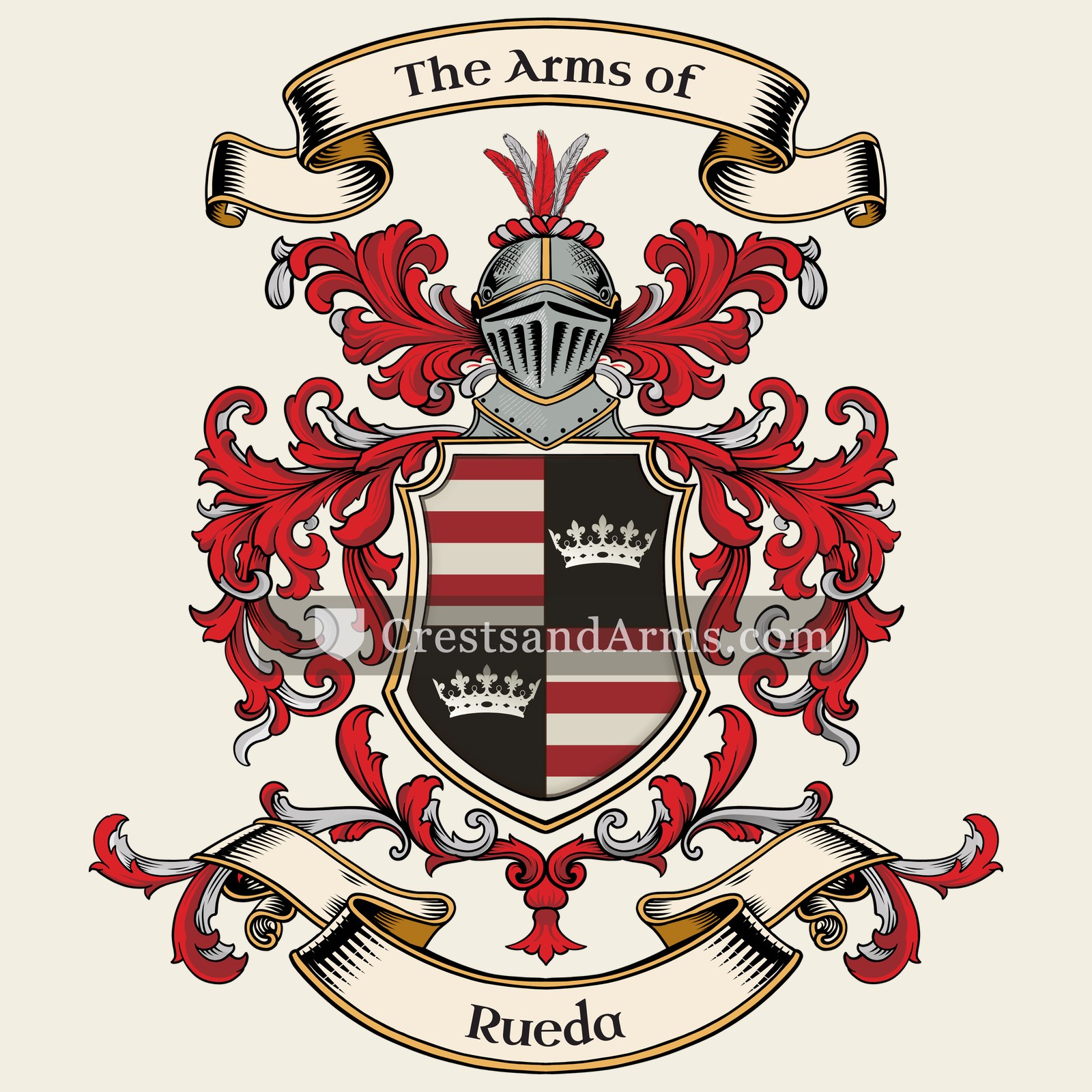
A record of documented arms, meaning and origin, researched for the Rueda family of Germany.
Reg. 0463 · German, P–S
Coat of Arms & Family Crest Details
Symbols on this shield
fessThe military belt, and readiness to serve
crownSovereignty, authority and just reward
Colours
Silver (Argent)Means: Peace and sincerity
Black (Sable)Means: Constancy
Historical info
Source
J. B. Rietstap, Armorial Général, Gouda: G. B. van Goor Zonen, 1884–87
Blazon (the actual original written record)
“Ec.: aux 1 et 4 fascé d'arg. et de gu., de quatre pièces; aux 2 et 3 de sa. à une couronne princière au nat. C.: la couronne du 2, sommée d'un sceptre d'or en pal; entre deux guidons, à dextre coupé d'arg. sur sa. et à sen. coupé d'arg. sur gu. L.: à dextre d'or et de sa., à sen. d'arg. et de gu.”
Germanyc. 1765
Digital archive packCoat of arms PNG, gold border print PDF, vector SVG and the certificate of authenticity. Sent to your email in minutes.
Map of Germany showing where the Rueda arms are recorded
The Rueda arms were recorded in Germany, c. 1765.
Arms such as these were typically recorded in Bavaria.
Bavaria was a country of old landed families and walled market towns. Estates passed down the same line for centuries, and both the landowners and the leading townsmen kept arms, which is why so many Bavarian names sit in the registers.
This is where the arms were entered in the register. Families often moved to other parts of the country, so the same name can turn up in more than one region.
The body that granted and recorded arms in Germany in this period.
Francis I, Holy Roman Emperor
Sovereign of the period
Francis I, Holy Roman Emperor
1745–1765
Reigning in Germany when the Rueda arms are first recorded.
How Arms Worked in Germany
In the Holy Roman Empire, coats of arms were often granted to individuals by the Emperor or his representatives. These arms were then passed down through the generations to all legitimate descendants of the original holder. Younger branches of a family usually kept the same shield design without needing to change it, as the arms belonged to the entire lineage.
Granting authority
The Holy Roman Emperor held the sole power to grant new coats of arms throughout his vast imperial territories.
How they got arms
Families typically obtained their coats of arms through a formal imperial grant or by proving their noble status to the authorities.
Where arms were recorded
These grants were officially recorded in the Imperial Chancery registers, which began keeping formal records of such honors during the Middle Ages.
The family's standing
Recorded among the armigerous families of Germany.
Origin & History of the Rueda Family in Germany
The surname Rueda is traditionally associated with regions in Spain, where it refers to a wheel or a place located near a waterwheel used for milling. While the name has deep roots in the Iberian Peninsula, historical records confirm that members of the family were established in Bavaria by 1765. During the eighteenth century, the movement of families across European borders was often driven by the search for new agricultural opportunities or the pursuit of specialized trade crafts. The presence of the Rueda family in Bavaria suggests they were part of a broader pattern of migration where skilled individuals relocated to central Europe to integrate into local economies. By settling in this region, the family adapted to the local culture while maintaining their distinct name, which served as a link to their ancestral history.
Related Branches & Arms
Root word
Rota
Latin term referring to a wheel or a circular object.
This name
RuedaAn occupational name for a wheelwright or someone who lived near a waterwheel.
also spelled
Rudda
Rudah
Rooda
Documented Sources
J. B. Rietstap, Armorial Général, Gouda: G. B. van Goor Zonen, 1884–87
Moll, Friedrich. Die deutsche Radmacherkunst. 1928


 fessThe military belt, and readiness to serve
 crownSovereignty, authority and just reward
 fessThe military belt, and readiness to serve
 crownSovereignty, authority and just reward