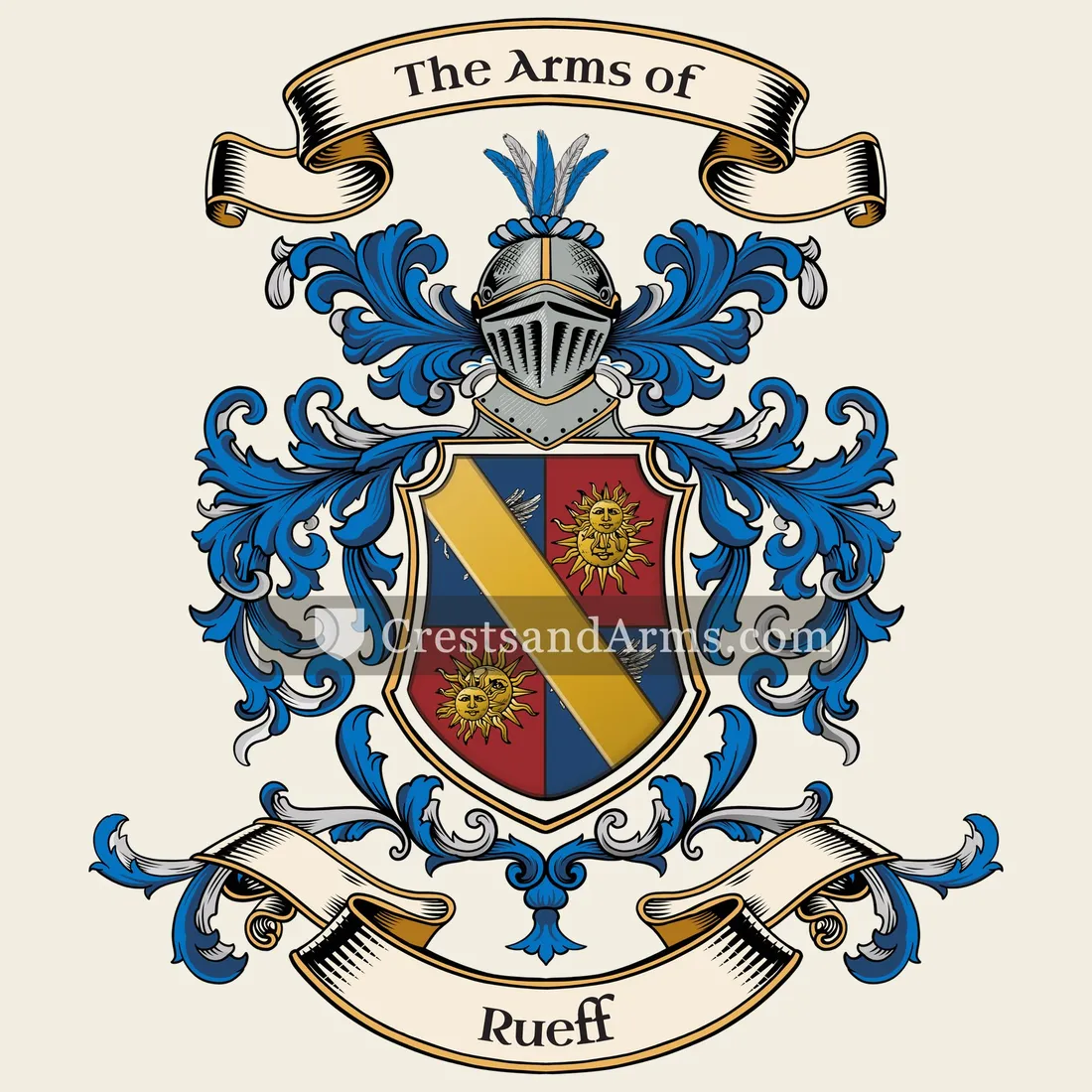
A record of documented arms, meaning and origin, researched for the Rueff family of Austria.
Reg. 2115 · Austrian, P–S
Meaning of the Rueff family crest colors & symbols
Symbols on this shield
bendDefence, and the scarf of a commander
sunGlory, splendour and the source of life
pegasusFame, eloquence and swift renown
Colours
Blue (Azure)Means: Loyalty and truth
Red (Gules)Means: Military strength
Gold (Or)Means: Generosity
Silver (Argent)Means: Peace and sincerity
Historical info
Source
J. B. Rietstap, Armorial Général, Gouda: G. B. van Goor Zonen, 1884–87
Blazon (the actual original written record)
“D'azur à la bande d'or, acc. de deux soleils du même. - (An., 1 fév. 1602.) Éc.: aux 1 et 4 de gu. à un Pégase saillant d'arg.; aux 2 et 3 d'azur à un soleil d'or.”
Austriac. 1772
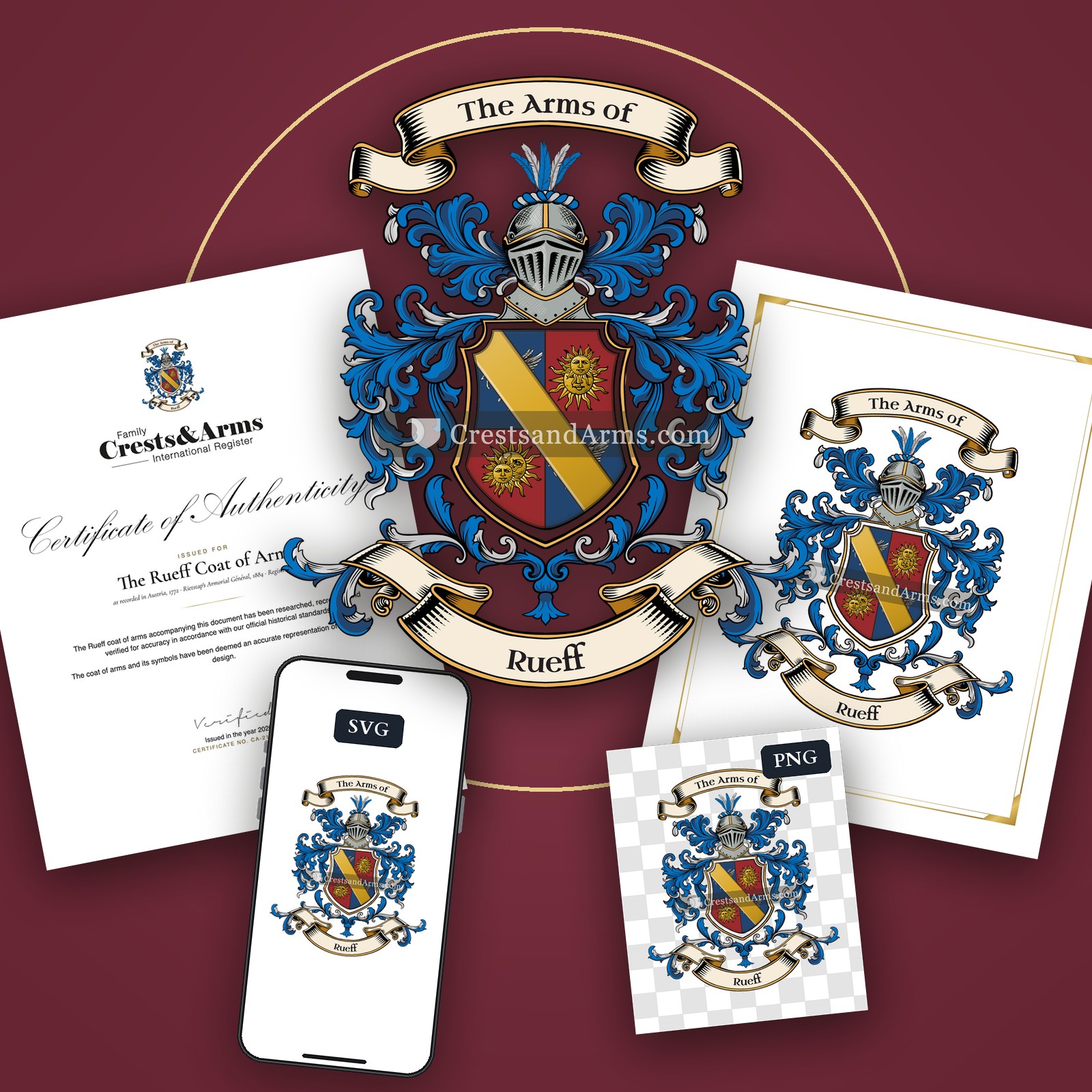
Digital archive packCoat of arms PNG, gold border print PDF, vector SVG and the certificate of authenticity. Sent to your email in minutes.
Map of Austria showing where the Rueff arms are recorded
The Rueff arms were recorded in Austria, c. 1772.
Arms such as these were typically recorded in Tyrol.
Tyrol was mountain country in western Austria, where the valleys were held by families who had been there a very long time. Old tenure counted for more than money, and old families carried arms.
This is where the arms were entered in the register. Families often moved to other parts of the country, so the same name can turn up in more than one region.
Region
Tyrol
First recorded
1772
Granting Authority for the Rueff Arms
Imperial and Royal chancery
Sodacan · CC BY-SA 3.0
The body that granted and recorded arms in Austria in this period.
Joseph II, Holy Roman Emperor
Sovereign of the period
Joseph II, Holy Roman Emperor
1765–1790
Reigning in Austria when the Rueff arms are first recorded.
How Arms Worked in Austria
Austrian coats of arms were often linked directly to noble titles granted by the Emperor. These symbols belonged to the entire family line rather than just one individual. When a family grew, new branches kept the original design without needing to change it. This system allowed all members of a noble house to share the same identity across many generations.
Granting authority
The Imperial and Royal chancery managed all heraldic matters and controlled the official granting of arms throughout the Austrian lands.
How they got arms
Families typically received their arms through a formal imperial decree that often accompanied the elevation of a person to noble status.
Where arms were recorded
Official records of these grants were kept in the Imperial Register of Nobility which began its formal documentation process in 1453.
The family's standing
Recorded among the armigerous families of Austria.
Origin & History of the Rueff Family in Austria
The family name Rueff has deep roots in the Alpine region of Tyrol, where members of the family were documented as early as 1772. The name is considered a variation of the Germanic given name Rudolf, which means famous wolf. Over many generations, the name evolved as it was passed down through families living in the mountainous terrain of what is now Austria and northern Italy. Families with this surname were often involved in local community life, agriculture, or trade within the isolated valleys of the region. Because these areas were geographically separated by high peaks, the family name remained concentrated in specific villages for centuries. This stability allowed the Rueff name to persist as a recognizable identifier for generations of families living in the heart of the Alps.
Rueff Meaning & Related Branches
Root word
Rudolf
Derived from Germanic elements meaning famous wolf.
This name
RueffA patronymic or diminutive form originating from the given name Rudolf.
also spelled
Ruef
Roof
Reef
Related arms
Ruefvariant spelling
Documented Sources
J. B. Rietstap, Armorial Général, Gouda: G. B. van Goor Zonen, 1884–87
Bahlow, Hans, Deutsches Namenlexikon: Familien- und Vornamen nach Ursprung und Sinn erklärt, 1967
Kranzmayer, Eberhard, Ortsnamenbuch von Kärnten, 1956


 bendDefence, and the scarf of a commander
 sunGlory, splendour and the source of life
 pegasusFame, eloquence and swift renown
 bendDefence, and the scarf of a commander
 sunGlory, splendour and the source of life
 pegasusFame, eloquence and swift renown