A record of documented arms, meaning and origin, researched for the Rummel family lines. Documented in 2 countries.
Reg. 4271 · Polish, P–S
Meaning of the Rummel family crest colors & symbols
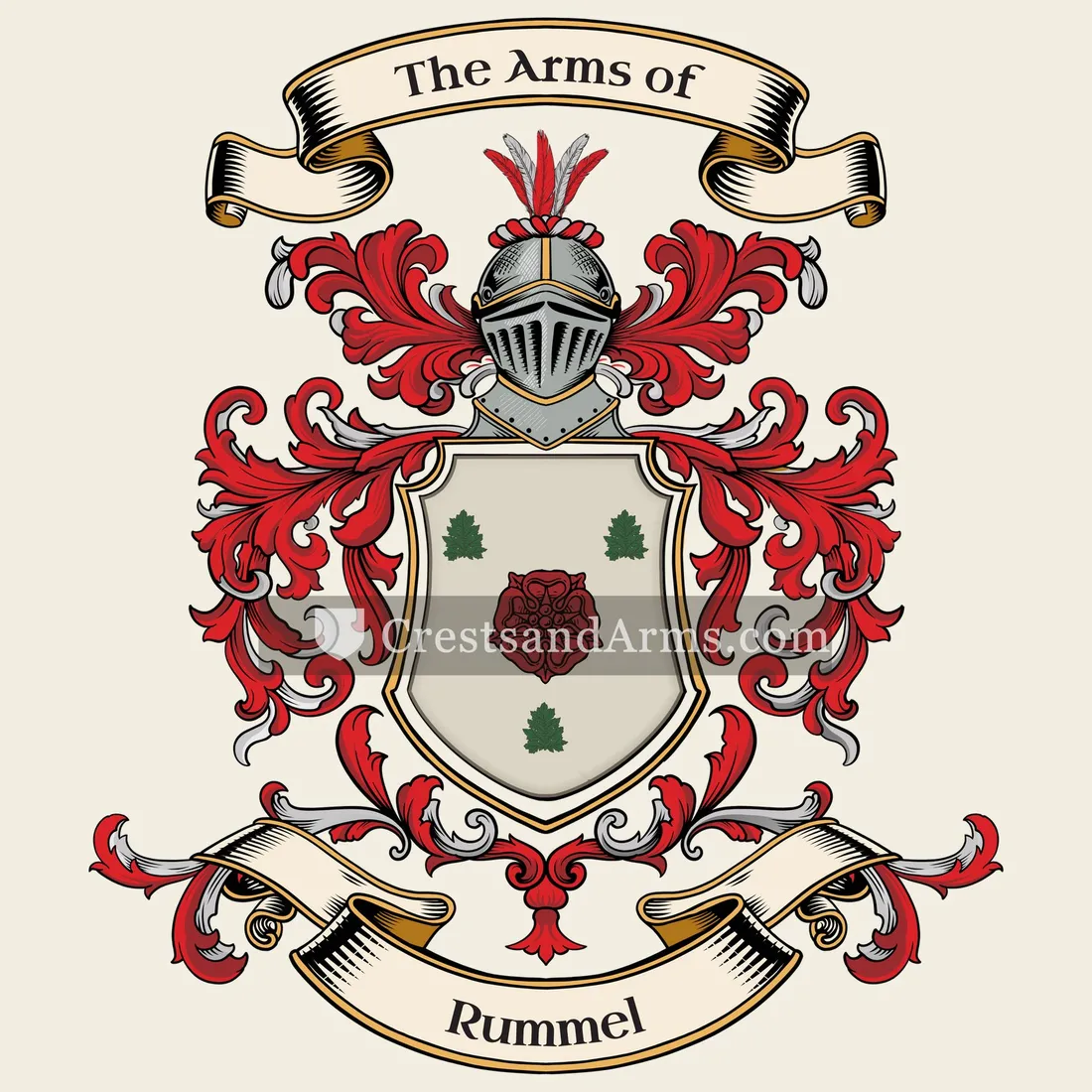
Symbols on this shield
roseThe seventh son, and beauty with grace
leafHappiness and abundance
Colours
Silver (Argent)Means: Peace and sincerity
Red (Gules)Means: Military strength
Green (Vert)Means: Hope
Historical info
Source
J. B. Rietstap, Armorial Général, Gouda: G. B. van Goor Zonen, 1884–87
Blazon (the actual original written record)
“D'arg. à une rose à quatre feuilles de gu., bout. d'or, acc. de trois feuilles de rosier de sin., mouv. de la rose en pairie. C.: un oiseau d'arg., tenant en son bec une bague d'or; entre un vol, de gu. et d'arg. L. d'arg. et de gu.”
CourlandCourland, c. 1772
Digital archive packCoat of arms PNG, gold border print PDF, vector SVG and the certificate of authenticity. Sent to your email in minutes.
Map of Poland showing where the Rummel arms are recorded
The Rummel arms were recorded in Courland, c. 1772.
Courland was Baltic coast country held in large estates by a small number of families. They kept their land for generations and served as officers abroad, and both landholding and service brought arms with them.
This is where the arms were entered in the register. Families often moved to other parts of the country, so the same name can turn up in more than one region.
Region
Courland
First recorded
1772
Granting Authority for the Rummel Arms
Ennoblement by the Sejm
Author: Olek Remesz · CC BY-SA 3.0
The body that granted and recorded arms in Poland in this period.
Stanisław August Poniatowski
Sovereign of the period
Stanisław August Poniatowski
1764–1795
Reigning in Poland when the Rummel arms are first recorded.
How Arms Worked in Poland
Polish noble families shared a single coat of arms across many different surnames, creating large clans rather than individual designs. These symbols were held collectively by all members of the clan regardless of their specific family name. When a new family joined the nobility, they were adopted into an existing clan and began using that group's established shield.
Granting authority
The Sejm, which was the Polish parliament, held the power to grant noble status and the right to bear arms.
How they got arms
Families typically received their coat of arms through a formal act of ennoblement granted by the Sejm for distinguished service.
Where arms were recorded
These grants were officially recorded in the Crown Metrica, which served as the central archive for state documents starting in the sixteenth century.
The family's standing
Recorded among the armigerous families of Courland.
Origin & History of the Rummel Family in Poland
The history of the Rummel family in the regions surrounding Poland is deeply tied to the shifting borders and cultural exchanges of the Baltic territories. By 1772, the family was well-established in Courland, a region that maintained strong historical and political connections to the Polish-Lithuanian Commonwealth. During this era, the name appeared among families who served as administrators and landowners within the complex social hierarchy of the Baltic provinces. Because these areas were often influenced by both German and Polish administrative traditions, the Rummel family likely functioned as a bridge between these cultures. Their presence in Courland suggests they were part of a mobile class of people who moved across borders to manage estates or serve in local government roles. This period was a time of great political transition, and the family name became a permanent fixture in the regional records as they integrated into the local nobility and professional classes.
Meaning of the Rummel family crest colors & symbols
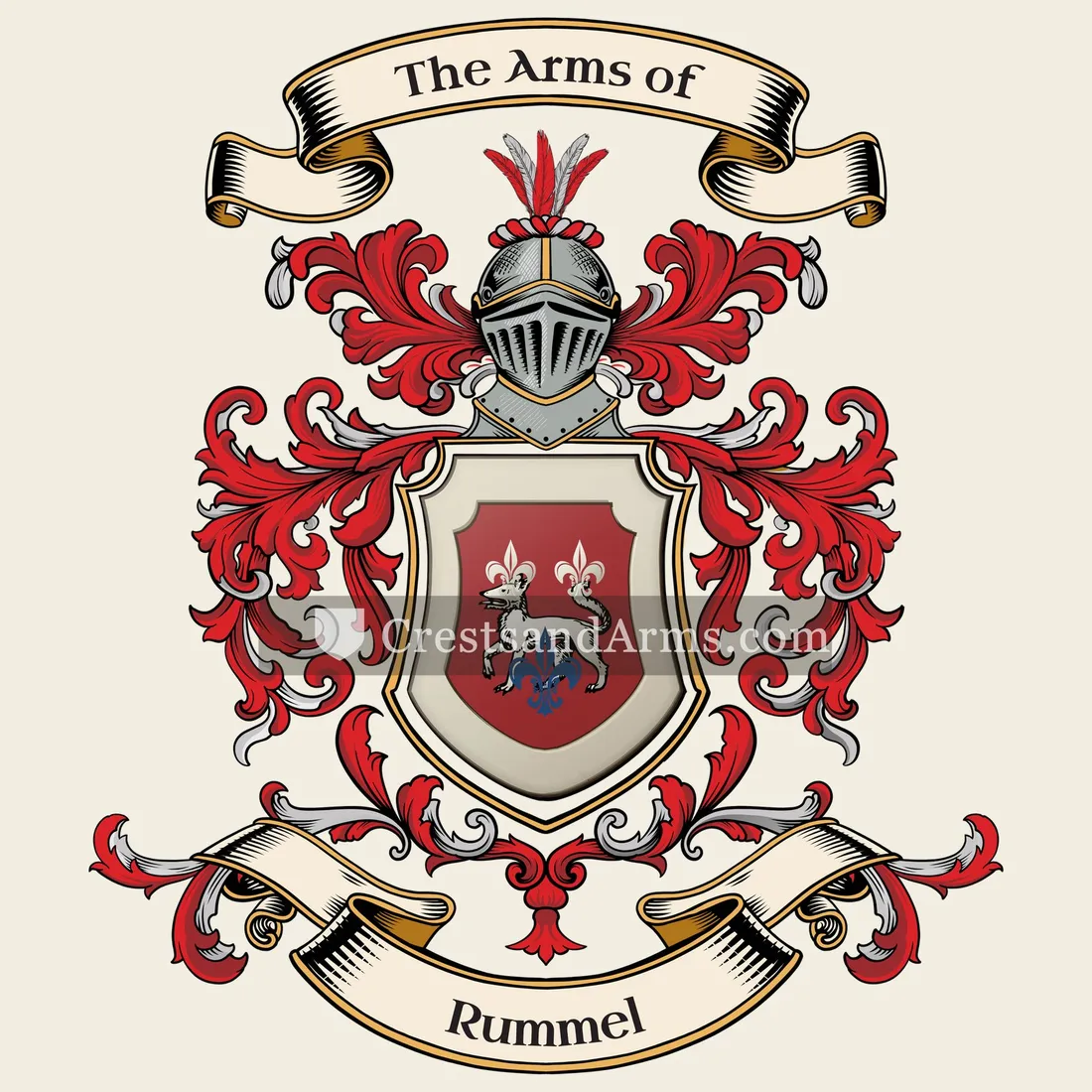
Symbols on this shield
wolfReward from long service and hard work
fleur de lisPurity, light, and the sixth son
Colours
Red (Gules)Means: Military strength
Silver (Argent)Means: Peace and sincerity
Blue (Azure)Means: Loyalty and truth
Historical info
Source
J. B. Rietstap, Armorial Général, Gouda: G. B. van Goor Zonen, 1884–87
Blazon (the actual original written record)
“De gu. à une louve d'arg., la tête cont., allaitant deux enfants de carn.; la louve acc. de deux fleurs-de-lis d'arg. en chef et d'une troisième fleur-de-lis d'azur, en p.; à la bord. d'arg. Cq. cour. C.: une louve iss. d'arg. L. d'arg. et d'azur.”
GermanyPalatinat, c. 1570
Digital archive packCoat of arms PNG, gold border print PDF, vector SVG and the certificate of authenticity. Sent to your email in minutes.
Map of Germany showing where the Rummel arms are recorded
The Rummel arms were recorded in Palatinat, c. 1570.
This is where the arms were entered in the register. Families often moved to other parts of the country, so the same name can turn up in more than one region.
The body that granted and recorded arms in Germany in this period.
Maximilian II, Holy Roman Emperor
Sovereign of the period
Maximilian II, Holy Roman Emperor
1564–1576
Reigning in Poland when the Rummel arms are first recorded.
How Arms Worked in Germany
In the Holy Roman Empire, coats of arms were often granted to individuals by the Emperor or his representatives. These arms were then passed down through the generations to all legitimate descendants of the original holder. Younger branches of a family usually kept the same shield design without needing to change it, as the arms belonged to the entire lineage.
Granting authority
The Holy Roman Emperor held the sole power to grant new coats of arms throughout his vast imperial territories.
How they got arms
Families typically obtained their coats of arms through a formal imperial grant or by proving their noble status to the authorities.
Where arms were recorded
These grants were officially recorded in the Imperial Chancery registers, which began keeping formal records of such honors during the Middle Ages.
The family's standing
Recorded among the armigerous families of Germany.
Origin & History of the Rummel Family in Germany
The surname Rummel has deep roots in the German-speaking regions, particularly within the Palatinate area where family members were documented as early as 1570. The name is generally categorized as a descriptive or nickname-based surname, likely originating from the Middle High German word "rummeln," which implies making a loud noise or moving with great energy. During the sixteenth century, the Palatinate was a region defined by agricultural traditions and significant religious shifts, which shaped the lives of families living there. As the family established itself in these rural communities, the name became a permanent fixture in local parish registers and tax records. These early Rummels were likely farmers or tradespeople who contributed to the local economy during a time of great social change in Central Europe. By tracking these early records, we see a family that was well-integrated into the social fabric of the German states long before the modern era.
Rummel Meaning & Related Branches
Root word
rumen
Middle High German term for a noisy, boisterous, or rowdy person.
This name
RummelAn occupational or descriptive nickname for an individual known for being loud or boisterous.
also spelled
Rumel
Related arms
Rumelvariant spelling
Documented Sources
J. B. Rietstap, Armorial Général, Gouda: G. B. van Goor Zonen, 1884–87
Bunge, Friedrich Georg von, Die Quellen des Revaler Stadtrechts, 1842
Manteuffel, Gustav von, Polnisch-Livland, 1906
Seraphim, Ernst, Geschichte Liv-, Est- und Kurlands, 1895
Latvian State Historical Archives (Latvijas Valsts vēstures arhīvs), Fond 214 (Courland Nobility Records)
Herder Institute for Historical Research on East Central Europe, Marburg, Baltic Biographical Archive
Digital archive packCoat of arms PNG, gold border print PDF, vector SVG and the certificate of authenticity. Sent to your email in minutes.


 roseThe seventh son, and beauty with grace
 leafHappiness and abundance
 roseThe seventh son, and beauty with grace
 leafHappiness and abundance


 wolfReward from long service and hard work
 fleur de lisPurity, light, and the sixth son