Map of Germany showing where the Runkel arms are recorded
The Runkel arms were recorded in Westphalia, c. 1765.
Westphalia was a land of small estates and fortified farmhouses in western Germany. Its families were numerous and not especially rich, but each held its own ground, and holding ground was what brought arms.
This is where the arms were entered in the register. Families often moved to other parts of the country, so the same name can turn up in more than one region.
The body that granted and recorded arms in Germany in this period.
Francis I, Holy Roman Emperor
Sovereign of the period
Francis I, Holy Roman Emperor
1745–1765
Reigning in Germany when the Runkel arms are first recorded.
How Arms Worked in Germany
In the Holy Roman Empire, coats of arms were often granted to individuals by the Emperor or his representatives. These arms were then passed down through the generations to all legitimate descendants of the original holder. Younger branches of a family usually kept the same shield design without needing to change it, as the arms belonged to the entire lineage.
Granting authority
The Holy Roman Emperor held the sole power to grant new coats of arms throughout his vast imperial territories.
How they got arms
Families typically obtained their coats of arms through a formal imperial grant or by proving their noble status to the authorities.
Where arms were recorded
These grants were officially recorded in the Imperial Chancery registers, which began keeping formal records of such honors during the Middle Ages.
The family's standing
Recorded among the armigerous families of Westphalia.
Origin & History of the Runkel Family in Germany
The surname Runkel originates from the historic region of Westphalia in Germany, where the family established deep roots by the mid-18th century. The name itself is linked to the Middle High German word "runkel," which often referred to a type of beet or a root vegetable, suggesting that the family’s earliest ancestors were likely farmers or landowners who lived near fields where these crops were grown. By 1765, records confirm that the Runkel family was well-integrated into the local social fabric of Westphalian villages. During this period, families in the region were typically tied to the land through agricultural labor and local trade. As the family grew, they became part of the steady expansion of rural communities that defined the German landscape before the industrial changes of the 19th century. This history reflects a life centered on community, seasonal work, and the enduring traditions of the Westphalian countryside.
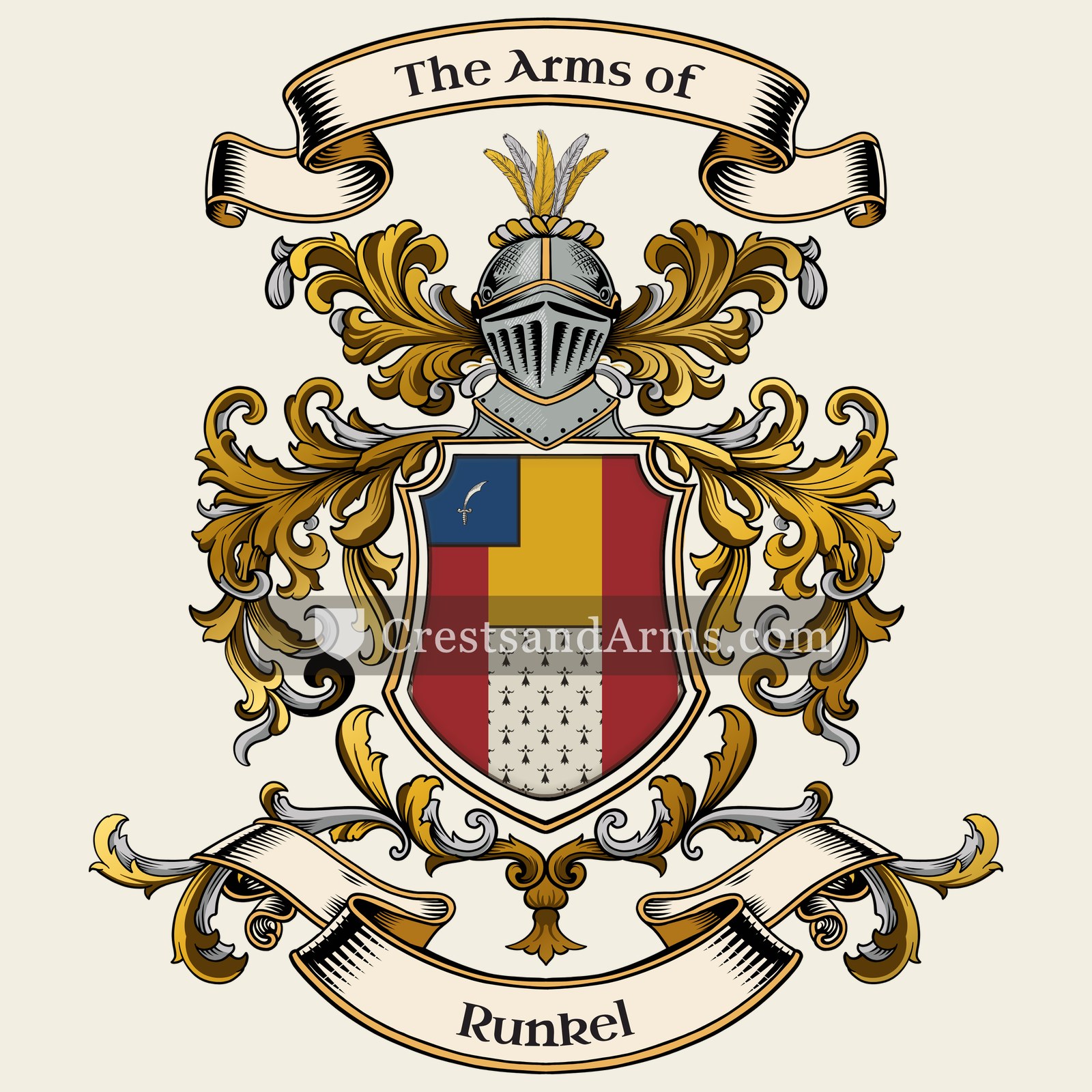
Coat of Arms & Family Crest Details
Symbols on this shield
paleMilitary strength, and a fortified defence
cantonA mark of honour granted by the sovereign
mountThe ground held, and steadfastness upon it
swordJustice, and military honour
Colours
Gold (Or)Means: Generosity
ErmineMeans: Dignity
Red (Gules)Means: Military strength
Blue (Azure)Means: Loyalty and truth
Silver (Argent)Means: Peace and sincerity
Historical info
Source
J. B. Rietstap, Armorial Général, Gouda: G. B. van Goor Zonen, 1884–87
Blazon (the actual original written record)
“Coupé d'or sur herm.; à deux pals de gu., br. sur le tout; au canton d'azur, ch. d'une épée d'arg., garnie d'or. C.: l'épée, devant un bosquet de fougère de sin., posé sur un tertre du même. L. d'or et de gu. D.: SPES IN DEO.”
Francec. 1811
Digital archive packCoat of arms PNG, gold border print PDF, vector SVG and the certificate of authenticity. Sent to your email in minutes.
Map of France showing where the Runkel arms are recorded
The Runkel arms were recorded in France, c. 1811.
Arms such as these were typically recorded in Bretagne.
More families held coats of arms in Bretagne than anywhere else in France. The land was divided into many small estates rather than a few large ones, so far more households counted as gentry, and each needed a shield of its own to be told apart.
This is where the arms were entered in the register. Families often moved to other parts of the country, so the same name can turn up in more than one region.
The body that granted and recorded arms in France in this period.
Napoleon
Sovereign of the period
Napoleon
1804–1814
Reigning in Germany when the Runkel arms are first recorded.
How Arms Worked in France
In France, a coat of arms was a mark of honor that passed down through the male line to all legitimate descendants. Families often used the same shield without changes to show their shared heritage. If a branch wanted to stand out, they could add a small mark to their shield to show their specific place in the family tree.
Granting authority
The Juge d'armes de France acted as the official authority that regulated and verified coats of arms across the country.
How they got arms
Families typically inherited their arms from ancestors, though they could also receive them through royal grants or by proving their noble status.
Where arms were recorded
Coats of arms were officially recorded in the Armorial Général de France, which began its main collection in the year 1696.
The family's standing
Recorded among the armigerous families of France.
Origin & History of the Runkel Family in France
The history of the Runkel name in France is deeply tied to the movement of people across European borders during the early nineteenth century. While the name itself has roots in Germanic regions, official records confirm that members of the family were established in the Brittany region of France by 1811. During this period, the Napoleonic Wars caused significant shifts in population as soldiers and administrators moved throughout the French Empire. Families often settled in new provinces to pursue trade or government service, and the presence of the Runkel name in Brittany suggests a transition from their ancestral lands into the social fabric of western France. These early ancestors likely integrated into local communities by adapting to the regional customs and the French language while maintaining their distinct family identity. This migration reflects a broader pattern of families seeking new opportunities during a time of intense political change in Europe.
Related Branches & Arms
Root word
Runkel
Derived from the Middle High German word for a turnip or beet.
This name
RunkelA topographic name for someone who lived near a field of turnips.
also spelled
Runckel
Related arms
Runckelvariant spelling
Documented Sources
J. B. Rietstap, Armorial Général, Gouda: G. B. van Goor Zonen, 1884–87
Bahlow, Hans, Deutsches Namenlexikon: Familien- und Vornamen nach Ursprung und Sinn erklärt, 1967
Heintze, Albert, Die deutschen Familien-Namen: geschichtlich, geographisch, sprachlich, 1903
Landesarchiv Nordrhein-Westfalen, Kirchenbücher der evangelischen und katholischen Kirchengemeinden in Westfalen
Digital archive packCoat of arms PNG, gold border print PDF, vector SVG and the certificate of authenticity. Sent to your email in minutes.


 paleMilitary strength, and a fortified defence
 cantonA mark of honour granted by the sovereign
 paleMilitary strength, and a fortified defence
 cantonA mark of honour granted by the sovereign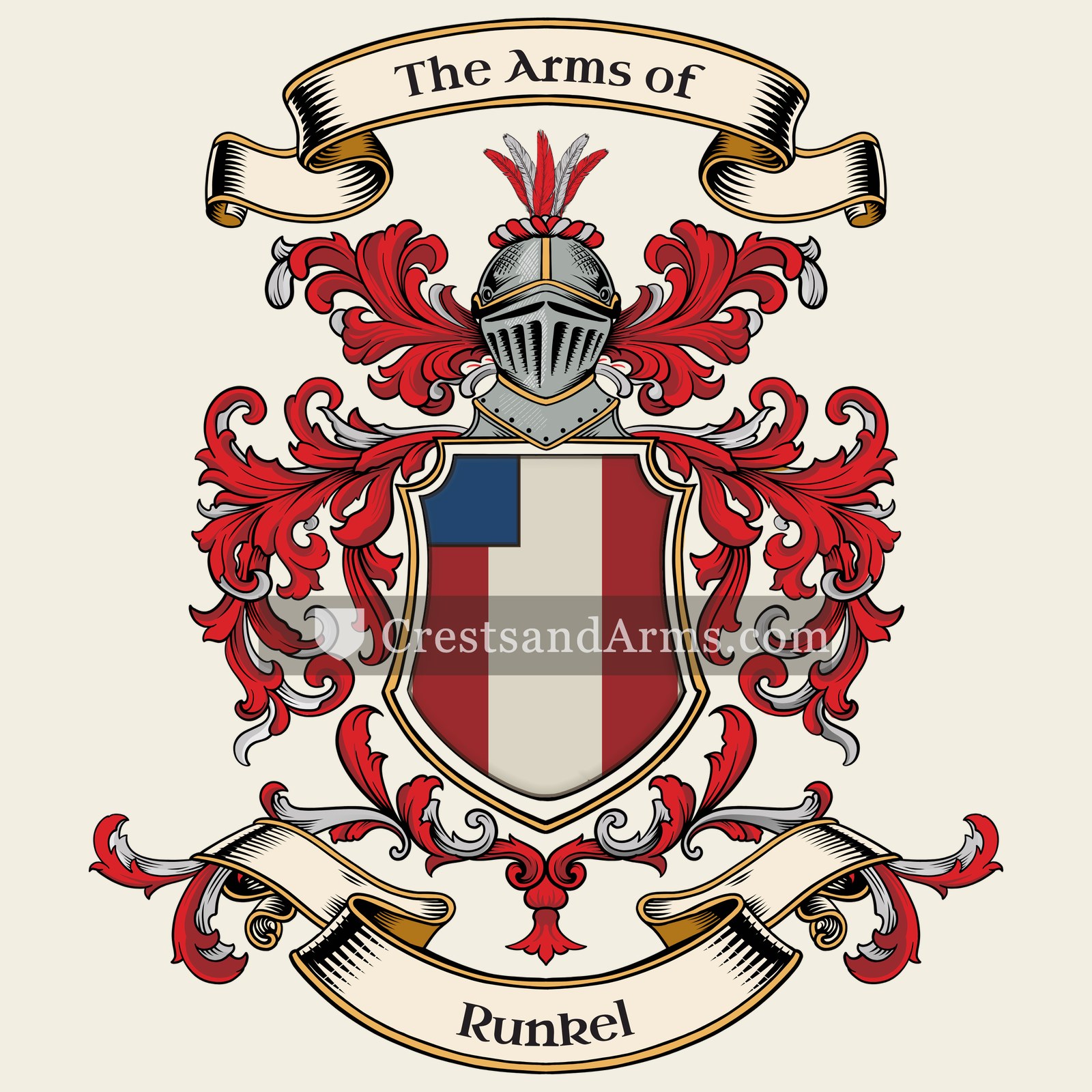


 mountThe ground held, and steadfastness upon it
 swordJustice, and military honour