Map of Germany showing where the Runkle arms are recorded
The Runkle arms were recorded in Westphalia, c. 1765.
Westphalia was a land of small estates and fortified farmhouses in western Germany. Its families were numerous and not especially rich, but each held its own ground, and holding ground was what brought arms.
This is where the arms were entered in the register. Families often moved to other parts of the country, so the same name can turn up in more than one region.
The body that granted and recorded arms in Germany in this period.
Francis I, Holy Roman Emperor
Sovereign of the period
Francis I, Holy Roman Emperor
1745–1765
Reigning in Germany when the Runkle arms are first recorded.
How Arms Worked in Germany
In the Holy Roman Empire, coats of arms were often granted to individuals by the Emperor or his representatives. These arms were then passed down through the generations to all legitimate descendants of the original holder. Younger branches of a family usually kept the same shield design without needing to change it, as the arms belonged to the entire lineage.
Granting authority
The Holy Roman Emperor held the sole power to grant new coats of arms throughout his vast imperial territories.
How they got arms
Families typically obtained their coats of arms through a formal imperial grant or by proving their noble status to the authorities.
Where arms were recorded
These grants were officially recorded in the Imperial Chancery registers, which began keeping formal records of such honors during the Middle Ages.
The family's standing
Recorded among the armigerous families of Westphalia.
Origin & History of the Runkle Family in Germany
The surname Runkle finds its linguistic roots in the German language, likely evolving from the Middle High German word "runkel," which was often used to describe someone with a round or stout physical appearance. By the mid-18th century, historical records confirm that families bearing this name were established in the Westphalia region of Germany. During this era, Westphalia was a landscape defined by small agrarian communities and a complex social structure tied to the land. Families like the Runkles were typically involved in farming or local trades, living in tight-knit villages where names were often recorded in local parish registers during baptisms, marriages, and burials. As these families navigated the social and economic changes of the 1700s, the name became a permanent fixture in the regional identity of the area, eventually serving as a bridge for those who would later migrate across the Atlantic to seek new opportunities.
Meaning of the Runkle family crest colors & symbols
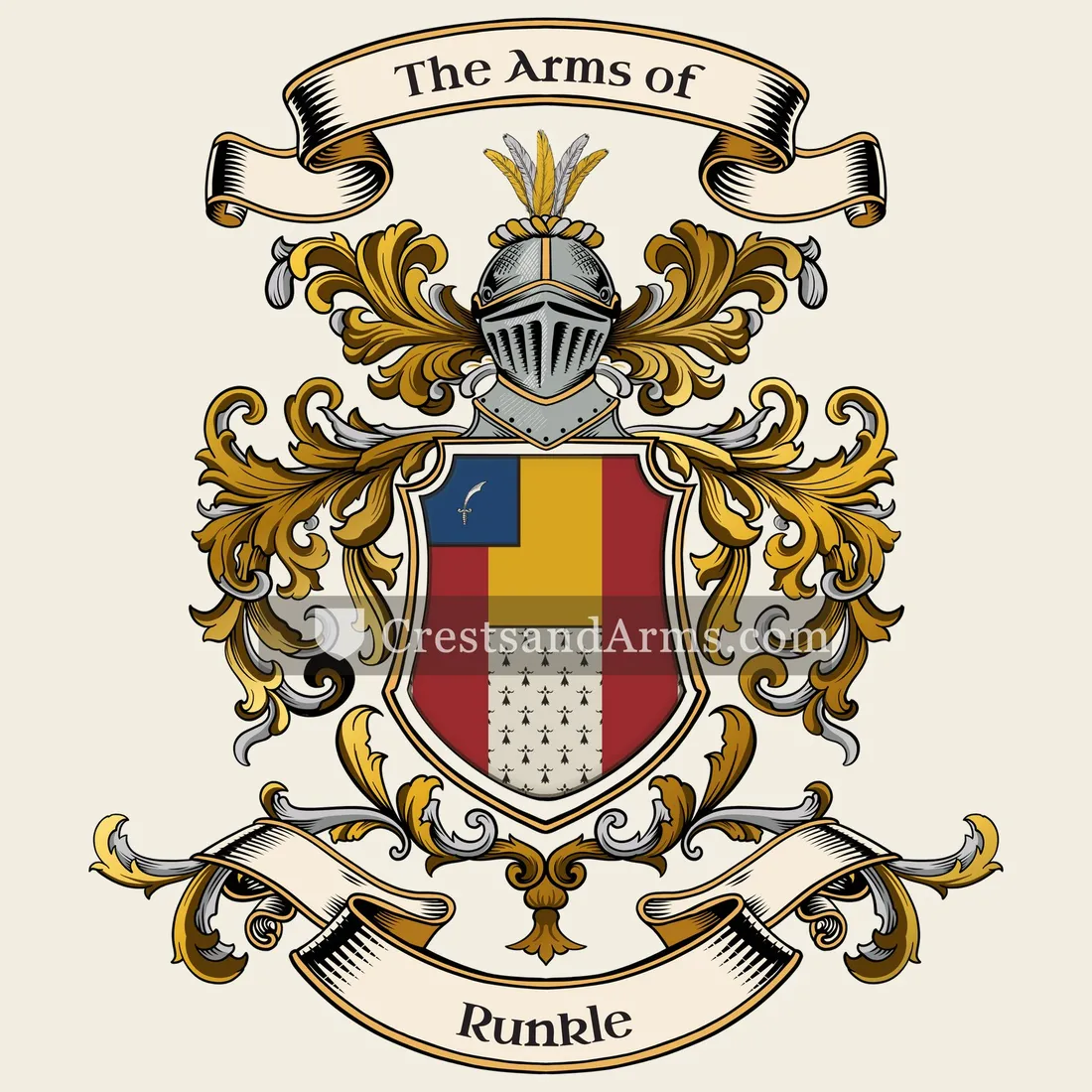
Symbols on this shield
paleMilitary strength, and a fortified defence
cantonA mark of honour granted by the sovereign
swordJustice, and military honour
Colours
Gold (Or)Means: Generosity
ErmineMeans: Dignity
Red (Gules)Means: Military strength
Blue (Azure)Means: Loyalty and truth
Silver (Argent)Means: Peace and sincerity
Historical info
Source
J. B. Rietstap, Armorial Général, Gouda: G. B. van Goor Zonen, 1884–87
Blazon (the actual original written record)
“Coupé d'or sur herm.; à deux pals de gu., br. sur le tout; au canton d'azur, ch. d'une épée d'arg., garnie d'or. C.: l'épée, devant un bosquet de fougère de sin., posé sur un tertre du même. L. d'or et de gu. D.: SPES IN DEO.”
Francec. 1811
Digital archive packCoat of arms PNG, gold border print PDF, vector SVG and the certificate of authenticity. Sent to your email in minutes.
Map of France showing where the Runkle arms are recorded
The Runkle arms were recorded in France, c. 1811.
Arms such as these were typically recorded in Bretagne.
More families held coats of arms in Bretagne than anywhere else in France. The land was divided into many small estates rather than a few large ones, so far more households counted as gentry, and each needed a shield of its own to be told apart.
This is where the arms were entered in the register. Families often moved to other parts of the country, so the same name can turn up in more than one region.
The body that granted and recorded arms in France in this period.
Napoleon
Sovereign of the period
Napoleon
1804–1814
Reigning in Germany when the Runkle arms are first recorded.
How Arms Worked in France
In France, a coat of arms was a mark of honor that passed down through the male line to all legitimate descendants. Families often used the same shield without changes to show their shared heritage. If a branch wanted to stand out, they could add a small mark to their shield to show their specific place in the family tree.
Granting authority
The Juge d'armes de France acted as the official authority that regulated and verified coats of arms across the country.
How they got arms
Families typically inherited their arms from ancestors, though they could also receive them through royal grants or by proving their noble status.
Where arms were recorded
Coats of arms were officially recorded in the Armorial Général de France, which began its main collection in the year 1696.
The family's standing
Recorded among the armigerous families of France.
Origin & History of the Runkle Family in France
The history of the Runkle family name in France is deeply tied to the regional identity of Bretagne. While the name is often associated with Germanic roots, its presence in the French records by 1811 suggests that the family had integrated into the local social fabric of western France during a period of significant political change. Families in this region during the early nineteenth century were often shaped by the transition from the Napoleonic era to the Restoration, which required citizens to register their births, marriages, and deaths in official civil status books. The Runkle family likely lived as part of the local agrarian or merchant classes, contributing to the unique cultural landscape of the Breton peninsula. By establishing themselves in this specific corner of France, these early ancestors helped preserve the name through generations of local history and community life.
Runkle Meaning & Related Branches
Root word
Runckel
A diminutive form of the Germanic personal name Runk.
This name
RunkleDerived from a nickname for a person with a rugged or wrinkled appearance.
also spelled
Runckel
Documented Sources
J. B. Rietstap, Armorial Général, Gouda: G. B. van Goor Zonen, 1884–87
Bahlow, Hans, Deutsches Namenlexikon: Familien- und Vornamen nach Ursprung und Sinn erklärt, 1967
Gottschald, Max, Deutsche Namenkunde: Unsere Familiennamen nach ihrer Entstehung und Bedeutung, 1971
Landesarchiv Nordrhein-Westfalen, Kirchenbücher der evangelischen und katholischen Kirchengemeinden in Westfalen
Digital archive packCoat of arms PNG, gold border print PDF, vector SVG and the certificate of authenticity. Sent to your email in minutes.


 paleMilitary strength, and a fortified defence
 cantonA mark of honour granted by the sovereign
 paleMilitary strength, and a fortified defence
 cantonA mark of honour granted by the sovereign
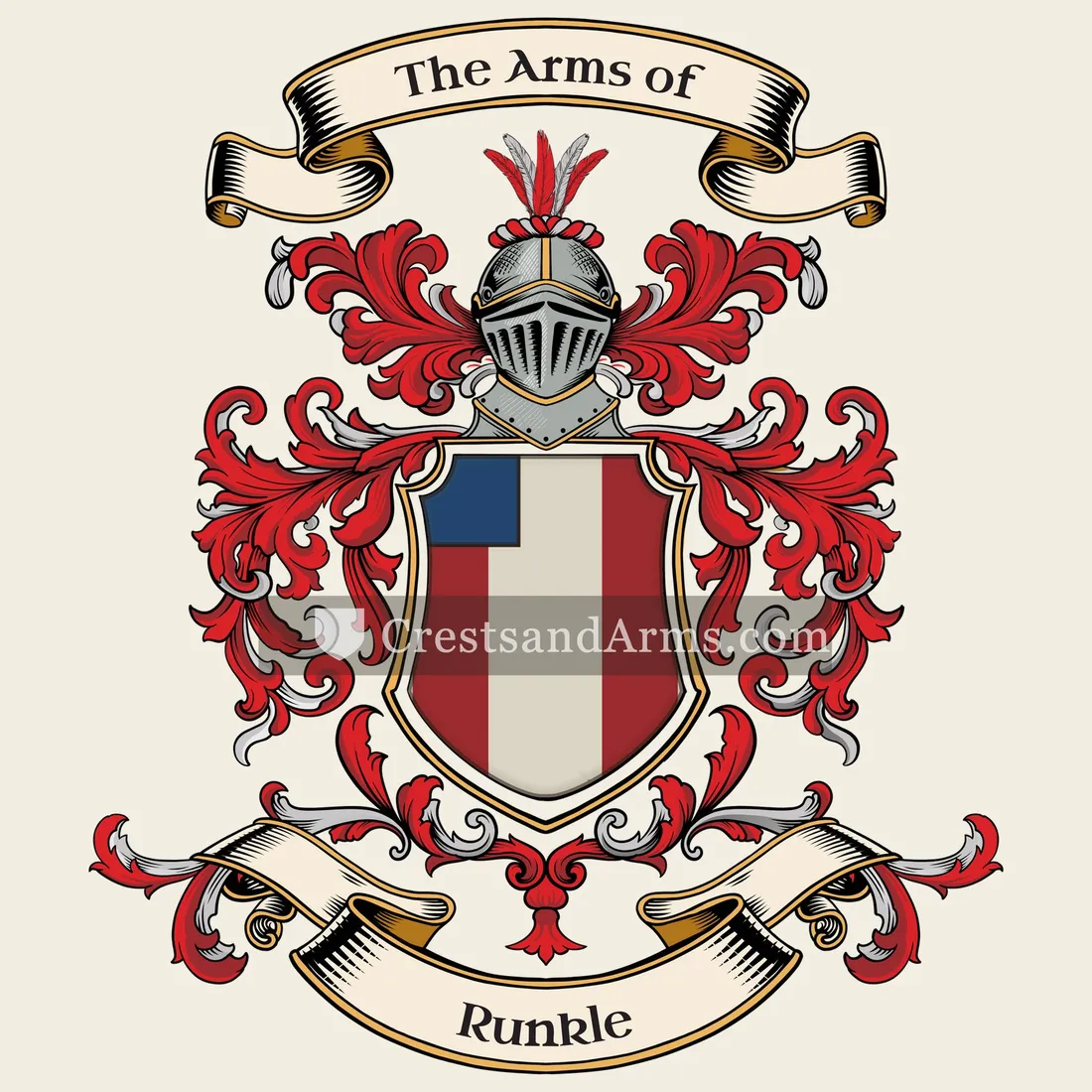


 swordJustice, and military honour