Map of Germany showing where the Runkles arms are recorded
The Runkles arms were recorded in Westphalia, c. 1765.
Westphalia was a land of small estates and fortified farmhouses in western Germany. Its families were numerous and not especially rich, but each held its own ground, and holding ground was what brought arms.
This is where the arms were entered in the register. Families often moved to other parts of the country, so the same name can turn up in more than one region.
The body that granted and recorded arms in Germany in this period.
Francis I, Holy Roman Emperor
Sovereign of the period
Francis I, Holy Roman Emperor
1745–1765
Reigning in Germany when the Runkles arms are first recorded.
How Arms Worked in Germany
In the Holy Roman Empire, coats of arms were often granted to individuals by the Emperor or his representatives. These arms were then passed down through the generations to all legitimate descendants of the original holder. Younger branches of a family usually kept the same shield design without needing to change it, as the arms belonged to the entire lineage.
Granting authority
The Holy Roman Emperor held the sole power to grant new coats of arms throughout his vast imperial territories.
How they got arms
Families typically obtained their coats of arms through a formal imperial grant or by proving their noble status to the authorities.
Where arms were recorded
These grants were officially recorded in the Imperial Chancery registers, which began keeping formal records of such honors during the Middle Ages.
The family's standing
Recorded among the armigerous families of Westphalia.
Origin & History of the Runkles Family in Germany
The family name Runkles finds its roots in the historical regions of Germany, specifically within the area of Westphalia. By the year 1765, records confirm that families bearing this name were established members of the local community. The name likely evolved from regional dialects and occupational or topographical descriptions common to the German-speaking lands during the Middle Ages. Families in Westphalia during this period often lived in small, agrarian settlements where surnames were slowly becoming standardized to help local officials track taxes and land ownership. Because Westphalia was a crossroads for trade and migration, the Runkles family likely participated in the traditional craft and farming industries that defined the local economy. Over time, the name became a permanent marker of their ancestry as they navigated the social and political changes occurring throughout the German states.
Meaning of the Runkles family crest colors & symbols
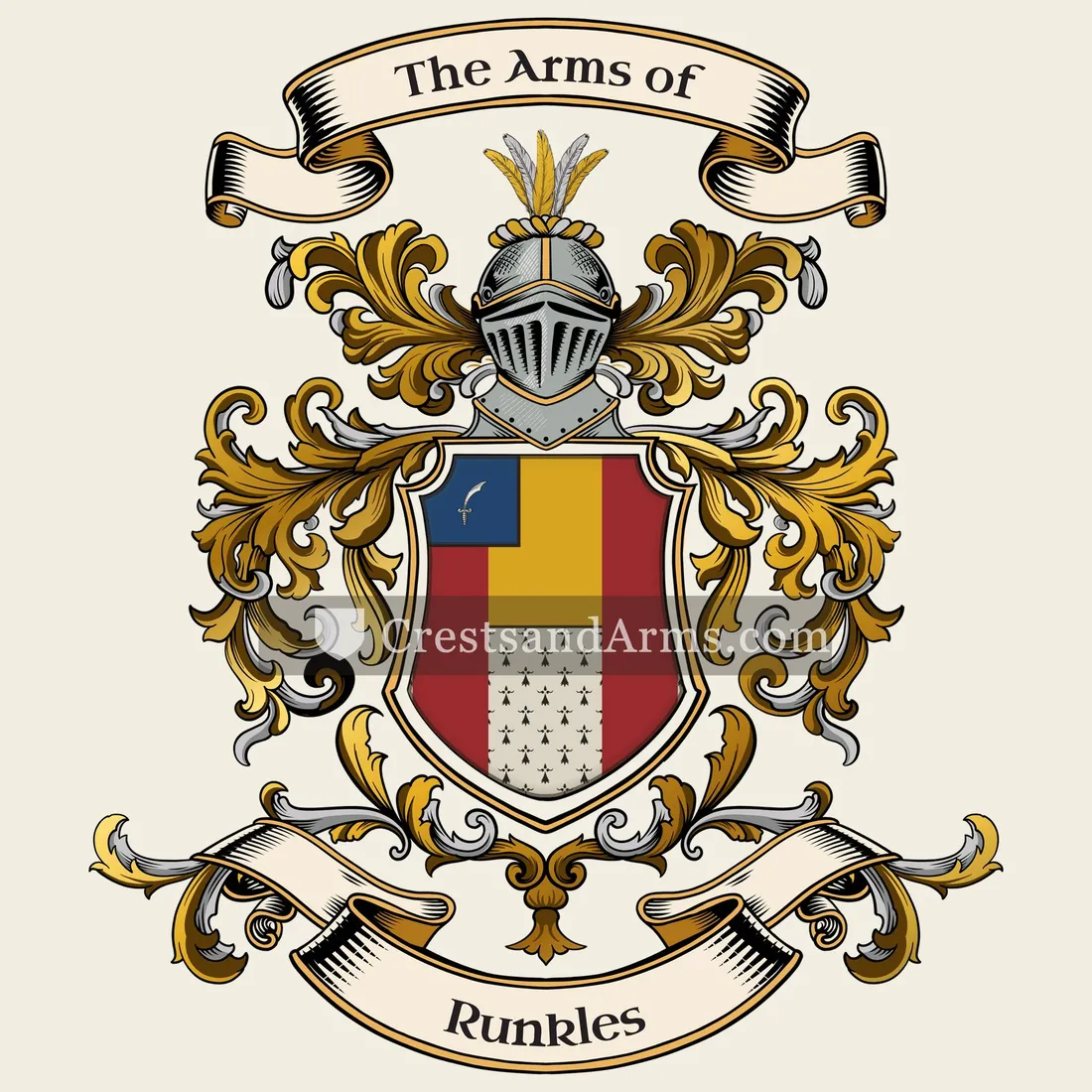
Symbols on this shield
paleMilitary strength, and a fortified defence
cantonA mark of honour granted by the sovereign
swordJustice, and military honour
Colours
Gold (Or)Means: Generosity
ErmineMeans: Dignity
Red (Gules)Means: Military strength
Blue (Azure)Means: Loyalty and truth
Silver (Argent)Means: Peace and sincerity
Historical info
Source
J. B. Rietstap, Armorial Général, Gouda: G. B. van Goor Zonen, 1884–87
Blazon (the actual original written record)
“Coupé d'or sur herm.; à deux pals de gu., br. sur le tout; au canton d'azur, ch. d'une épée d'arg., garnie d'or. C.: l'épée, devant un bosquet de fougère de sin., posé sur un tertre du même. L. d'or et de gu. D.: SPES IN DEO.”
Francec. 1811
Digital archive packCoat of arms PNG, gold border print PDF, vector SVG and the certificate of authenticity. Sent to your email in minutes.
Map of France showing where the Runkles arms are recorded
The Runkles arms were recorded in France, c. 1811.
Arms such as these were typically recorded in Bretagne.
More families held coats of arms in Bretagne than anywhere else in France. The land was divided into many small estates rather than a few large ones, so far more households counted as gentry, and each needed a shield of its own to be told apart.
This is where the arms were entered in the register. Families often moved to other parts of the country, so the same name can turn up in more than one region.
The body that granted and recorded arms in France in this period.
Napoleon
Sovereign of the period
Napoleon
1804–1814
Reigning in Germany when the Runkles arms are first recorded.
How Arms Worked in France
In France, a coat of arms was a mark of honor that passed down through the male line to all legitimate descendants. Families often used the same shield without changes to show their shared heritage. If a branch wanted to stand out, they could add a small mark to their shield to show their specific place in the family tree.
Granting authority
The Juge d'armes de France acted as the official authority that regulated and verified coats of arms across the country.
How they got arms
Families typically inherited their arms from ancestors, though they could also receive them through royal grants or by proving their noble status.
Where arms were recorded
Coats of arms were officially recorded in the Armorial Général de France, which began its main collection in the year 1696.
The family's standing
Recorded among the armigerous families of France.
Origin & History of the Runkles Family in France
The history of the Runkles family name in France is deeply tied to the rugged landscape of the Bretagne region. By the early 19th century, the family was well-established within this coastal area, which was known for its distinct cultural identity and maritime traditions. During this period, the name was likely shaped by the local Breton language and the specific social structures of the rural communities in western France. Families living in Bretagne during 1811 often focused on agriculture or local trade, and the Runkles name would have been recorded in local parish registers or civil status documents as the Napoleonic administration began to standardize record-keeping across the country. This era marked a time of transition for many families in the region, as they navigated the shifting political landscape of post-revolutionary France while maintaining their traditional ties to the land and their local community.
Runkles Meaning & Related Branches
Root word
Runckel
Derived from the Germanic personal name Runk, meaning strong or courageous.
This name
RunklesA patronymic surname indicating descent from an ancestor named Runk or Runkel.
also spelled
Runckel
Documented Sources
J. B. Rietstap, Armorial Général, Gouda: G. B. van Goor Zonen, 1884–87
Bischoff, Johannes. Westfälische Familiennamen und ihre Herkunft. 1928
State Archive of North Rhine-Westphalia (Landesarchiv Nordrhein-Westfalen), Kirchenbuchduplikate der preußischen Provinz Westfalen
Digital archive packCoat of arms PNG, gold border print PDF, vector SVG and the certificate of authenticity. Sent to your email in minutes.


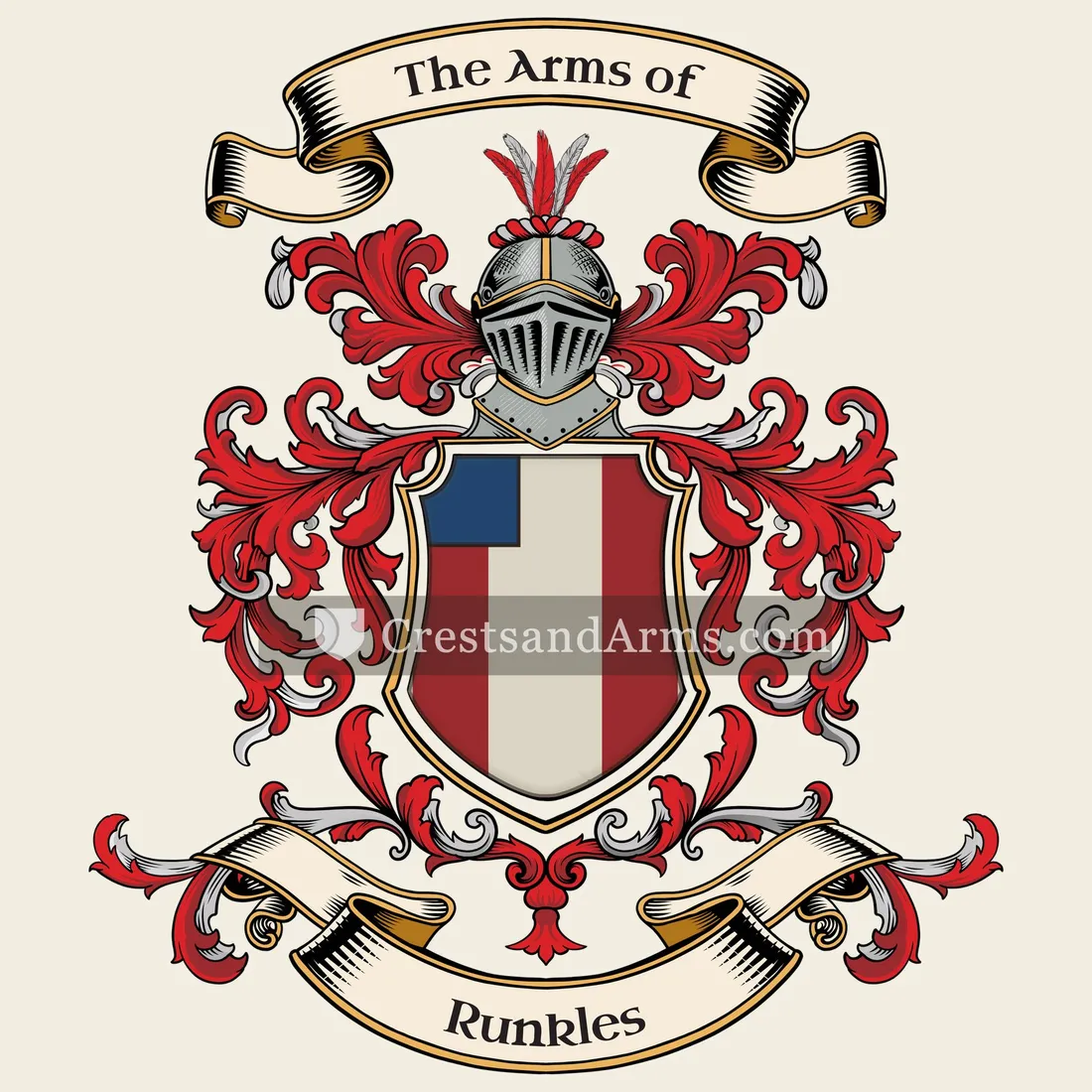
 paleMilitary strength, and a fortified defence
 cantonA mark of honour granted by the sovereign
 paleMilitary strength, and a fortified defence
 cantonA mark of honour granted by the sovereign


 swordJustice, and military honour