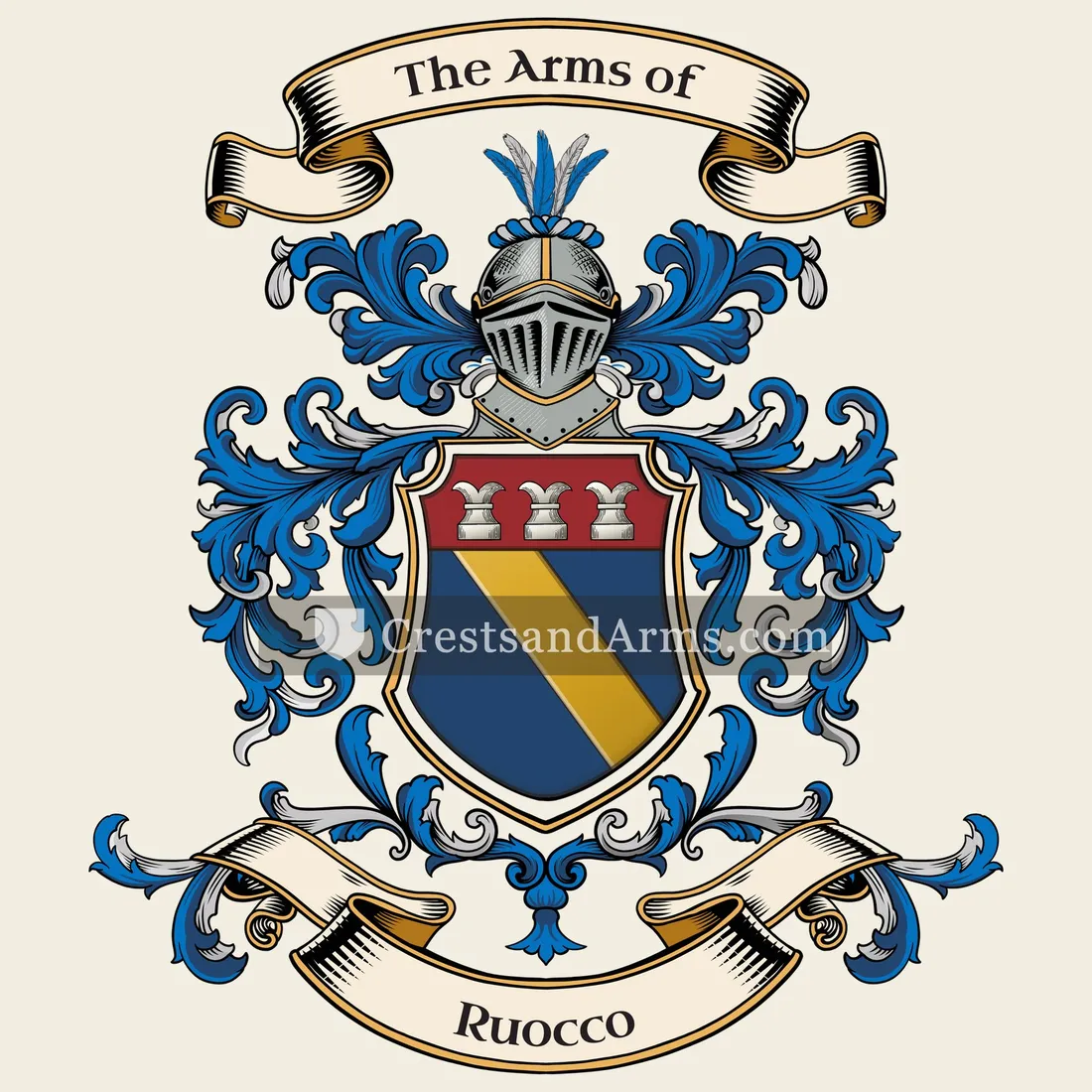
A record of documented arms, meaning and origin, researched for the Ruocco family of Italy.
Reg. 3038 · Italian, P–S
Meaning of the Ruocco family crest colors & symbols
Symbols on this shield
bendDefence, and the scarf of a commander
chiefAuthority, wisdom and dominion
chess rookStrategy, and the defence of a position
Colours
Blue (Azure)Means: Loyalty and truth
Gold (Or)Means: Generosity
Red (Gules)Means: Military strength
Silver (Argent)Means: Peace and sincerity
Historical info
Source
J. B. Rietstap, Armorial Général, Gouda: G. B. van Goor Zonen, 1884–87
Blazon (the actual original written record)
“D'azur à trois bandes d'or; au chef de gu., ch. de trois rocs d'échiquier d'arg. et soutenu d'une divise d'or. C.: trois pl. d'aut., celle du milieu enfilant deux couronnes à l'antique et chacune des deux autres enfilant une seule couronne pareille.”
NaplesNaples, c. 1641
Digital archive packCoat of arms PNG, gold border print PDF, vector SVG and the certificate of authenticity. Sent to your email in minutes.
Map of Italy showing where the Ruocco arms are recorded
The Ruocco arms were recorded in Naples, c. 1641.
Naples was the largest city in Italy and the seat of a kingdom. Its noble houses were numerous, and the kingdom kept formal lists of the families entitled to arms, which is why so many appear in the records.
This is where the arms were entered in the register. Families often moved to other parts of the country, so the same name can turn up in more than one region.
The body that granted and recorded arms in Italy in this period.
Francesco Erizzo
Sovereign of the period
Francesco Erizzo
1631–1646
Reigning in Italy when the Ruocco arms are first recorded.
How Arms Worked in Italy
In the Italian states, coats of arms were often used by noble families to show their status and history. These symbols were passed down through the generations to all legitimate male descendants. Younger branches of a family usually kept the original design but sometimes added small changes to distinguish their specific line from the main branch.
Granting authority
Various local rulers and city governments controlled the use of coats of arms across the different Italian states.
How they got arms
Families often assumed their own arms or received them as official grants from local lords, popes, or city councils.
Where arms were recorded
Arms were recorded in local city archives or private family books rather than in one single national register.
The family's standing
Recorded among the armigerous families of Naples.
Origin & History of the Ruocco Family in Italy
The surname Ruocco finds its deep roots in the Campania region of Italy, with a significant historical presence documented in Naples by 1641. The name is believed to have originated as a nickname or a descriptive term, likely derived from the Italian word "rocco," which relates to concepts of strength or ruggedness. During the 17th century, families bearing this name were often integrated into the urban fabric of Naples, a city defined by its bustling trade and complex social hierarchy under Spanish rule. As the family established itself in the region, they became part of the local artisan and merchant classes that helped shape the vibrant culture of southern Italy. By the mid-1600s, the name was already well-established in parish registers and municipal documents, reflecting a lineage that was deeply connected to the daily life and administrative growth of the Neapolitan kingdom.
Ruocco Meaning & Related Branches
Root word
Rubeus
Latin term meaning red or reddish in color.
This name
RuoccoA nickname for someone with red hair or a ruddy complexion.
also spelled
Roco
Roko
Rock
Documented Sources
J. B. Rietstap, Armorial Général, Gouda: G. B. van Goor Zonen, 1884–87
De Felice, Emidio. Dizionario dei cognomi italiani. 1978
Archivio di Stato di Napoli, Stato Civile della Restaurazione
Digital archive packCoat of arms PNG, gold border print PDF, vector SVG and the certificate of authenticity. Sent to your email in minutes.


 bendDefence, and the scarf of a commander
 chiefAuthority, wisdom and dominion
 chess rookStrategy, and the defence of a position
 bendDefence, and the scarf of a commander
 chiefAuthority, wisdom and dominion
 chess rookStrategy, and the defence of a position