Map of Britain showing where the Ruter arms are recorded
The Ruter arms were recorded in Cheshire, c. 1700.
This is where the arms were entered in the register. Families often moved to other parts of the country, so the same name can turn up in more than one region.
The body that granted and recorded arms in Britain in this period.
William III of England
Sovereign of the period
William III of England
1694–1702
Reigning in Britain when the Ruter arms are first recorded.
How Arms Worked in Britain
English heraldry allowed arms to be shared by all legitimate descendants of the original owner. These symbols were treated as personal property that moved through the generations to all children. While the eldest son kept the original design, other family members could use the same shield without needing to change it or register their own unique versions.
Granting authority
The College of Arms in London has regulated the use of coats of arms throughout England and Wales since 1484.
How they got arms
Families typically obtained their coats of arms through a formal grant from the Crown or by proving their ancient right to them.
Where arms were recorded
All official coats of arms are recorded in the registers kept at the College of Arms, which date back to the fifteenth century.
The family's standing
Recorded among the armigerous families of Cheshire.
Origin & History of the Ruter Family in Britain
The family name Ruter has deep roots in the rural landscape of Cheshire, where records confirm members of the family were established by the year 1700. During this period, the name likely emerged as a descriptive term for people who worked in the local timber or agricultural trades, as the linguistic roots of the name often relate to the clearing of land or the management of rural estates. Life for the Ruter family in eighteenth-century Cheshire was defined by the rhythms of village life and the seasonal demands of the English countryside. As the family grew, they became part of the local social fabric, contributing to the development of the county’s parishes through their work and community involvement. By tracing their presence back to this era, we see a family that was firmly integrated into the regional history of Northwest England, living through a time of significant agricultural and social change.
Coat of Arms & Family Crest Details
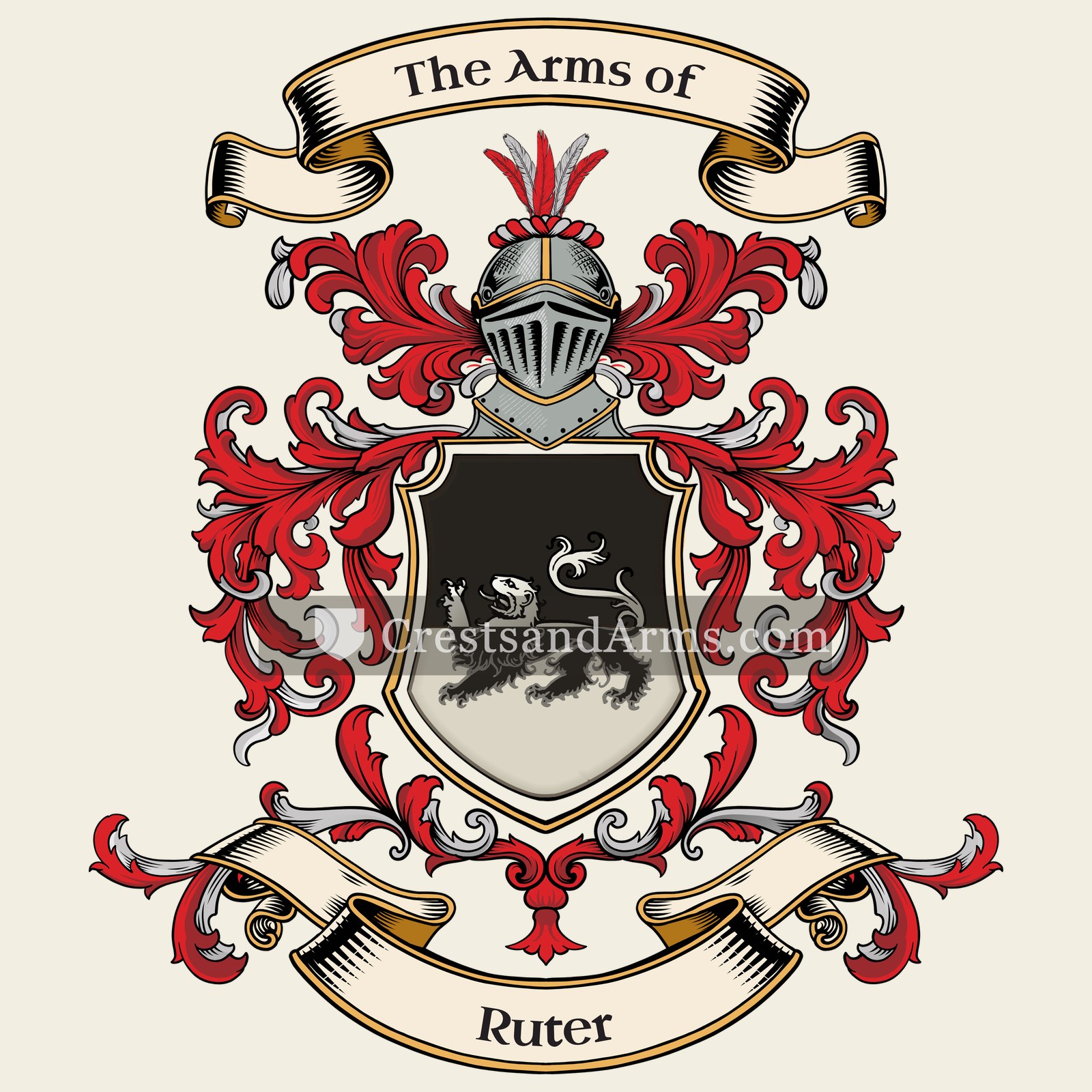
Symbols on this shield
lionCourage, strength and royalty
Colours
Black (Sable)Means: Constancy
Silver (Argent)Means: Peace and sincerity
Historical info
Source
J. B. Rietstap, Armorial Général, Gouda: G. B. van Goor Zonen, 1884–87
Blazon (the actual original written record)
“Coupé de sa. sur arg.; au lion de l'un en l'autre, tenant une pique. C.: le lion, iss., entre deux prob. coupées de sa. sur arg., ornées chacune dans son embouchure de trois pl. d'aut. d'arg. et de sa.”
PolandPosnanie, c. 1812
Digital archive packCoat of arms PNG, gold border print PDF, vector SVG and the certificate of authenticity. Sent to your email in minutes.
Map of Poland showing where the Ruter arms are recorded
The Ruter arms were recorded in Posnanie, c. 1812.
This is where the arms were entered in the register. Families often moved to other parts of the country, so the same name can turn up in more than one region.
Region
Posnanie
Town
Posnanie
First recorded
1812
Granting Authority for the Ruter Arms
Ennoblement by the Sejm
Author: Olek Remesz · CC BY-SA 3.0
The body that granted and recorded arms in Poland in this period.
How Arms Worked in Poland
Polish noble families shared a single coat of arms across many different surnames, creating large clans rather than individual designs. These symbols were held collectively by all members of the clan regardless of their specific family name. When a new family joined the nobility, they were adopted into an existing clan and began using that group's established shield.
Granting authority
The Sejm, which was the Polish parliament, held the power to grant noble status and the right to bear arms.
How they got arms
Families typically received their coat of arms through a formal act of ennoblement granted by the Sejm for distinguished service.
Where arms were recorded
These grants were officially recorded in the Crown Metrica, which served as the central archive for state documents starting in the sixteenth century.
The family's standing
Recorded among the armigerous families of Poland.
Origin & History of the Ruter Family in Poland
The Ruter family name has deep roots in the region of Posnanie, where members of the family were documented as residents as early as 1812. During this period, the area was part of the Duchy of Warsaw, a time of significant political transition and military upheaval in Central Europe. The name likely evolved from regional linguistic patterns, reflecting the diverse cultural influences present in the Polish territories during the nineteenth century. Families like the Ruters often played essential roles in the local agricultural and civic life of Posnanie, contributing to the development of the region's towns and rural estates. By settling in this specific part of Poland, the family became part of a long history of community building that defined the local population throughout the nineteenth century.
Related Branches & Arms
Root word
Hrut
Old Norse word meaning ram
This name
RuterAn occupational name for a person who worked as a clearer of land or a pathfinder.
also spelled
Ruter
Ruttar
Ruttier
Ruttor
Ruttir
Documented Sources
J. B. Rietstap, Armorial Général, Gouda: G. B. van Goor Zonen, 1884–87
Cheshire Archives and Local Studies, Bishop's Transcripts of Cheshire Parish Registers, 1700
Dyer, Christopher, Standards of Living in the Later Middle Ages: Social Change in England c. 1200–1520, 1989
Hey, David, Family Names and Family History, 2000
Digital archive packCoat of arms PNG, gold border print PDF, vector SVG and the certificate of authenticity. Sent to your email in minutes.


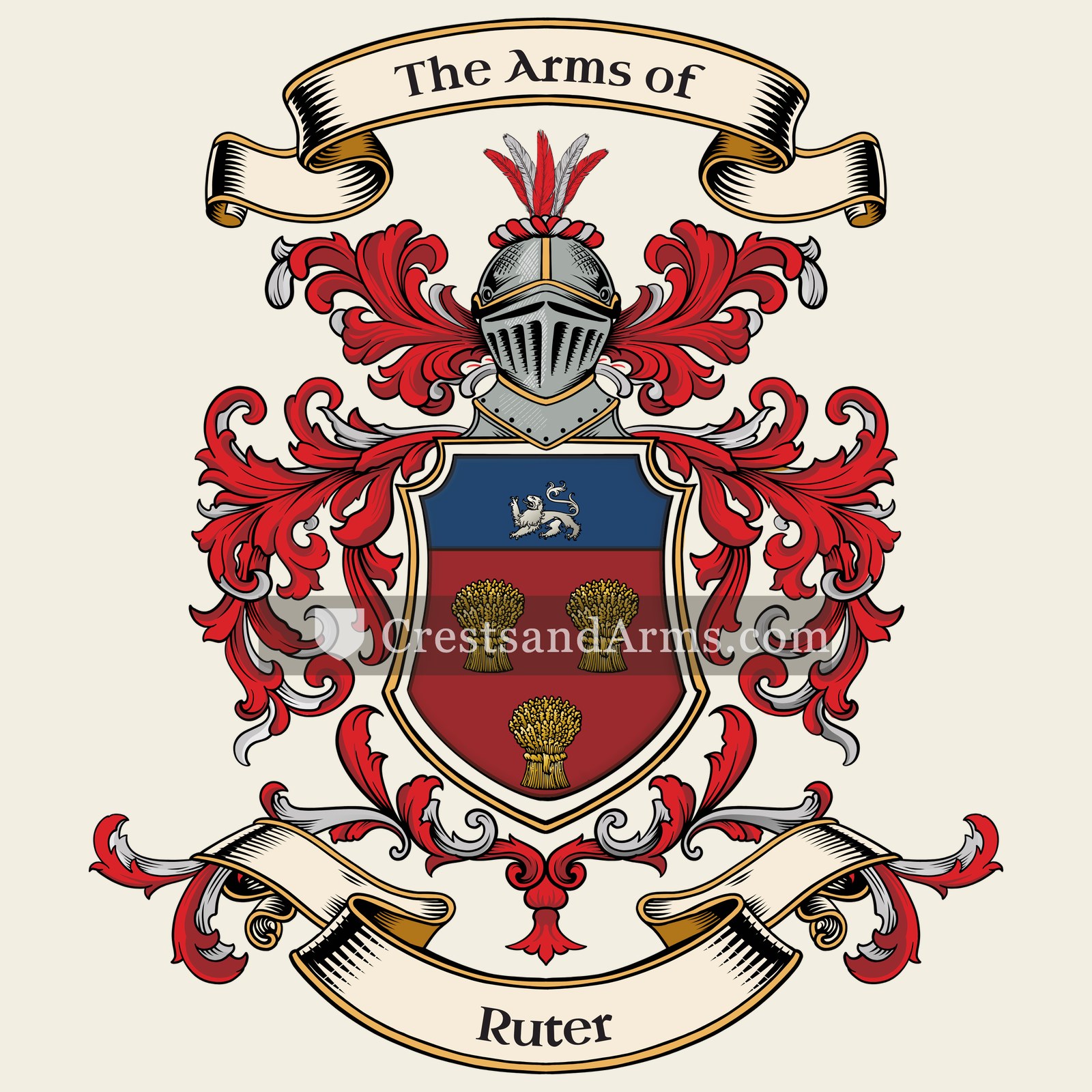
 bendDefence, and the scarf of a commander
 chiefAuthority, wisdom and dominion
 wheatsheafPlenty, and the harvest of one's own labour
 lionCourage, strength and royalty
 bendDefence, and the scarf of a commander
 chiefAuthority, wisdom and dominion
 wheatsheafPlenty, and the harvest of one's own labour
 lionCourage, strength and royalty