Map of Britain showing where the Rutter arms are recorded
The Rutter arms were recorded in Cheshire, c. 1700.
This is where the arms were entered in the register. Families often moved to other parts of the country, so the same name can turn up in more than one region.
The body that granted and recorded arms in Britain in this period.
William III of England
Sovereign of the period
William III of England
1694–1702
Reigning in Britain when the Rutter arms are first recorded.
How Arms Worked in Britain
English heraldry allowed arms to be shared by all legitimate descendants of the original owner. These symbols were treated as personal property that moved through the generations to all children. While the eldest son kept the original design, other family members could use the same shield without needing to change it or register their own unique versions.
Granting authority
The College of Arms in London has regulated the use of coats of arms throughout England and Wales since 1484.
How they got arms
Families typically obtained their coats of arms through a formal grant from the Crown or by proving their ancient right to them.
Where arms were recorded
All official coats of arms are recorded in the registers kept at the College of Arms, which date back to the fifteenth century.
The family's standing
Recorded among the armigerous families of Cheshire.
Origin & History of the Rutter Family in Britain
The surname Rutter is a classic example of an occupational name that emerged in medieval Britain. It originates from the Middle English word "rutier," which was used to describe a traveler, a wanderer, or a professional soldier. Because people often received surnames based on their trade or how they moved through the world, the name likely began as a nickname for someone who spent much of their life on the road. By the year 1700, the Rutter family had established a strong presence in the county of Cheshire. In this region, they were often recorded as yeoman farmers or tradesmen who played an active role in the local community. These early families were deeply connected to the land and the local parish systems, which helped them maintain their identity as they settled into the rural landscapes of North West England.
Coat of Arms & Family Crest Details
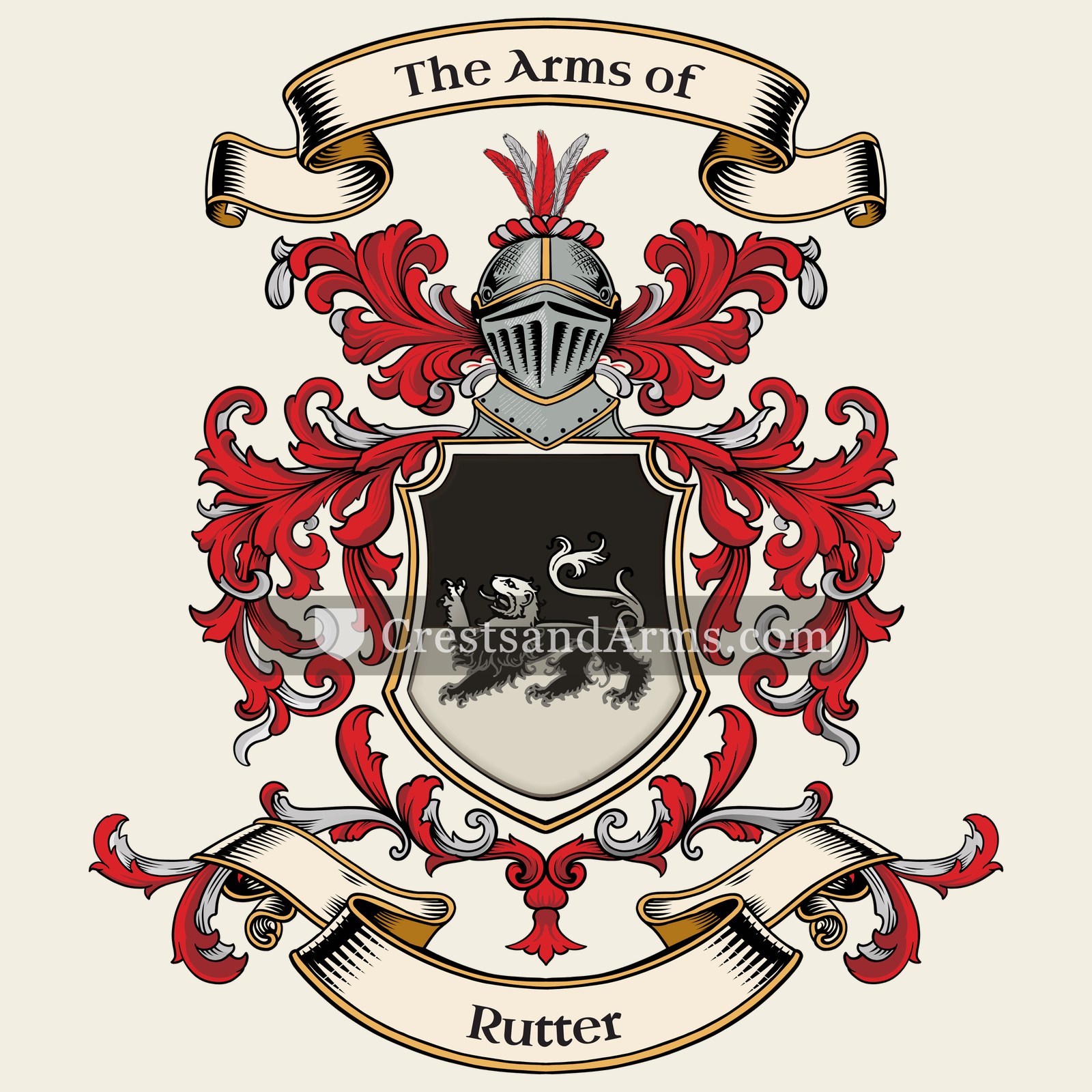
Symbols on this shield
lionCourage, strength and royalty
Colours
Black (Sable)Means: Constancy
Silver (Argent)Means: Peace and sincerity
Historical info
Source
J. B. Rietstap, Armorial Général, Gouda: G. B. van Goor Zonen, 1884–87
Blazon (the actual original written record)
“Coupé de sa. sur arg.; au lion de l'un en l'autre, tenant une pique. C.: le lion, iss., entre deux prob. coupées de sa. sur arg., ornées chacune dans son embouchure de trois pl. d'aut. d'arg. et de sa.”
PolandPosnanie, c. 1812
Digital archive packCoat of arms PNG, gold border print PDF, vector SVG and the certificate of authenticity. Sent to your email in minutes.
Map of Poland showing where the Rutter arms are recorded
The Rutter arms were recorded in Posnanie, c. 1812.
This is where the arms were entered in the register. Families often moved to other parts of the country, so the same name can turn up in more than one region.
Region
Posnanie
Town
Posnanie
First recorded
1812
Granting Authority for the Rutter Arms
Ennoblement by the Sejm
Author: Olek Remesz · CC BY-SA 3.0
The body that granted and recorded arms in Poland in this period.
How Arms Worked in Poland
Polish noble families shared a single coat of arms across many different surnames, creating large clans rather than individual designs. These symbols were held collectively by all members of the clan regardless of their specific family name. When a new family joined the nobility, they were adopted into an existing clan and began using that group's established shield.
Granting authority
The Sejm, which was the Polish parliament, held the power to grant noble status and the right to bear arms.
How they got arms
Families typically received their coat of arms through a formal act of ennoblement granted by the Sejm for distinguished service.
Where arms were recorded
These grants were officially recorded in the Crown Metrica, which served as the central archive for state documents starting in the sixteenth century.
The family's standing
Recorded among the armigerous families of Poland.
Origin & History of the Rutter Family in Poland
The surname Rutter has deep roots in the region of Posnanie, which is located in west-central Poland. By the year 1812, families bearing this name were already established members of the local community. The name itself is often linked to the Middle High German word *ruter*, which historically referred to a rider or a mounted soldier. During the early nineteenth century, Posnanie was a vibrant area undergoing significant social and political changes due to the influence of the Napoleonic era. Families like the Rutters were part of this shifting landscape, likely working as skilled tradespeople or landowners who helped shape the local economy. Their presence in the region during this time suggests they were well-integrated into the social fabric of the province, living through a period where the borders and governance of Poland were frequently redefined.
Coat of Arms & Family Crest Details
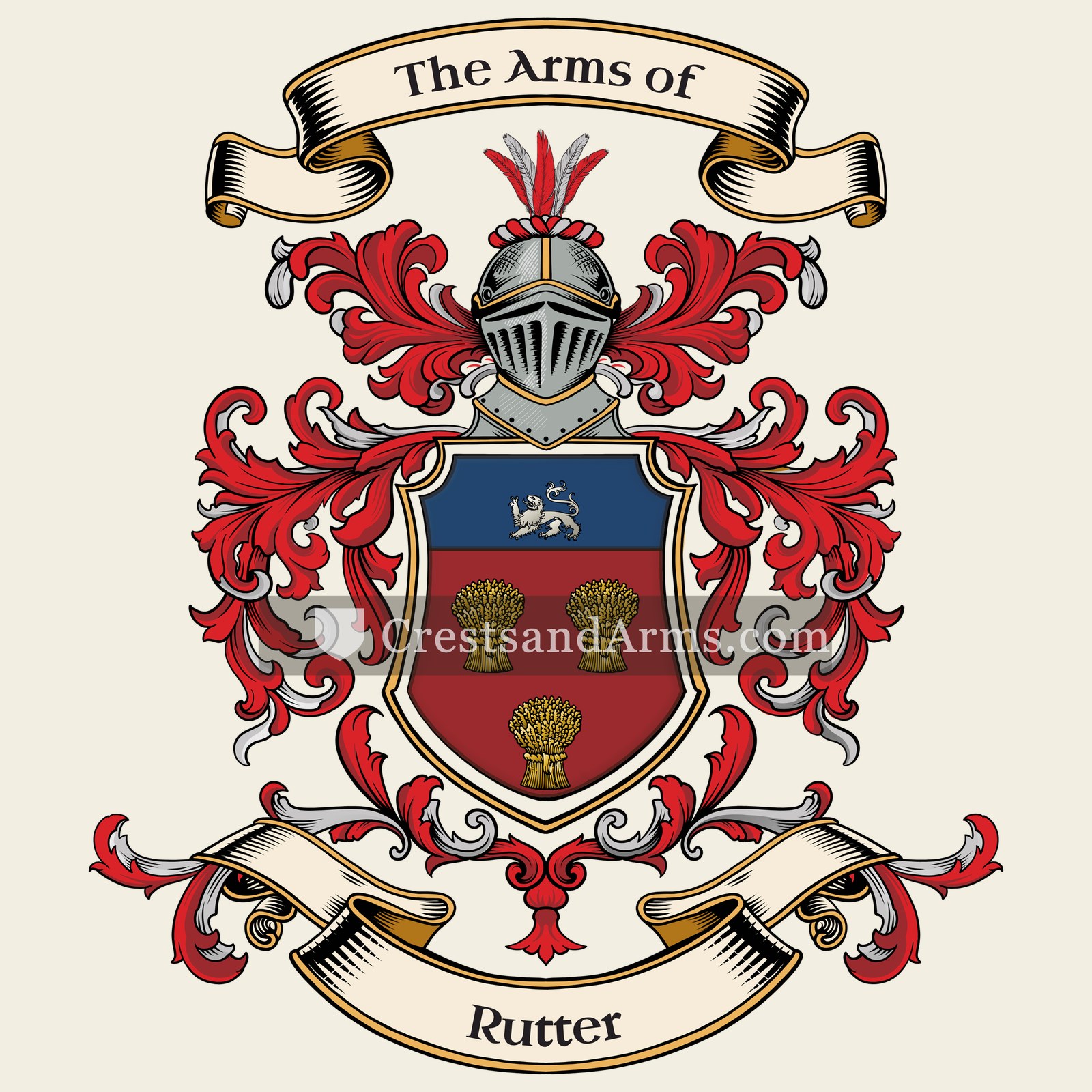
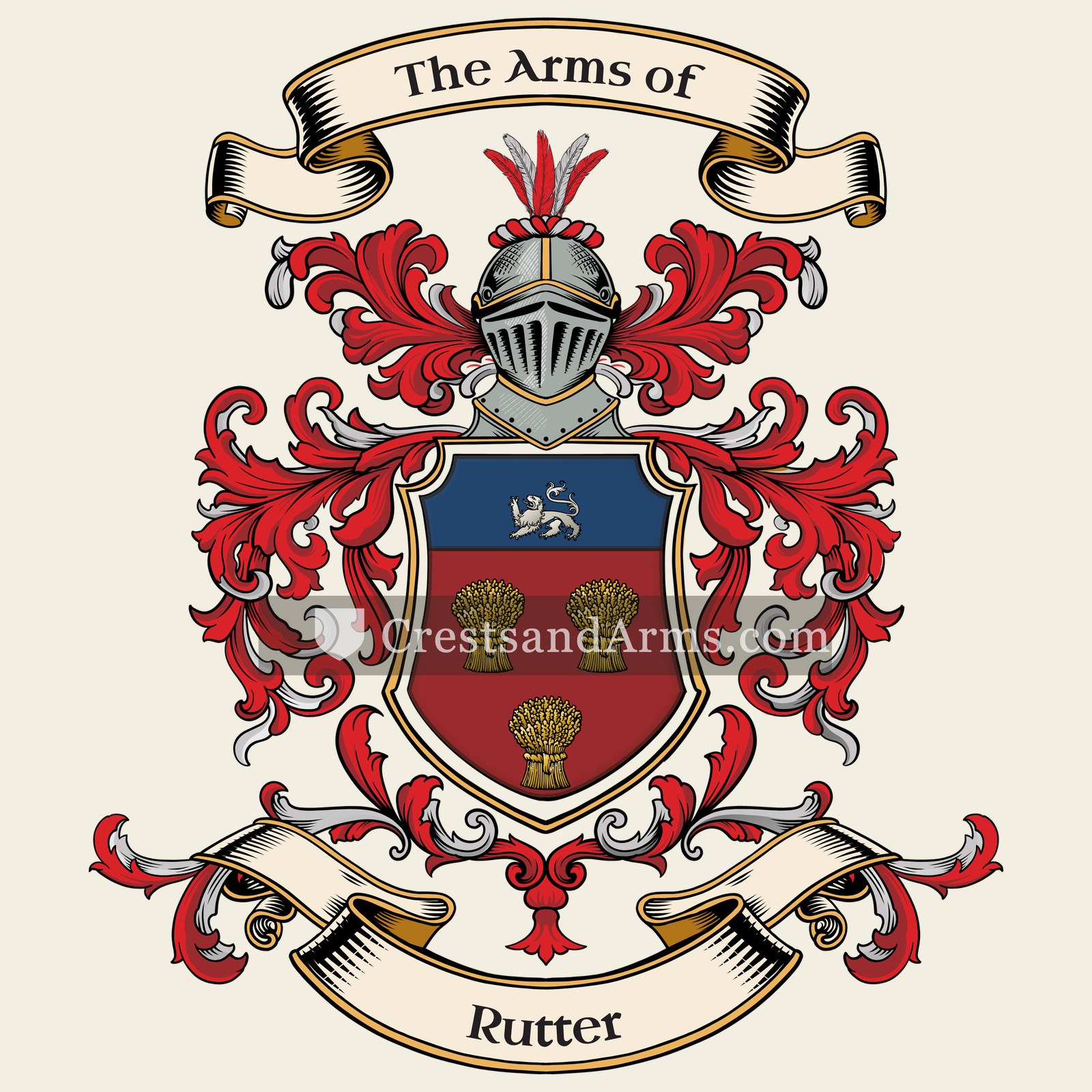
Symbols on this shield
chiefAuthority, wisdom and dominion
wheatsheafPlenty, and the harvest of one's own labour
lionCourage, strength and royalty
Colours
Red (Gules)Means: Military strength
Blue (Azure)Means: Loyalty and truth
Gold (Or)Means: Generosity
Silver (Argent)Means: Peace and sincerity
Historical info
Source
Sir Bernard Burke, The General Armory of England, Scotland, Ireland and Wales, London: Harrison & Sons, 1884
Blazon (the actual original written record)
“Gu. three garbs or, on a chief az. a lion pass. ar”
ChesterKingsley · Chester, c. 1620
Digital archive packCoat of arms PNG, gold border print PDF, vector SVG and the certificate of authenticity. Sent to your email in minutes.
Map of England showing where the Rutter arms are recorded
The Rutter arms were recorded in Chester, c. 1620.
Cheshire was governed apart from the rest of England for much of its history, with its own courts and its own gentry. That separateness bred a strong local landed class, and landed families carried arms.
This is where the arms were entered in the register. Families often moved to other parts of the country, so the same name can turn up in more than one region.
The body that granted and recorded arms in England in this period.
James VI and I
Sovereign of the period
James VI and I
1603–1625
Reigning in Britain when the Rutter arms are first recorded.
How Arms Worked in England
English heraldry allowed arms to be shared by all legitimate descendants of the original owner. These symbols were treated as personal property that moved through the generations to all children. While the eldest son kept the original design, other family members could use the same shield without needing to change it or register their own unique versions.
Granting authority
The College of Arms in London has regulated the use of coats of arms throughout England and Wales since 1484.
How they got arms
Families typically obtained their coats of arms through a formal grant from the Crown or by proving their ancient right to them.
Where arms were recorded
All official coats of arms are recorded in the registers kept at the College of Arms, which date back to the fifteenth century.
The family's standing
Recorded among the armigerous families of Chester.
Origin & History of the Rutter Family in England
The surname Rutter is rooted in the social and linguistic landscape of medieval England, where it likely functioned as an occupational or descriptive nickname. The name is derived from the Middle English word *ruter*, which was often used to describe a traveler, a soldier, or a person known for their boisterous behavior. By the early 17th century, the family had established a notable presence in the city of Chester, a historic trade hub in the northwest of England. Records from 1620 confirm that members of the Rutter family were active in this region, where they participated in the local civic and economic life of the city. During this era, families in Chester were often deeply connected to the merchant guilds and the administrative duties of the county, allowing the Rutter name to become firmly embedded in the local historical record of Cheshire.
Related Branches & Arms
Root word
rotier
Old French term for a player of the rote or fiddle.
This name
RutterAn occupational surname for a musician who played the medieval stringed instrument.
also spelled
Ruter
Ruttar
Ruttier
Ruttor
Ruttir
Related arms
Chischich dit Clesanichsimilar arms
Whitornesimilar arms
Gerardrecorded with Rutter, same area
Spillerrecorded with Rutter, same area
Documented Sources
J. B. Rietstap, Armorial Général, Gouda: G. B. van Goor Zonen, 1884–87
Bardsley, Charles Wareing, A Dictionary of English and Welsh Surnames, 1901
Reaney, P.H. and Wilson, R.M., A Dictionary of English Surnames, 1991
Cheshire Archives and Local Studies, Bishop’s Transcripts of Cheshire Parish Registers, 1700
Digital archive packCoat of arms PNG, gold border print PDF, vector SVG and the certificate of authenticity. Sent to your email in minutes.


 bendDefence, and the scarf of a commander
 chiefAuthority, wisdom and dominion
 wheatsheafPlenty, and the harvest of one's own labour
 lionCourage, strength and royalty
 bendDefence, and the scarf of a commander
 chiefAuthority, wisdom and dominion
 wheatsheafPlenty, and the harvest of one's own labour
 lionCourage, strength and royalty