A record of documented arms, meaning and origin, researched for the Sack family lines. Documented in 2 countries.
Reg. 5584 · German, T–V
Meaning of the Sack family crest colors & symbols
Symbols on this shield
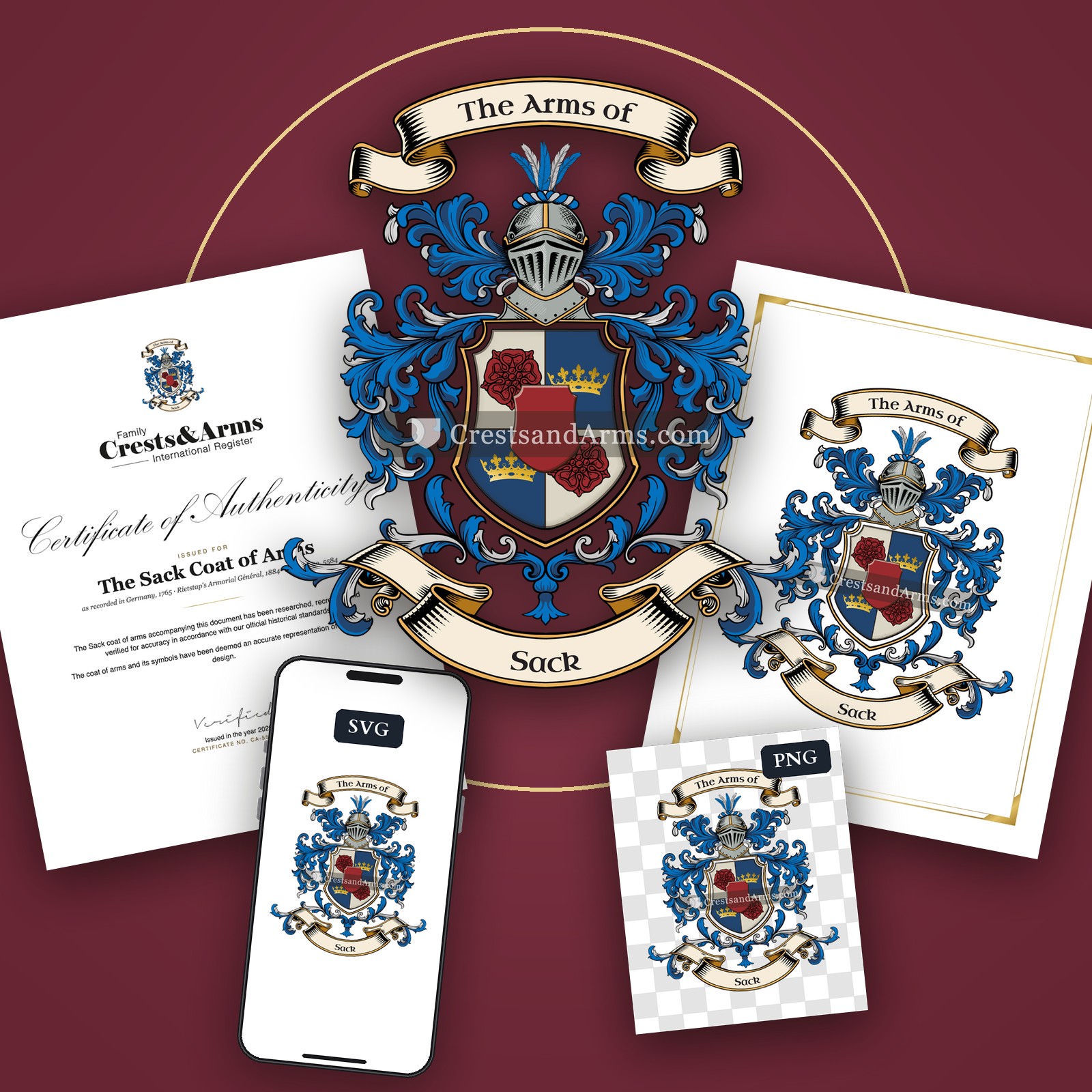
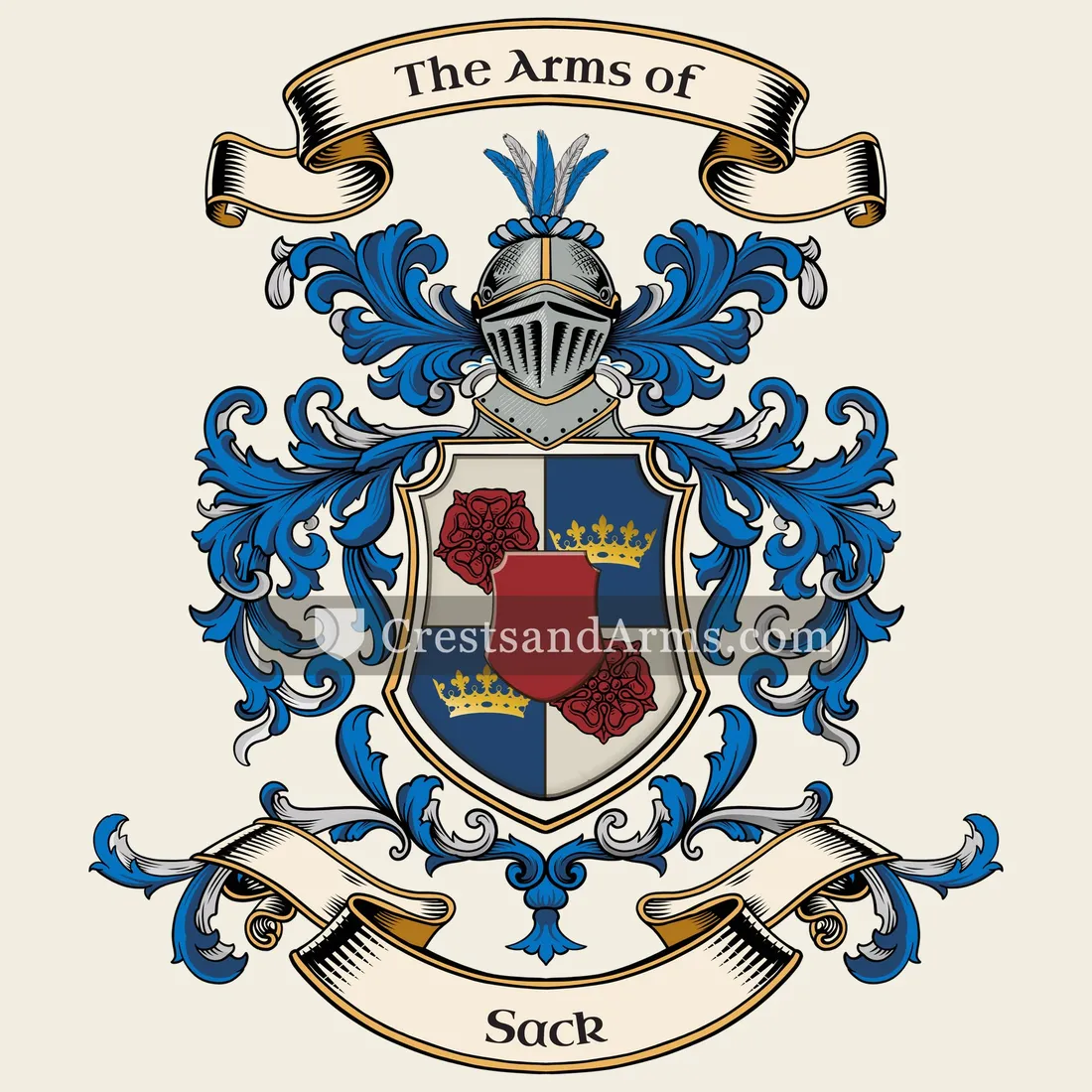
roseThe seventh son, and beauty with grace
crownSovereignty, authority and just reward
Colours
Silver (Argent)Means: Peace and sincerity
Blue (Azure)Means: Loyalty and truth
Red (Gules)Means: Military strength
Gold (Or)Means: Generosity
Historical info
Source
J. B. Rietstap, Armorial Général, Gouda: G. B. van Goor Zonen, 1884–87
Blazon (the actual original written record)
“Ec.: aux 1 et 4 d'arg. à une rose de gu.; aux 2 et 3 d'azur à une couronne d'or. Sur le tout de gu. à quatre sacs d'or, appointés en saut. Trois cq. cour. C.: 1º une croix de Jérusalem d'or; 2º une femme moresque, iss., tort. d'arg. et de gu., hab. d'une jupe rayée des mêmes émaux; 3º un panache de cinq pl. d'aut. d'arg., sommé d'un croiss. du même. L.: à dextre d'or et de gu., à sen. d'arg. et d'azur. S.: à dextre un ours blanc, coll. d'azur, bordé et bouclé d'or; à sen. un léopard lionné d'or, arm. et lamp. de gu. D.: NIL DESPERANDUM AUSPICE DEO.”
Germanyc. 1765
Digital archive packCoat of arms PNG, gold border print PDF, vector SVG and the certificate of authenticity. Sent to your email in minutes.
Map of Germany showing where the Sack arms are recorded
The Sack arms were recorded in Germany, c. 1765.
Arms such as these were typically recorded in Bavaria.
Bavaria was a country of old landed families and walled market towns. Estates passed down the same line for centuries, and both the landowners and the leading townsmen kept arms, which is why so many Bavarian names sit in the registers.
This is where the arms were entered in the register. Families often moved to other parts of the country, so the same name can turn up in more than one region.
The body that granted and recorded arms in Germany in this period.
Francis I, Holy Roman Emperor
Sovereign of the period
Francis I, Holy Roman Emperor
1745–1765
Reigning in Germany when the Sack arms are first recorded.
How Arms Worked in Germany
In the Holy Roman Empire, coats of arms were often granted to individuals by the Emperor or his representatives. These arms were then passed down through the generations to all legitimate descendants of the original holder. Younger branches of a family usually kept the same shield design without needing to change it, as the arms belonged to the entire lineage.
Granting authority
The Holy Roman Emperor held the sole power to grant new coats of arms throughout his vast imperial territories.
How they got arms
Families typically obtained their coats of arms through a formal imperial grant or by proving their noble status to the authorities.
Where arms were recorded
These grants were officially recorded in the Imperial Chancery registers, which began keeping formal records of such honors during the Middle Ages.
The family's standing
Recorded among the armigerous families of Germany.
Origin & History of the Sack Family in Germany
The surname Sack originated in Germany as a descriptive name, likely referring to a person who made or sold bags and sacks. In the medieval period, many German families adopted surnames based on their trade to help identify them within growing village communities. By the time members of the family were documented in Bavaria in 1765, the name was already well-established across various German-speaking regions. Families with this name often lived as skilled craftsmen or farmers, contributing to the local economy of their specific towns. Because record-keeping in the eighteenth century was often tied to church registries and local tax rolls, the presence of the Sack family in Bavarian documents suggests they were integrated members of their community who participated in the social and legal life of the region.
Meaning of the Sack family crest colors & symbols
Symbols on this shield
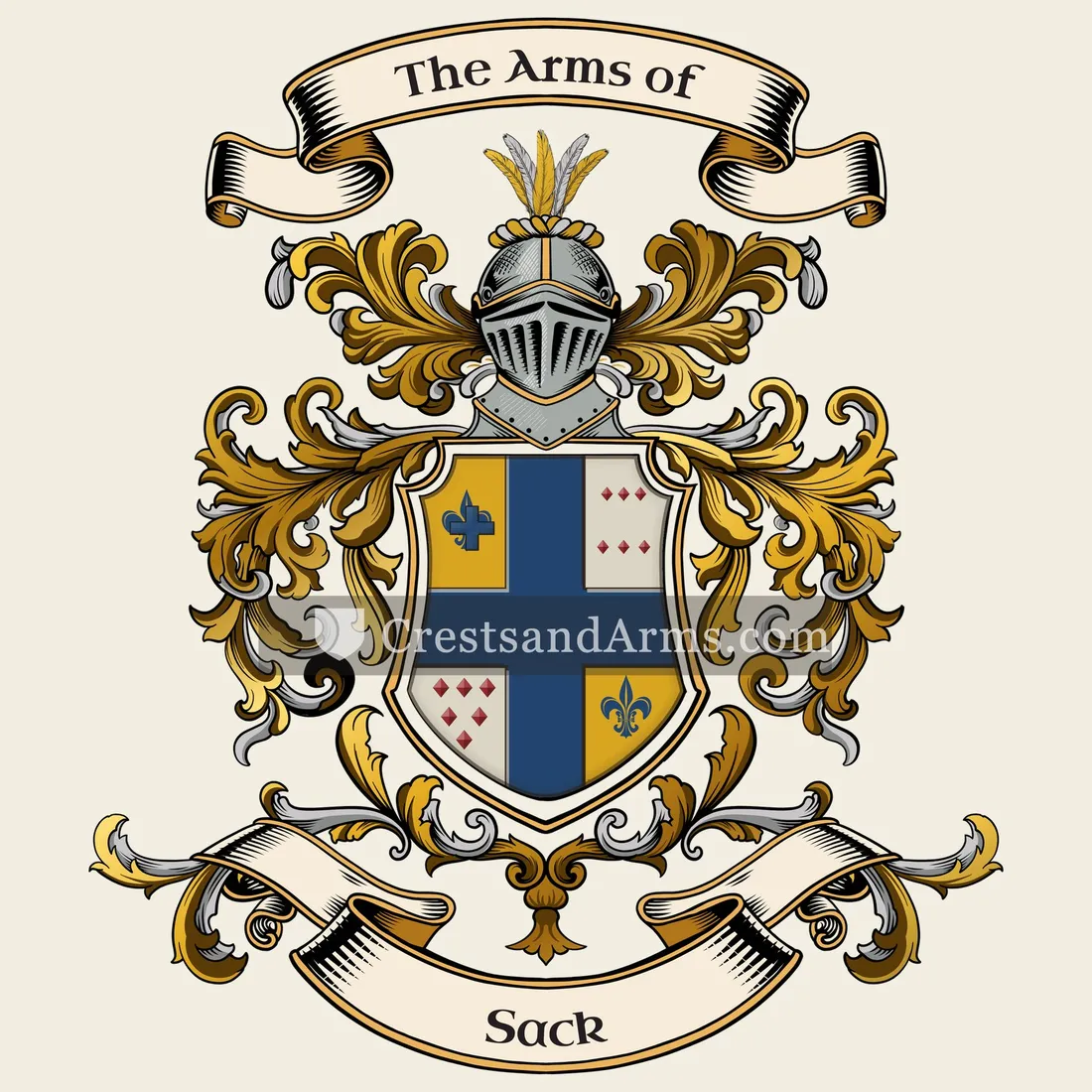
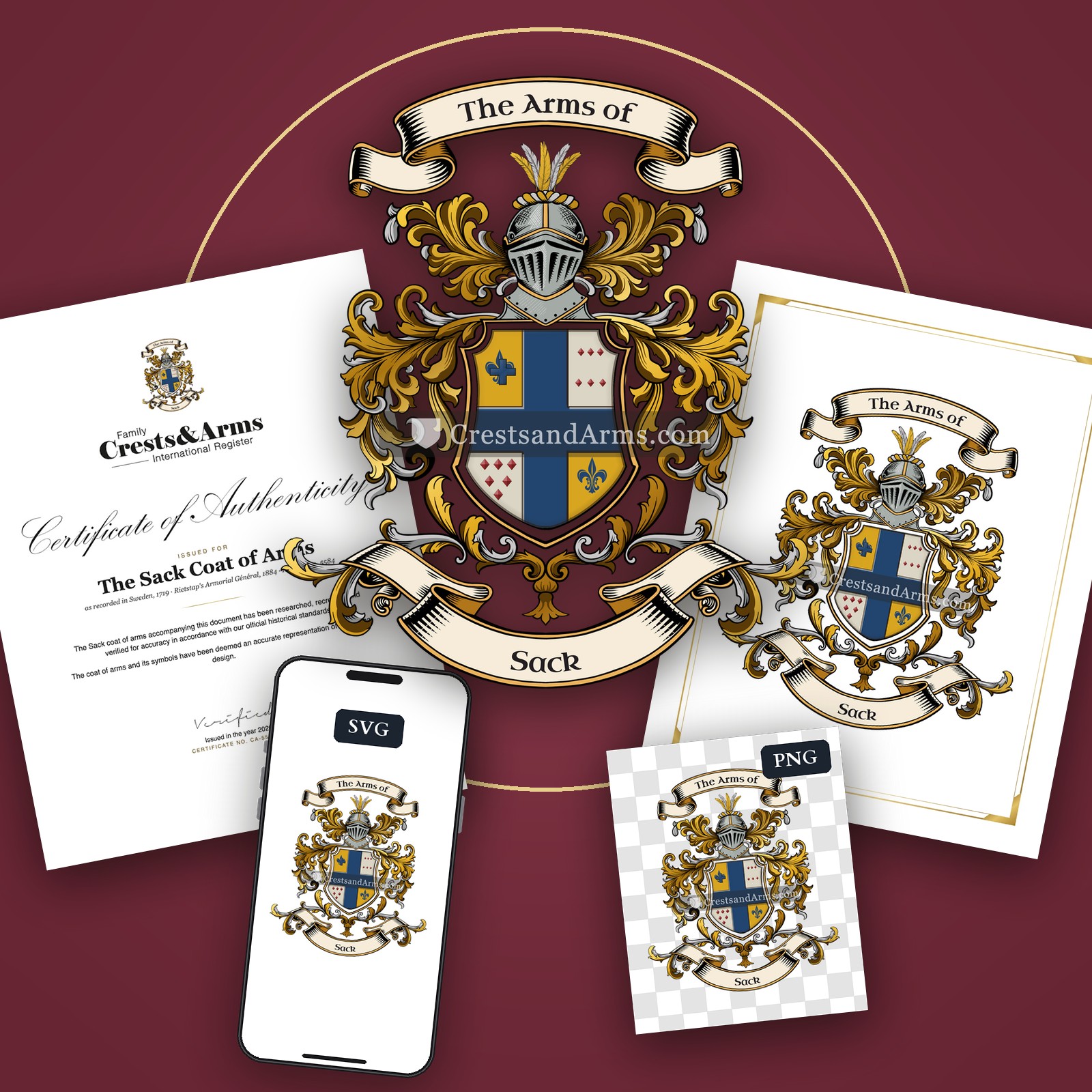
cross symbolChristian faith and service
fleur de lisPurity, light, and the sixth son
lozengeHonour and nobility, and the arms of a woman
Colours
Gold (Or)Means: Generosity
Silver (Argent)Means: Peace and sincerity
Blue (Azure)Means: Loyalty and truth
Red (Gules)Means: Military strength
Historical info
Source
J. B. Rietstap, Armorial Général, Gouda: G. B. van Goor Zonen, 1884–87
Blazon (the actual original written record)
“Ec.: aux 1 et 4 d'or à une fleur-de-lis d'azur; aux 2 et 3 d'arg. à six los. de gu., 3 et 3. A la croix pattée d'azur, br. sur l'écartelé. Sur le tout de gu. à quatre sacs d'arg., appointés en saut. Deux cq. cour. C.: 1º une femme moresque, les cheveux épars, tort. d'arg. et de gu., ceinte de lierre; 2º la moitié dextre d'une fleur-de-lis de gu., et la moitié sen. d'une fleur-de-lis d'azur, sommées chacune d'une plume de paon d'arg. S.: deux dauphins d'arg., les têtes en bas.”
Swedenc. 1719
Digital archive packCoat of arms PNG, gold border print PDF, vector SVG and the certificate of authenticity. Sent to your email in minutes.
Map of Sweden showing where the Sack arms are recorded
The Sack arms were recorded in Sweden, c. 1719.
Arms such as these were typically recorded in Stockholm.
Stockholm held the Swedish court and the House of Nobility, where every noble family's arms were entered and kept. Families ennobled for service registered there, which is why so many are recorded around the city.
This is where the arms were entered in the register. Families often moved to other parts of the country, so the same name can turn up in more than one region.
The body that granted and recorded arms in Sweden in this period.
Ulrika Eleonora I of Sweden
Sovereign of the period
Ulrika Eleonora I of Sweden
1718–1720
Reigning in Germany when the Sack arms are first recorded.
How Arms Worked in Sweden
In Sweden, a coat of arms belonged to a noble family as a whole rather than just one individual. These arms were passed down through the generations to all legitimate descendants. Younger branches of the family used the same shield without needing to change it. This system ensured that the entire lineage shared the same identity and status under the law.
Granting authority
The Riddarhuset, or House of Nobility, regulated all noble coats of arms in Sweden under royal authority.
How they got arms
Families received their coats of arms through royal grants of nobility which were then officially registered with the House.
Where arms were recorded
Coats of arms were officially recorded in the Swedish House of Nobility register starting in the year 1626.
The family's standing
Recorded among the armigerous families of Sweden.
Origin & History of the Sack Family in Sweden
The Sack family name holds a distinct place in Swedish history, with records confirming their presence in Stockholm as early as 1719. During this period, the family became integrated into the urban life of the capital, which was then a bustling center of trade and administration. The name itself likely originated from occupational or descriptive roots, reflecting a time when surnames were becoming more permanent markers of identity within Swedish society. By the early 18th century, members of the family were navigating the social and economic shifts of the Swedish Empire, contributing to the professional landscape of Stockholm. Their documented presence in the city during this era suggests they were part of the growing class of citizens who helped define the civic character of the capital as it recovered from the challenges of the Great Northern War.
Sack Meaning & Related Branches
Root word
Saccus
Latin term for a bag, sack, or pouch.
This name
SackAn occupational name for a maker or seller of sacks and bags.
also spelled
Sacke
Sackh
Sackk
Sak
Documented Sources
J. B. Rietstap, Armorial Général, Gouda: G. B. van Goor Zonen, 1884–87
Bahlow, Hans. Deutsches Namenlexikon: Familien- und Vornamen nach Ursprung und Sinn erklärt. 1967


 roseThe seventh son, and beauty with grace
 crownSovereignty, authority and just reward
 roseThe seventh son, and beauty with grace
 crownSovereignty, authority and just reward


 cross symbolChristian faith and service
 fleur de lisPurity, light, and the sixth son
 lozengeHonour and nobility, and the arms of a woman