A record of documented arms, meaning and origin, researched for the Sacre family lines. Documented in 2 countries.
Reg. 9210 · Belgian, T–V
Meaning of the Sacre family crest colors & symbols
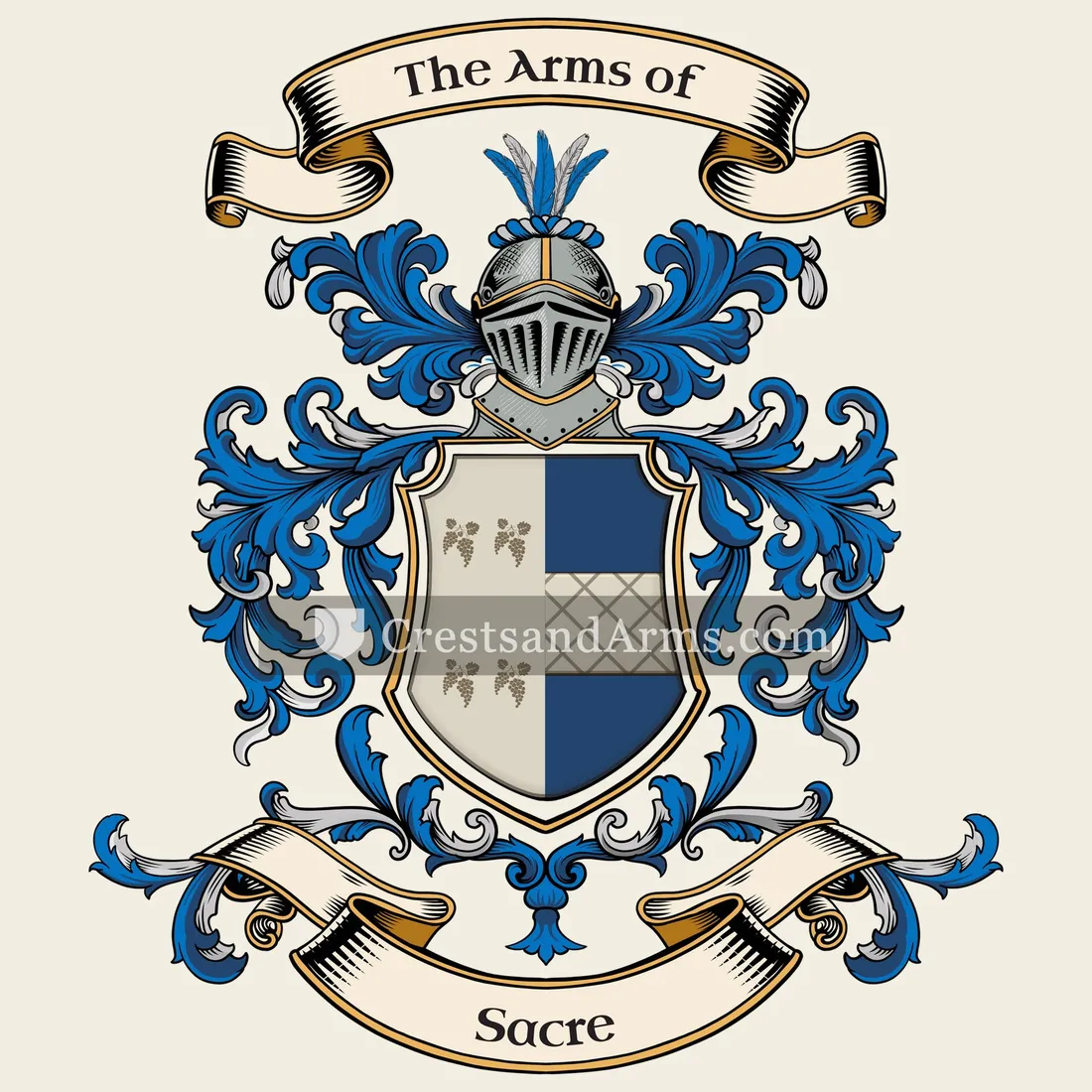
Symbols on this shield
fessThe military belt, and readiness to serve
grapesPlenty, and the labour of the vine
Colours
Silver (Argent)Means: Peace and sincerity
Blue (Azure)Means: Loyalty and truth
Historical info
Source
J. B. Rietstap, Armorial Général, Gouda: G. B. van Goor Zonen, 1884–87
Blazon (the actual original written record)
“Parti: au 1 d'arg. à un cep de vigne pampré, fruité de trois grappes de raisins, 2 et 1, le tout au nat.; au 2 d'azur à la fasce d'arg. C.: une grappe de raisins pamprée, au nat., la tige en haut.”
Belgiumc. 1737
Digital archive packCoat of arms PNG, gold border print PDF, vector SVG and the certificate of authenticity. Sent to your email in minutes.
Map of Belgium showing where the Sacre arms are recorded
The Sacre arms were recorded in Belgium, c. 1737.
Arms such as these were typically recorded in Brabant.
Brabant lay at the heart of the Low Countries, where the trade routes met. Its towns were wealthy and its landowners many, and both kinds of family kept arms, which is why the region is so heavily represented.
This is where the arms were entered in the register. Families often moved to other parts of the country, so the same name can turn up in more than one region.
The body that granted and recorded arms in Belgium in this period.
Charles VI, Holy Roman Emperor
Sovereign of the period
Charles VI, Holy Roman Emperor
1711–1740
Reigning in Belgium when the Sacre arms are first recorded.
How Arms Worked in Belgium
In Belgium, a coat of arms is considered personal property that is passed down through the male line to legitimate descendants. Families often use the same shield design across generations to show their shared heritage. If a branch of the family wants to change the design, they must apply for an official update to their specific version of the arms.
Granting authority
The Conseil héraldique is the official body that regulates and approves all coats of arms in Belgium.
How they got arms
Families obtain their coats of arms through formal royal grants or by confirming their historical right to use existing designs.
Where arms were recorded
All approved coats of arms are officially recorded in the public registers of the Conseil héraldique since 1844.
The family's standing
Recorded among the armigerous families of Belgium.
Origin & History of the Sacre Family in Belgium
The family name Sacre has deep roots in the historical region of Brabant, where members of the family were documented as early as 1737. During the eighteenth century, this area was part of the Austrian Netherlands, a time when the region served as a vital crossroads for trade and agriculture in Western Europe. Families like the Sacres often lived in rural villages or growing market towns, where their daily lives were shaped by the local parish church and the seasonal rhythms of the land. Because the name appears in local records during this period, it suggests that the family was well-established within the social fabric of the community long before the modern borders of Belgium were drawn. Over the following generations, the family likely navigated the significant political changes of the region, including the transition through French and Dutch rule, while maintaining their presence in the Brabant landscape.
Meaning of the Sacre family crest colors & symbols
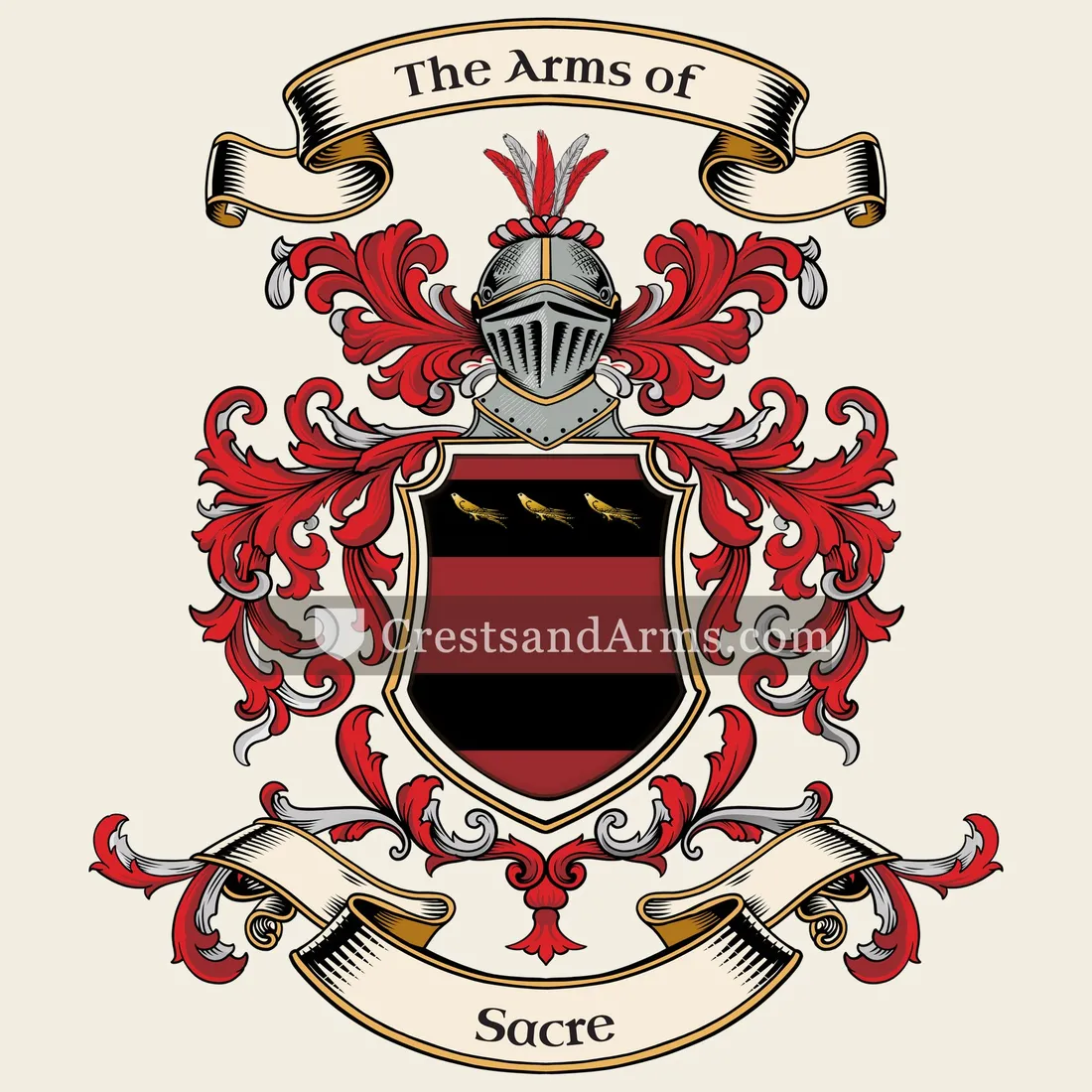
Symbols on this shield
martletA younger son, who must win his own land
Colours
Red (Gules)Means: Military strength
ErmineMeans: Dignity
Gold (Or)Means: Generosity
Historical info
Source
Sir Bernard Burke, The General Armory of England, Scotland, Ireland and Wales, London: Harrison & Sons, 1884
Blazon (the actual original written record)
“Gu. two bars erm. in chief three martlets or”
KentKent, c. 1614
Digital archive packCoat of arms PNG, gold border print PDF, vector SVG and the certificate of authenticity. Sent to your email in minutes.
Map of England showing where the Sacre arms are recorded
The Sacre arms were recorded in Kent, c. 1614.
Kent sits between London and the short crossing to Europe, and the trade passing through made it wealthy. Merchant families bought land with that money, and it was landowners who took coats of arms.
This is where the arms were entered in the register. Families often moved to other parts of the country, so the same name can turn up in more than one region.
The body that granted and recorded arms in England in this period.
James VI and I
Sovereign of the period
James VI and I
1603–1625
Reigning in Belgium when the Sacre arms are first recorded.
How Arms Worked in England
English heraldry allowed arms to be shared by all legitimate descendants of the original owner. These symbols were treated as personal property that moved through the generations to all children. While the eldest son kept the original design, other family members could use the same shield without needing to change it or register their own unique versions.
Granting authority
The College of Arms in London has regulated the use of coats of arms throughout England and Wales since 1484.
How they got arms
Families typically obtained their coats of arms through a formal grant from the Crown or by proving their ancient right to them.
Where arms were recorded
All official coats of arms are recorded in the registers kept at the College of Arms, which date back to the fifteenth century.
The family's standing
Recorded among the armigerous families of Kent.
Origin & History of the Sacre Family in England
The family name Sacre has deep roots in the county of Kent, where records confirm members of the family were established by the early seventeenth century. The name is believed to be topographic or occupational in origin, likely derived from the Middle English word for a sacred place or perhaps a reference to a specific role within a local parish. During the 1600s, families in this region were often tied closely to the land and the local church, which played a central role in daily life. As the family grew, they became integrated into the social fabric of Kentish village life, appearing in parish registers that tracked baptisms, marriages, and burials. This period was one of significant transition in England, and the Sacre family lived through an era defined by agricultural development and the growth of local trade. By documenting their presence in Kent in 1614, historians can trace the family back to a time when surnames were becoming firmly fixed as a way to identify lineage and community standing.
Sacre Meaning & Related Branches
Root word
sacrum
Latin term meaning holy, sacred, or consecrated.
This name
SacreA topographic or habitational name for someone living near a holy place or a church.
also spelled
Sacreh
Sacker
Sakre
Sacer
Documented Sources
J. B. Rietstap, Armorial Général, Gouda: G. B. van Goor Zonen, 1884–87
Archives: State Archives in Belgium (Rijksarchief), Parochieregisters van de provincie Brabant
De Smet, J., Geschiedenis van de Brabantse families, 1954
Warlop, E., De Vlaamse adel voor 1300, 1968
Digital archive packCoat of arms PNG, gold border print PDF, vector SVG and the certificate of authenticity. Sent to your email in minutes.


 fessThe military belt, and readiness to serve
 grapesPlenty, and the labour of the vine
 fessThe military belt, and readiness to serve
 grapesPlenty, and the labour of the vine


 martletA younger son, who must win his own land