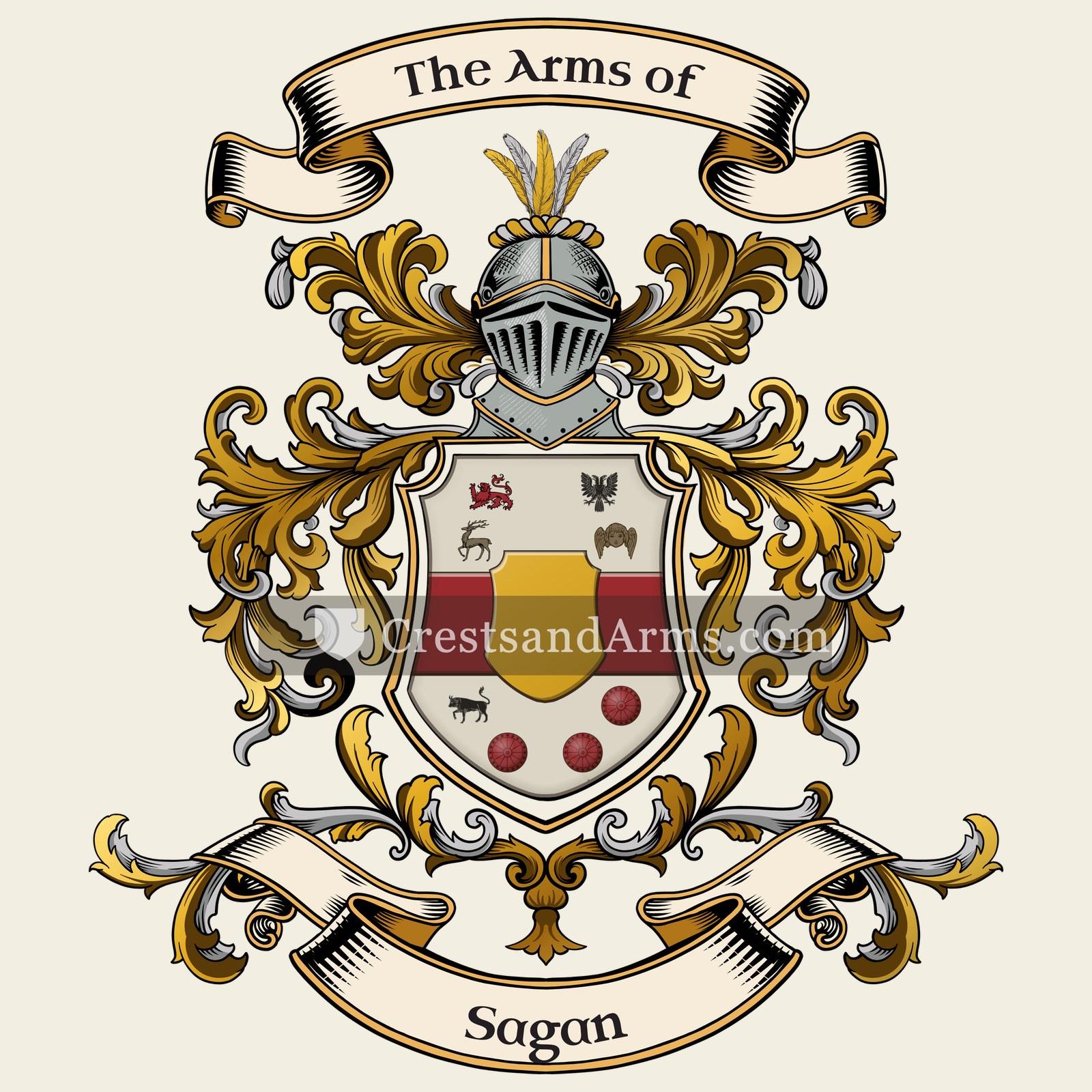
A record of documented arms, meaning and origin, researched for the Sagan family of Germany.
Reg. 2210 · German, T–V
Coat of Arms & Family Crest Details
Symbols on this shield
fessThe military belt, and readiness to serve
lionCourage, strength and royalty
eagleNobility, strength and a keen mind
stagPeace and harmony, and one who will not fight unprovoked
cherubDivine protection over the innocent
bullValour and generosity
roundelA coin, and one who has been to the crusades
Colours
Silver (Argent)Means: Peace and sincerity
Gold (Or)Means: Generosity
Blue (Azure)Means: Loyalty and truth
Red (Gules)Means: Military strength
Black (Sable)Means: Constancy
Historical info
Source
J. B. Rietstap, Armorial Général, Gouda: G. B. van Goor Zonen, 1884–87
Blazon (the actual original written record)
“Parti de deux traits, coupé de deux autres, qui font neuf quartiers: aux 1 et 4 d'arg. au lion de gu., cour. d'or, celui du 1 cont.; au 2 d'or à l'aigle de sa., sommé d'une couronne royale, la poitrine ch. d'un croissant qui s'étend sur les ailes en demi-cercles treflés et qui supporte une croisette, le tout d'arg.; aux 3 et 7 d'azur à un élan pass. au nat., mouv. du flanc de l'écu et ayant entre ses cornes une couronne royale, celui du 7 cont.; au 4 de gu. à un ange naiss. de carn., hab. et ailé d'or (Sagan); (le 5 quartier est caché par le surtout); au 6 d'or au rencontre de boeuf de sa., bouclé d'arg.; au 8 d'arg. à la fasce de gu., acc. de trois tourt. du même. Sur le tout éc.: a. d'or au chiffre A. S. entrelacé de sa., cour. d'or; b. de gu. à trois chev. d'arg., le premier cour. d'or; c. les armes de Biron; d. d'arg. à un 3 posé entre les jambes d'un A, le tout de sa., cette lettre cour. d'or. S.: deux lions d'or, arm. et lamp. de gu., sommés de couronnes princières. Manteau de gu., doublé d'herm., sommé de la couronne princière.”
SilesiaSilesia, c. 1765
Digital archive packCoat of arms PNG, gold border print PDF, vector SVG and the certificate of authenticity. Sent to your email in minutes.
Map of Germany showing where the Sagan arms are recorded
The Sagan arms were recorded in Silesia, c. 1765.
Silesia was farming country in the east of the German lands, held in large estates by families who stayed put for generations. Owning land was what entitled a family to arms, so the region fills a good deal of the register.
This is where the arms were entered in the register. Families often moved to other parts of the country, so the same name can turn up in more than one region.
The body that granted and recorded arms in Germany in this period.
Francis I, Holy Roman Emperor
Sovereign of the period
Francis I, Holy Roman Emperor
1745–1765
Reigning in Germany when the Sagan arms are first recorded.
How Arms Worked in Germany
In the Holy Roman Empire, coats of arms were often granted to individuals by the Emperor or his representatives. These arms were then passed down through the generations to all legitimate descendants of the original holder. Younger branches of a family usually kept the same shield design without needing to change it, as the arms belonged to the entire lineage.
Granting authority
The Holy Roman Emperor held the sole power to grant new coats of arms throughout his vast imperial territories.
How they got arms
Families typically obtained their coats of arms through a formal imperial grant or by proving their noble status to the authorities.
Where arms were recorded
These grants were officially recorded in the Imperial Chancery registers, which began keeping formal records of such honors during the Middle Ages.
The family's standing
Recorded among the armigerous families of Silesia.
Origin & History of the Sagan Family in Germany
The surname Sagan is deeply rooted in the historical region of Silesia, where records confirm the presence of family members as early as 1765. The name is likely topographic or locational in origin, derived from the town of Sagan, which is known today as Żagań in modern-day Poland. During the eighteenth century, people often adopted the names of their home towns or regions to distinguish themselves as they traveled or settled in new areas. Because Silesia was a crossroads of cultural and linguistic exchange between German and Slavic populations, the family likely navigated a complex social landscape defined by changing borders and shifting political loyalties. By the mid-1700s, families bearing this name were established within the local administrative and social structures of the region, contributing to the agricultural and civic life of the Silesian landscape.
Related Branches & Arms
Root word
Saga
Old High German term referring to a story, tale, or saying.
This name
SaganA habitational name for someone who originated from the town of Sagan in Silesia.
also spelled
Biron
Sagan
Beeron
Documented Sources
J. B. Rietstap, Armorial Général, Gouda: G. B. van Goor Zonen, 1884–87
Knie, Johann Georg. Alphabetisch-statistisch-topographische Uebersicht der Dörfer, Flecken, Städte und andern Orte der Königl. Preuß. Provinz Schlesien. 1845
Zimmermann, Friedrich Albert. Beyträge zur Beschreibung von Schlesien. 1783–1796
State Archive in Wrocław (Archiwum Państwowe we Wrocławiu), Standesamt records and local census registers for the Żagań district
Digital archive packCoat of arms PNG, gold border print PDF, vector SVG and the certificate of authenticity. Sent to your email in minutes.


 fessThe military belt, and readiness to serve
 lionCourage, strength and royalty
 eagleNobility, strength and a keen mind
 stagPeace and harmony, and one who will not fight unprovoked
 cherubDivine protection over the innocent
 bullValour and generosity
 roundelA coin, and one who has been to the crusades