Map of Spain showing where the Sainz arms are recorded
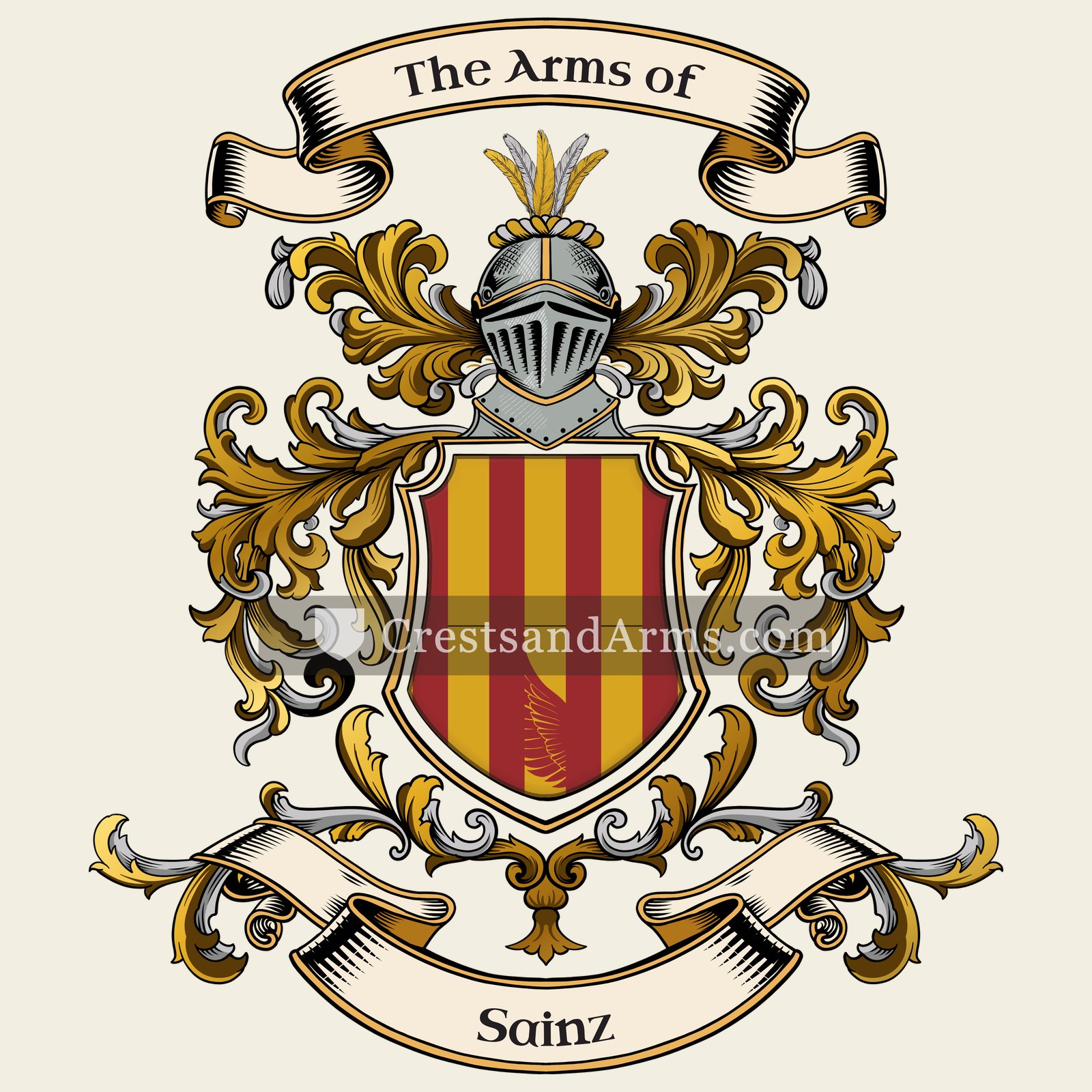
The Sainz arms were recorded in Aragon, c. 1722.
Aragon was mountain and river country in north-eastern Spain, with a strong tradition of small independent landholders. A great many families counted as gentry there, and each one needed a shield to be told apart.
This is where the arms were entered in the register. Families often moved to other parts of the country, so the same name can turn up in more than one region.
The body that granted and recorded arms in Spain in this period.
Philip V of Spain
Sovereign of the period
Philip V of Spain
1714–1724
Reigning in Spain when the Sainz arms are first recorded.
How Arms Worked in Spain
In Spain, a coat of arms was considered a form of property that belonged to the entire family line. These arms were passed down from a father to all his children equally. Younger branches of the family usually kept the original design without needing to add any special marks to distinguish their specific line.
Granting authority
The Cronista Rey de Armas was the official body that regulated and granted coats of arms throughout Spain.
How they got arms
Families often obtained their arms through royal grants or by proving their noble status to the official heraldic authority.
Where arms were recorded
Coats of arms were officially recorded in the registers of the Cronista Rey de Armas starting in 1496.
The family's standing
Recorded among the armigerous families of Aragon.
Origin & History of the Sainz Family in Spain
The surname Sainz is a patronymic name, which means it was originally created to identify a person as the son of someone named Sancho. The name Sancho itself comes from the Latin word sanctus, meaning saint or holy. By the early 18th century, families carrying this name were well-established in the region of Aragon. During this period, the people of Aragon lived in a society shaped by centuries of agricultural traditions and local governance. Families like the Sainz clan often played active roles in their local communities, working as landowners or skilled tradespeople. As the name spread across the Iberian Peninsula, it became a common way to track family lineage through official parish records and tax documents. These records show that the Sainz family was part of the foundational fabric of northern Spanish society long before modern census systems were created.
Related Branches & Arms
Root word
Sanctius
Derived from the Latin word for holy or sacred.
This name
SainzA patronymic surname meaning son of Sancho, originating from the Latin sanctus.
also spelled
Sans
Sance
Documented Sources
J. B. Rietstap, Armorial Général, Gouda: G. B. van Goor Zonen, 1884–87
Albaigès, Josep M., Diccionario de nombres de personas, 1993
Moll, Francesc de B., Els llinatges catalans, 1959
Archivo de la Corona de Aragón, Censo de población de 1722
Digital archive packCoat of arms PNG, gold border print PDF, vector SVG and the certificate of authenticity. Sent to your email in minutes.


 paleMilitary strength, and a fortified defence
 wingSwiftness, and protection under a raised wing
 paleMilitary strength, and a fortified defence
 wingSwiftness, and protection under a raised wing