Map of England showing where the Salkeld arms are recorded
The Salkeld arms were recorded in Cumberland, c. 1437.
Cumberland was rough border country in the north-west, facing Scotland across a disputed line. Its families held land in return for keeping it defended, and men who fought carried shields of their own.
This is where the arms were entered in the register. Families often moved to other parts of the country, so the same name can turn up in more than one region.
The body that granted and recorded arms in England in this period.
Henry VI of England
Sovereign of the period
Henry VI of England
1422–1461
Reigning in England when the Salkeld arms are first recorded.
How Arms Worked in England
English heraldry allowed arms to be shared by all legitimate descendants of the original owner. These symbols were treated as personal property that moved through the generations to all children. While the eldest son kept the original design, other family members could use the same shield without needing to change it or register their own unique versions.
Granting authority
The College of Arms in London has regulated the use of coats of arms throughout England and Wales since 1484.
How they got arms
Families typically obtained their coats of arms through a formal grant from the Crown or by proving their ancient right to them.
Where arms were recorded
All official coats of arms are recorded in the registers kept at the College of Arms, which date back to the fifteenth century.
The family's standing
Recorded among the armigerous families of Cumberland.
Origin & History of the Salkeld Family in England
The Salkeld family name originates from the northern English county of Cumberland, where the family established deep roots by the early fifteenth century. The name itself is locative, meaning it was taken from the village of Great Salkeld near the River Eden. During the medieval period, the Salkelds became significant landowners and played an active role in the governance of the border regions between England and Scotland. Because of their location in this volatile area, family members were frequently involved in local administration and the defense of the northern marches. By 1437, the family had already secured a prominent social standing, serving as knights of the shire and holding various official positions that allowed them to influence regional politics for generations. Their history is closely tied to the rugged landscape of the Eden Valley, reflecting the broader patterns of northern gentry families who built their power through local service and land management.
Related Branches & Arms
Root word
Salh-kelda
Old Norse for willow tree and spring or fountain.
This name
SalkeldRefers to a willow spring or a stream bordered by willow trees.
also spelled
Salkild
Salkyll
Salkeldt
Related arms
Rawlesrecorded with Salkeld, same area
Documented Sources
Sir Bernard Burke, The General Armory of England, Scotland, Ireland and Wales, London: Harrison & Sons, 1884
Nicolson, Joseph and Burn, Richard, The History and Antiquities of the Counties of Westmorland and Cumberland, 1777
Jefferson, Samuel, The History and Antiquities of Leath Ward in the County of Cumberland, 1840
Cumbria Archive Service, The Salkeld of Whitehall Family Papers, D/SK
The National Archives, Calendar of the Patent Rolls, Henry VI, 1436–1441
Digital archive packCoat of arms PNG, gold border print PDF, vector SVG and the certificate of authenticity. Sent to your email in minutes.


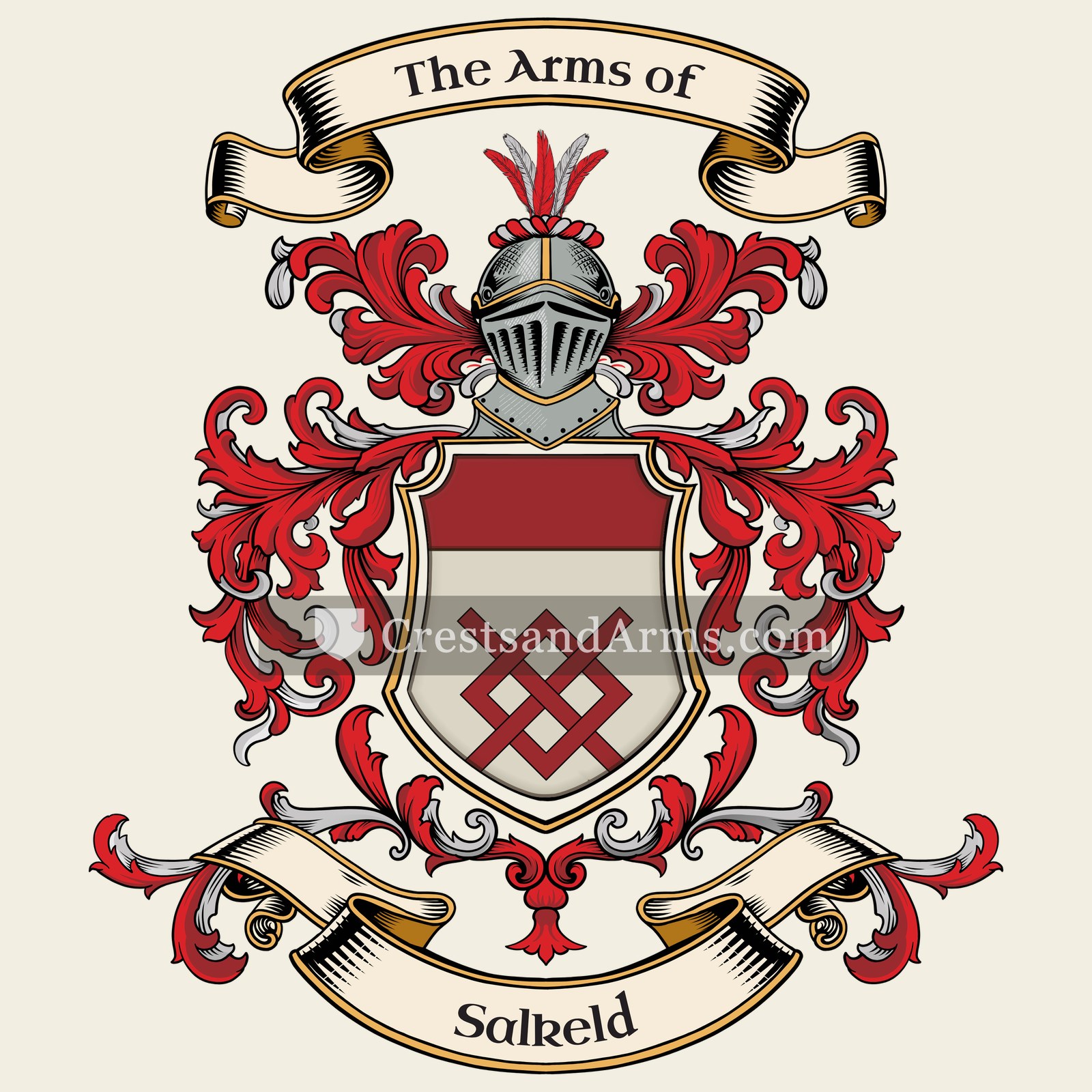
 chiefAuthority, wisdom and dominion
 fretPersuasion, and the net that holds
 chiefAuthority, wisdom and dominion
 fretPersuasion, and the net that holds