A record of documented arms, meaning and origin, researched for the Salve family lines. Documented in 2 countries.
Reg. 9260 · German, T–V
Coat of Arms & Family Crest Details
Symbols on this shield
mountThe ground held, and steadfastness upon it
cantonA mark of honour granted by the sovereign
bendDefence, and the scarf of a commander
leafHappiness and abundance
armA person of action, industrious and laborious
mulletThe third son, and a divine quality from above
Colours
Silver (Argent)Means: Peace and sincerity
Blue (Azure)Means: Loyalty and truth
Green (Vert)Means: Hope
Gold (Or)Means: Generosity
Historical info
Source
J. B. Rietstap, Armorial Général, Gouda: G. B. van Goor Zonen, 1884–87
Blazon (the actual original written record)
“Coupé: au 1 d'arg. à trois feuilles de tilleul de sin., rangées en fasce, les tiges en haut; au 2 d'azur à un avant-bras, en pal, paré de gu., iss. entre deux collines basses de sin., la main de carn. tenant une clé d'arg. en barre, l'anneau en bas, le panneton en haut à dextre, acc. de deux étoiles d'or, posées dans les cantons du chef. Cq. cour. C.: un peuplier de sin., iss. entre deux collines basses du même; le tout entre un vol, l'aile dextre tranchée d'azur sur gu., à une bande d'arg., surch. d'une rose de gu. et br. sur le tranché; l'aile sen. taillée de gu. sur azur, à une barre d'arg. surch. d'une rose de gu. et br. sur le taillé. L.: à dextre d'arg. et d'azur, à sen. d'arg. et de gu.”
GermanyPalatinat, c. 1765
Digital archive packCoat of arms PNG, gold border print PDF, vector SVG and the certificate of authenticity. Sent to your email in minutes.
Map of Germany showing where the Salve arms are recorded
The Salve arms were recorded in Palatinat, c. 1765.
This is where the arms were entered in the register. Families often moved to other parts of the country, so the same name can turn up in more than one region.
The body that granted and recorded arms in Germany in this period.
Francis I, Holy Roman Emperor
Sovereign of the period
Francis I, Holy Roman Emperor
1745–1765
Reigning in Germany when the Salve arms are first recorded.
How Arms Worked in Germany
In the Holy Roman Empire, coats of arms were often granted to individuals by the Emperor or his representatives. These arms were then passed down through the generations to all legitimate descendants of the original holder. Younger branches of a family usually kept the same shield design without needing to change it, as the arms belonged to the entire lineage.
Granting authority
The Holy Roman Emperor held the sole power to grant new coats of arms throughout his vast imperial territories.
How they got arms
Families typically obtained their coats of arms through a formal imperial grant or by proving their noble status to the authorities.
Where arms were recorded
These grants were officially recorded in the Imperial Chancery registers, which began keeping formal records of such honors during the Middle Ages.
The family's standing
Recorded among the armigerous families of Germany.
Origin & History of the Salve Family in Germany
The family name Salve finds its roots in the historical region of the Palatinate, a territory in southwestern Germany known for its rolling hills and long tradition of viticulture. By the year 1765, records confirm that members of the Salve family were established residents of this area. During the eighteenth century, the Palatinate was a region defined by agricultural labor and small village life, where families often identified themselves through their local trade or their connection to the land. The name likely evolved from regional dialects or linguistic shifts common to the German Rhineland during this period. As the family lived in this crossroads of Europe, they were part of a resilient population that navigated the complex social and economic changes defining the German states before the turn of the nineteenth century. Their presence in the region during the 1760s places them within a time of significant transition, as many families began to solidify their identities within the local parish registers and community structures of the Palatinate.
Coat of Arms & Family Crest Details
Symbols on this shield
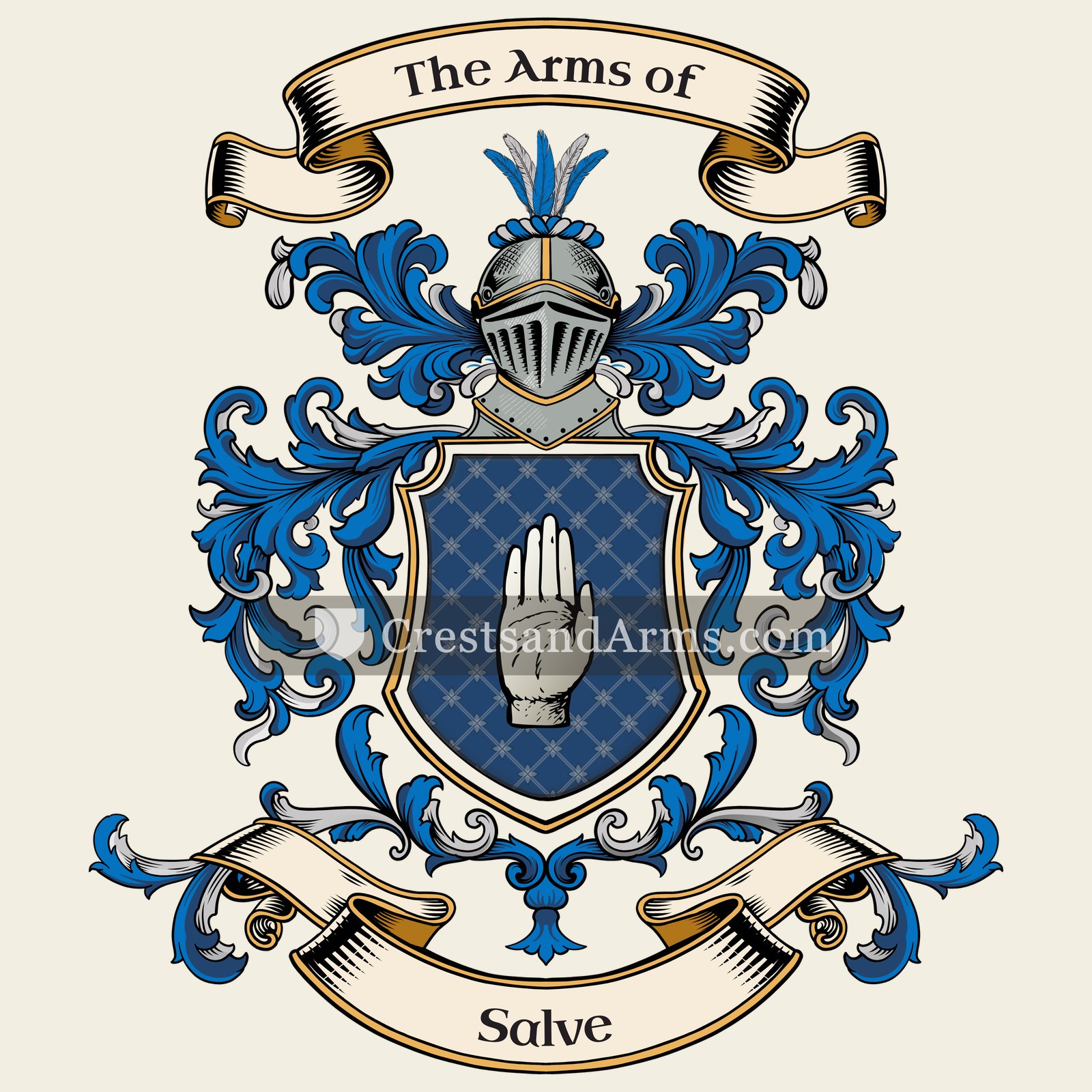
handFaith, sincerity and justice
Colours
Blue (Azure)Means: Loyalty and truth
Silver (Argent)Means: Peace and sincerity
Historical info
Source
J. B. Rietstap, Armorial Général, Gouda: G. B. van Goor Zonen, 1884–87
Blazon (the actual original written record)
“D'azur à une main sen. ap-”
DalmatiaDalmatia, c. 1775
Digital archive packCoat of arms PNG, gold border print PDF, vector SVG and the certificate of authenticity. Sent to your email in minutes.
Map of Italy showing where the Salve arms are recorded
The Salve arms were recorded in Dalmatia, c. 1775.
Dalmatia was a string of walled towns along the Adriatic coast, each with its own leading families. Sea trade made them wealthy, and the towns kept lists of the houses entitled to arms.
This is where the arms were entered in the register. Families often moved to other parts of the country, so the same name can turn up in more than one region.
The body that granted and recorded arms in Italy in this period.
Alvise Giovanni Mocenigo
Sovereign of the period
Alvise Giovanni Mocenigo
1763–1778
Reigning in Germany when the Salve arms are first recorded.
How Arms Worked in Italy
In the Italian states, coats of arms were often used by noble families to show their status and history. These symbols were passed down through the generations to all legitimate male descendants. Younger branches of a family usually kept the original design but sometimes added small changes to distinguish their specific line from the main branch.
Granting authority
Various local rulers and city governments controlled the use of coats of arms across the different Italian states.
How they got arms
Families often assumed their own arms or received them as official grants from local lords, popes, or city councils.
Where arms were recorded
Arms were recorded in local city archives or private family books rather than in one single national register.
The family's standing
Recorded among the armigerous families of Dalmatia.
Origin & History of the Salve Family in Italy
The name Salve carries a rich history rooted in the cultural crossroads of the Adriatic Sea. While the family maintained a notable presence in Dalmatia by 1775, their origins are deeply connected to the broader movements of people between the Italian peninsula and the eastern Adriatic coast. During this era, the Republic of Venice exerted significant influence over Dalmatian trade and administration, which encouraged many families to migrate across the water for economic and professional opportunities. The name likely evolved within this bilingual environment where Italian and Slavic influences blended in coastal cities. Families like the Salves often served as a bridge between these two regions, contributing to the maritime commerce and local governance that defined the Adriatic world during the late eighteenth century. This movement of people helped establish the family as a recognized part of the social fabric in both their Italian ancestral lands and their new homes in Dalmatia.
Related Branches & Arms
Root word
salvus
Latin term meaning safe, healthy, or whole.
This name
SalveA topographic or occupational name derived from Latin indicating a person who is saved or healthy.
also spelled
Salv
Documented Sources
J. B. Rietstap, Armorial Général, Gouda: G. B. van Goor Zonen, 1884–87
Archive: Landesarchiv Speyer, Kirchenbücher der Pfalz (Church records of the Palatinate)
Book: Heinz, Joachim, Die Auswanderung aus der Pfalz im 18. Jahrhundert, 1992


 mountThe ground held, and steadfastness upon it
 cantonA mark of honour granted by the sovereign
 bendDefence, and the scarf of a commander
 leafHappiness and abundance
 armA person of action, industrious and laborious
 mulletThe third son, and a divine quality from above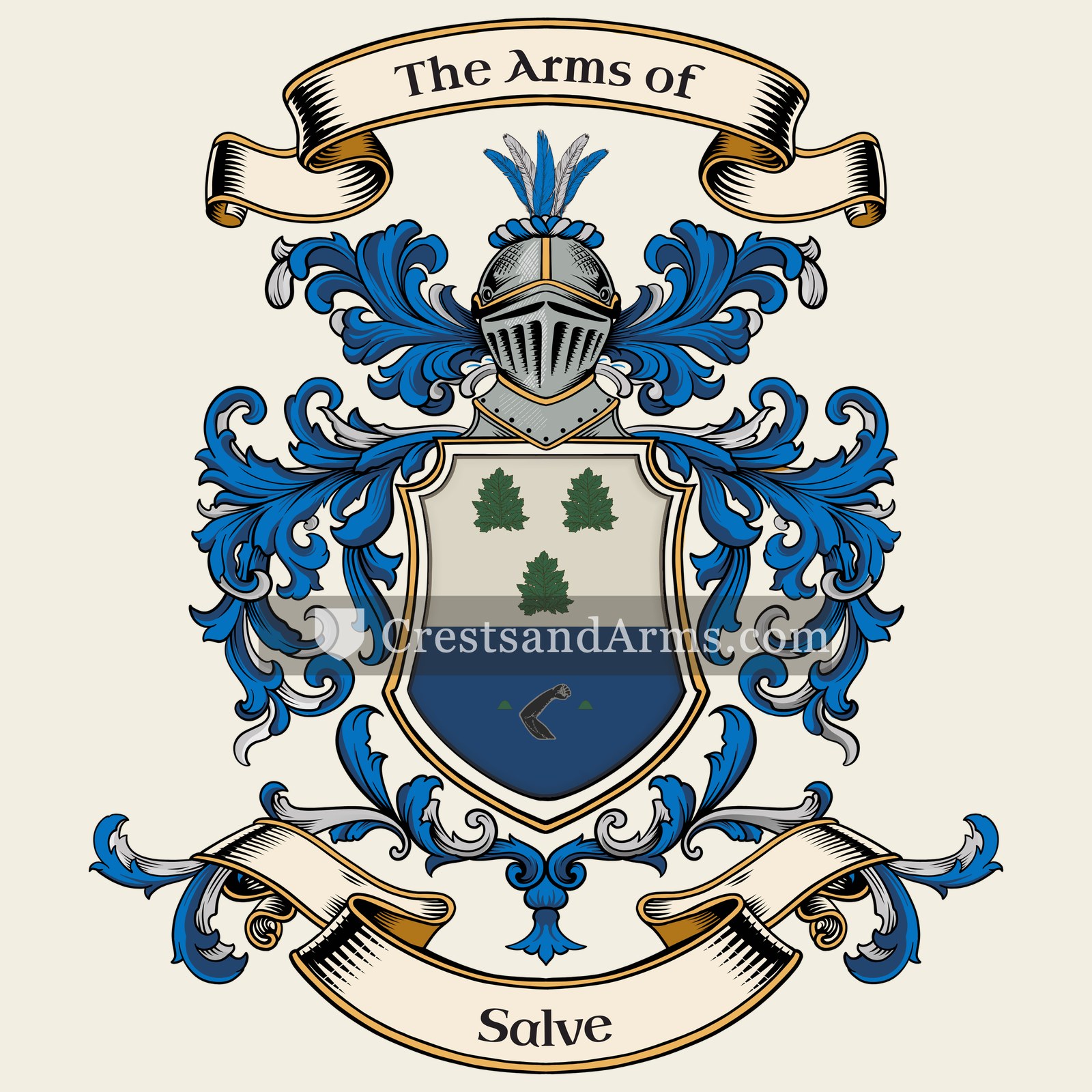


 handFaith, sincerity and justice