Map of Britain showing where the Samie arms are recorded
The Samie arms were recorded in Suffolk, c. 1684.
Suffolk was wool country, and its cloth towns were among the wealthiest in England. Clothier families bought manors with their profits, and holding a manor was the ordinary route to a coat of arms.
This is where the arms were entered in the register. Families often moved to other parts of the country, so the same name can turn up in more than one region.
The body that granted and recorded arms in Britain in this period.
Charles II of England
Sovereign of the period
Charles II of England
1660–1685
Reigning in Britain when the Samie arms are first recorded.
How Arms Worked in Britain
English heraldry allowed arms to be shared by all legitimate descendants of the original owner. These symbols were treated as personal property that moved through the generations to all children. While the eldest son kept the original design, other family members could use the same shield without needing to change it or register their own unique versions.
Granting authority
The College of Arms in London has regulated the use of coats of arms throughout England and Wales since 1484.
How they got arms
Families typically obtained their coats of arms through a formal grant from the Crown or by proving their ancient right to them.
Where arms were recorded
All official coats of arms are recorded in the registers kept at the College of Arms, which date back to the fifteenth century.
The family's standing
Recorded among the armigerous families of Suffolk.
Origin & History of the Samie Family in Britain
The history of the Samie family in Britain begins to emerge clearly in the late seventeenth century, specifically within the county of Suffolk. By 1684, records indicate that members of the family were established in this region, which was then a prominent center for the wool trade and agricultural production. During this period, Suffolk was a hub of religious and social change, and families like the Samies often integrated into the local parish structures that governed daily life. The name itself likely reflects the linguistic shifts occurring in England at the time, as families moved between rural villages and growing market towns. Living in Suffolk allowed these early ancestors to participate in a stable community where land ownership and trade were the primary ways to build a family legacy. While the exact origins of the name remain a subject of study, its presence in the 1684 records confirms that the family was well-rooted in the English landscape during the late Stuart era.
Coat of Arms & Family Crest Details
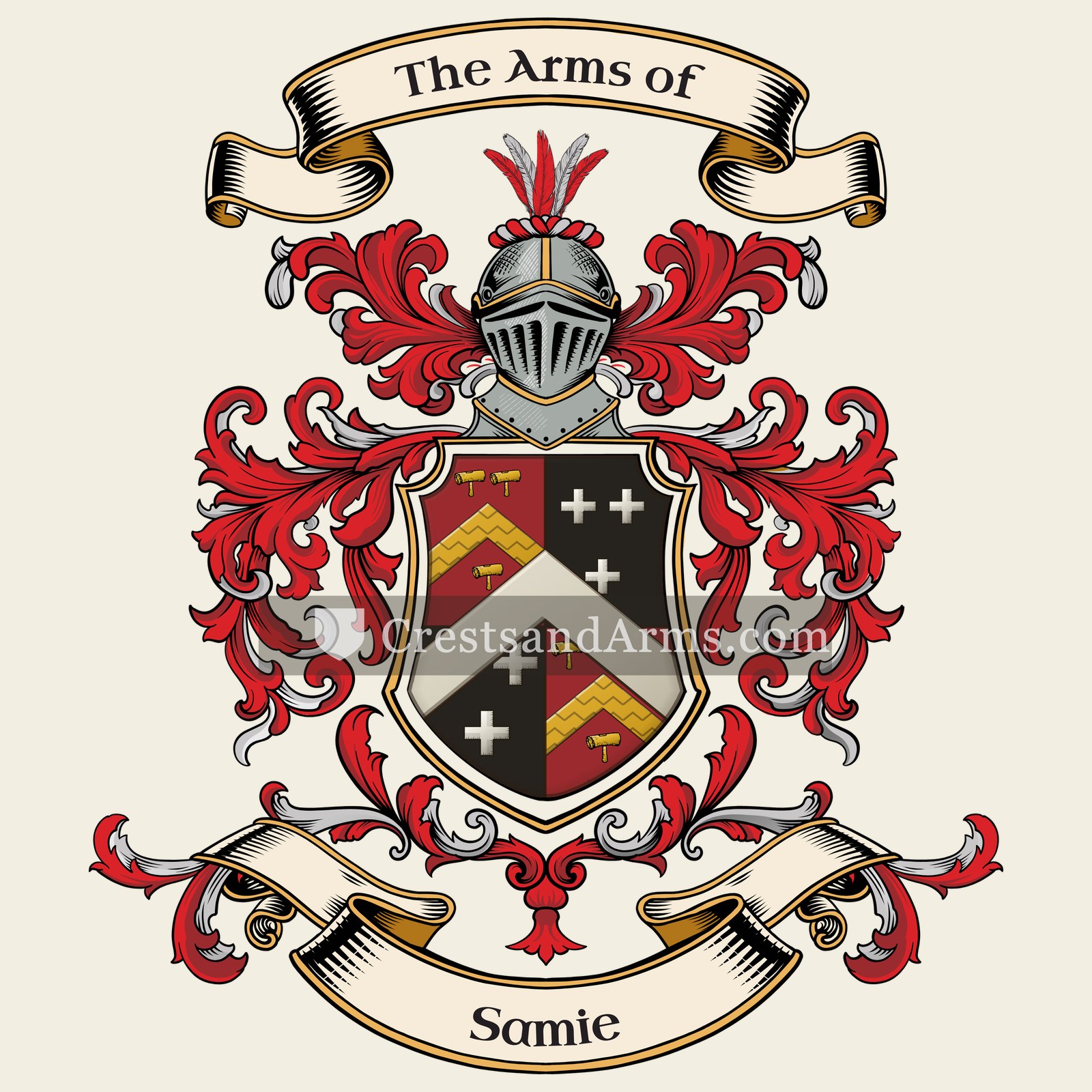
Symbols on this shield
chevronProtection, and faithful service completed
cross symbolChristian faith and service
hammerHonest labour, and the smith's craft
Colours
Red (Gules)Means: Military strength
Black (Sable)Means: Constancy
Silver (Argent)Means: Peace and sincerity
Gold (Or)Means: Generosity
Historical info
Source
Sir Bernard Burke, The General Armory of England, Scotland, Ireland and Wales, London: Harrison & Sons, 1884
Blazon (the actual original written record)
“Quarterly, 1st and 4th, gu. a chev. betw. three mallets or, for SOAME; 2nd and 3rd, sa. a chev. betw. three cross crosslets fitchée ar., for BUCKWORTH”
SurreySheen · Surrey, c. 1806
Digital archive packCoat of arms PNG, gold border print PDF, vector SVG and the certificate of authenticity. Sent to your email in minutes.
Map of England showing where the Samie arms are recorded
The Samie arms were recorded in Surrey, c. 1806.
Surrey sat just south of London and filled up with families who had made money in the City. Buying an estate there was the usual next step, and an estate was the usual reason to take arms.
This is where the arms were entered in the register. Families often moved to other parts of the country, so the same name can turn up in more than one region.
The body that granted and recorded arms in England in this period.
George III of Great Britain
Sovereign of the period
George III of Great Britain
1801–1820
Reigning in Britain when the Samie arms are first recorded.
How Arms Worked in England
English heraldry allowed arms to be shared by all legitimate descendants of the original owner. These symbols were treated as personal property that moved through the generations to all children. While the eldest son kept the original design, other family members could use the same shield without needing to change it or register their own unique versions.
Granting authority
The College of Arms in London has regulated the use of coats of arms throughout England and Wales since 1484.
How they got arms
Families typically obtained their coats of arms through a formal grant from the Crown or by proving their ancient right to them.
Where arms were recorded
All official coats of arms are recorded in the registers kept at the College of Arms, which date back to the fifteenth century.
The family's standing
Recorded among the armigerous families of Surrey.
Origin & History of the Samie Family in England
The family name Samie has roots that trace back to the rural landscapes of Surrey during the early nineteenth century. Records confirm that members of the family were established in this region by 1806, a time when England was undergoing significant social and economic shifts. During this period, families in Surrey often lived in close-knit agricultural communities where surnames were frequently tied to local parish registers and land tax assessments. While the name itself may have evolved from older linguistic roots or regional variations, its presence in Surrey suggests a history deeply connected to the local development of the English countryside. By settling in this area, the early members of the Samie family became part of the long-standing tradition of local record-keeping that defined life in Georgian England. These early inhabitants helped establish a lasting footprint for the name within the local history of the county.
Related Branches & Arms
Root word
Samuel
God has heard
This name
SamieA patronymic surname derived from the Hebrew name meaning God has heard.
also spelled
Some
Soames
Soam
Som
Sohm
Documented Sources
J. B. Rietstap, Armorial Général, Gouda: G. B. van Goor Zonen, 1884–87
Suffolk Archives, Bury St Edmunds Archdeaconry Probate Records, 1684
The National Archives, Calendar of State Papers, Domestic Series, of the Reign of Charles II, 1684
Digital archive packCoat of arms PNG, gold border print PDF, vector SVG and the certificate of authenticity. Sent to your email in minutes.


 chevronProtection, and faithful service completed
 hammerHonest labour, and the smith's craft
 chevronProtection, and faithful service completed
 hammerHonest labour, and the smith's craft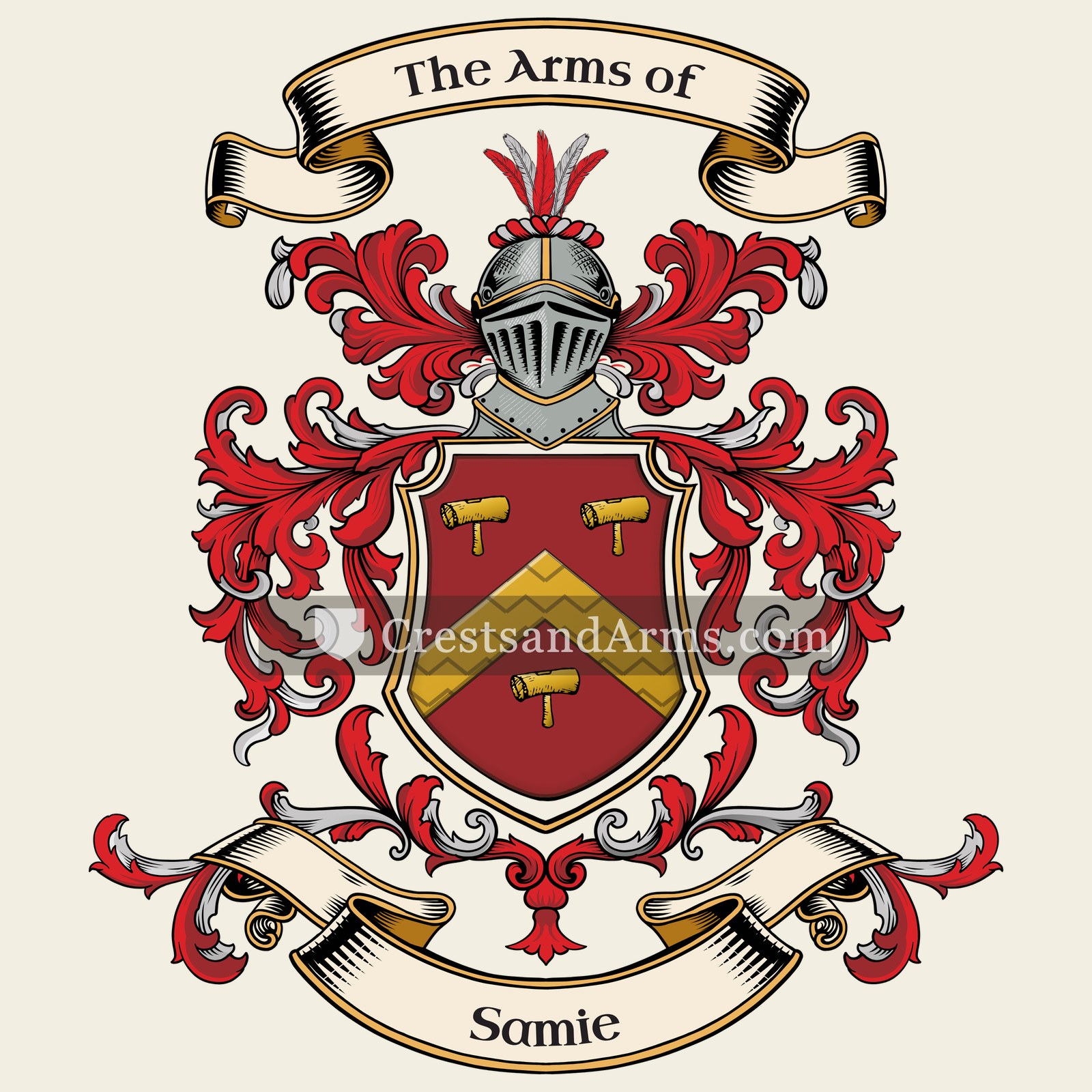


 cross symbolChristian faith and service