Map of France showing where the Samson arms are recorded
The Samson arms were recorded in Paris, c. 1663.
This is where the arms were entered in the register. Families often moved to other parts of the country, so the same name can turn up in more than one region.
The body that granted and recorded arms in France in this period.
Louis XIV of France
Sovereign of the period
Louis XIV of France
1643–1715
Reigning in France when the Samson arms are first recorded.
How Arms Worked in France
In France, a coat of arms was a mark of honor that passed down through the male line to all legitimate descendants. Families often used the same shield without changes to show their shared heritage. If a branch wanted to stand out, they could add a small mark to their shield to show their specific place in the family tree.
Granting authority
The Juge d'armes de France acted as the official authority that regulated and verified coats of arms across the country.
How they got arms
Families typically inherited their arms from ancestors, though they could also receive them through royal grants or by proving their noble status.
Where arms were recorded
Coats of arms were officially recorded in the Armorial Général de France, which began its main collection in the year 1696.
The family's standing
Recorded among the armigerous families of France.
Origin & History of the Samson Family in France
The name Samson has deep roots in French history, appearing as a surname long before the seventeenth century. It is derived from the biblical name Samson, which became popular in medieval Europe due to its association with strength and religious devotion. By the time members of the family were documented in Paris in 1663, the name was already well-established across various French provinces. During this era, families with this name were often part of the growing urban middle class, working as skilled artisans, merchants, or legal professionals. These individuals contributed to the vibrant life of Paris as the city expanded under the reign of King Louis XIV. Because the name was relatively common, it appears frequently in parish registers and tax records from the period, reflecting a family history tied to the daily social and economic development of France.
Meaning of the Samson family crest colors & symbols
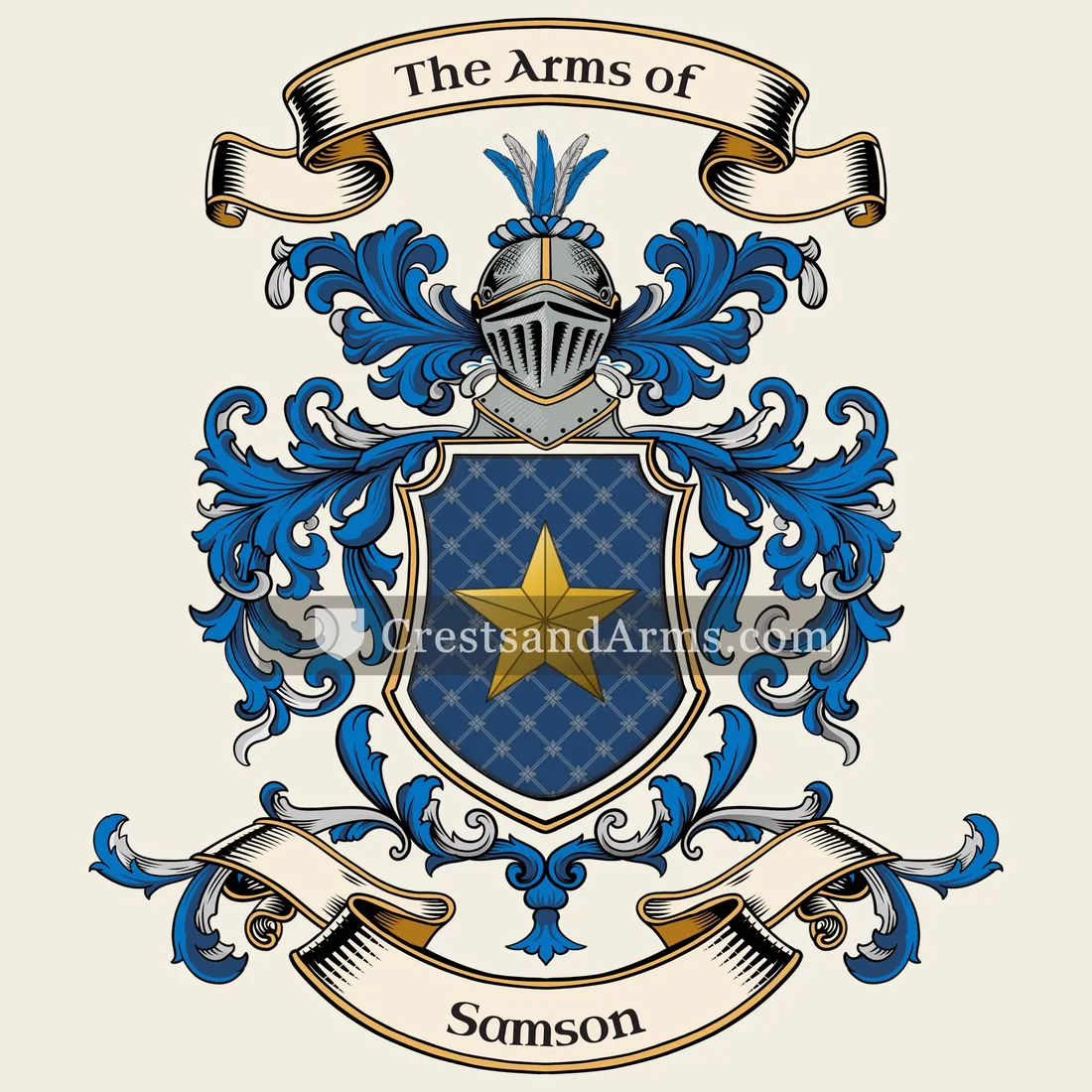
Symbols on this shield
mulletThe third son, and a divine quality from above
Colours
Blue (Azure)Means: Loyalty and truth
Gold (Or)Means: Generosity
Historical info
Source
J. B. Rietstap, Armorial Général, Gouda: G. B. van Goor Zonen, 1884–87
Blazon (the actual original written record)
“D'azur à une équerre d'arg., posée 1, adextrée d'une étoile (5) d'or. C.: une étoile d'or, entre un vol d'arg. L. d'arg. et d'azur.”
SwitzerlandBâle, c. 1745
Digital archive packCoat of arms PNG, gold border print PDF, vector SVG and the certificate of authenticity. Sent to your email in minutes.
Map of Switzerland showing where the Samson arms are recorded
The Samson arms were recorded in Bâle, c. 1745.
This is where the arms were entered in the register. Families often moved to other parts of the country, so the same name can turn up in more than one region.
The body that granted and recorded arms in Switzerland in this period.
How Arms Worked in Switzerland
In Switzerland, coats of arms were not restricted to the nobility and were often adopted by common citizens and families. These symbols were passed down through generations to show family identity. When branches of a family grew, they often changed small details of the design to distinguish their own line from the original group.
Granting authority
Cantonal and civic authorities managed the use of coats of arms within their specific regions and local jurisdictions.
How they got arms
Families typically assumed their own coats of arms based on local custom rather than receiving them from a central monarch.
Where arms were recorded
Arms were recorded in various cantonal and civic registers starting from the fourteenth century throughout the Swiss region.
The family's standing
Recorded among the armigerous families of Switzerland.
Origin & History of the Samson Family in Switzerland
The Samson family name in Switzerland carries a history deeply rooted in the cultural and religious shifts of the eighteenth century. By 1745, records confirm that members of the family were established in the city of Bâle, a major hub for trade and intellectual exchange along the Rhine River. During this period, Bâle was a center for the textile industry and banking, which likely provided the economic foundation for families like the Samsons to settle and grow. The name itself is of ancient Hebrew origin, meaning "sun," and it often entered European naming traditions through religious influence and the widespread study of biblical texts. As the family integrated into the Swiss social structure, they became part of the local urban fabric, contributing to the professional and civic life of the region. Their presence in Bâle reflects the broader movement of families who sought stability and opportunity in the Swiss cantons during a time of significant European transition.
Meaning of the Samson family crest colors & symbols
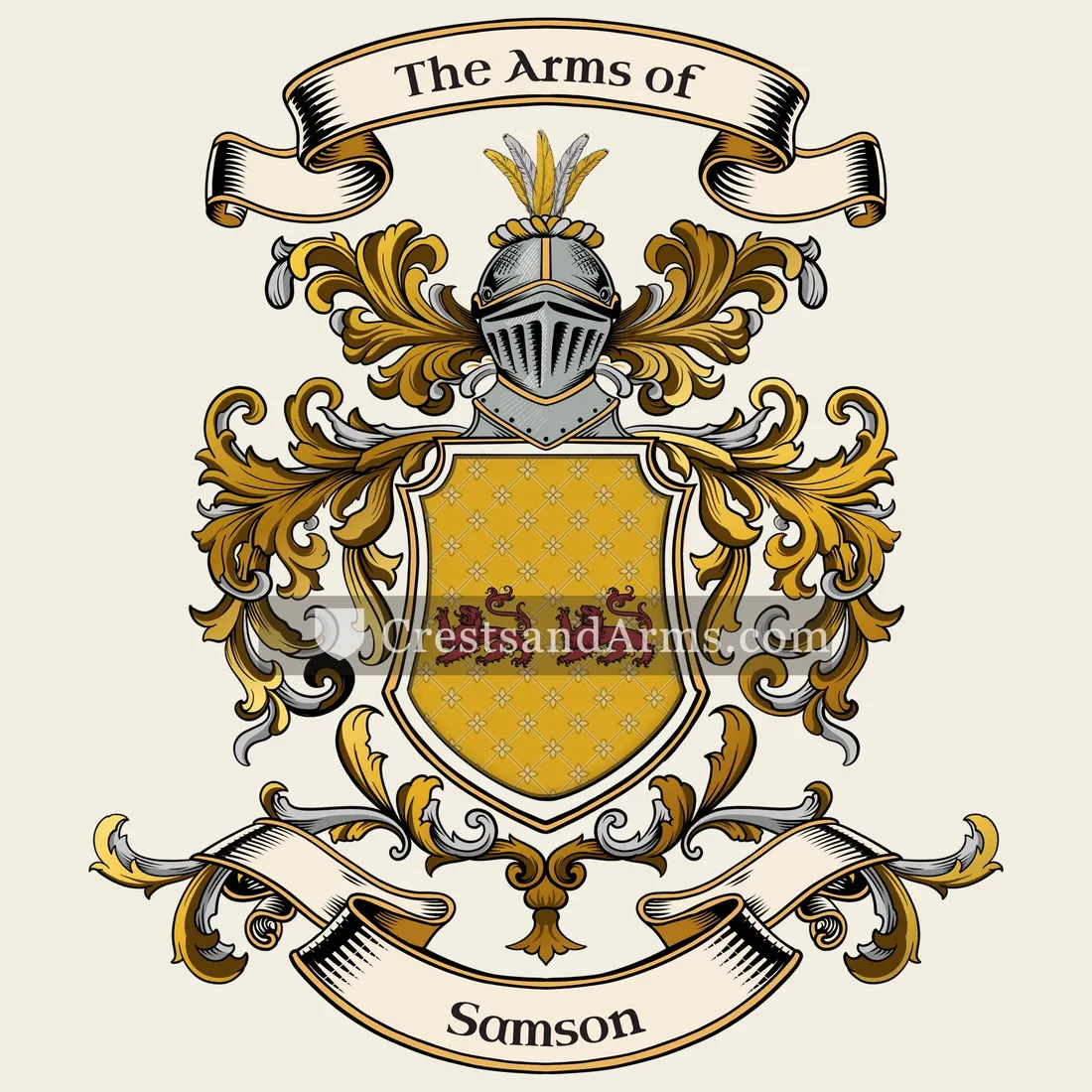
Symbols on this shield
lionCourage, strength and royalty
Colours
Gold (Or)Means: Generosity
Red (Gules)Means: Military strength
Historical info
Source
Sir Bernard Burke, The General Armory of England, Scotland, Ireland and Wales, London: Harrison & Sons, 1884
Blazon (the actual original written record)
“Or, two lions pass. guard. gu”
Englandc. 1620
Digital archive packCoat of arms PNG, gold border print PDF, vector SVG and the certificate of authenticity. Sent to your email in minutes.
Map of England showing where the Samson arms are recorded
The Samson arms were recorded in England, c. 1620.
Arms such as these were typically recorded in York.
Yorkshire is the largest of the English counties, and it held more gentry families than any other. Land there was split among a great many households rather than a few, so a great many of them carried arms.
This is where the arms were entered in the register. Families often moved to other parts of the country, so the same name can turn up in more than one region.
The body that granted and recorded arms in England in this period.
James VI and I
Sovereign of the period
James VI and I
1603–1625
Reigning in France when the Samson arms are first recorded.
How Arms Worked in England
English heraldry allowed arms to be shared by all legitimate descendants of the original owner. These symbols were treated as personal property that moved through the generations to all children. While the eldest son kept the original design, other family members could use the same shield without needing to change it or register their own unique versions.
Granting authority
The College of Arms in London has regulated the use of coats of arms throughout England and Wales since 1484.
How they got arms
Families typically obtained their coats of arms through a formal grant from the Crown or by proving their ancient right to them.
Where arms were recorded
All official coats of arms are recorded in the registers kept at the College of Arms, which date back to the fifteenth century.
The family's standing
Recorded among the armigerous families of England.
Origin & History of the Samson Family in England
The surname Samson has deep roots in England, originating as a patronymic name derived from the biblical figure Samson. By the early 17th century, the family had established a notable presence in the city of York, a major northern hub with a rich history of trade and civic life. Records from 1620 confirm that members of the Samson family were living in this region, likely participating in the local economy as merchants, craftsmen, or members of the growing urban middle class. During this period, the name was becoming more fixed as a hereditary identifier, moving away from its origins as a simple descriptive label. Families like the Samsons in York were part of a broader social shift where surnames became essential for tracking property, legal obligations, and parish registrations. Their presence in York suggests they were well-integrated into the fabric of English society long before the massive migrations to the New World.
Samson Meaning & Related Branches
Root word
Shimshon
Hebrew for sun or sunlight
This name
SamsonDerived from the biblical figure representing strength and solar power
also spelled
Sampson
Related arms
Sampsonvariant spelling
Documented Sources
J. B. Rietstap, Armorial Général, Gouda: G. B. van Goor Zonen, 1884–87
Dauzat, Albert, Dictionnaire étymologique des noms et prénoms de France, 1951
Morlet, Marie-Thérèse, Dictionnaire étymologique des noms de famille, 1991
Archives Nationales de France, Minutier central des notaires de Paris, Series MC
Digital archive packCoat of arms PNG, gold border print PDF, vector SVG and the certificate of authenticity. Sent to your email in minutes.


 lionCourage, strength and royalty
 wheatsheafPlenty, and the harvest of one's own labour
 lionCourage, strength and royalty
 wheatsheafPlenty, and the harvest of one's own labour
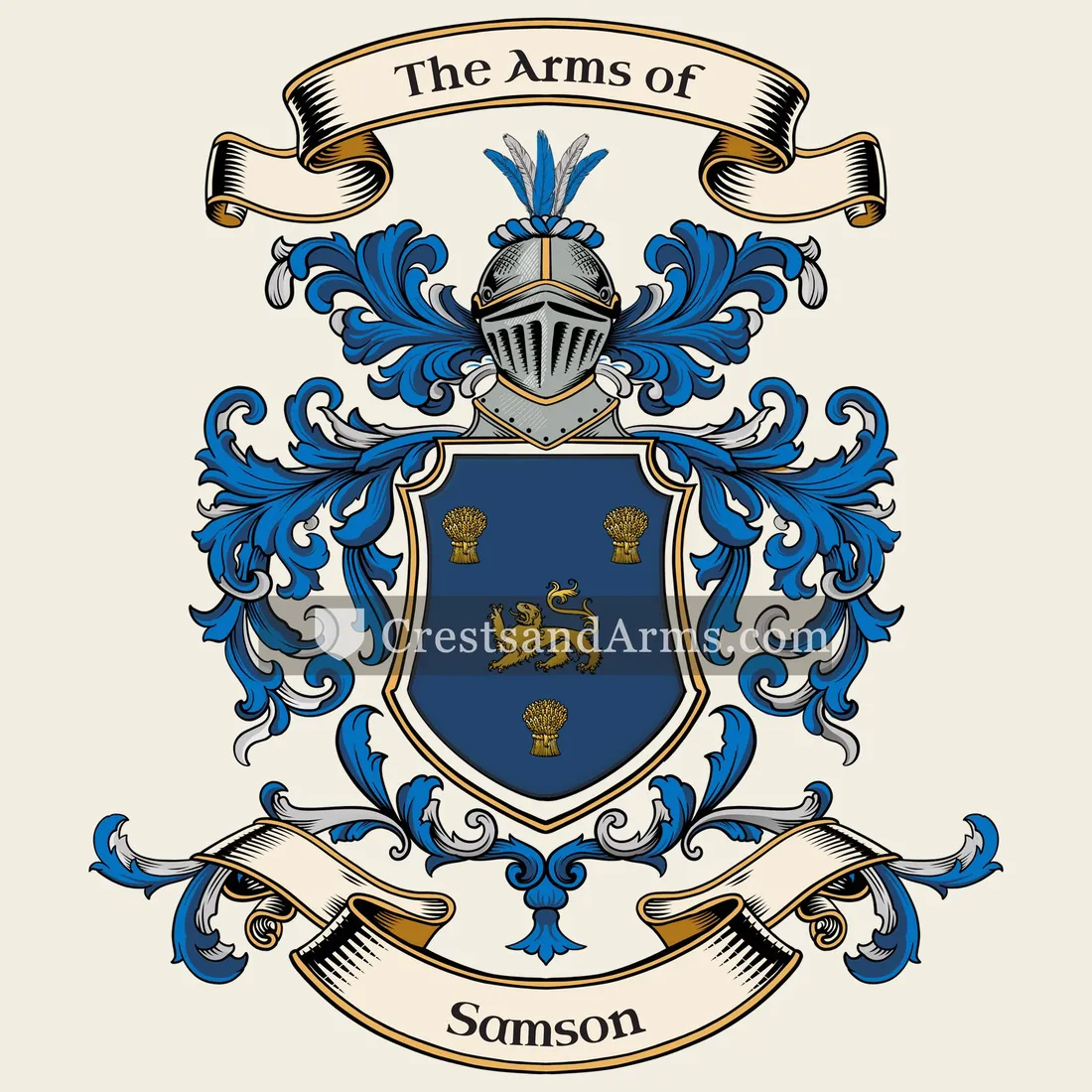


 mulletThe third son, and a divine quality from above