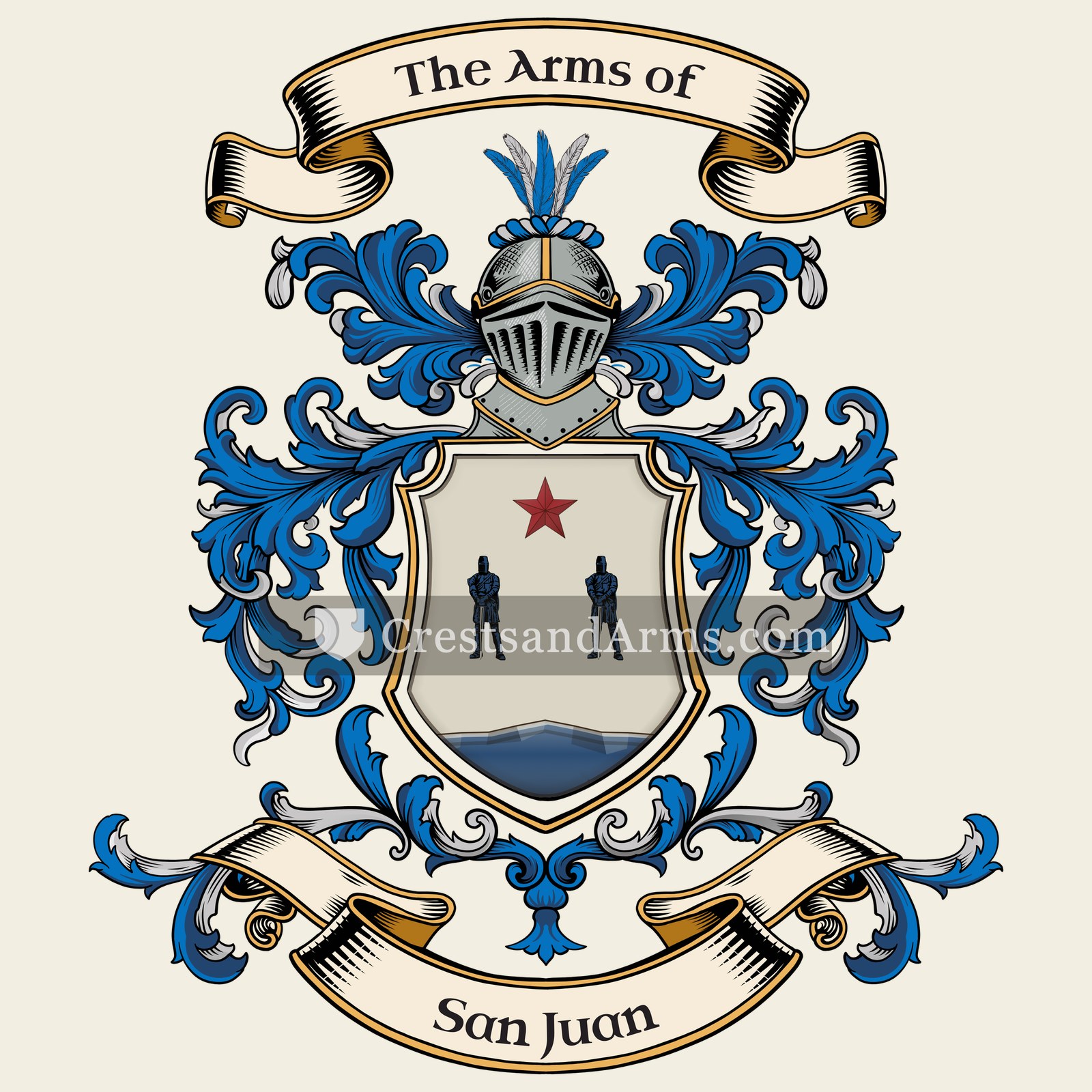
A record of documented arms, meaning and origin, researched for the San Juan family of Spain.
Reg. 8659 · Spanish, T–V
Coat of Arms & Family Crest Details
Symbols on this shield
mountThe ground held, and steadfastness upon it
knightChivalry and service in arms
mulletThe third son, and a divine quality from above
Colours
Silver (Argent)Means: Peace and sincerity
Blue (Azure)Means: Loyalty and truth
Red (Gules)Means: Military strength
Historical info
Source
J. B. Rietstap, Armorial Général, Gouda: G. B. van Goor Zonen, 1884–87
Blazon (the actual original written record)
“D'arg. à deux chevaliers affr., arm. de toutes pièces d'azur, le casque panaché de gu., tenant une épée haute, montés sur des chevaux affr. et galopants au nat. sur une terrasse au nat.; le tout acc. d'une étoile (5) de gu., rayonnante du même, posée au point du chef.”
NavarreGuipuzcoa · Navarre, c. 1722
Digital archive packCoat of arms PNG, gold border print PDF, vector SVG and the certificate of authenticity. Sent to your email in minutes.
Map of Spain showing where the San Juan arms are recorded
The San Juan arms were recorded in Navarre, c. 1722.
Navarre was mountain country straddling the Pyrenees, with a strong class of small independent landholders. A great many households counted as gentry there, and each needed a shield to be told apart.
This is where the arms were entered in the register. Families often moved to other parts of the country, so the same name can turn up in more than one region.
The body that granted and recorded arms in Spain in this period.
Philip V of Spain
Sovereign of the period
Philip V of Spain
1714–1724
Reigning in Spain when the San Juan arms are first recorded.
How Arms Worked in Spain
In Spain, a coat of arms was considered a form of property that belonged to the entire family line. These arms were passed down from a father to all his children equally. Younger branches of the family usually kept the original design without needing to add any special marks to distinguish their specific line.
Granting authority
The Cronista Rey de Armas was the official body that regulated and granted coats of arms throughout Spain.
How they got arms
Families often obtained their arms through royal grants or by proving their noble status to the official heraldic authority.
Where arms were recorded
Coats of arms were officially recorded in the registers of the Cronista Rey de Armas starting in 1496.
The family's standing
Recorded among the armigerous families of Navarre.
Origin & History of the San Juan Family in Spain
The family name San Juan is a topographic surname, meaning it was originally derived from the geography of a specific place rather than a single ancestor. It translates to Saint John in Spanish and was frequently adopted by families living near churches, chapels, or parishes dedicated to Saint John the Baptist. By the year 1722, records confirm that members of the family were well-established in the Kingdom of Navarre, a region in northern Spain with a unique cultural and linguistic history. During this period, families in Navarre often lived in rural communities where their identity was closely tied to the local land and the religious institutions that served as the center of village life. As the family grew, the name spread across the region, reflecting the deep roots that many Navarrese families held in their ancestral towns and mountain valleys.
Related Branches & Arms
Root word
Iohannes
Hebrew origin meaning Yahweh is gracious.
This name
San JuanRefers to Saint John the Baptist, often associated with locations dedicated to him.
also spelled
Sanjuan
Sanjuanen
Documented Sources
J. B. Rietstap, Armorial Général, Gouda: G. B. van Goor Zonen, 1884–87
Mikel Belasko, Diccionario etimológico de los nombres de los pueblos, villas y ciudades de Navarra, 1999
Archivo General de Navarra, Sección de Procesos Judiciales, 1722
Endika de Mogrobejo, Diccionario hispano de apellidos y blasones, 1995
Digital archive packCoat of arms PNG, gold border print PDF, vector SVG and the certificate of authenticity. Sent to your email in minutes.


 mountThe ground held, and steadfastness upon it
 knightChivalry and service in arms
 mulletThe third son, and a divine quality from above
 mountThe ground held, and steadfastness upon it
 knightChivalry and service in arms
 mulletThe third son, and a divine quality from above