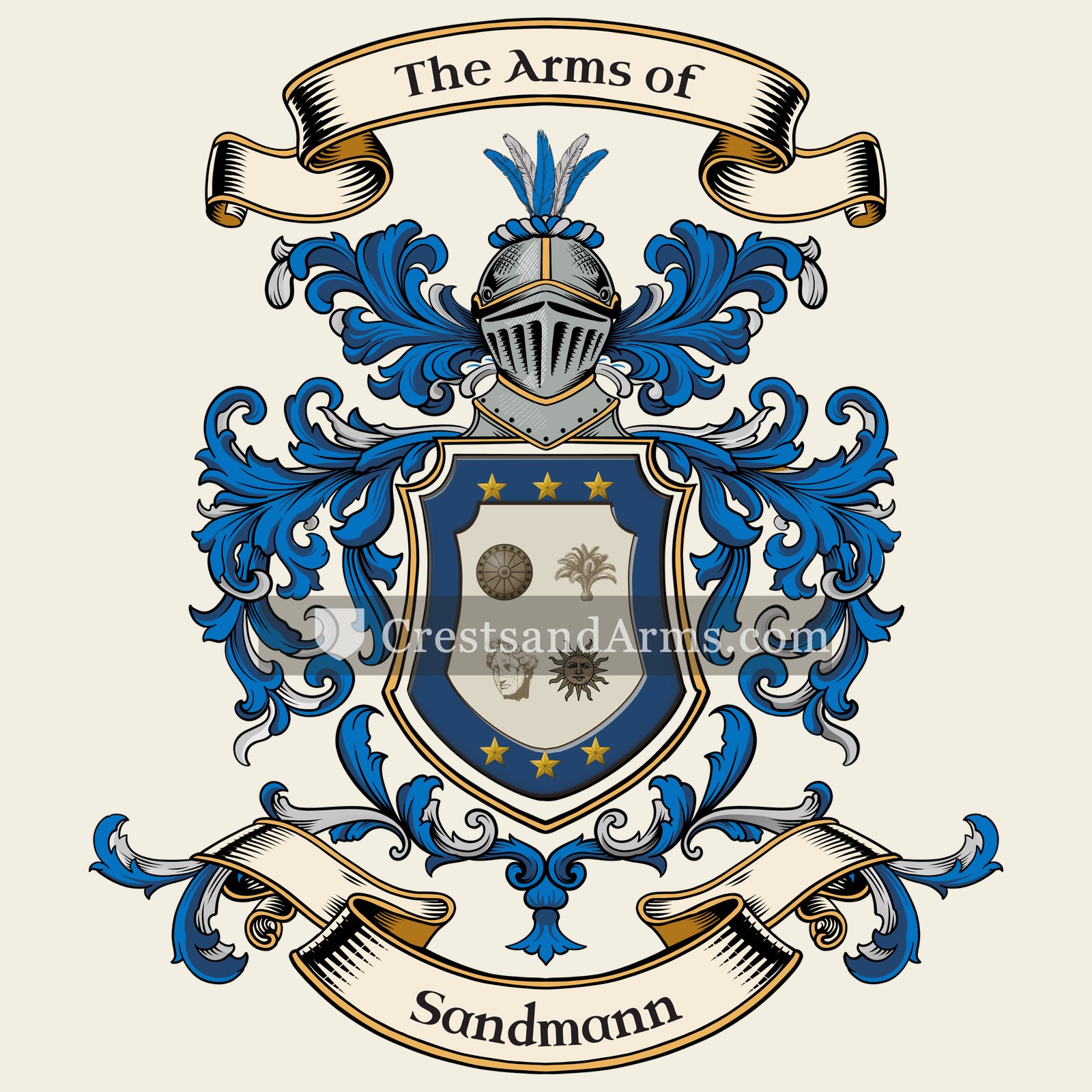
A record of documented arms, meaning and origin, researched for the Sandmann family of Scotland.
Reg. 2196 · Scottish, T–V
Coat of Arms & Family Crest Details
Symbols on this shield
bordureA difference between branches of one family
womanGrace, and the founding of a house
roundelA coin, and one who has been to the crusades
palm treeVictory, and righteousness that flourishes
sunGlory, splendour and the source of life
mulletThe third son, and a divine quality from above
Colours
Silver (Argent)Means: Peace and sincerity
Blue (Azure)Means: Loyalty and truth
Gold (Or)Means: Generosity
Historical info
Source
Sir Bernard Burke, The General Armory of England, Scotland, Ireland and Wales, London: Harrison & Sons, 1884
Blazon (the actual original written record)
“Ar. the emblem of Truth, a naked woman standing on a terrestrial globe, issuing from the base, holding in the dexter hand an open book, and in her sinister, which is elevated above her head, a palm branch, upon her breast the sun in his splendour ppr. a veil across her middle of the field, all within a bordure az. charged with six mullets or”
PerthPerth, c. 1780
Digital archive packCoat of arms PNG, gold border print PDF, vector SVG and the certificate of authenticity. Sent to your email in minutes.
Map of Scotland showing where the Sandmann arms are recorded
The Sandmann arms were recorded in Perth, c. 1780.
Perth sat where the Highlands meet the Lowlands, and its families held land on both sides of that line. Estates passed down whole for centuries, and unbroken tenure is what puts a name in the register.
This is where the arms were entered in the register. Families often moved to other parts of the country, so the same name can turn up in more than one region.
The body that granted and recorded arms in Scotland in this period.
George III of Great Britain
Sovereign of the period
George III of Great Britain
1760–1801
Reigning in Scotland when the Sandmann arms are first recorded.
How Arms Worked in Scotland
Scottish heraldry is unique because it treats a coat of arms as a piece of personal property protected by law. Only one person can own a specific design at any given time. When a family grows, the head keeps the original shield while other relatives must apply for their own distinct version with slight changes to prove their specific identity.
Granting authority
The Court of the Lord Lyon acts as the official body that regulates and controls all heraldic matters throughout Scotland.
How they got arms
Individuals obtain a legal right to their arms through a formal petition process that confirms their identity and family connection.
Where arms were recorded
All valid coats of arms are officially entered into the Public Register of All Arms and Bearings starting from 1672.
The family's standing
Recorded among the armigerous families of Perth.
Origin & History of the Sandmann Family in Scotland
The surname Sandmann is of German origin and functions as a descriptive occupational name. It historically referred to a person who worked with sand, such as a sand merchant, a quarry worker, or someone who transported sand for construction and glassmaking. By the late 18th century, members of the family had established a presence in Perth, Scotland. This suggests that the family likely migrated from Northern Europe during a period of increased trade and movement across the North Sea. These early settlers in Perth would have integrated into the local economy, potentially continuing their traditional trades or adapting to the industrial growth of the city. Over time, the name became firmly rooted in the region, reflecting the broader patterns of European migration that shaped the demographics of 18th-century Scotland.
Related Branches & Arms
Root word
Sand
A Germanic term referring to sandy soil or a sandy shore.
This name
SandmannAn occupational surname for someone who worked as a sand merchant or lived near a sandy area.
also spelled
Sandiman
Sandyman
Documented Sources
Sir Bernard Burke, The General Armory of England, Scotland, Ireland and Wales, London: Harrison & Sons, 1884
Bahlow, Hans, Deutsches Namenlexikon: Familien- und Vornamen nach Ursprung und Sinn erklärt, 1967
National Records of Scotland, Register of Testaments, 1780
National Records of Scotland, Old Parish Registers of Births and Marriages, 1780
Digital archive packCoat of arms PNG, gold border print PDF, vector SVG and the certificate of authenticity. Sent to your email in minutes.


 bordureA difference between branches of one family
 womanGrace, and the founding of a house
 roundelA coin, and one who has been to the crusades
 palm treeVictory, and righteousness that flourishes
 sunGlory, splendour and the source of life
 mulletThe third son, and a divine quality from above
 bordureA difference between branches of one family
 womanGrace, and the founding of a house
 roundelA coin, and one who has been to the crusades
 palm treeVictory, and righteousness that flourishes
 sunGlory, splendour and the source of life
 mulletThe third son, and a divine quality from above