Map of Germany showing where the Sandvick arms are recorded
The Sandvick arms were recorded in Han, c. 1765.
This is where the arms were entered in the register. Families often moved to other parts of the country, so the same name can turn up in more than one region.
The body that granted and recorded arms in Germany in this period.
Francis I, Holy Roman Emperor
Sovereign of the period
Francis I, Holy Roman Emperor
1745–1765
Reigning in Germany when the Sandvick arms are first recorded.
How Arms Worked in Germany
In the Holy Roman Empire, coats of arms were often granted to individuals by the Emperor or his representatives. These arms were then passed down through the generations to all legitimate descendants of the original holder. Younger branches of a family usually kept the same shield design without needing to change it, as the arms belonged to the entire lineage.
Granting authority
The Holy Roman Emperor held the sole power to grant new coats of arms throughout his vast imperial territories.
How they got arms
Families typically obtained their coats of arms through a formal imperial grant or by proving their noble status to the authorities.
Where arms were recorded
These grants were officially recorded in the Imperial Chancery registers, which began keeping formal records of such honors during the Middle Ages.
The family's standing
Recorded among the armigerous families of Germany.
Origin & History of the Sandvick Family in Germany
The family name Sandvick originates from the Norwegian topographical term "sandvik," which translates literally to "sandy bay." In the context of Scandinavian naming traditions, families often adopted surnames based on the specific farm or geographical feature where they resided. By 1765, records confirm that members of the family were living in the Han area of Norway. During this period, it was common for individuals to be identified by their farmstead rather than a fixed hereditary surname. As these early family members moved or grew in number, the name became a permanent way to track their lineage and connection to the coastal landscape. This naming practice highlights a deep historical bond between the family and the specific geography of the Norwegian shoreline.
Sandvick Meaning & Related Branches
Root word
Sand-Vik
Sandy soil or beach combined with a bay or inlet.
This name
SandvickA topographic name for someone who lived near a sandy bay or a coastal inlet.
also spelled
Sandbek
Sandbecke
Zandbeck
Documented Sources
J. B. Rietstap, Armorial Général, Gouda: G. B. van Goor Zonen, 1884–87
Norsk Slektshistorisk Forening, Norsk Slektskalender, 1951
Statens Arkiv (National Archives of Norway), Digitalarkivet: Folketellingen 1801
Rygh, Oluf, Norske Gaardnavne, 1897
Digital archive packCoat of arms PNG, gold border print PDF, vector SVG and the certificate of authenticity. Sent to your email in minutes.


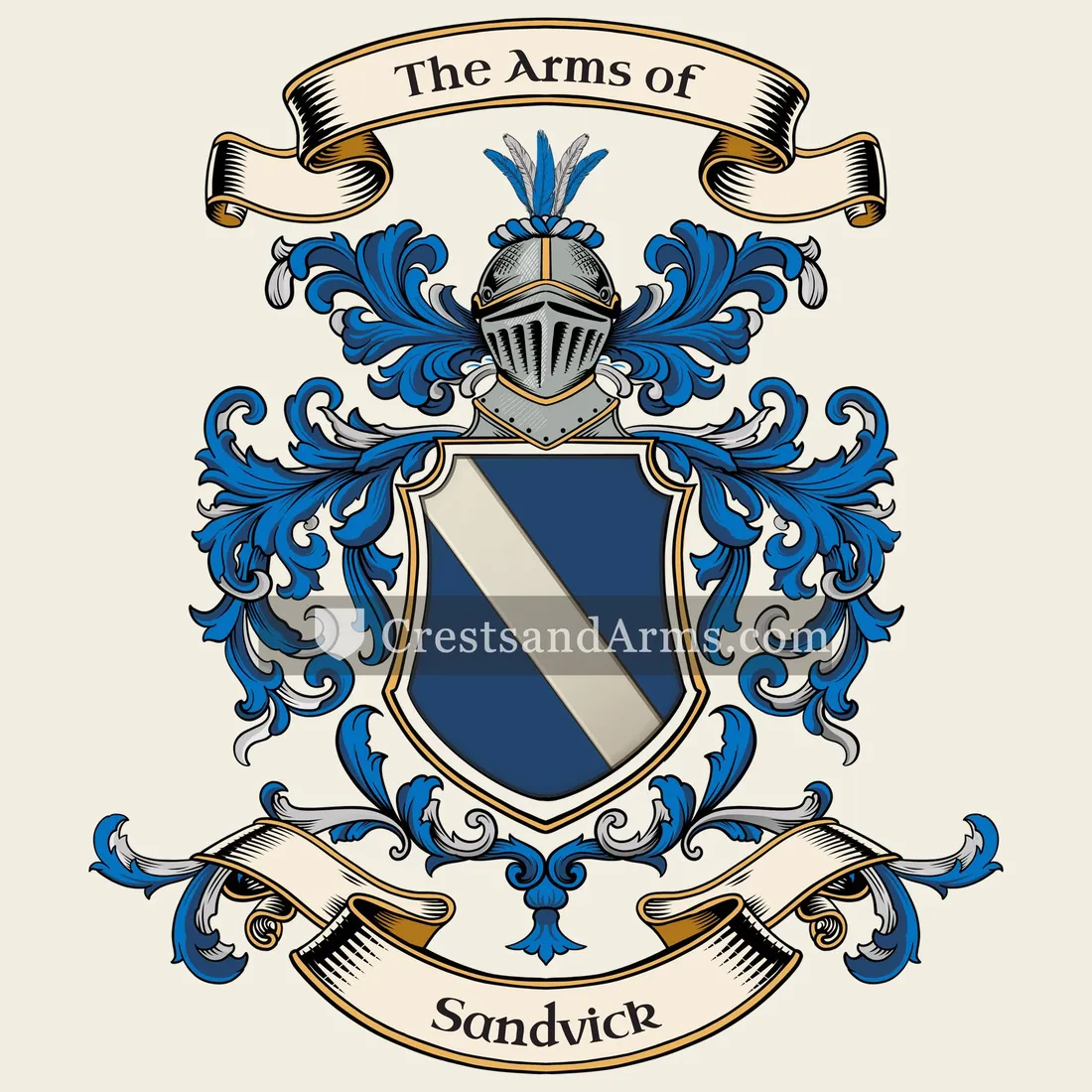
 bendDefence, and the scarf of a commander
 bendDefence, and the scarf of a commander