Map of France showing where the Sanzone arms are recorded
The Sanzone arms were recorded in Normandie, c. 1663.
Normandie held a dense crowd of knightly families on some of the best farmland in France. Its men had fought and settled abroad for generations, and a family that sent sons to war needed a shield they could be recognised by.
This is where the arms were entered in the register. Families often moved to other parts of the country, so the same name can turn up in more than one region.
The body that granted and recorded arms in France in this period.
Louis XIV of France
Sovereign of the period
Louis XIV of France
1643–1715
Reigning in France when the Sanzone arms are first recorded.
How Arms Worked in France
In France, a coat of arms was a mark of honor that passed down through the male line to all legitimate descendants. Families often used the same shield without changes to show their shared heritage. If a branch wanted to stand out, they could add a small mark to their shield to show their specific place in the family tree.
Granting authority
The Juge d'armes de France acted as the official authority that regulated and verified coats of arms across the country.
How they got arms
Families typically inherited their arms from ancestors, though they could also receive them through royal grants or by proving their noble status.
Where arms were recorded
Coats of arms were officially recorded in the Armorial Général de France, which began its main collection in the year 1696.
The family's standing
Recorded among the armigerous families of Normandie.
Origin & History of the Sanzone Family in France
The history of the Sanzone family name is deeply rooted in the cultural shifts of seventeenth-century France. By 1663, records confirm that members of the family were established in the region of Normandie. During this period, Normandie served as a vital hub for families navigating the transition from rural agricultural life to the structured society of the French kingdom. The name likely evolved as a regional identifier, reflecting the specific linguistic patterns common to northern France at that time. As these early ancestors settled into their communities, they contributed to the local economy and social fabric of the province. Their presence in the historical record during the mid-1600s suggests that the family was part of a stable population that helped shape the development of the region before later generations began to migrate further across Europe.
Sanzone Meaning & Related Branches
Root word
Sanctus
Latin term meaning holy, sacred, or saintly.
This name
SanzoneDerived from a nickname for a person associated with a saint or a holy place.
also spelled
Sanzon
Documented Sources
J. B. Rietstap, Armorial Général, Gouda: G. B. van Goor Zonen, 1884–87
Archives départementales de la Seine-Maritime, Série B, Fonds de la justice seigneuriale
Gautier, Hippolyte, La vie en France aux XVIIe et XVIIIe siècles, 1895
Le Cacheux, Paul, Inventaire sommaire des archives départementales antérieures à 1790, 1910
Digital archive packCoat of arms PNG, gold border print PDF, vector SVG and the certificate of authenticity. Sent to your email in minutes.


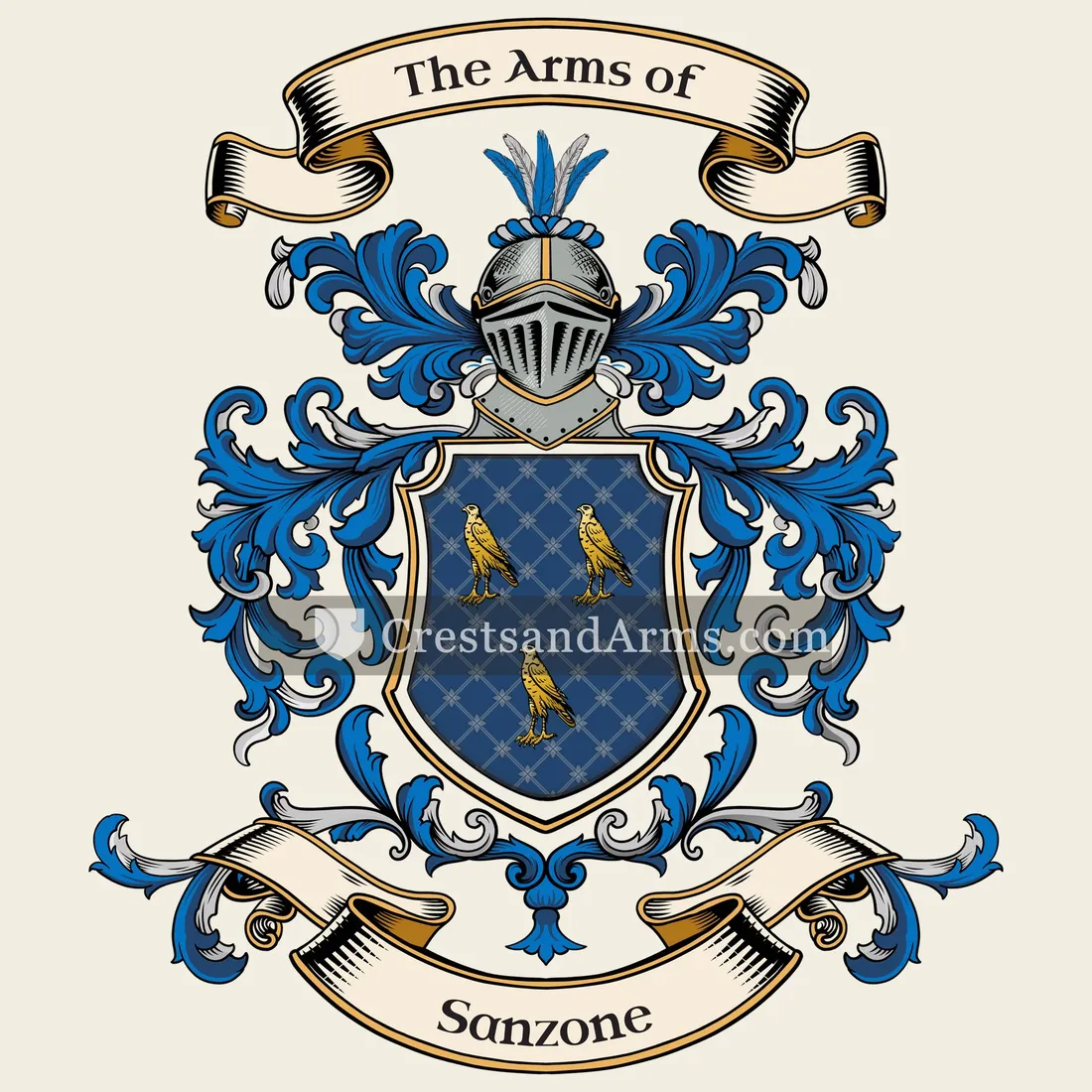
 falconOne eager and quick in pursuit
 falconOne eager and quick in pursuit