Map of France showing where the Sarcia arms are recorded
The Sarcia arms were recorded in Languedoc, c. 1663.
Languedoc stretched across the south of France, a country of small towns, vineyards and old local families. Its gentry were numerous rather than grand, and a great many of them held arms even where their estates were modest.
This is where the arms were entered in the register. Families often moved to other parts of the country, so the same name can turn up in more than one region.
The body that granted and recorded arms in France in this period.
Louis XIV of France
Sovereign of the period
Louis XIV of France
1643–1715
Reigning in France when the Sarcia arms are first recorded.
How Arms Worked in France
In France, a coat of arms was a mark of honor that passed down through the male line to all legitimate descendants. Families often used the same shield without changes to show their shared heritage. If a branch wanted to stand out, they could add a small mark to their shield to show their specific place in the family tree.
Granting authority
The Juge d'armes de France acted as the official authority that regulated and verified coats of arms across the country.
How they got arms
Families typically inherited their arms from ancestors, though they could also receive them through royal grants or by proving their noble status.
Where arms were recorded
Coats of arms were officially recorded in the Armorial Général de France, which began its main collection in the year 1696.
The family's standing
Recorded among the armigerous families of Languedoc.
Origin & History of the Sarcia Family in France
The family name Sarcia has deep roots in the Languedoc region of southern France, where records confirm members of the family were living as early as 1663. During the seventeenth century, this area was a vibrant center for trade and agriculture, shaped by a unique blend of Occitan culture and French royal influence. Families in this part of France often lived in small rural communities or near growing market towns, where they played essential roles in the local economy. The name itself likely evolved from regional dialects that were common in the Mediterranean provinces during the late Middle Ages and the early modern period. As the family established their presence in Languedoc, they became part of the long history of a region known for its strong local traditions and its resilience during times of political and religious change.
Sarcia Meaning & Related Branches
Root word
Sars
Derived from the Latin word for a rocky or stony place.
This name
SarciaRefers to a person who originated from a rocky or mountainous region in France.
also spelled
Sariack
Sariak
Documented Sources
J. B. Rietstap, Armorial Général, Gouda: G. B. van Goor Zonen, 1884–87
Archives départementales de l'Hérault, Registres paroissiaux et d'état civil
Le Roy Ladurie, Emmanuel, Les Paysans de Languedoc, 1966
Wolff, Philippe, Histoire du Languedoc, 1967
Digital archive packCoat of arms PNG, gold border print PDF, vector SVG and the certificate of authenticity. Sent to your email in minutes.


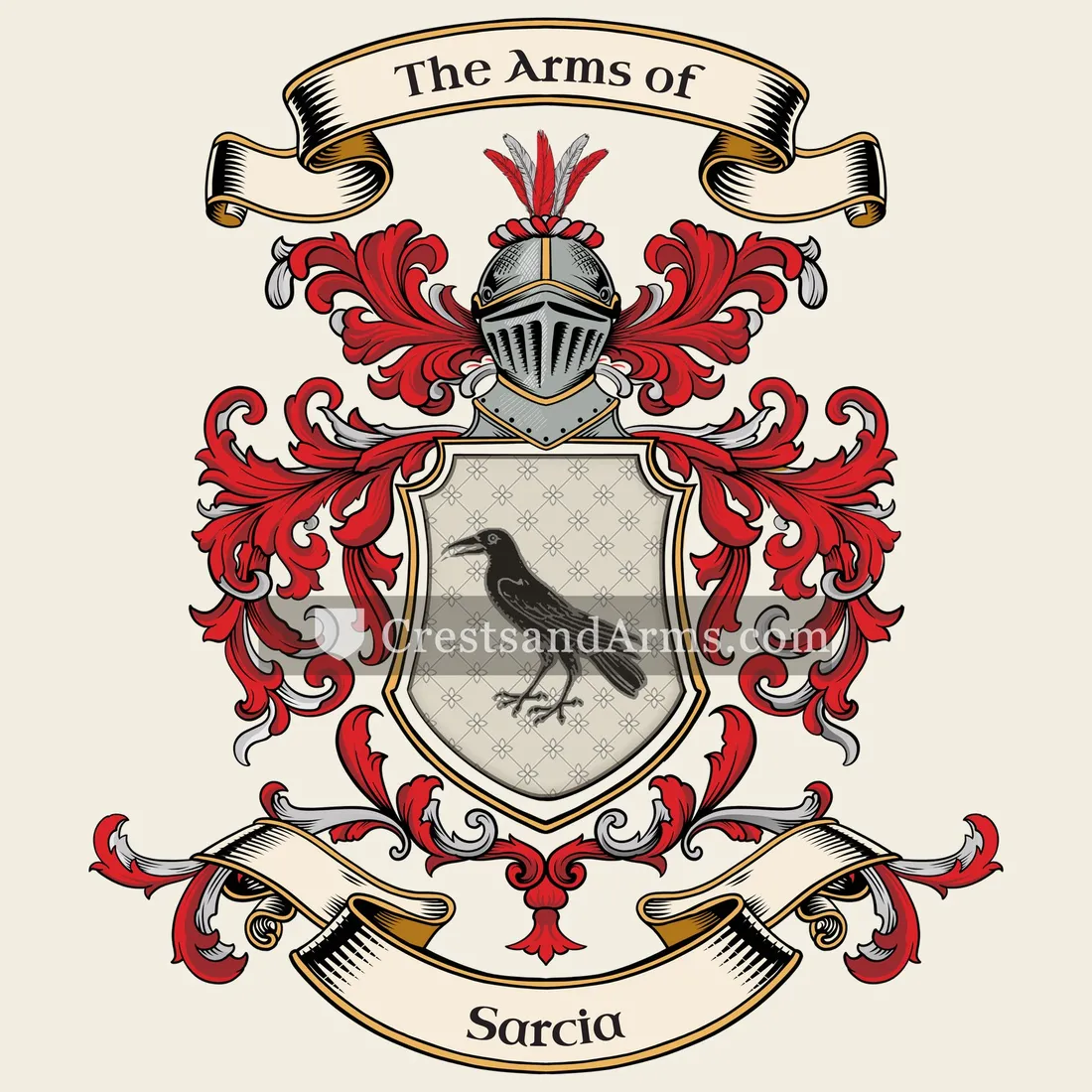
 ravenConstancy and divine providence
 ravenConstancy and divine providence